A good Similes Video can turn an ordinary sentence into an image readers can see, hear, or feel. Instead of simply saying that someone is happy, angry, nervous, or tired, a writer can compare that feeling to something familiar and create a stronger impression.
A similes video can make this idea especially easy to understand because viewers can connect words with visual scenes, music, movement, and emotion. But you do not need a video to master the technique. Once you understand how comparisons work, you can create effective similes for stories, poems, songs, conversations, essays, and everyday descriptions.
This guide explains how similes work, shows original examples, and explores related ideas such as similes in music, similes for happiness, friendship, rain, love, and anger. Most importantly, it shows how to create comparisons that feel fresh rather than predictable.
What Is a Simile?
A Similes Video is a comparison between two different things, usually using words such as like or as.
For example:
Her laughter was like similes video sunlight slipping through the curtains.
The Similes Video laughter is not literally sunlight. The comparison suggests that it feels bright, warm, and uplifting.
Similes Video matter because they give abstract ideas a concrete shape. Instead of telling readers exactly what something is like, you give them an image and let them experience the meaning.
Quick Answer: What Is a Simile?
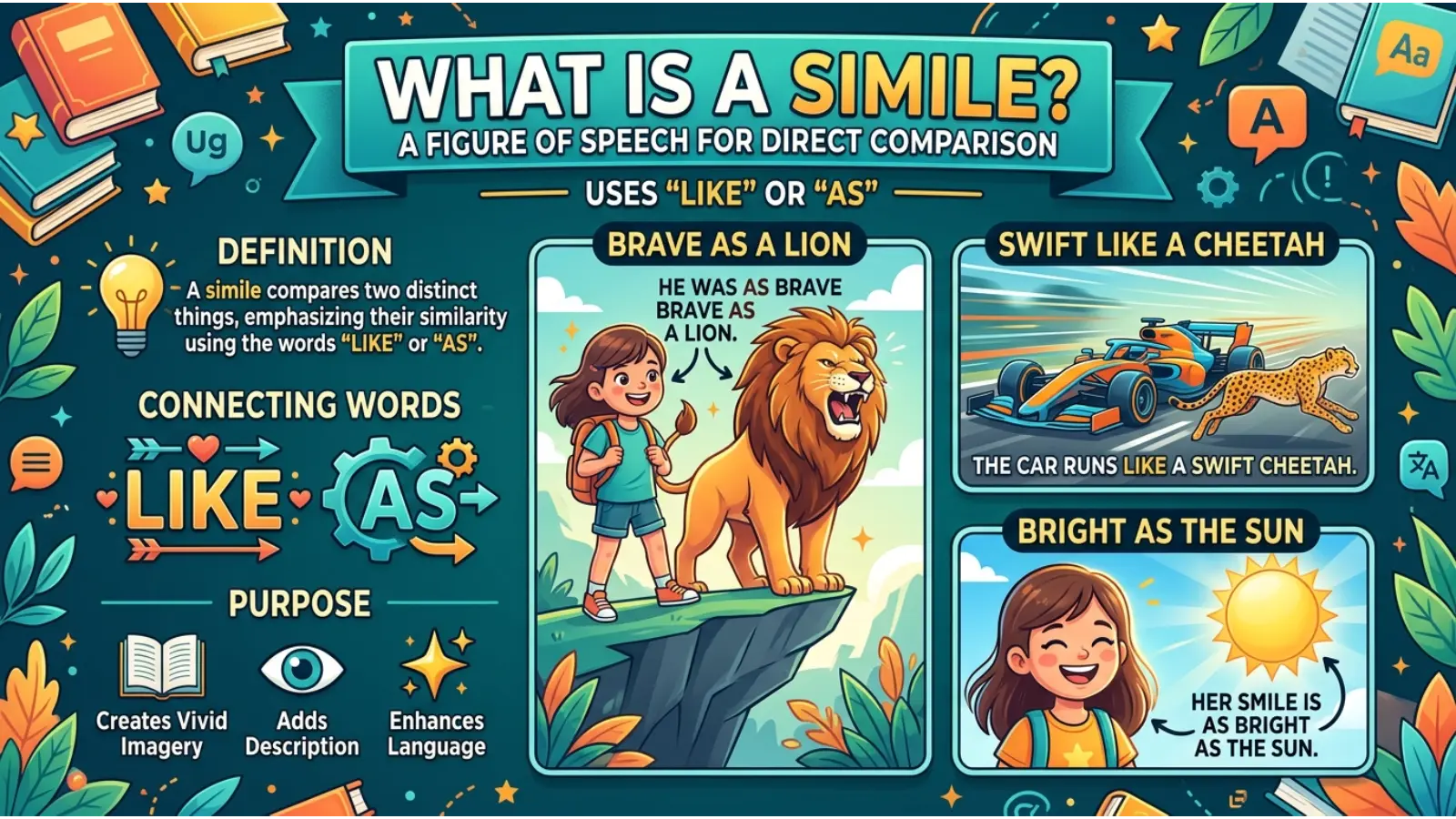
A Similes Video is a figure of speech that compares two unlike things using like or as to make an idea more vivid. Writers use Similes Video to communicate emotions, describe scenes, create imagery, and make language memorable.
Why Similes Work So Well in Writing
Readers Similes Video understand familiar objects quickly. A writer can use that familiarity to communicate a complicated feeling in only a few words.
Compare:
Plain:
The room was very quiet.
With a simile:
The room was as quiet as a library after closing time.
The Similes Video second sentence gives the reader a stronger sense of the silence.
A useful Similes Video does more than decorate a sentence. It should add information about the subject’s quality, mood, movement, texture, sound, or emotional effect.
Original Similes for Different Feelings and Situations
1. Happiness: “Her smile opened like a window on a spring morning.”
This comparison connects happiness with freshness, light, and possibility.
Example:
When she heard the good news, her smile opened like a window on a spring morning.
Writing purpose: Use this when happiness feels sudden but gentle.
Why it works: The image suggests that the person’s expression changes the atmosphere around her, not merely her own mood.
2. Happiness: “His excitement bounced like a bright ball across the room.”
This Similes Video makes excitement feel energetic and difficult to contain.
Example:
His excitement bounced like a bright ball across the room as he explained the surprise.
It works especially well in children’s stories, lively scenes, and informal writing.
3. Friendship: “Their friendship grew like two trees sharing the same patch of sunlight.”
This Similes Video comparison presents friendship as something that develops gradually.
Example:
They had started as strangers, but their friendship grew like two trees sharing the same patch of sunlight.
Writing tip: Comparisons involving growth are useful when describing relationships that become stronger over time.
4. Friendship: “They stood together like two lanterns on a dark road.”
Here, friendship becomes a source of support.
Emotional effect: Warmth, loyalty, and reassurance.
This is particularly effective in stories where characters face uncertainty together.
5. Rain: “Rain tapped the rooftop like impatient fingers.”
The rain becomes active and almost human.
Example:
Rain tapped the rooftop like impatient fingers while everyone waited for the storm to pass.
Why it works: The comparison gives sound a physical quality, helping readers imagine the rhythm.
6. Rain: “The streets shimmered like scattered pieces of glass after the shower.”
This focuses on the visual effect of rain rather than the rain itself.
Best context: Descriptive fiction, travel writing, poetry, and atmospheric scenes.
Be careful not to use visual comparisons merely because they sound pretty. The comparison should fit the scene.
7. Love: “Her kindness felt like a blanket on a cold evening.”
This simile presents love through comfort rather than dramatic romance.
Example:
After a difficult day, her kindness felt like a blanket on a cold evening.
It works because the reader already understands the physical comfort of warmth.
8. Love: “Their memories stayed like footprints after the tide had gone.”
This comparison suggests that experiences remain even after circumstances change.
Writing purpose: Useful for reflective stories and poetry about lasting emotional connections.
9. Anger: “His words snapped like dry branches under a boot.”
The sound of breaking branches creates a sharp emotional effect.
Example:
His words snapped like dry branches under a boot, and the conversation suddenly stopped.
Why it works: Instead of simply saying that someone spoke angrily, the comparison gives the anger a recognizable sound.
10. Anger: “Her frustration simmered like a pot forgotten on the stove.”
This works for anger that builds slowly rather than exploding immediately.
Writing tip: Match the simile to the intensity of the emotion. A simmering comparison is better for controlled frustration than sudden rage.
11. Fear: “The hallway stretched like a road with no end.”
The comparison makes a familiar place feel threatening and unfamiliar.
Best context: Suspense, mystery, and storytelling.
12. Sadness: “His voice faded like music drifting away from an open window.”
This suggests sadness without directly explaining it.
Emotional effect: Distance, loss, and quiet reflection.
13. Nervousness: “Her thoughts fluttered like paper caught in a fan.”
This creates a sense of scattered, uncontrollable thinking.
Example:
Before the presentation, her thoughts fluttered like paper caught in a fan.
This is more vivid than simply saying she was nervous.
14. Confidence: “He walked onto the stage like a captain stepping onto a familiar deck.”
The comparison communicates calmness and control.
Writing purpose: Character development. It can show confidence without directly labeling the character as confident.
15. Confusion: “The instructions tangled in his mind like headphones pulled from a pocket.”
This is useful because nearly everyone recognizes the frustrating experience of tangled headphones.
Writing tip: Everyday objects can produce powerful similes when the shared quality is obvious.
16. Speed: “The cyclist flew like a letter racing through a pneumatic tube.”
The unusual image gives speed a playful quality.
Best context: Humorous stories, children’s writing, and energetic descriptions.
17. Silence: “The classroom became as still as a photograph.”
This comparison freezes the scene in the reader’s imagination.
Example:
When the principal entered, the classroom became as still as a photograph.
18. Music: “The guitar notes moved like sparks skipping across dry leaves.”
This is a strong example of how similes in music can translate sound into visual movement.
Why it works: Music is invisible, so writers often compare sound with movement, light, weather, color, or physical objects.
19. Music: “Her voice rose like a kite catching a sudden wind.”
The comparison gives the voice upward movement.
Best context: Song reviews, poetry, creative nonfiction, and descriptions of singers.
A useful music simile should tell the reader something about the sound—perhaps its speed, volume, texture, emotion, or movement.
20. Hope: “Hope glowed like a porch light in a distant storm.”
This comparison suggests that hope may be small but still visible.
Writing purpose: Emotional storytelling and reflective writing.
21. Determination: “She kept moving like a river finding a path through stone.”
The river suggests persistence without making the character seem invincible.
Why it works: Strong writing often shows determination through action instead of simply calling a character “determined.”
22. Loneliness: “The empty chair looked like a missing word in the middle of a sentence.”
This comparison turns absence into something visible.
Best context: Stories about separation, change, memory, or loss.
23. Curiosity: “His questions popped up like bubbles in a glass.”
This creates a playful image for someone who keeps asking questions.
Best context: Children’s writing, classroom stories, and lighthearted character descriptions.
24. Laughter: “Their laughter rolled through the house like marbles across a wooden floor.”
The simile communicates movement and sound at the same time.
Writing tip: Sound-based comparisons are especially useful when describing laughter, music, footsteps, rain, or voices.
25. A Busy Morning: “The market moved like a river crowded with colorful boats.”
This comparison makes a busy place feel alive.
It also gives the writer several possible details to develop: movement, direction, color, noise, and density.
How Similes in Music Create Stronger Images
Music gives writers a special challenge because sound cannot be seen directly. A simile helps bridge that gap.
Instead of writing:
The piano sounded beautiful.
You could write:
The piano notes floated like leaves carried across a quiet pond.
Now the reader has a visual and emotional image.
When creating similes for music, think about five qualities:
- Volume: whispering, booming, swelling
- Speed: racing, drifting, crawling
- Texture: smooth, rough, sharp, soft
- Movement: rising, falling, circling, jumping
- Emotion: joyful, lonely, tense, peaceful
The strongest comparison usually focuses on one or two of these qualities instead of trying to describe everything at once.
How to Write Better Similes for Happiness
Happiness does not always look the same.
A character might experience:
- quiet satisfaction
- sudden excitement
- relief
- playful joy
- peaceful contentment
- proud happiness
That means one generic comparison cannot describe every happy moment.
For example, peaceful happiness might be:
The afternoon settled over her like warm sunlight.
Sudden excitement might be:
His news burst into the room like confetti.
The lesson is simple: identify the exact kind of emotion before choosing the comparison.
How to Create Similes for Friendship
Good friendship similes often involve ideas such as:
- trust
- support
- shared experiences
- loyalty
- growth
- comfort
- teamwork
Instead of writing:
They were as close as two peas in a pod.
try asking what makes their friendship special.
If they always help each other, you might compare them to two supports holding up the same bridge. If they have known each other since childhood, an image involving roots, old paths, or familiar places may work better.
A personal detail makes a friendship simile feel less generic.
How to Write Fresh Similes for Rain
Rain offers far more possibilities than simply comparing it to tears.
Think about what rain does:
- taps
- floods
- drifts
- washes
- blurs
- reflects
- rattles
- cools
- darkens
- sparkles
For example:
Rain blurred the city lights like wet paint dragged across a canvas.
The comparison focuses on the visual effect rather than merely announcing that it was raining.
Similes for Love Without Falling Into Clichés
Love is one of the easiest subjects to describe with familiar phrases, which makes originality especially important.
Instead of reaching immediately for hearts, roses, stars, or fire, look for ordinary experiences that communicate care.
Consider:
His presence felt like finding your own key after searching every pocket.
The comparison communicates relief and familiarity without directly naming the emotion.
When writing about love, ask:
What does this relationship allow the character to feel?
The answer may be safety, excitement, belonging, courage, peace, or vulnerability. Build the simile around that feeling.
Similes for Anger: Match the Comparison to the Emotion
Anger can be:
- sudden
- controlled
- explosive
- quiet
- persistent
- defensive
- frustrated
A writer should choose an image that matches the specific type.
For controlled anger:
Her patience tightened like a knot pulled one inch too far.
For sudden anger:
His temper flashed like a match struck in a dark room.
The second image is more abrupt, while the first suggests pressure building over time.
Common Similes That Still Have a Place in Writing
Some similes are familiar because they communicate an idea quickly. Expressions such as “as cold as ice” or “as busy as a bee” can be useful when the goal is clarity rather than originality.
The problem occurs when a writer uses familiar comparisons everywhere.
In creative writing, consider whether the reader has encountered the comparison hundreds of times before. If so, ask yourself whether you can replace it with an image connected specifically to your character or setting.
A common simile can communicate meaning efficiently. A fresh simile can make the writing memorable.
Both have a place.
Funny Similes: How Humor Changes the Comparison
Funny similes often work because the comparison is unexpectedly specific.
For example:
He stared at the math problem like a cat studying a bathtub.
The humor comes from the mismatch between the serious situation and the unusual image.
Another:
My backpack felt like it had secretly collected bricks overnight.
Funny similes are particularly effective when the comparison exaggerates an everyday problem while remaining recognizable.
The key is surprise. If the comparison is predictable, the joke loses much of its energy.
How to Make a Simile More Vivid
A weak simile often compares something to an object without identifying the meaningful connection.
For example:
The car was like a bird.
That leaves too many questions.
Was it fast? Light? Noisy? Graceful? Difficult to control?
A stronger version might be:
The little car darted between traffic like a sparrow escaping a crowded yard.
Now the reader understands the intended quality: quick, agile movement.
Before finalizing a simile, ask:
What exactly do these two things have in common?
If you cannot answer that question, the comparison probably needs work.
How Professional Writers Avoid Clichés
A cliché is a comparison or expression that has become so familiar that it no longer creates a strong image.
One way to avoid clichés is to study the scene before choosing the comparison.
Imagine a character standing outside a school during a thunderstorm. Instead of automatically comparing the rain to tears, notice what is actually around the character:
- puddles swallowing sidewalk chalk
- headlights stretching across wet pavement
- umbrellas bumping together
- water racing along the curb
- thunder shaking classroom windows
The environment gives you original material.
Observation creates better imagery than searching for impressive words.
A Simple Formula for Creating Your Own Similes
You can build an original simile in five steps.
Step 1: Choose the subject
Start with something you want to describe.
Example: A nervous student.
Step 2: Identify its strongest quality
Maybe the student’s thoughts are scattered.
Step 3: Brainstorm unrelated objects
Think about objects that are scattered or difficult to control:
- leaves in wind
- papers in a storm
- beads rolling across a floor
- birds leaving a tree
Step 4: Choose the most precise image
Suppose you choose beads rolling across a floor.
Step 5: Connect the two
Her thoughts rolled in every direction like beads spilled across a floor.
Now the comparison has a clear purpose.
Three Exercises for Practicing Similes
Exercise 1: Describe an Emotion Without Naming It
Choose one:
- happiness
- fear
- anger
- embarrassment
- excitement
- loneliness
Write three similes without using the emotion’s name.
Instead of writing “He was nervous,” create an image that lets readers discover the nervousness.
Exercise 2: Describe the Same Object in Three Ways
Choose something simple, such as a tree.
Describe it as:
- peaceful
- frightening
- joyful
The object stays the same, but the similes change its emotional meaning.
Exercise 3: Improve a Cliché
Start with a familiar comparison.
Then ask:
What would this character, place, or situation make the comparison look like?
Replace the generic image with something specific to the scene.
This exercise teaches one of the most valuable skills in creative writing: turning familiar ideas into personal imagery.
Simile vs. Metaphor: What Is the Difference?
A simile makes an explicit comparison, usually with “like” or “as.”
The moon looked like a silver coin.
A metaphor makes the comparison directly.
The moon was a silver coin in the sky.
Both create imagery, but they produce slightly different effects.
Similes often feel more explanatory because the writer openly signals the comparison. Metaphors can feel more immediate or symbolic.
Simile and Imagery
Imagery is the broader use of language to create sensory experience.
A simile can strengthen imagery by connecting one sensory experience to another.
For example:
The bakery smelled like warm cinnamon wrapped in a blanket.
The comparison gives the smell a feeling of warmth and comfort.
When writing imagery, use more than sight. Think about sound, smell, touch, taste, temperature, movement, and emotional sensation.
Simile and Personification
Personification gives human qualities to nonhuman things.
For example:
The old house groaned in the wind.
A simile can work alongside personification:
The old house groaned like an exhausted traveler.
The first sentence gives the house a human action. The second adds a comparison that develops the mood.
Common Mistakes Writers Make With Similes
Using too many similes
A paragraph packed with comparisons can become tiring. A strong image needs room to breathe.
Mixing unrelated imagery
If one sentence compares a character to a bird, the next to a machine, and the next to an ocean without a clear purpose, the description can feel scattered.
Choosing an image only because it sounds impressive
A complicated comparison is not automatically a good one. Precision matters more than decoration.
Explaining the simile too much
If the comparison is clear, let the reader experience it. You usually do not need several sentences explaining what the image means.
Forgetting the context
A funny simile may be perfect in a comedy scene and completely wrong in a serious moment.
Confusing a simile with a metaphor
If you write “The classroom was a zoo,” you are using a metaphor. If you write “The classroom was like a zoo,” you are using a simile.
Frequently Asked Questions About Similes
What is a simple example of a simile?
“The baby’s laugh sounded like tiny bells” is a simile because it compares the baby’s laugh with bells using the word “like.”
What are similes used for?
Similes help writers make descriptions clearer, more vivid, emotional, memorable, and imaginative.
What is the difference between a simile and a metaphor?
A simile usually signals a comparison with words such as “like” or “as,” while a metaphor directly identifies one thing with another.
Can similes be used in songs?
Yes. Songwriters can use similes to express emotions and turn sounds, people, places, or experiences into memorable images.
How do I make a simile less cliché?
Start with specific observations from your character, setting, or situation. Look for unusual but believable similarities instead of automatically using familiar comparisons.
Can a simile be funny?
Absolutely. Funny similes often create humor by making an unexpected comparison or exaggerating an ordinary experience.
How many similes should I use in my writing?
There is no fixed number. Use a simile when it adds something meaningful to the description. One precise comparison can be stronger than several unnecessary ones.
What makes a good simile?
A good simile has a clear connection, fits the context, creates a useful image, and adds meaning rather than simply decorating the sentence.
Conclusion
Similes are small pieces of language with a surprisingly large effect. They can turn silence into a photograph, anger into a breaking branch, friendship into shared shelter, and music into something readers can almost see. The best similes are not necessarily the most complicated. They are the ones that make readers notice something they might otherwise overlook. When you write your next description, pause before choosing the first familiar comparison that comes to mind. Look closely at the character, setting, sound, or emotion. Find a quality worth showing, then search for an unexpected image that shares it. That is where memorable similes begin.
I am Helena Frost, a writer captivated by the beauty of language and the art of comparison. Through my words, I explore the world by turning ordinary moments into vivid similes and reflections. I enjoy crafting phrases that spark imagination, evoke emotion, and linger in the mind. My writing celebrates the subtle connections between people, nature, and the stories we live. For me, every sentence is an opportunity to reveal the extraordinary in the everyday.