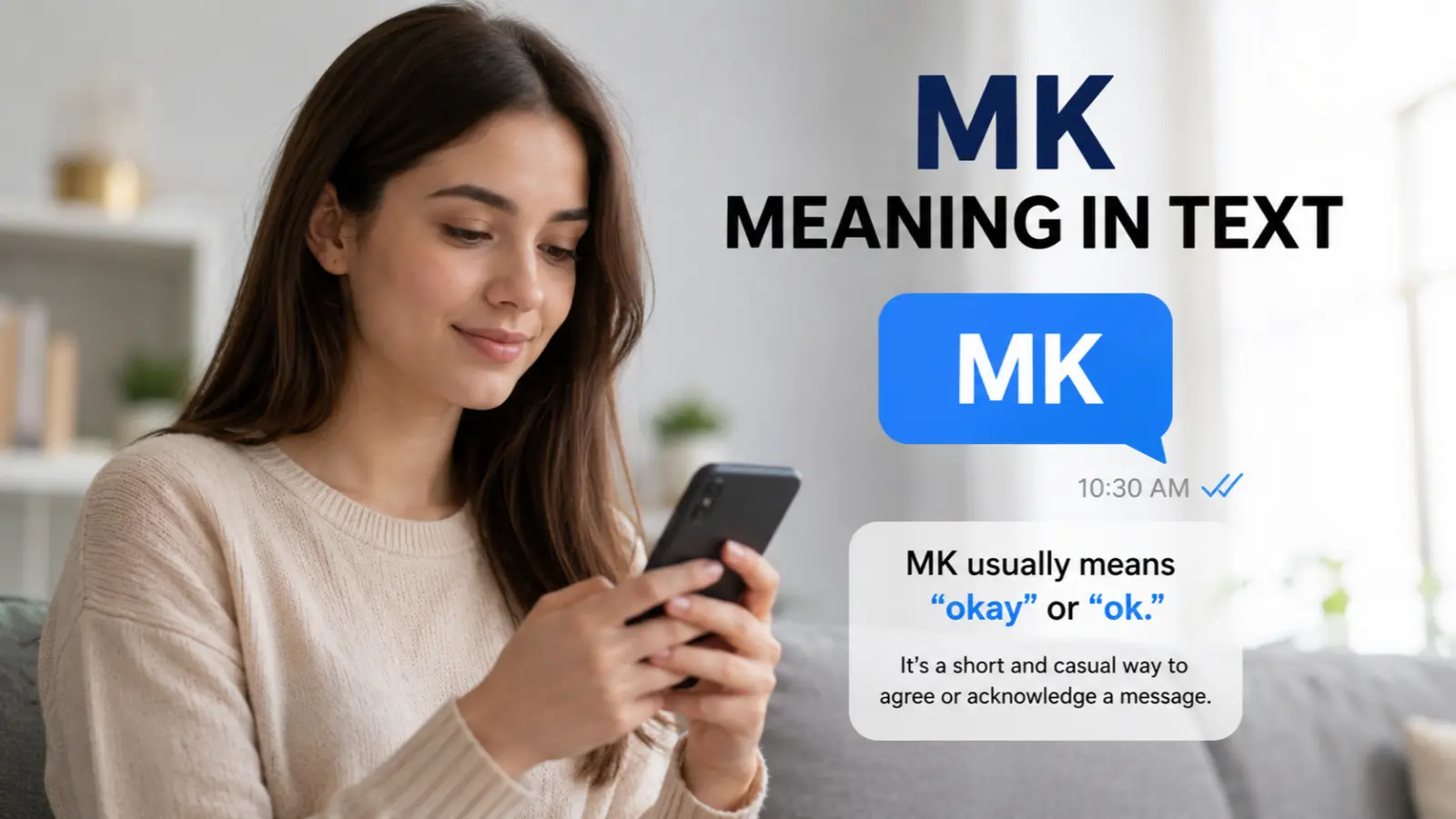
MK meaning in text usually refers to “okay” or “OK.” It is a short, casual way to acknowledge something in texting, chats, social media, and online conversations.
You may see someone reply with “mk” after a question, suggestion, reminder, or explanation.
People often search for the meaning of “mk” because its tone can change depending on the conversation.
A simple “mk” might mean “okay,” but in some situations, it can sound short, uninterested, annoyed, or even dismissive. The surrounding words and the relationship between the people texting are important.
If someone sends you “mk,” there is usually no need to worry. It is generally a neutral and informal abbreviation.
Quick Answer
“MK” in text usually means “okay” or “OK.” It is a casual texting abbreviation used to acknowledge or agree with something.
What Does MK Mean in Text?
The most common mk meaning in text is “okay.”
It is often used as a quick response when someone wants to show that they understand, agree, or acknowledge what another person has said.
Examples
- “Meet me at 7.”
“Mk.” - “Please remember to bring your book.”
“Mk, I will.” - “We can talk about it later.”
“Mk.”
In these examples, “mk” works much like “okay,” “alright,” or “sure.”
MK Full Form and Definition
The mk full form in texting is generally “okay.”
However, “MK” is not usually a formal acronym with one official expansion. Instead, it is a shortened texting form of “okay.”
You may see it written in several ways:
- mk
- MK
- Mk
- mkay
- m’kay
The lowercase version “mk” is especially common in casual digital conversations.
MK Meaning Slang: Is It Slang?
Yes, “mk” can be considered informal texting slang or a casual abbreviation.
It is mainly used in:
- Text messages
- Instagram DMs
- Snapchat
- TikTok comments or messages
- Discord
- Gaming chats
- Group chats
- Casual online conversations
It is not normally appropriate for formal writing such as business reports, academic assignments, or professional emails.
What Does MK Stand For in Different Contexts?
Although “okay” is the most common interpretation, its emotional meaning can vary.
1. MK = Okay
This is the standard meaning.
Example:
“I’ll call you tonight.”
“Mk.”
The person is simply acknowledging the message.
2. MK = Sure
Sometimes “mk” means the person agrees to a request.
“Can you send me the notes?”
“Mk.”
Here, it can mean “Sure” or “Okay, I will.”
3. MK = I Understand
Someone may use “mk” to show that they understand what was explained.
“Don’t forget that the meeting starts at 9.”
“Mk, got it.”
4. MK = Fine
Depending on tone, “mk” can sometimes mean “fine.”
For example:
“We can watch your movie.”
“Mk.”
The person may be agreeing without showing much excitement.
Is MK Rude, Offensive, or Neutral?
“MK” is generally neutral and not offensive.
However, the tone can sometimes feel cold or dismissive because it is very short.
Compare these responses:
- “Okay! 😊” — friendly and positive
- “Okay, sounds good.” — cooperative
- “Mk.” — brief and neutral
- “mk…” — may sound uncertain or annoyed
- “MK.” — may feel firm or irritated depending on context
The punctuation, capitalization, emojis, and previous conversation can all affect how “mk” is interpreted.
Why Does “MK” Sometimes Sound Rude?
The abbreviation itself is not rude. The perceived attitude comes from context and tone.
For example:
Person A: “I’m sorry I forgot to tell you.”
Person B: “Mk.”
This might sound like Person B is still annoyed.
But:
Person A: “I’ll send the picture later.”
Person B: “mk 😊”
This sounds much friendlier.
So, when interpreting mk meaning slang, look at the entire conversation rather than focusing on the abbreviation alone.
Where Is MK Commonly Used?
“MK” is most common in fast, informal communication.
Common places include:
- Text messaging
- Snapchat
- Facebook Messenger
- TikTok
- Discord
- Gaming chats
- Group conversations
People use it because it is quick to type and easy to understand among people who are familiar with texting abbreviations.
Real-Life Conversation Examples
Friendly Example
Alex: “Want to grab food later?”
Sam: “Mk 😊 What time?”
Here, “mk” is casual and friendly.
Casual Example
Alex: “I’ll see you after class.”
Sam: “Mk.”
It simply means “okay.”
Argumentative Example
Alex: “You never listen to me.”
Sam: “Mk.”
In this context, “mk” could sound dismissive or irritated.
Agreeing Example
Alex: “Can you finish this tomorrow?”
Sam: “Mk, no problem.”
This clearly shows agreement.
Short Response
Alex: “Don’t forget your keys.”
Sam: “Mk.”
The person is acknowledging the reminder.
Emotional and Psychological Meaning of MK
“MK” does not have a fixed psychological meaning. Its emotional effect depends on the person using it and the situation.
A short response can sometimes communicate:
- Agreement
- Understanding
- Indifference
- Irritation
- Lack of enthusiasm
- A desire to end the conversation
For example, someone who normally sends long, warm messages may suddenly reply with only “mk.” You might interpret that as a sign that something is wrong.
However, you should not automatically assume they are angry. They could simply be busy or typing quickly.
Origin and Background of MK
“MK” developed as part of the broader culture of internet and mobile texting.
As people began communicating through SMS, instant messaging, and social media, shorter forms became popular. Words such as “okay,” “thanks,” “please,” and “see you” were often shortened or replaced with informal abbreviations.
“MK” is essentially a compact version of “okay.” It is related to other casual forms such as “k,” “kk,” and “mkay.”
Unlike some internet slang, it does not usually represent a complex phrase or hidden expression.
MK vs. Similar Texting Terms
| Text Term | Common Meaning | Typical Tone |
|---|---|---|
| MK | Okay | Casual, brief |
| OK | Okay | Neutral |
| K | Okay | Very brief; can sound cold |
| KK | Okay | Casual, often friendly |
| Okay | Okay | Neutral and clear |
| Sure | Yes / agreed | Friendly or cooperative |
| Alright | Okay / accepted | Neutral |
| Mkay | Okay | Playful or conversational |
MK vs. K
These two can look similar, but “k” is often perceived as colder than “mk.”
For example:
“I’ll call you later.”
“K.”
This can sometimes feel dismissive.
Meanwhile:
“I’ll call you later.”
“Mk.”
usually feels slightly softer, although context still matters.
When Should You Use MK?
You can use “mk” when talking casually with people who understand texting slang.
Good situations include:
- Talking with friends
- Casual group chats
- Messaging family
- Gaming conversations
- Informal social media chats
For example:
“I’ll meet you there at 8.”
“Mk, see you!”
When Should You Avoid Using MK?
Avoid “mk” in situations where you need to sound professional or especially respectful.
For example, do not normally write:
“Mk, I’ll complete the report.”
to your manager or a client.
Instead, use:
“Okay, I’ll complete the report.”
or:
“Understood. I’ll take care of it.”
Professional communication benefits from clarity, especially when the relationship or situation is formal.
Polite Alternatives to MK
If you want to make your response warmer or clearer, try:
- Okay
- Alright
- Sure
- Sounds good
- Got it
- Understood
- No problem
- Absolutely
- That works for me
- Sure, I can do that
These alternatives make your intention easier to understand.
Why Do People Use MK?
People commonly use “mk” because it is:
- Fast to type
- Easy to understand
- Casual
- Short
- Convenient for quick replies
- Useful when acknowledging a message
Texting often favors short responses. When someone does not need to write a full sentence, “mk” can communicate the basic idea quickly.
Impact of Using MK in Communication
The impact of “mk” depends heavily on the receiver.
With close friends, it may feel completely normal.
In a serious conversation, however, it may appear uninterested.
For example:
“I really need your help with something important.”
Replying “mk” may sound insensitive because the message deserves a more thoughtful response.
A better reply might be:
“Okay, tell me what happened.”
This shows both acknowledgment and interest.
Is MK Safe for Social Media?
Yes. “MK” is generally safe and harmless to use on social media.
It is not normally offensive, vulgar, or inappropriate by itself.
Still, remember that short replies can sometimes be misunderstood. If you are responding to an emotional or serious post, use clearer and more supportive language.
Common Misunderstandings About MK
Misunderstanding 1: MK Always Means Someone Is Angry
Not necessarily. It usually just means “okay.”
Misunderstanding 2: MK Is Offensive
No. “MK” is generally harmless and informal.
Misunderstanding 3: MK Has Only One Possible Tone
Its basic meaning is “okay,” but its emotional tone can change.
Misunderstanding 4: MK Is Appropriate Everywhere
It is mainly informal. It may not be suitable for professional or academic communication.
Variations and Types of MK
You may encounter several similar forms online.
MK
The shortest common version.
Mk
A mixed-case version that can look more conversational.
mkay
A longer, playful form of “okay.”
M’kay
Another stylized version, sometimes used humorously.
The meaning is generally similar, but the tone can be different.
How to Respond When Someone Uses MK
Your response should depend on the conversation.
If they simply acknowledge something, you may not need to reply.
You: “I’ll be there at 6.”
Them: “Mk.”
No response is necessary.
If you are unsure whether they are annoyed, you can ask:
“Everything okay?”
If the conversation is serious, respond with more detail rather than another one-word abbreviation.
Regional and Cultural Usage
“MK” is most recognizable in English-language digital communication. Its use can vary between communities, age groups, and online platforms.
Some people use “mk” frequently, while others prefer:
- okay
- ok
- k
- kk
- alright
- sure
Because internet slang changes quickly, the safest way to understand “mk” is to consider the person’s normal texting style and the context of the conversation.
FAQs About MK Meaning in Text
What does MK mean in text?
MK usually means “okay” or “OK.” It is a casual abbreviation commonly used in texting and online chats.
What does MK stand for in texting?
In most texting situations, MK stands for or represents “okay.” It is an informal shortened form rather than a formal acronym.
Is MK rude in a text?
Not usually. However, a very short “mk” can sometimes sound cold, annoyed, or dismissive depending on the conversation.
What does “mk” mean from a girl?
The meaning is generally the same: “okay.” Her personal texting style and the context are more important than her gender.
What is the difference between MK and K?
Both can mean “okay,” but “k” can sometimes sound colder or more dismissive. “Mk” may feel slightly softer, although tone depends on context.
Should I use MK in a professional message?
It is better to avoid it in formal communication. Use “Okay,” “Understood,” “Certainly,” or “Sounds good” instead.
Conclusion
The mk meaning in text is usually simple: “okay.” It is a short, informal way to acknowledge a message, agree with someone, or show that you understand.
Although “mk” is generally neutral, its tone can change depending on punctuation, the conversation, and the relationship between the people involved. A simple “mk” can sound friendly in one conversation but slightly dismissive in another.
If you are chatting casually with friends, “mk” is usually fine. For professional, serious, or emotional conversations, a clearer response such as “Okay,” “Got it,” or “Understood” is often a better choice.
Understanding both the literal meaning and the context will help you interpret MK meaning slang correctly and avoid unnecessary misunderstandings.