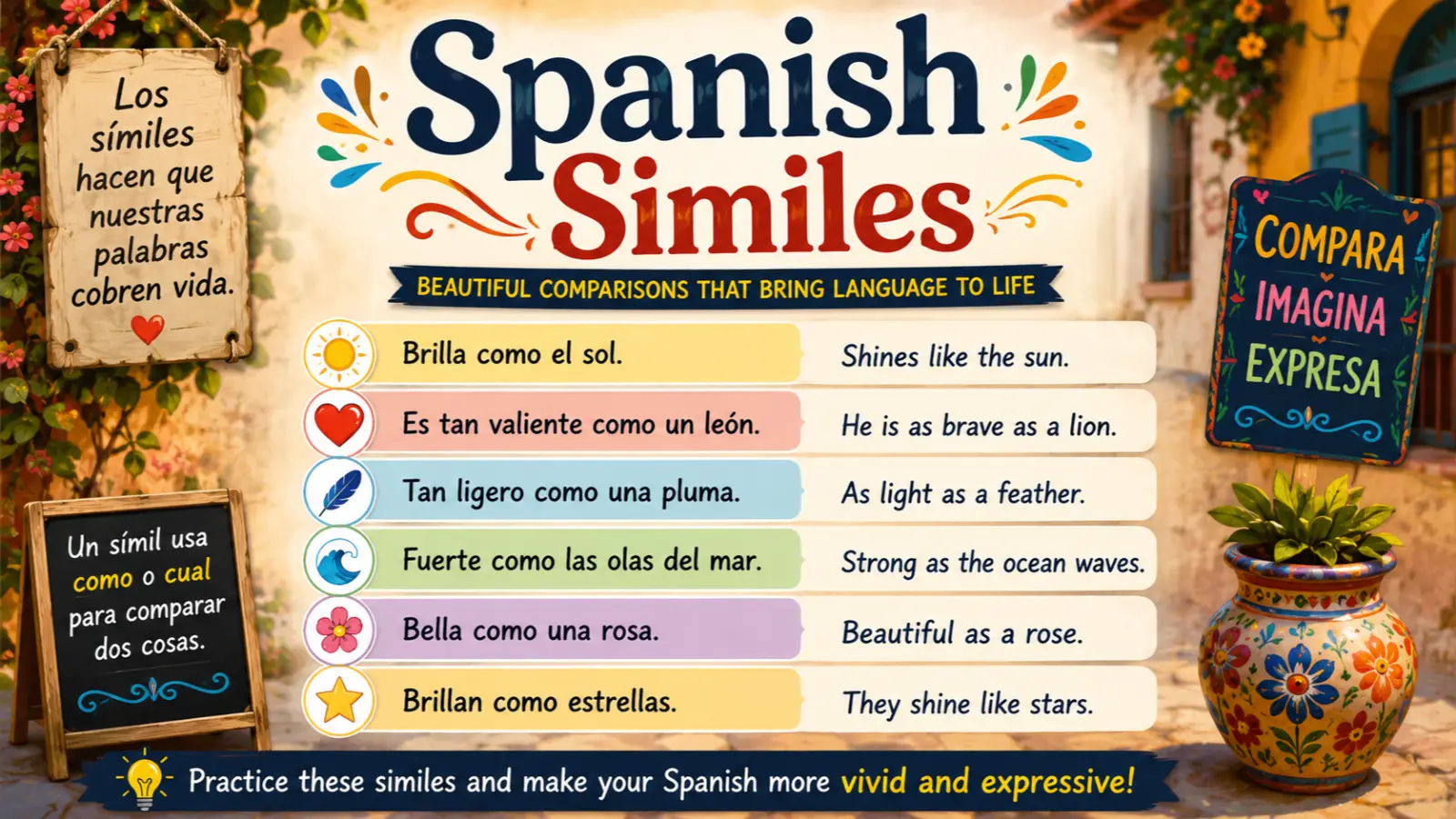
A simile compares two different things to make an idea easier to picture or feel. In Spanish, similes commonly use words such as “como” (“like” or “as”), “parecer” (“to seem”), or phrases such as “tan… como” (“as… as”).
For example:
Sus ojos brillaban como estrellas después de la lluvia.
Her eyes shone like stars after the rain.
The comparison does more than describe bright eyes. It creates an image and gives the sentence a particular mood.
Spanish similes appear in everyday conversation, songs, poetry, stories, speeches, advertising, and personal writing. They can express happiness, sadness, love, anger, friendship, beauty, fear, or almost any other experience.
This collection focuses on original Spanish similes rather than relying on familiar clichés. Each example shows how a comparison can add emotion, imagery, and personality to writing.
Quick Answer: What Is a Simile in Spanish?
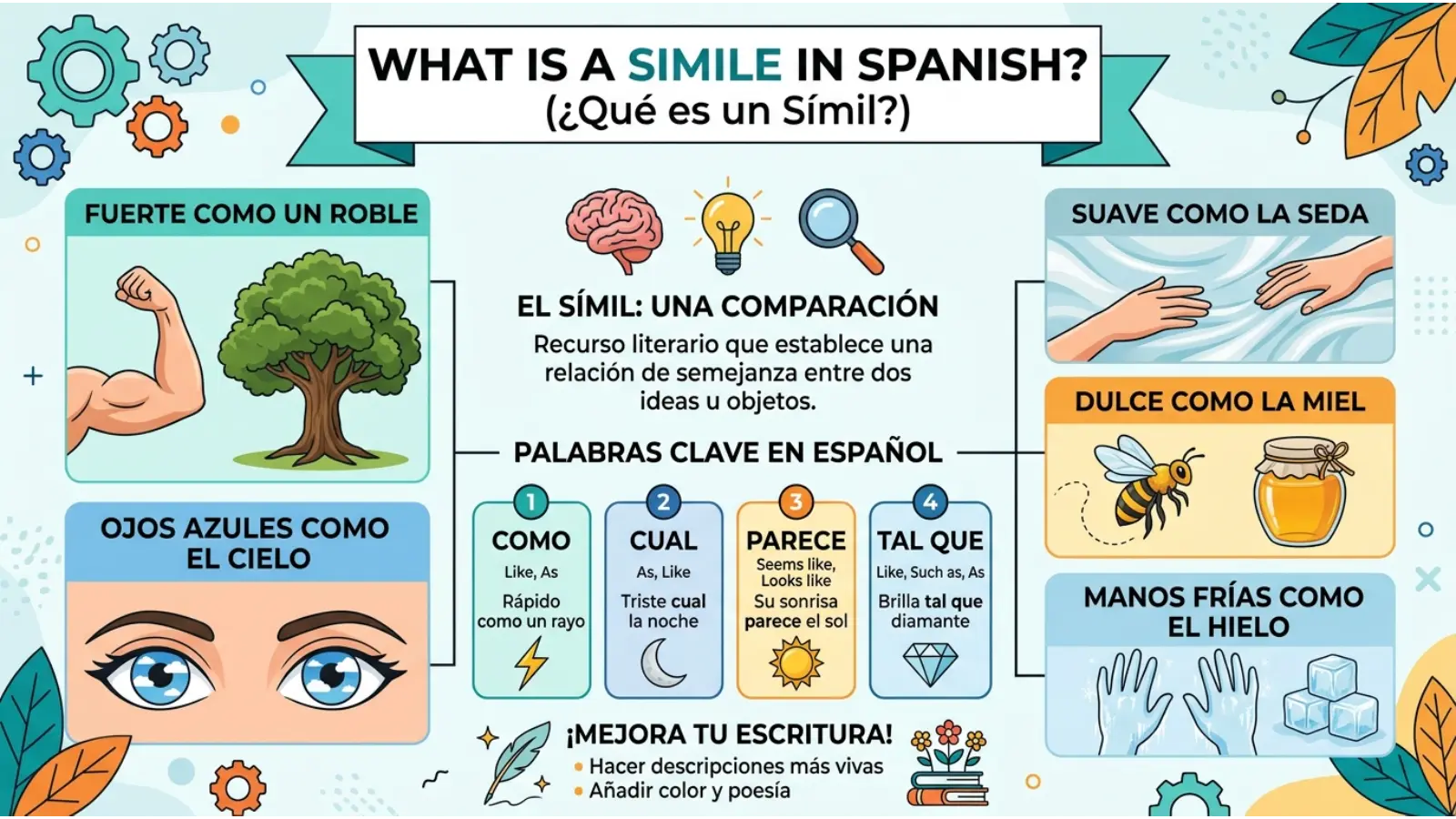
A Spanish simile is a comparison between two different things, usually connected with words such as “como” or “tan… como.” For example, “Corre como el viento” means “He runs like the wind.” Writers use similes to make descriptions more vivid, emotional, and memorable.
30 Original Spanish Simile Examples
1. Feliz como una ventana abierta al amanecer
Spanish: Estaba feliz como una ventana abierta al amanecer.
English meaning: She was as happy as an open window at dawn.
This comparison connects happiness with freshness, light, and possibility. It works especially well when describing someone whose mood suddenly improves.
Writing tip: Instead of simply saying “estaba muy feliz,” connect happiness to an image that suggests why the person feels that way.
2. Su sonrisa brillaba como una moneda bajo el sol
Spanish: Su sonrisa brillaba como una moneda bajo el sol.
English meaning: Her smile shone like a coin beneath the sun.
The image gives a smile a physical quality. It could fit a character who is cheerful, confident, or unexpectedly pleased.
Best context: Character descriptions and storytelling.
3. La amistad creció como una planta junto a la ventana
Spanish: Nuestra amistad creció como una planta junto a la ventana.
English meaning: Our friendship grew like a plant beside the window.
The comparison suggests that friendship develops gradually with attention and care.
Writing purpose: Use it when you want to show that a relationship became stronger over time rather than appearing instantly.
4. Su amistad era firme como una puerta de madera vieja
Spanish: Su amistad era firme como una puerta de madera vieja.
English meaning: Their friendship was sturdy like an old wooden door.
Here, the physical strength of the door represents reliability.
A useful technique is to choose an object whose physical quality matches the emotional quality you want to communicate.
5. La lluvia cayó como cuentas de cristal
Spanish: La lluvia cayó como cuentas de cristal sobre el techo.
English meaning: The rain fell like glass beads on the roof.
The comparison gives ordinary rain a delicate, almost musical quality.
Poetry example:
La lluvia cayó como cuentas de cristal,
despertando las calles dormidas.
The second line adds imagery without explaining the comparison directly.
6. Las gotas corrían como pequeños viajeros por el cristal
Spanish: Las gotas corrían como pequeños viajeros por el cristal.
English meaning: The drops ran like little travelers across the glass.
This simile makes rain feel active. It turns a static window into a small landscape.
Why it works: Giving movement to something ordinary helps readers visualize it.
7. Su voz era suave como una manta en invierno
Spanish: Su voz era suave como una manta en invierno.
English meaning: Her voice was soft like a blanket in winter.
This comparison uses comfort rather than simply describing volume or tone.
Writing insight: Sensory similes become stronger when they connect one sense with another experience. A voice can be described through the feeling of warmth or softness.
8. Mi corazón saltó como un pájaro sorprendido
Spanish: Mi corazón saltó como un pájaro sorprendido.
English meaning: My heart jumped like a startled bird.
This works well for sudden excitement, nervousness, or surprise.
Rather than naming the emotion immediately, the writer lets the physical image communicate it.
9. El amor llegó como una canción inesperada
Spanish: El amor llegó como una canción inesperada.
English meaning: Love arrived like an unexpected song.
The comparison presents love as something surprising and emotionally powerful.
Best context: Poetry, reflective writing, and romantic storytelling.
10. Sus palabras flotaban como pétalos sobre el agua
Spanish: Sus palabras flotaban como pétalos sobre el agua.
English meaning: Her words floated like petals on water.
This creates an impression of gentleness and calm.
Writing tip: Ask yourself whether your comparison should make the reader feel the scene, not merely see it.
11. Su enojo ardía como una lámpara olvidada encendida
Spanish: Su enojo ardía como una lámpara que alguien había olvidado encendida.
English meaning: His anger burned like a lamp someone had forgotten to turn off.
Unlike a simple comparison with fire, this image suggests anger that continues quietly over time.
Why it works: A good simile can reveal the type of emotion, not just its intensity.
12. La discusión explotó como una caja llena de fuegos artificiales
Spanish: La discusión explotó como una caja llena de fuegos artificiales.
English meaning: The argument exploded like a box full of fireworks.
This gives the scene speed, noise, and unpredictability.
Best context: Fiction and dramatic storytelling.
13. Caminaba como si llevara el cielo en los zapatos
Spanish: Caminaba como si llevara el cielo en los zapatos.
English meaning: He walked as if he carried the sky in his shoes.
This unusual image can suggest freedom, confidence, excitement, or an almost dreamlike mood.
Writing lesson: Not every effective comparison needs to be physically literal. Imaginative connections can make prose distinctive.
14. La ciudad despertó como un gigante después de una larga noche
Spanish: La ciudad despertó como un gigante después de una larga noche.
English meaning: The city woke like a giant after a long night.
Traffic, lights, people, and noise can all be introduced through this central image.
Best context: Opening paragraphs and setting descriptions.
15. El silencio cayó como nieve sobre la habitación
Spanish: El silencio cayó como nieve sobre la habitación.
English meaning: Silence fell like snow over the room.
The comparison makes silence seem gradual, soft, and covering.
This is stronger than simply writing “la habitación quedó en silencio” because it gives the silence a visible presence.
16. Sus pensamientos corrían como peces en un río
Spanish: Sus pensamientos corrían como peces en un río.
English meaning: Her thoughts moved like fish in a river.
The image suggests thoughts that are active and difficult to hold onto.
Writing purpose: Useful for nervousness, creativity, confusion, or mental restlessness.
17. El niño reía como una campana en una mañana tranquila
Spanish: El niño reía como una campana en una mañana tranquila.
English meaning: The child laughed like a bell on a quiet morning.
The comparison emphasizes sound and brightness.
Writing tip: When describing laughter, choose an object with a recognizable sound rather than adding empty intensifiers such as “muy fuerte” or “muy bonito.”
18. Sus lágrimas brillaban como pequeñas luces
Spanish: Sus lágrimas brillaban como pequeñas luces en la oscuridad.
English meaning: Her tears shone like tiny lights in the darkness.
The image combines sadness with a small suggestion of hope.
That emotional contrast can make a description more layered.
19. El recuerdo regresó como una canción que conocía de memoria
Spanish: El recuerdo regresó como una canción que conocía de memoria.
English meaning: The memory returned like a song I knew by heart.
This simile works because songs can return unexpectedly when a familiar sound or place triggers them.
Best context: Personal essays, memoir-style writing, and reflective fiction.
20. El miedo se escondía como una sombra detrás de sus palabras
Spanish: El miedo se escondía como una sombra detrás de sus palabras.
English meaning: Fear hid like a shadow behind his words.
Instead of directly stating that the character is frightened, the simile lets readers infer the emotion.
Writing insight: Indirect emotional description often creates more curiosity than simply naming the feeling.
21. La esperanza apareció como una pequeña estrella
Spanish: La esperanza apareció como una pequeña estrella en el horizonte.
English meaning: Hope appeared like a small star on the horizon.
The comparison suggests that hope may be small but visible.
Best context: Inspirational writing and moments when a difficult situation begins to improve.
22. El bosque respiraba como un animal enorme
Spanish: El bosque respiraba como un animal enorme.
English meaning: The forest breathed like an enormous animal.
This comparison makes the natural setting feel alive and slightly mysterious.
It also approaches personification, showing how literary devices can overlap.
23. Las hojas giraban como pequeñas brújulas perdidas
Spanish: Las hojas giraban como pequeñas brújulas perdidas en el viento.
English meaning: The leaves spun like tiny compasses lost in the wind.
The image creates movement while suggesting uncertainty.
Writing tip: A strong comparison can carry two ideas at once: physical movement and emotional meaning.
24. El café estaba caliente como una piedra bajo el sol
Spanish: El café estaba caliente como una piedra bajo el sol.
English meaning: The coffee was hot like a stone beneath the sun.
This gives the reader a physical sensation instead of a generic adjective.
Best context: Food descriptions, travel writing, and everyday storytelling.
25. La música entró como una corriente de aire fresco
Spanish: La música entró como una corriente de aire fresco.
English meaning: The music came in like a stream of fresh air.
This is especially useful when music changes the atmosphere of a scene.
Writing purpose: It connects sound with physical sensation, making the experience more vivid.
26. Sus recuerdos pesaban como piedras mojadas
Spanish: Sus recuerdos pesaban como piedras mojadas.
English meaning: Her memories weighed like wet stones.
The comparison communicates emotional heaviness through physical weight.
Why it works: Readers understand physical weight immediately, so it becomes a powerful bridge to an abstract emotion.
27. La noticia cayó como una hoja en medio del ruido
Spanish: La noticia cayó como una hoja en medio del ruido.
English meaning: The news fell like a leaf amid the noise.
This unusual comparison creates a softer, quieter image for a moment that might otherwise be described directly.
Best context: Reflective or literary storytelling.
28. Su risa se extendió como luz por el pasillo
Spanish: Su risa se extendió como luz por el pasillo.
English meaning: Her laughter spread like light through the hallway.
The comparison suggests that one person’s happiness affects the surrounding environment.
29. La paciencia se agotó como una vela al final de la noche
Spanish: Su paciencia se agotó como una vela al final de la noche.
English meaning: His patience ran out like a candle at the end of the night.
The candle gives the abstract idea of patience a clear visual endpoint.
Writing lesson: Abstract nouns such as patience, hope, fear, and memory become easier to imagine when connected to physical objects
30. El sueño llegó como una marea silenciosa
Spanish: El sueño llegó como una marea silenciosa.
English meaning: Sleep arrived like a silent tide.
This suggests that sleep gradually takes over rather than arriving suddenly.
Best context: Poetry, nighttime scenes, and descriptive prose.
How to Make Spanish Similes More Vivid
A simile becomes memorable when the comparison adds information that the original description does not contain.
Compare:
La niña estaba feliz.
with:
La niña estaba feliz como una ventana abierta al amanecer.
The second sentence gives the reader an image associated with freshness, brightness, and openness.
When creating a simile, ask three questions:
- What exactly am I describing?
- What quality do I want the reader to notice?
- What image naturally carries that quality?
If you are describing anger, for example, don’t automatically choose fire. Anger can also feel like pressure inside a sealed container, a storm arriving across a quiet field, or a door that refuses to close.
The goal is not to make the comparison complicated. The goal is to make it precise.
How to Avoid Cliché Spanish Similes
Some comparisons are so familiar that readers barely notice them. Familiar expressions can still be useful, especially in everyday conversation, but creative writing benefits from fresh imagery.
Instead of immediately reaching for a comparison involving stars, fire, roses, or the sea, look at the character or setting itself.
A mechanic might describe exhaustion through an engine.
A musician might describe excitement through rhythm.
A gardener might describe patience through growing plants.
A child might create a completely different comparison.
The best simile often comes from the world of the person telling the story.
Spanish Similes in Poetry, Music, and Storytelling
Similes are particularly useful in creative forms where emotional atmosphere matters.
In poetry, a short comparison can carry several layers of meaning:
La esperanza apareció como una pequeña estrella en el horizonte.
storytelling, similes can slow down an important moment and help readers visualize it.
In music, comparisons can make abstract emotions easier to communicate. A lyric or poetic line may compare love to weather, movement, light, sound, or distance.
When writing for music, however, clarity and rhythm matter. A beautiful comparison that is awkward to say aloud may not work well in a song.
Read your simile aloud. If the sentence feels difficult to speak, consider simplifying it.
Spanish Similes for Different Emotions
Happiness
For happiness, choose images associated with movement, light, openness, sound, or warmth.
Examples:
- Su alegría brillaba como una ventana al amanecer.
- Reía como una campana en una mañana tranquila.
- Caminaba como si llevara el cielo en los zapatos.
These comparisons communicate different versions of happiness rather than treating every joyful character the same way.
Love
Love can be gentle, surprising, overwhelming, comforting, or uncertain.
Examples:
- El amor llegó como una canción inesperada.
- Sus palabras flotaban como pétalos sobre el agua.
- Su presencia era como una luz encendida en una casa vacía.
The important question is not simply “How do I describe love?” but “What kind of love am I describing?”
Anger
Anger can be explosive, controlled, persistent, or barely visible.
Examples:
- La discusión explotó como una caja llena de fuegos artificiales.
- Su enojo ardía como una lámpara olvidada encendida.
- Su paciencia se quebró como una rama bajo demasiado peso.
Specific comparisons make characters feel more believable.
Friendship
Friendship often develops through trust and time.
Examples:
- Nuestra amistad creció como una planta junto a la ventana.
- Su amistad era firme como una puerta de madera vieja.
- Estaban unidos como dos caminos que siempre terminaban encontrándose.
These images emphasize growth, reliability, and connection.
Simile vs. Metaphor in Spanish
A simile usually makes the comparison explicit.
Sus ojos brillaban como estrellas.
A metaphor makes the comparison more direct.
Sus ojos eran estrellas.
Both devices create imagery, but they produce slightly different effects.
The simile gives readers a visible bridge between two things. The metaphor makes the identification stronger and more immediate.
Neither is automatically better. Choose the device that matches the voice and intensity of the passage.
Other Literary Devices That Work With Similes
Imagery
Imagery uses descriptive language to create sensory experiences. A strong simile often creates imagery automatically.
Personification
Personification gives human qualities to nonhuman things.
El bosque respiraba como un animal enorme.
The forest is treated as if it can breathe, while the simile strengthens the image.
Hyperbole
Hyperbole deliberately exaggerates.
A character might say:
Esperé como si hubieran pasado mil inviernos.
The point is emotional exaggeration rather than literal measurement.
Alliteration
Alliteration repeats similar beginning sounds. It can work alongside a simile to give poetic language additional rhythm.
Using several devices together can make writing richer, but too many devices in one sentence can make the prose feel forced.
How to Create Your Own Spanish Similes
You can build original comparisons with a simple process.
Start with the emotion or object
Write down the thing you want to describe:
fear
Then list its qualities:
- sudden
- quiet
- physical
- difficult to control
- hidden
Search for a matching image
Think beyond obvious comparisons.
Fear might resemble:
- a locked door
- a distant sound
- cold air under a doorway
- an animal hiding nearby
Connect the ideas
For example:
El miedo era como un ruido detrás de una puerta cerrada.
Now the reader has something concrete to imagine.
Make the comparison specific
Instead of:
Era como una puerta.
Try:
El miedo era como un ruido detrás de una puerta cerrada.
The second version gives the reader sound, distance, mystery, and tension.
Read it aloud
If the simile sounds unnatural when spoken, revise it. Good creative writing should feel natural even when its imagery is imaginative.
Creative Exercises for Better Similes
Exercise 1: Five senses
Choose one emotion and create five comparisons:
- one based on sight
- one based on sound
- one based on touch
- one based on smell
- one based on movement
This prevents you from relying on the same type of imagery.
Exercise 2: Ban the obvious comparison
Choose love, anger, happiness, or sadness.
Write a simile without using stars, fire, roses, storms, hearts, or oceans.
The restriction forces you to search for less predictable imagery.
Exercise 3: Change the narrator
Describe the same object from three perspectives.
For example, describe rain as seen by:
- a child
- a musician
- a traveler
Each narrator should naturally choose different comparisons.
This is an excellent way to develop voice.
Common Mistakes When Writing Similes
Using a comparison that says nothing new
A simile should add meaning. If removing it makes the sentence equally vivid, it may not be necessary.
Mixing unrelated imagery
Avoid combining several comparisons that pull the reader in different directions.
For example, describing someone’s anger as a storm, a burning engine, a sharp knife, and a falling mountain in the same sentence creates confusion.
Choose the strongest image and let it do its work.
Making every sentence poetic
Constant figurative language can overwhelm readers. Strong prose needs ordinary sentences too.
Save your most memorable comparisons for moments where imagery matters.
Explaining the simile too much
If the image is clear, trust the reader.
Instead of describing a comparison and then explaining exactly what every part represents, allow the image to create the effect naturally.
Confusing similes and metaphors
Remember:
Simile: Es como una estrella.
Metaphor: Es una estrella.
The distinction is simple, but using each deliberately helps control your writing style.
Frequently Asked Questions About Spanish Similes
What is an example of a Spanish simile?
One example is “La lluvia cayó como cuentas de cristal sobre el techo,” meaning “The rain fell like glass beads on the roof.” The word “como” introduces the comparison.
What words are commonly used for similes in Spanish?
“Como” is the most common connector. Spanish also uses structures such as “tan… como,” “parece,” and “igual que” depending on the sentence and intended meaning.
What is the difference between a Spanish simile and a metaphor?
A Spanish simile explicitly compares two things, often with “como.” A metaphor makes the comparison directly. For example, “brilla como una estrella” is a simile, while “es una estrella” can function as a metaphor.
How can I make Spanish similes sound natural?
Start with the quality you want to communicate, then choose an image that genuinely shares that quality. Read the sentence aloud and remove unnecessary words.
Can similes be used in Spanish songs?
Yes. Similes can make emotions, relationships, settings, and abstract ideas easier to visualize. In songs, the comparison should also fit the rhythm and tone of the lyrics.
Are Spanish similes useful for learning Spanish?
Yes. They can help learners understand descriptive vocabulary, sentence structure, cultural expressions, and figurative language. However, learners should distinguish creative comparisons from established idiomatic expressions.
How do I avoid clichés when writing Spanish similes?
Look for comparisons connected to the character, setting, profession, memory, or situation. The more specific the source of the image, the more personal the writing can feel.
Conclusion
Spanish similes give writers a practical way to turn ordinary descriptions into images readers can see, hear, feel, or remember. A simple word such as “como” can connect an emotion to an object, a sound to a memory, or a setting to an unexpected idea. The strongest similes are not necessarily the most complicated. They are the ones that reveal something useful about the subject. When writing your next Spanish sentence, don’t ask only, “What is this like?” Ask “What is this like in this particular moment?” That small change can lead to fresher comparisons, stronger imagery, and writing with a voice that feels genuinely your own.

I am Helena Frost, a writer captivated by the beauty of language and the art of comparison. Through my words, I explore the world by turning ordinary moments into vivid similes and reflections. I enjoy crafting phrases that spark imagination, evoke emotion, and linger in the mind. My writing celebrates the subtle connections between people, nature, and the stories we live. For me, every sentence is an opportunity to reveal the extraordinary in the everyday.