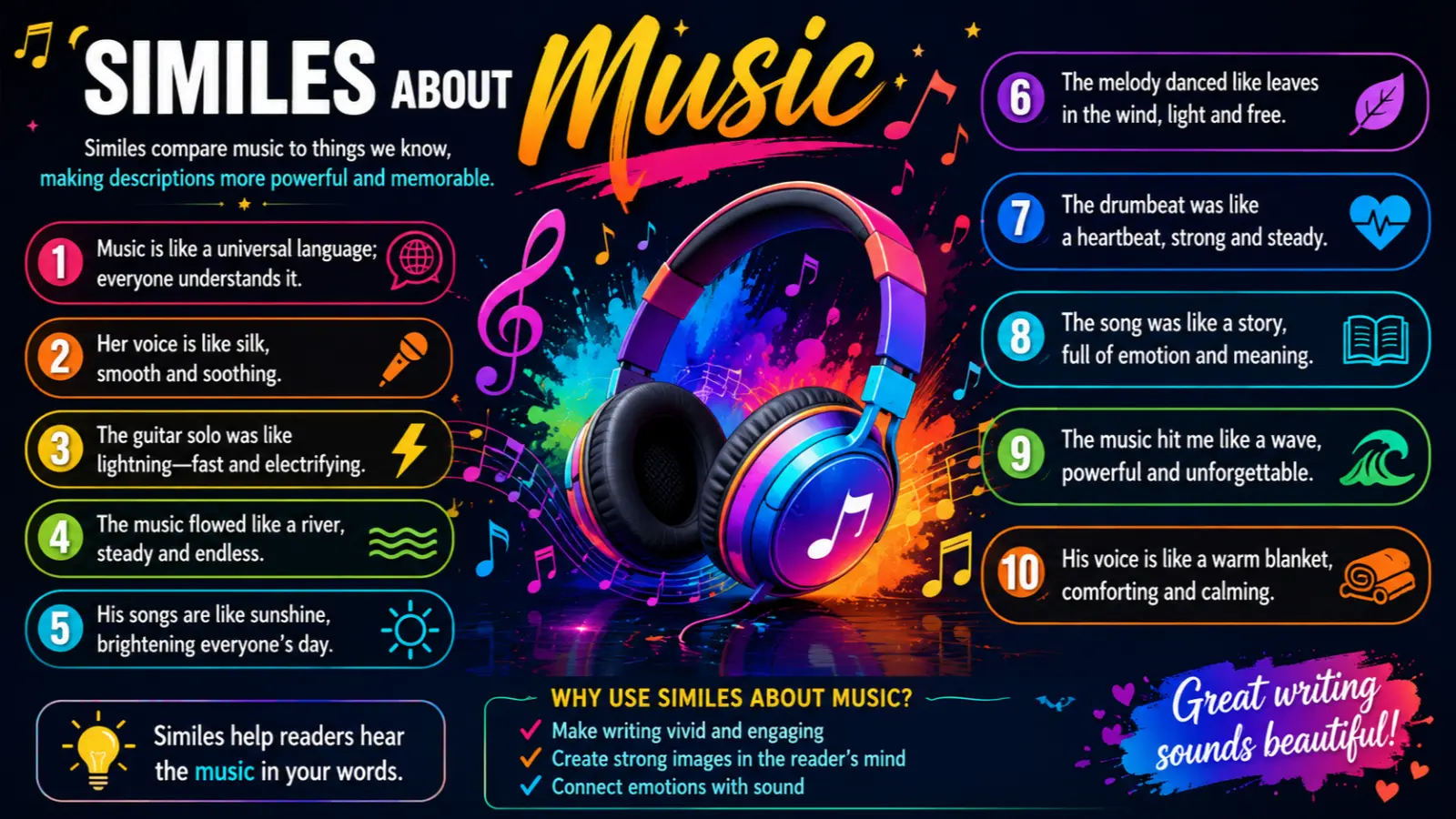
Similes About Music is difficult to describe because we cannot hold it, see it, or measure its emotional effect in quite the same way we describe a physical object. A simile gives writers a way to bridge that gap.
A simile compares one thing with another using words such as “like” or “as.” When writing about music, a comparison can turn an abstract sound into something readers can imagine, feel, or almost experience.
For example, saying “The violin sounded beautiful” gives readers basic information. Saying “The violin sounded like sunlight slipping through an open window” creates an image.
This collection of similes about music offers original comparisons for songs, voices, instruments, melodies, rhythms, concerts, and musical emotions. More importantly, it explains why these comparisons work and how you can create stronger ones yourself.
What Is a Simile About Music?
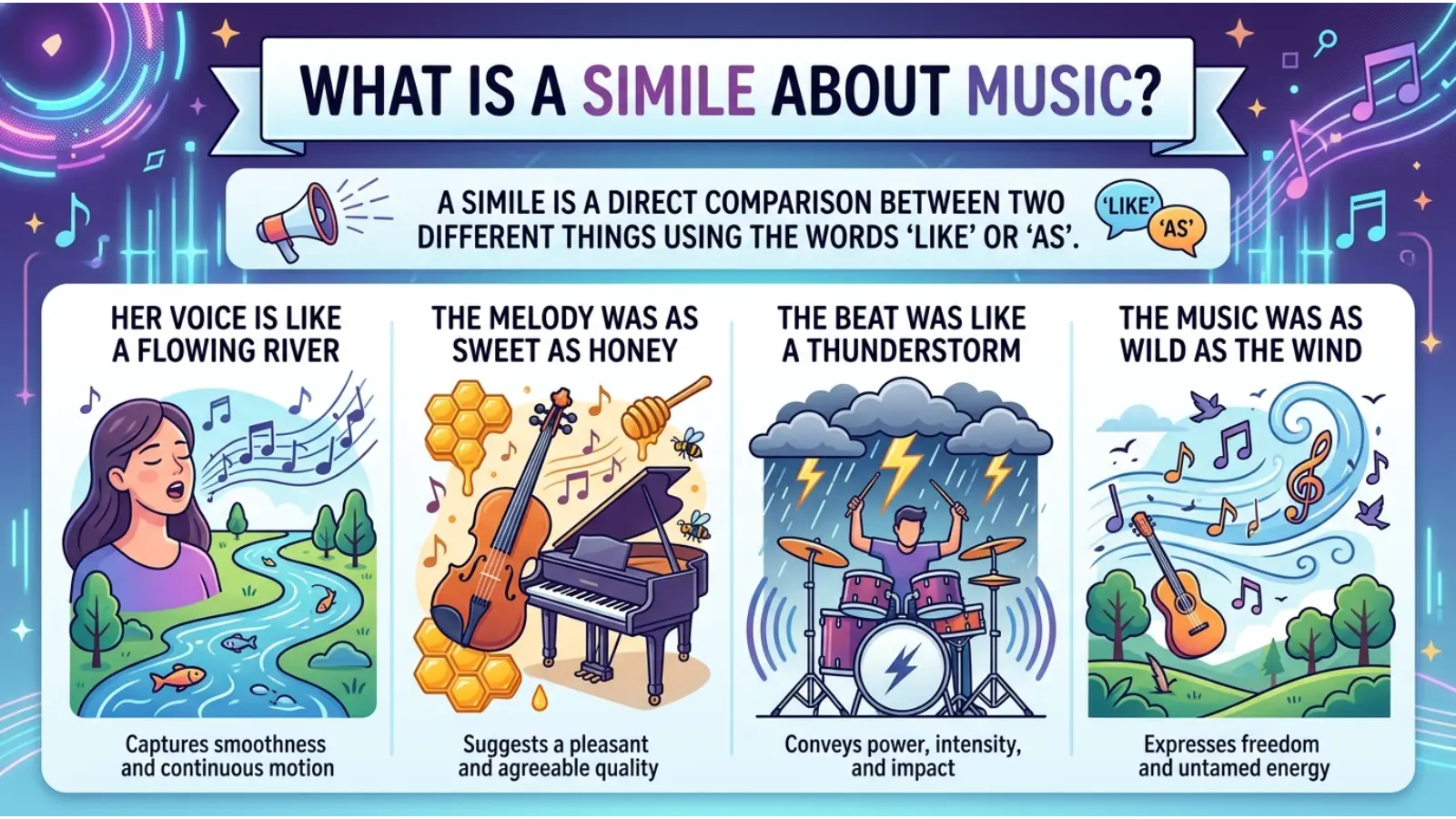
A music simile compares a musical sound, performance, rhythm, voice, or emotional experience to something familiar.
For example:
The melody moved like a silver ribbon floating through the air.
The melody is being compared to a ribbon. The comparison helps readers imagine its smooth, flowing quality.
Music similes can describe:
- The sound of an instrument
- A singer’s voice
- The rhythm of a song
- A melody or tune
- Loud or soft music
- Fast or slow music
- Emotional reactions to music
- A live performance
- The atmosphere created by a song
The strongest comparisons do more than say that music is “good” or “beautiful.” They give the reader a specific sensation or image.
30 Original Similes About Music
1. The Melody Floated Like a Paper Boat on a Quiet River
Meaning: The melody feels gentle, peaceful, and effortless.
Example:
The melody floated like a paper boat on a quiet river, carrying the audience into silence.
Writing purpose: This works especially well for calm instrumental music or a soft piano piece.
Writing tip: When creating a peaceful music simile, choose an image that moves slowly rather than simply calling the music “soft.”
2. Her Voice Was Like Warm Tea on a Cold Morning
Meaning: The singer’s voice feels comforting and soothing.
Example:
Her voice was like warm tea on a cold morning, familiar enough to make everyone relax.
This comparison creates comfort rather than just describing sound. It is useful when writing about singers whose voices create an intimate atmosphere.
3. The Drums Beat Like Footsteps Racing Through a Dark Alley
Meaning: The rhythm is fast, tense, and energetic.
Example:
The drums beat like footsteps racing through a dark alley.
Best context: Action scenes, suspenseful music, intense performances, or dramatic storytelling.
The important technique here is movement. Instead of saying the drums were “fast,” the comparison makes the reader imagine speed.
4. The Piano Notes Fell Like Rain Against a Window
Meaning: The notes arrive repeatedly and create a reflective atmosphere.
Example:
The piano notes fell like rain against a window while the room remained perfectly still.
This can work beautifully for melancholy or contemplative music because rain already carries associations of solitude and reflection.
5. The Guitar Riff Cut Through the Room Like a Flash of Lightning
Meaning: The guitar sound is sudden, powerful, and attention-grabbing.
Example:
The guitar riff cut through the room like a flash of lightning.
Writing purpose: Use this type of comparison when the music suddenly changes the energy of a scene.
Notice the verb “cut.” A strong simile becomes more vivid when the verb is active.
6. The Chorus Rose Like a Wave Gathering Beneath the Moon
Meaning: The chorus gradually becomes larger and more powerful.
Example:
The chorus rose like a wave gathering beneath the moon.
This is useful for describing music that builds toward an emotional climax.
7. The Violin Sang Like a Bird Hidden in the Trees
Meaning: The violin produces a delicate, expressive, almost living sound.
Example:
The violin sang like a bird hidden in the trees.
This comparison gives the instrument a natural and mysterious quality without directly saying it is “beautiful.”
8. The Bass Shook Like Thunder Beneath the Floor
Meaning: The bass is deep, powerful, and physically noticeable.
Example:
The bass shook like thunder beneath the floor, making every chair tremble with the beat.
Best context: Concerts, dance music, rock performances, and scenes where sound physically affects the surroundings.
9. The Melody Twisted Like Smoke Around a Streetlamp
Meaning: The melody feels mysterious, winding, or difficult to predict.
Example:
The melody twisted like smoke around a streetlamp, disappearing just when I thought I understood it.
This is a good example of using a simile for musical complexity, not simply volume or beauty.
10. The Rhythm Marched Like Soldiers Across a Distant Field
Meaning: The rhythm is steady, forceful, and organized.
Example:
The rhythm marched like soldiers across a distant field.
Writing tip: Rhythmic comparisons work particularly well when the comparison has its own recognizable pattern.
11. The Flute Sounded Like Wind Passing Through Bamboo
Meaning: The flute has a light, airy, natural quality.
Example:
The flute sounded like wind passing through bamboo.
This comparison is particularly useful for peaceful, traditional, or nature-inspired musical scenes.
12. His Voice Cracked Like Ice Under a Heavy Boot
Meaning: His voice sounds strained, fragile, or emotionally overwhelmed.
Example:
His voice cracked like ice under a heavy boot when he reached the final verse.
This is a stronger choice than simply saying that his voice was “emotional” because it suggests fragility and pressure.
13. The Song Unfolded Like an Old Photograph
Meaning: The song gradually revealed memories or feelings from the past.
Example:
The song unfolded like an old photograph, bringing forgotten moments back into focus.
Best context: Nostalgic writing, personal essays, reflective fiction, and emotional scenes.
14. The Trumpet Blared Like a Horn Calling Dawn
Meaning: The trumpet is bold, loud, and commanding.
Example:
The trumpet blared like a horn calling dawn across the sleeping city.
This comparison gives the sound a sense of announcement and importance.
15. The Soft Harmony Wrapped Around Us Like a Wool Blanket
Meaning: The harmony feels warm, protective, and comforting.
Example:
The soft harmony wrapped around us like a wool blanket while the snow fell outside.
This works because the physical warmth of a blanket gives readers a sensory way to understand emotional warmth in music.
16. The Beat Sparked Like Fireworks in the Night
Meaning: The rhythm feels energetic, exciting, and explosive.
Example:
The beat sparked like fireworks in the night as the dancers rushed onto the floor.
Best context: Celebrations, energetic performances, parties, and exciting scenes.
17. The Song Wandered Like a Traveler Without a Map
Meaning: The music feels unpredictable or directionless.
Example:
The song wandered like a traveler without a map, taking unexpected turns before finding its way home.
This is especially useful when describing experimental or unconventional music.
18. The Piano Chords Glowed Like Lanterns Along a Dark Road
Meaning: The chords provide warmth, guidance, or hope.
Example:
The piano chords glowed like lanterns along a dark road.
This comparison is effective when music provides emotional relief during a difficult moment.
19. Her High Notes Rose Like Kites Caught by a Strong Wind
Meaning: Her high notes climb naturally and seem to become lighter or more expansive.
Example:
Her high notes rose like kites caught by a strong wind.
The image creates a sense of height and freedom rather than merely saying that the singer has a high vocal range.
20. The Guitar Strings Shivered Like Leaves Before a Storm
Meaning: The guitar produces a trembling, nervous, or suspenseful sound.
Example:
The guitar strings shivered like leaves before a storm.
Best context: Suspense, sadness, uncertainty, or a song that gradually becomes darker.
21. The Orchestra Swelled Like the Ocean Filling a Quiet Bay
Meaning: The music gradually becomes fuller and more powerful.
Example:
The orchestra swelled like the ocean filling a quiet bay.
This is useful for describing a gradual musical crescendo.
22. The Melody Sparkled Like Frost Under Morning Light
Meaning: The melody sounds delicate, bright, and clear.
Example:
The melody sparkled like frost under morning light.
This works particularly well for high notes, bells, piano, harp, or other sounds with a crisp quality.
23. The Song Hit Me Like a Sudden Memory
Meaning: The music unexpectedly creates a strong emotional response.
Example:
The opening notes hit me like a sudden memory.
Unlike a comparison based on physical sound, this simile focuses on the listener’s emotional reaction.
24. The Rhythm Pulsed Like a Heart Beneath the Music
Meaning: The rhythm feels essential, steady, and alive.
Example:
The rhythm pulsed like a heart beneath the music, holding every instrument together.
This is useful when explaining the role of rhythm in a song.
25. The Choir Rose Like Morning Light Across the Hills
Meaning: The voices gradually create a sense of beauty, openness, and hope.
Example:
The choir rose like morning light across the hills.
This comparison works especially well for inspirational or grand musical moments.
26. The Solo Slipped Through the Silence Like a Needle Through Cloth
Meaning: A single musical line moves precisely through an otherwise quiet space.
Example:
The violin solo slipped through the silence like a needle through cloth.
The comparison suggests precision and quiet movement, making it more specific than saying the solo was “soft.”
27. The Crowd Moved Like Grass Beneath a Summer Wind
Meaning: The audience moves together naturally in response to the music.
Example:
The crowd moved like grass beneath a summer wind when the band began the chorus.
This is useful for concert descriptions because it connects collective human movement to something natural.
28. The Old Record Crackled Like a Fireplace in Winter
Meaning: The recording has a warm, imperfect, nostalgic quality.
Example:
The old record crackled like a fireplace in winter.
This comparison shows that imperfections can sometimes contribute to a recording’s atmosphere.
29. The Final Chord Hung in the Air Like a Question
Meaning: The ending feels unresolved or makes the listener expect something more.
Example:
The final chord hung in the air like a question, refusing to give us an answer.
Writing purpose: This is particularly effective when describing unresolved endings.
30. The Song Stayed With Me Like a Fragrance on an Empty Street
Meaning: The music continues to affect the listener even after it has ended.
Example:
The song stayed with me like a fragrance on an empty street.
This is useful for describing music that leaves a lasting emotional impression.
How to Make Music Similes More Vivid
A weak music simile often chooses an adjective first and searches for an image afterward.
For example:
The song was beautiful like a flower.
The comparison is understandable, but it is broad and predictable. What kind of flower? What kind of beauty? does the comparison actually help the reader experience?
A stronger approach is to identify the specific quality of the music first.
Ask:
- Is it bright or dark?
- Is it smooth or rough?
- Does it move quickly or slowly?
- Does it feel warm or cold?
- Does it build gradually?
- Does it surprise the listener?
- Does it create tension?
- Does it remind someone of the past?
Then find an image that naturally possesses that same quality.
For example:
Musical quality: gradual growth
Image: a wave becoming larger
Simile: The chorus rose like a wave gathering beneath the moon.
The comparison feels natural because both things develop in stages.
Match the Simile to the Emotion
Music can create completely different emotions, so the image should change with the mood.
For peaceful music
Try images involving:
- Still water
- Morning light
- Gentle wind
- Quiet landscapes
- Soft fabric
- Floating objects
Example:
The melody drifted like a leaf across still water.
For energetic music
Consider:
- Fireworks
- Racing animals
- Storms
- Sparks
- Running feet
- Waves
Example:
The beat raced like sparks skipping across dry grass.
For sad music
Look toward:
- Rain
- Empty streets
- Fading light
- Old photographs
- Winter landscapes
- Abandoned places
Example:
The piano sounded like rain remembering an empty house.
For mysterious music
Use imagery involving:
- Fog
- Shadows
- Smoke
- Hidden paths
- Distant lights
- Locked doors
Example:
The melody curled like fog around a forgotten doorway.
The goal isn’t to follow a fixed formula. The goal is to choose an image whose emotional character matches the music.
Why Specific Similes Are More Powerful Than Generic Ones
Consider these two sentences:
The singer had a beautiful voice.
Her voice was like warm light spilling across a quiet room.
The first sentence tells readers what to think. The second gives them an experience to interpret.
Specific imagery also makes writing more memorable.
Instead of:
The music was loud.
Try:
The drums struck like thunder trapped inside a small room.
Instead of:
The song was relaxing.
Try:
The melody settled over the room like evening mist.
The best similes don’t merely decorate sentences. They add information.
Similes for Different Musical Instruments
Different instruments naturally invite different kinds of imagery.
Piano
Piano music can be compared to:
- Rain
- Falling leaves
- Footsteps
- Glass
- Lanterns
- Ripples
Example:
The piano notes scattered like pebbles across a pond.
Violin
A violin may suggest:
- A human voice
- Birds
- Wind
- Strings of light
- Crying rain
- Whispering leaves
Example:
The violin trembled like a voice trying not to cry.
Drums
Drums often work with images of:
- Thunder
- Footsteps
- Heartbeats
- Machinery
- Storms
- Marching crowds
Example:
The drums pounded like rain against a metal roof.
Guitar
A guitar might be compared to:
- Sparks
- Waves
- Conversation
- Rustling leaves
- A distant train
- A voice in the dark
Example:
The acoustic guitar rang like sunlight bouncing off a quiet lake.
The instrument doesn’t determine the simile. Its particular sound in a particular musical context does.
Simile vs. Metaphor in Music Writing
Similes and metaphors both create comparisons, but they do it differently.
A simile uses comparison words such as like or as:
The melody flowed like water.
A metaphor makes the comparison directly:
The melody was water flowing through the room.
Both can create vivid imagery. A simile can feel slightly more exploratory because it invites the reader to compare two things rather than declaring that they are the same.
When writing creatively, try both and see which gives your sentence the right tone.
Music Similes and Imagery
Imagery is closely connected to simile writing because a good comparison activates the senses.
Don’t limit yourself to what music sounds like. Think about what it feels, looks, moves, or behaves like.
For example:
The bass rolled through the room like warm thunder.
This combines sound with a sense of physical movement and temperature.
That technique can make descriptions much richer.
How to Create Your Own Similes About Music
You can build original comparisons with a simple process.
Step 1: Listen for one quality
Don’t try to describe the entire song.
Choose one feature:
“The melody keeps rising.”
Step 2: Find something outside music that behaves the same way
Think about:
- A kite
- Smoke
- A climbing vine
- Morning light
- A rising wave
Step 3: Choose the most precise image
Suppose you choose a kite.
Now connect them:
The melody rose like a kite catching a sudden wind.
Step 4: Add a strong verb
Compare:
The melody was like a kite.
with:
The melody climbed like a kite catching a sudden wind.
The second version has movement.
Step 5: Check whether the comparison adds information
Ask yourself:
Does the simile help readers imagine something they could not easily imagine from the original sentence?
If the answer is no, replace it.
Creative Exercises for Better Music Similes
Exercise 1: Describe One Song Without Adjectives
Choose a song and describe it without using words such as:
- beautiful
- good
- amazing
- sad
- loud
- relaxing
Instead, use comparisons.
For example:
The melody moved like mist sliding between trees.
This forces you to think in images.
Exercise 2: Change the Mood
Take one musical object and give it three different similes.
For example, a piano:
- Peaceful: The piano notes fell like snow on a sleeping town.
- Tense: The piano notes clicked like footsteps approaching a locked door.
- Joyful: The piano notes bounced like sunlight across a kitchen floor.
The exercise teaches you that the same subject can produce completely different imagery.
Exercise 3: Use an Unexpected Comparison
Choose something ordinary:
A drumbeat.
Avoid the first comparison that comes to mind.
Instead of thunder, try:
The drumbeat knocked like a neighbor who had forgotten the time.
Unexpected comparisons can make writing more distinctive.
Common Mistakes When Writing Music Similes
Using Clichés Too Often
Some comparisons have been used so frequently that they no longer create a strong image.
Examples include:
- Music like heaven
- A voice like an angel
- Drums like thunder
- Music like magic
These aren’t automatically wrong, but they often lack specificity.
A fresh image tells readers what kind of heavenly, magical, or powerful experience you mean.
Mixing Two Different Images
Be careful not to start with one comparison and accidentally combine it with another.
For example:
The melody sailed like a bird swimming through the ocean.
A bird can fly, and a boat can sail, but the mixed image becomes confusing.
Choose one clear visual world.
Forcing a Clever Comparison
Not every sentence needs a striking simile.
If the comparison distracts from the music, remove it.
Good writing sometimes becomes stronger when a simile is left out.
Comparing Without a Clear Connection
A surprising comparison can be effective, but readers still need to understand why the two things belong together.
If you compare a bass line to a staircase, explain the shared quality through context: perhaps the bass rises step by step.
Repeating the Same Type of Image
If every musical description involves rain, storms, waves, or sunlight, the writing can become predictable.
Expand your imagery into:
- Food
- Architecture
- Weather
- Movement
- Objects
- Memories
- Landscapes
- Human behavior
- Light and shadow
Variety keeps your descriptions fresh.
Simile, Personification, and Musical Writing
Personification gives human qualities to something nonhuman.
For example:
The melody whispered through the room.
This is personification because a melody is described as performing a human action.
You can combine personification with simile:
The melody whispered like someone sharing a secret.
The first part gives the music a human behavior; the second creates a more specific image.
These techniques work especially well together in poetry and fiction.
Frequently Asked Questions About Similes About Music
What are some good similes for music?
Good music similes compare sound to familiar experiences, objects, movements, or natural phenomena. For example, a gentle melody might be compared to rain on a window, while a powerful rhythm might resemble a storm moving across the sky.
What is a simile for a beautiful song?
One original example is: The song unfolded like morning light entering a dark room. The comparison suggests beauty, gradual change, and emotional warmth.
What is a simile for a singer’s voice?
You might write: Her voice was like warm tea on a cold morning. The image suggests comfort and softness without simply saying that the voice was soothing.
How do you describe music creatively?
Focus on a specific quality of the music, such as rhythm, volume, texture, speed, mood, or emotional effect. Then compare that quality with something readers already understand.
What is a simile for loud music?
For example: The drums shook the room like thunder trapped beneath a roof. The comparison communicates both volume and physical impact.
What is a simile for a soft song?
You could write: The melody drifted like a feather across still water. The comparison suggests gentleness, lightness, and slow movement.
How can I avoid clichés when writing music similes?
Start by identifying exactly what you want the reader to experience. Instead of automatically comparing music to angels, heaven, thunder, or magic, search for a more specific image that captures the particular sound or emotion.
Conclusion
The best similes about music do not simply tell readers that a song is beautiful, loud, sad, exciting, or peaceful. They show what that quality feels like through an image. A melody can become a river. A rhythm can become footsteps. A voice can become warm light. A final chord can become a question hanging in the air. When you write your own similes, begin with the music itself. Listen closely. Notice its movement, texture, energy, silence, and emotional effect. Then look beyond music for something that behaves or feels the same way. That is where memorable imagery begins: not with the search for a fancy comparison, but with careful observation and a precise connection.

I am Helena Frost, a writer captivated by the beauty of language and the art of comparison. Through my words, I explore the world by turning ordinary moments into vivid similes and reflections. I enjoy crafting phrases that spark imagination, evoke emotion, and linger in the mind. My writing celebrates the subtle connections between people, nature, and the stories we live. For me, every sentence is an opportunity to reveal the extraordinary in the everyday.