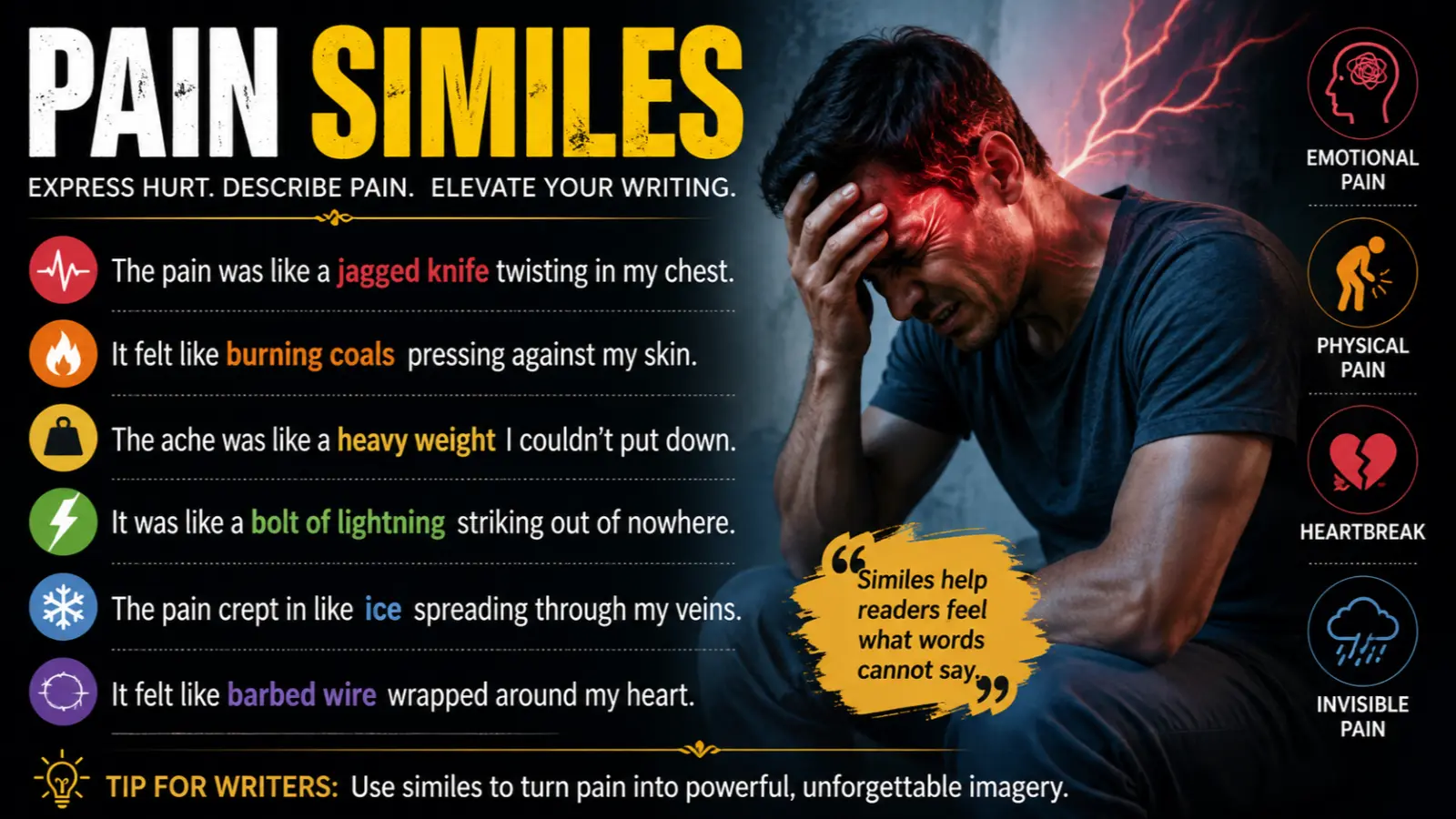
Pain Similes is difficult to describe because it is often invisible. A writer cannot simply point to pain and show the reader exactly what it feels like. Instead, strong writing gives pain a shape, movement, sound, or image.
That is where pain similes become useful.
A simile compares two different things using words such as like or as. A comparison can turn an abstract feeling into something readers can imagine. For example, instead of saying “Her headache was severe,” a writer might say, “Her headache pulsed like a drum trapped behind her eyes.”
Pain similes can describe physical discomfort, emotional hurt, grief, fear, exhaustion, or the lingering effect of a difficult experience. They appear in fiction, poetry, personal writing, dialogue, and everyday conversation.
This collection focuses on fresh comparisons that writers can adapt rather than simply memorize.
What Is a Simile for Pain?
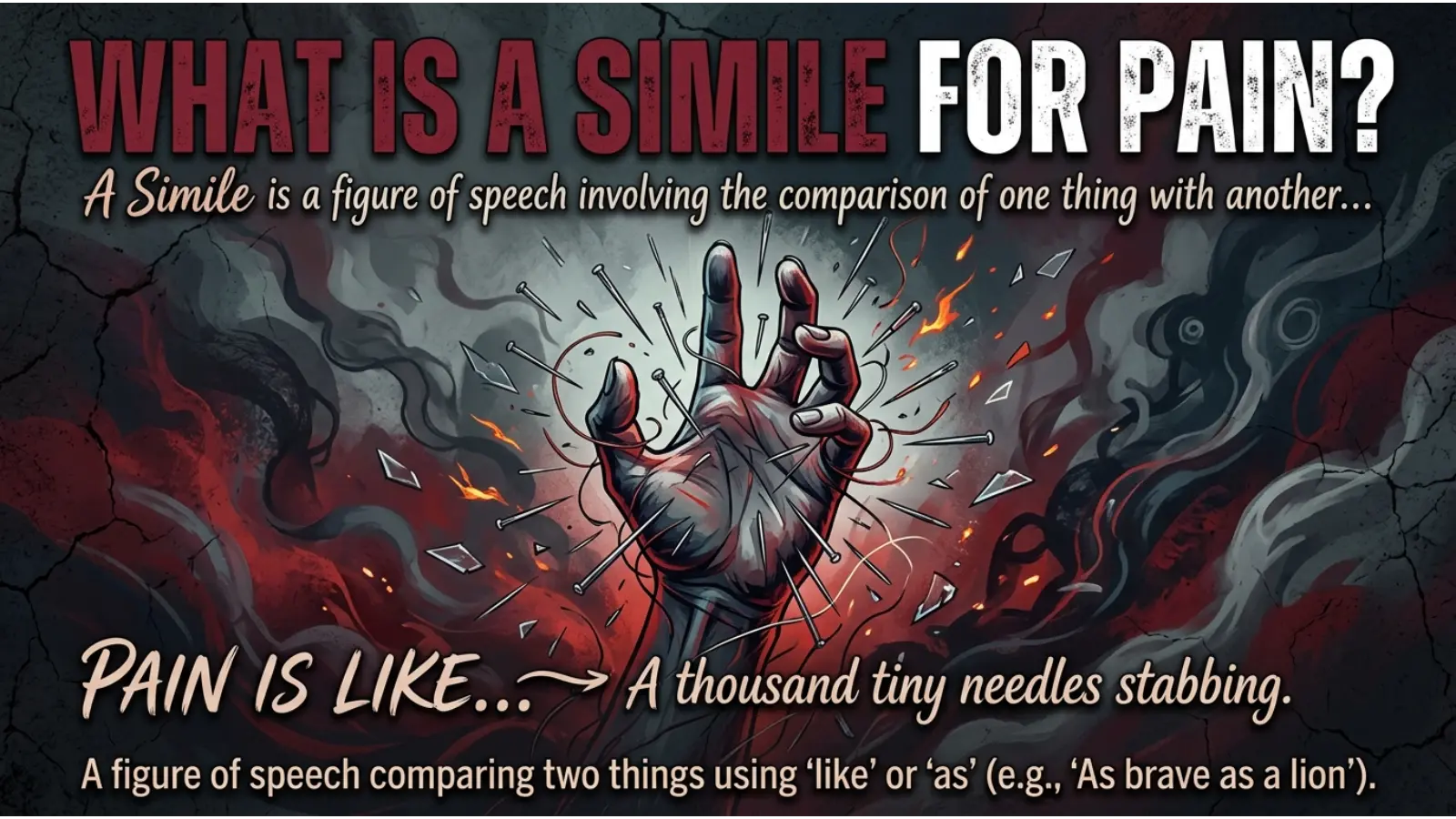
A pain simile compares pain to something familiar so the reader can better imagine its intensity, texture, movement, or emotional effect.
For example:
“The pain spread through his shoulder like ink escaping into water.”
The comparison does more than say that the pain spread. It gives the reader a visual sense of how gradually and widely it moved.
A useful pain simile should answer a question such as:
- What does the pain feel like?
- How quickly does it arrive?
- Does it pulse, stab, burn, tighten, or linger?
- What emotion does it create?
- How does the person react to it?
The strongest comparisons usually reveal something about the character as well as the pain.
30 Original Pain Similes to Strengthen Your Writing
1. The pain moved like ink spreading through wet paper.
Meaning: The discomfort gradually expanded from one place into another.
Example:
The pain moved like ink spreading through wet paper, slowly taking over his entire arm.
Why it works: Ink spreading is visual and gradual, making this useful for pain that grows rather than arrives suddenly.
Best context: Fiction, descriptive prose, medical scenes, or reflective writing.
2. Her headache throbbed like a distant drum that refused to stop.
Meaning: The pain was repetitive and persistent.
Example:
Her headache throbbed like a distant drum that refused to stop.
The sound of the imaginary drum gives the pain a rhythm. This works especially well for headaches or other recurring discomfort.
3. The ache sat in his chest like a stone left in a pocket.
Meaning: The pain felt heavy and constantly present.
Example:
Even after the argument ended, the ache sat in his chest like a stone left in a pocket.
Writing tip: This comparison can work for both physical and emotional pain because the image suggests weight without explaining the feeling directly.
4. Her muscles felt like ropes pulled too tight.
Meaning: Her body felt tense, strained, or exhausted.
Example:
After the long climb, her muscles felt like ropes pulled too tight.
This is especially effective when describing fatigue because the comparison suggests both tension and physical limitation.
5. The sting flashed through his hand like a spark jumping from a wire.
Meaning: The pain arrived suddenly and sharply.
Example:
The sting flashed through his hand like a spark jumping from a wire.
Best context: Sudden, brief physical pain.
6. Grief clung to her like rainwater refusing to dry.
Meaning: Emotional pain remained long after the original event.
Example:
Grief clung to her like rainwater refusing to dry, even on the brightest mornings.
This comparison turns grief into something persistent without relying on a familiar cliché.
7. His injured knee complained like an old door in the wind.
Meaning: The knee produced recurring discomfort, especially during movement.
Example:
His injured knee complained like an old door in the wind whenever he climbed the stairs.
Writing purpose: The personification of the knee makes the description more conversational and memorable.
8. The burn spread across her skin like sunlight trapped under glass.
Meaning: The sensation felt hot, broad, and difficult to escape.
Example:
The burn spread across her skin like sunlight trapped under glass.
The image combines heat with confinement, making it useful when ordinary words such as hot or painful feel too weak.
9. His ribs ached like bruised branches after a storm.
Meaning: The pain felt sore and battered.
Example:
His ribs ached like bruised branches after a storm whenever he moved.
Best context: Descriptive fiction where the surrounding scene already involves nature.
10. The sadness pressed against her like a door that would not open.
Meaning: Emotional pain created a feeling of restriction or helplessness.
Example:
The sadness pressed against her like a door that would not open.
This is a strong choice when the character feels emotionally trapped.
11. The cramp tightened like a knot pulled by an invisible hand.
Meaning: The pain felt increasingly constricted.
Example:
The cramp tightened like a knot pulled by an invisible hand.
The invisible hand adds mystery while emphasizing the lack of control.
12. His loneliness felt like an empty chair under a bright light.
Meaning: The emotional pain was noticeable despite being surrounded by normal life.
Example:
His loneliness felt like an empty chair under a bright light in the middle of the crowded room.
Writing tip: Notice how the setting can make an emotional simile stronger. Surrounding the character with people can intensify loneliness.
13. The ache returned like a tide that knew the way home.
Meaning: The discomfort repeatedly came back.
Example:
Every evening, the ache returned like a tide that knew the way home.
This works particularly well when describing recurring pain.
14. Her throat felt raw like a road scraped by winter.
Meaning: Her throat felt irritated and rough.
Example:
After hours of speaking, her throat felt raw like a road scraped by winter.
The rough road creates a tactile image that readers can easily understand.
15. The emotional wound opened like a letter she had never wanted to read.
Meaning: An old painful memory returned unexpectedly.
Example:
His question made the emotional wound open like a letter she had never wanted to read.
Best context: Character development, grief, memory, and reflective storytelling.
16. The pain flickered like a faulty light.
Meaning: The discomfort appeared and disappeared unpredictably.
Example:
The pain flickered like a faulty light, present one moment and gone the next.
This is useful when consistency is not the defining feature of the pain.
17. Her back felt as stiff as a board forgotten in the cold.
Meaning: Her back felt rigid and difficult to move.
Example:
After sitting too long, her back felt as stiff as a board forgotten in the cold.
The comparison gives stiffness a physical quality without exaggerating it.
18. His heartbreak sounded like a song missing its final note.
Meaning: Emotional pain created a sense of incompleteness.
Example:
After she left, his heartbreak sounded like a song missing its final note.
Why it works: The missing note suggests something unfinished rather than simply saying that the character was sad.
19. The sharp pain struck like a pebble thrown against glass.
Meaning: The pain was sudden and startling.
Example:
A sharp pain struck like a pebble thrown against glass.
This comparison emphasizes sudden impact rather than duration.
20. Her exhaustion hung over her like a heavy curtain.
Meaning: Tiredness made everything feel slower and harder.
Example:
Exhaustion hung over her like a heavy curtain as she tried to finish the last page.
Best context: Stories about demanding days, emotional fatigue, or difficult journeys.
21. The memory hurt like a song played in the wrong room.
Meaning: A memory felt emotionally painful and out of place.
Example:
The memory hurt like a song played in the wrong room, familiar but impossible to enjoy.
This is particularly useful for subtle emotional pain.
22. His stomach twisted like a towel wrung by impatient hands.
Meaning: His stomach felt tightly knotted.
Example:
His stomach twisted like a towel wrung by impatient hands before the announcement.
The comparison communicates tension through movement rather than simply using the word nervous.
23. The old injury lingered like a shadow at the edge of every step.
Meaning: The injury remained part of his awareness even when it was not constantly painful.
Example:
The old injury lingered like a shadow at the edge of every step.
Writing purpose: This works well when pain affects a character psychologically as well as physically.
24. Her sadness spread like frost across a window.
Meaning: Emotional pain gradually covered more of her thoughts.
Example:
Sadness spread like frost across a window until even good memories looked distant.
This comparison is especially effective for gradual emotional change.
25. The headache arrived like a train that had forgotten its schedule.
Meaning: The headache appeared unexpectedly.
Example:
The headache arrived like a train that had forgotten its schedule, sudden and impossible to predict.
The unusual image can add personality to an otherwise ordinary description.
26. His disappointment landed like a package filled with stones.
Meaning: Disappointment felt unexpectedly heavy.
Example:
The rejection landed like a package filled with stones.
Why it works: The reader can imagine the physical weight of an emotional experience.
27. The soreness faded like footprints disappearing under new snow.
Meaning: The pain gradually disappeared.
Example:
By morning, the soreness had faded like footprints disappearing under new snow.
This is a good example of matching the comparison to the direction of change: the pain is not spreading but vanishing.
28. Her fear tightened around her like a belt pulled one notch too far.
Meaning: Fear created a strong sensation of pressure and restriction.
Example:
Fear tightened around her like a belt pulled one notch too far.
Best context: Suspense, anxiety, tense conversations, and internal conflict.
29. The old sadness returned like a familiar road in the dark.
Meaning: Emotional pain felt recognizable even after time had passed.
Example:
The old sadness returned like a familiar road in the dark.
This comparison is quieter than dramatic descriptions, making it useful for literary or reflective writing.
30. The pain faded like thunder traveling beyond the hills.
Meaning: The discomfort gradually became quieter and more distant.
Example:
She waited until the pain faded like thunder traveling beyond the hills.
Writing tip: Notice the contrast with the earlier similes about spreading pain. Good imagery should reflect the direction and behavior of the sensation.
How to Choose the Right Pain Simile
Not every comparison works for every kind of pain. Before choosing an image, decide what the pain is actually doing.
If it is sharp and sudden, use an image involving impact, sparks, cracks, or quick movement.
If it is persistent, consider images that remain, repeat, or slowly occupy space.
it is heavy, choose something associated with weight or pressure.
If it is emotional, look for an image that captures the character’s inner experience rather than simply naming the emotion.
For example, compare these two sentences:
She was very sad.
and:
Sadness spread through her thoughts like frost across a window.
The second sentence gives the reader something to visualize. More importantly, it suggests that sadness is gradually changing how the character sees everything.
How Writers Make Pain Imagery More Vivid
Focus on the behavior of the pain
Instead of asking, “What does pain look like?” ask:
What does this particular pain do?
Does it:
- pulse?
- spread?
- tighten?
- flicker?
- return?
- disappear?
- press?
- linger?
- strike?
- crawl?
Once you identify the action, finding a comparison becomes much easier.
Use sensory details
Pain can be described through more than touch.
A comparison might involve:
- Sound: a drum, alarm, crack, or distant engine
- Sight: ink, frost, shadows, sparks, or moving water
- Weight: stones, luggage, or pressure
- Movement: waves, ropes, smoke, or falling objects
- Temperature: sunlight, ice, steam, or warm metal
Using different senses prevents your descriptions from sounding repetitive.
Match the image to the emotion
Physical pain and emotional pain often overlap, but they do not have to sound the same.
A headache might be compared with a rhythmic sound because rhythm captures throbbing.
Grief might be compared with something that lingers because grief often changes the character’s perception over time.
Fear might be compared with something tightening because fear can create a sense of restriction.
The comparison should support the emotion instead of merely decorating the sentence.
How to Avoid Cliché Pain Similes
Some comparisons have become so common that they may no longer create a strong image for readers.
Expressions involving knives, unbearable torture, or exaggerated physical destruction can easily sound predictable when used without a fresh context.
That does not mean familiar imagery is always wrong. A common comparison can still work when the surrounding writing gives it a specific purpose.
A useful test is:
Could another writer have written this exact comparison without knowing anything about my character or scene?
If the answer is yes, look for a more personal image.
For example, a character who works with music might naturally describe heartbreak through an unfinished melody. A character who spends time outdoors might understand emotional pain through changing weather.
The best imagery often grows from the character’s world.
Pain Similes vs. Metaphors
A simile makes a comparison using like or as:
The pain spread like ink in water.
A metaphor makes the comparison directly:
The pain was ink in water.
Both can create vivid imagery, but they produce slightly different effects.
Similes often feel more explanatory because they invite readers to connect two separate images. Metaphors can feel more immediate and forceful.
When writing a scene, try both forms and see which better matches the voice.
Other Literary Devices That Work With Pain Imagery
Imagery
Imagery gives readers sensory details. A pain simile is often most effective when surrounded by other sensory information.
The room smelled of rain, her fingers trembled, and the ache in her shoulder spread like ink through wet paper.
The simile becomes stronger because the scene gives the reader additional details.
Personification
Personification gives human qualities to something nonhuman.
The old injury complained whenever he climbed the stairs.
The injury cannot literally complain, but the personification makes the sentence expressive.
Hyperbole
Hyperbole deliberately exaggerates something for emphasis.
The headache felt large enough to fill the whole room.
This can work in humorous, dramatic, or highly emotional writing, but it should fit the tone.
Symbolism
A recurring image can become symbolic.
If a character repeatedly compares grief with frost, frost might eventually represent emotional distance throughout the story.
This gives an individual simile a larger role in the narrative.
How to Create Your Own Pain Similes
You do not need a huge vocabulary to create strong comparisons. You need careful observation.
Step 1: Identify the sensation
Write down what the pain is doing.
For example:
“It keeps coming back.”
Step 2: Find something that behaves similarly
Think of things that repeatedly return:
- waves
- echoes
- footsteps
- shadows
- rain
- music
Step 3: Choose the least obvious useful image
Instead of:
The pain returned like a wave.
Try something more specific:
The pain returned like a tide that knew the way home.
Step 4: Connect it to the character
Ask what objects, places, hobbies, memories, or experiences matter to the character.
A musician may compare pain with an unresolved chord. A gardener might compare it with a thorn hidden beneath leaves. A traveler might compare it with a road that keeps appearing on the map.
Step 5: Read the sentence aloud
If the comparison sounds unnatural when spoken, revise it.
A good simile should feel like part of the sentence rather than an ornament attached to it.
A Simple Exercise for Better Pain Descriptions
Take this plain sentence:
My character’s shoulder hurt.
Now write three versions.
Version 1 — Visual
My character’s shoulder hurt like ink spreading beneath a blotter.
2 — Movement
A dull ache traveled across his shoulder like a slow-moving tide.
Version 3 — Character-based
His shoulder complained like the rusty gate he had spent years repairing.
The third version demonstrates an important principle: specific imagery can reveal character at the same time it describes sensation.
Common Mistakes When Writing Pain Similes
Using too many similes
A paragraph filled with comparisons can become distracting. One precise image can be more powerful than five competing ones.
Mixing unrelated images
Avoid jumping from one sensory world to another without purpose.
For example, comparing pain to a wave, a broken clock, a burning road, and a bird in the same sentence creates confusion rather than stronger imagery.
Choosing an image only because it sounds poetic
A beautiful comparison is not automatically a useful one.
Ask whether the image accurately represents the sensation.
Explaining the simile too much
Once the image works, trust the reader.
Instead of:
The pain spread like ink in water, meaning that it moved slowly and gradually across his arm.
Simply let the image do its job within the story.
Forgetting the character’s voice
A teenager, scientist, poet, athlete, and mechanic may describe the same sensation differently.
Your character’s vocabulary should influence the comparisons they naturally make.
How Pain Similes Can Improve Storytelling
A strong pain simile can do more than describe a physical sensation.
It can reveal fear:
Fear tightened around her like a belt pulled one notch too far.
It can reveal grief:
Grief clung to her like rainwater refusing to dry.
A can reveal exhaustion:
Exhaustion hung over him like a heavy curtain.
It can reveal personality:
His knee complained like the old door he refused to replace.
This is why effective figurative language matters. It can carry description, emotion, atmosphere, and characterization at the same time.
Frequently Asked Questions About Pain Similes
What is a good simile for pain?
A good pain simile should match the type of pain. For example, “The pain flashed through her hand like a spark jumping from a wire” works for sudden pain, while “The ache returned like a tide that knew the way home” suits recurring discomfort.
What is a simile for emotional pain?
Emotional pain can be compared with images of weight, distance, weather, silence, or confinement. For example, “The sadness pressed against her like a door that would not open.”
How do you describe pain creatively in writing?
Focus on what the pain does rather than simply calling it severe. Describe whether it pulses, spreads, tightens, burns, returns, or fades, then compare that behavior with a familiar image.
Can pain similes be used in poetry?
Yes. Similes are especially useful in poetry because they compress a complex emotion or sensation into a memorable image. The key is choosing imagery that fits the poem’s mood and voice.
Are pain similes only for physical pain?
No. They can describe physical discomfort as well as grief, heartbreak, fear, loneliness, disappointment, exhaustion, and other emotional experiences.
How can I make a pain simile less cliché?
Start with the character rather than with a list of familiar comparisons. Think about the character’s environment, memories, work, hobbies, and experiences, then find an image that naturally belongs to that world.
What is the difference between a pain simile and a pain metaphor?
A simile uses a comparison such as “the pain spread like ink,” while a metaphor makes the comparison directly, such as “the pain was ink spreading through him.”
Conclusion
The best pain similes do not merely make suffering sound dramatic. They help readers understand what a character experiences in a way that ordinary description cannot always achieve. Start with the sensation. Notice its movement, intensity, rhythm, temperature, or emotional weight. Then find an image that behaves in a similar way. The more closely that image belongs to the character and scene, the more memorable the writing becomes. Try replacing one plain sentence about pain with a carefully chosen comparison. Then experiment again. With practice, your similes will become less predictable, more precise, and much more personal.

I am Helena Frost, a writer captivated by the beauty of language and the art of comparison. Through my words, I explore the world by turning ordinary moments into vivid similes and reflections. I enjoy crafting phrases that spark imagination, evoke emotion, and linger in the mind. My writing celebrates the subtle connections between people, nature, and the stories we live. For me, every sentence is an opportunity to reveal the extraordinary in the everyday.