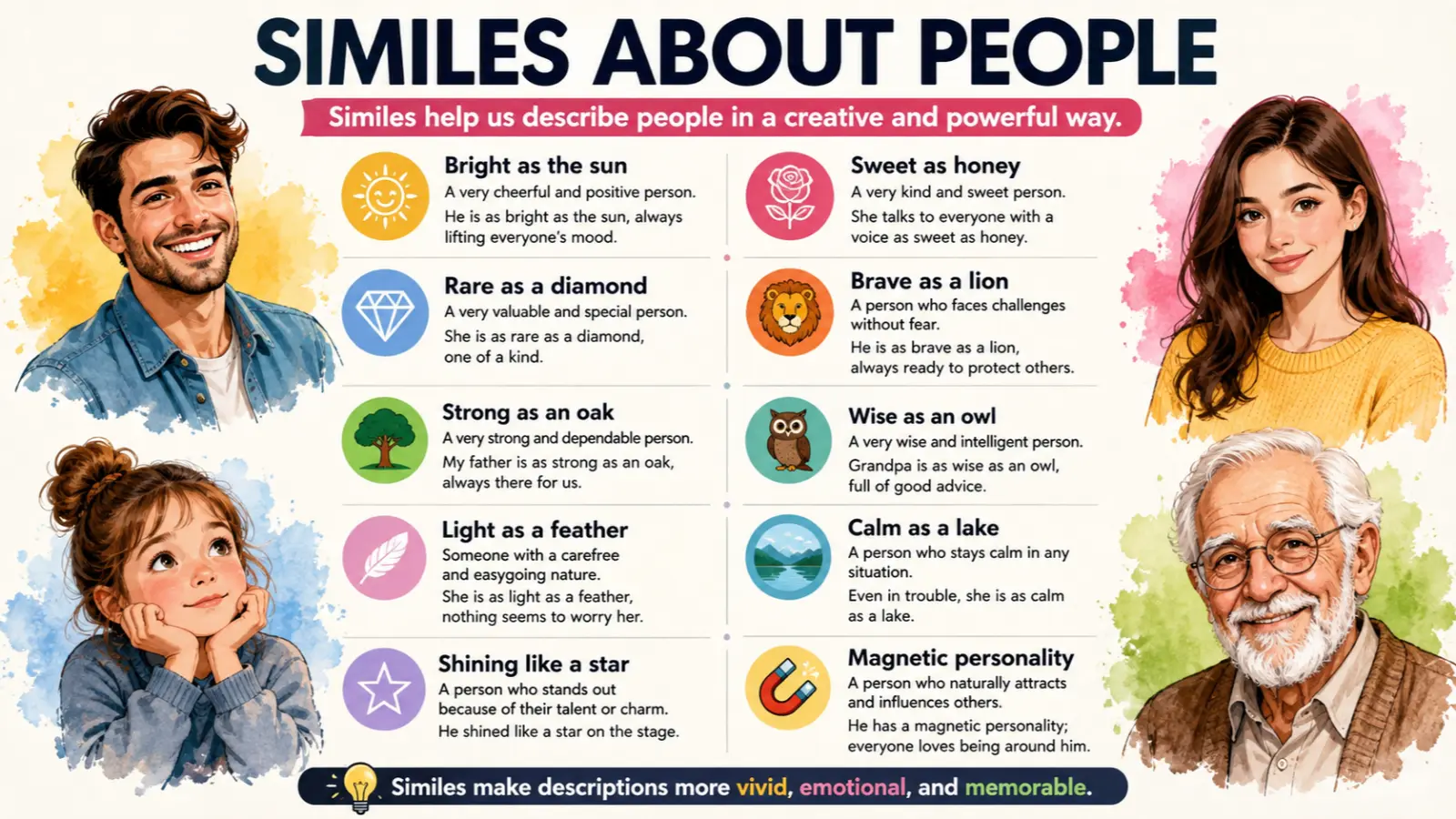
Similes About People are complicated. Someone can be confident in one moment and uncertain in the next, warm with a friend but distant with a stranger. That complexity can be difficult to capture with plain description.
That is where similes about people become useful. A Similes About People compares one thing with another using words such as like or as, helping readers picture a person’s appearance, personality, emotions, voice, movements, or behavior.
Instead of saying, “She was nervous,” a writer might say, “She was as restless as a bird trapped inside a quiet room.” The comparison gives the reader something concrete to imagine.
Similes About People appear in novels, poetry, speeches, songs, conversations, essays, and everyday storytelling. In this guide, you’ll find original comparisons along with explanations of why they work and how to create your own.
What Are Similes About People?
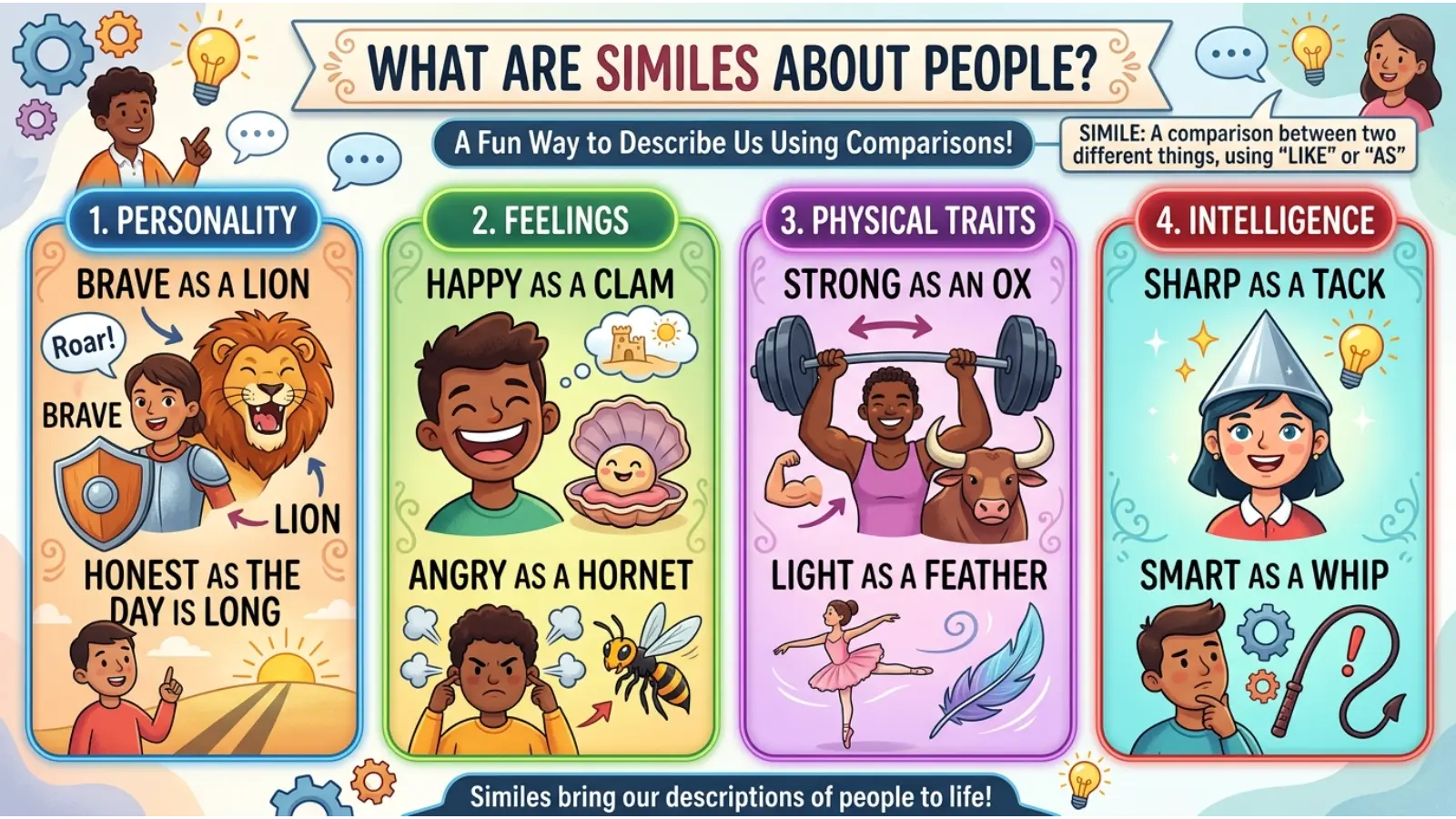
Similes about people compare a person or a human quality to something else to make a description more vivid.
For example:
He stood as still as a lighthouse in a storm.
The person is not literally a lighthouse. The comparison emphasizes his stillness and creates a strong visual image.
A good simile does more than decorate a sentence. It can reveal personality, establish mood, show emotion, or help readers understand how a character behaves.
30 Original Similes About People
1. She was as bright as a window catching the first morning sun.
Meaning: She had an uplifting, cheerful presence.
This simile connects her personality with natural light. It works especially well when introducing an optimistic character.
Example:
“She walked into the classroom as bright as a window catching the first morning sun.”
Writing purpose: Use it to create an immediate feeling of warmth around a character.
2. He moved like a shadow slipping across an empty hallway.
Meaning: He moved quietly and almost unnoticed.
The comparison creates mystery without simply telling readers that the person was quiet.
Example:
“He moved like a shadow slipping across an empty hallway, careful not to disturb anyone.”
Best context: Suspense, mystery, or quiet scenes.
3. Her laughter burst out like popcorn over a hot pan.
Meaning: Her laughter was sudden, energetic, and difficult to contain.
The unexpected comparison gives the character a playful quality.
Writing tip: Funny or surprising comparisons can reveal personality more effectively than generic adjectives such as funny or energetic.
4. He was as patient as a gardener waiting for a seed to wake.
Meaning: He was willing to wait without becoming frustrated.
The gardener image suggests patience with purpose rather than passive waiting.
Example:
“Grandpa was as patient as a gardener waiting for a seed to wake.”
Emotional effect: Calmness, trust, and quiet confidence.
5. Her words landed like pebbles dropped into still water.
Meaning: Her words created small but noticeable emotional effects.
This works particularly well when a character says something that seems simple but stays in another person’s mind.
Best context: Reflective fiction and emotional scenes.
6. He was as stubborn as a locked door with no key.
Meaning: He refused to change his mind or give in.
Unlike a basic statement such as “He was stubborn,” the comparison makes his resistance visual.
Example:
“He was as stubborn as a locked door with no key.”
Writing tip: Match the comparison to the specific trait. A strong image should explain how the trait feels.
7. She listened like a detective collecting clues.
Meaning: She paid extremely close attention.
This simile gives the character an alert and curious quality.
Example:
“She listened like a detective collecting clues, noticing every pause in his story.”
Best context: Dialogue, mystery, and character development.
8. His smile appeared like a lamp turning on in a dark room.
Meaning: His smile suddenly brought warmth or relief.
This comparison works because the image has an emotional transformation built into it.
Writing purpose: Show how one person’s presence changes the mood of a scene.
9. She was as nervous as a kite tugging against its string.
Meaning: She felt restless, tense, and unable to settle.
The movement of the kite gives the emotion physical energy.
Example:
“Before the audition, she was as nervous as a kite tugging against its string.”
10. He spoke like a train gathering speed.
Meaning: His speech became increasingly fast and energetic.
The comparison is especially useful for enthusiastic or excited characters.
Writing tip: Similes can describe voices and speech patterns, not just physical appearance.
11. Her kindness was like a blanket left beside a cold doorway.
Meaning: Her kindness offered comfort when it was needed.
The image suggests generosity without requiring a dramatic description.
Best context: Friendship, family stories, and emotional writing.
12. He stared at the problem like a mechanic examining a strange engine.
Meaning: He studied the problem carefully and practically.
This comparison characterizes someone through their approach to difficulty.
Writing purpose: Use similes to reveal a person’s habits of thinking.
13. She entered the room like a breeze through an open window.
Meaning: Her arrival felt refreshing, natural, and welcome.
This is useful for characters whose presence changes the atmosphere positively.
14. He was as quiet as snow settling on a rooftop.
Meaning: He made almost no sound.
The comparison creates a peaceful image rather than simply stating that he was silent.
Best context: Calm scenes, nighttime settings, and reflective writing.
15. Her determination burned like a small fire refusing the rain.
Meaning: She continued trying despite difficulties.
The image emphasizes persistence rather than effortless success.
Example:
“Her determination burned like a small fire refusing the rain.”
Writing tip: For emotional traits, choose an image that shows resistance, movement, growth, or change.
16. He looked at the crowd like a sailor seeing land after a long voyage.
Meaning: He felt relief, excitement, or hope.
The comparison gives emotional history to a simple glance.
Best context: Reunion scenes, competitions, journeys, and moments of achievement.
17. She was as curious as a cat studying a box it had never seen before.
Meaning: She wanted to discover everything about something unfamiliar.
The familiar animal image makes the character’s curiosity easy to picture.
Writing purpose: Animal comparisons can quickly communicate recognizable behavior.
18. His confidence stood like a bridge over rushing water.
Meaning: His confidence remained steady despite pressure.
The bridge suggests strength and stability while the water represents difficulty.
Example:
“His confidence stood like a bridge over rushing water.”
19. She changed moods like clouds crossing a windy sky.
Meaning: Her emotions shifted quickly.
The comparison works because clouds naturally suggest changing conditions.
Best context: Character descriptions where emotional unpredictability matters.
20. He was as generous as a tree offering shade to every traveler.
Meaning: He willingly helped people without demanding anything in return.
The tree provides a concrete image of generosity and shelter.
Writing tip: When writing about positive traits, natural objects can create gentle and memorable comparisons.
21. Her questions came like rain on a tin roof.
Meaning: She asked many questions quickly and continuously.
The sound pattern creates a sense of repetition and energy.
Example:
“Her questions came like rain on a tin roof.”
Best context: Curious children, interviews, lively conversations, or comic scenes.
22. He stood like a chess piece waiting for the next move.
Meaning: He was alert, controlled, and waiting to see what would happen.
This comparison can create tension because chess implies strategy.
23. She carried disappointment like a stone hidden inside her pocket.
Meaning: She kept a painful feeling with her without openly discussing it.
The hidden stone suggests emotional weight that others cannot see.
Emotional effect: Quiet sadness and restraint.
24. His jokes flew like paper airplanes across the room.
Meaning: His jokes moved easily from person to person and created playful energy.
This is a good choice for humorous scenes.
Writing purpose: It shows not only that someone jokes but also how those jokes affect the surrounding people.
25. She was as focused as a photographer waiting for the perfect frame.
Meaning: She concentrated carefully on one goal.
The photographer comparison suggests patience, observation, and precision.
Best context: Creative work, competitions, exams, sports, and difficult tasks.
26. He apologized like a traveler finally finding the right road.
Meaning: His apology brought a sense of relief or correction.
The comparison gives the action emotional direction.
Writing tip: A useful simile can describe an abstract action such as apologizing, forgiving, deciding, or remembering.
27. Her excitement sparkled like sunlight on moving water.
Meaning: Her happiness was lively and constantly visible.
The moving-water image makes the emotion feel active rather than static.
Best context: Celebrations, reunions, good news, and joyful character moments.
28. He guarded his secrets like a keeper protecting an old map.
Meaning: He was extremely careful about revealing personal information.
The old map suggests something valuable, private, and difficult to replace.
Best context: Mystery stories and secretive characters.
29. She recovered from mistakes like grass rising after heavy rain.
Meaning: She was resilient and able to continue after setbacks.
The comparison focuses on recovery rather than failure.
Writing purpose: Use nature to show growth, endurance, and renewal.
30. He greeted strangers like doors opening into unfamiliar rooms.
Meaning: He approached new people with curiosity and openness.
This unusual comparison can characterize someone who welcomes new experiences.
Best context: Travel writing, introductions, coming-of-age stories, and optimistic characters.
How Similes Make Character Descriptions Stronger
A weak character description tells readers what a person is.
A stronger description gives readers something to experience.
Compare:
Plain:
“Marcus was very confident.”
With a simile:
“Marcus walked into the meeting like someone who had already found the answer.”
The second version does not simply label Marcus. It suggests how his confidence appears through behavior.
This is one of the most important principles of creative writing: a comparison should reveal something rather than merely sound pretty.
Use Similes to Show Personality
Personality traits can be difficult to make visible because qualities such as kindness, arrogance, patience, jealousy, and confidence are abstract.
A carefully chosen comparison gives those qualities a physical form.
For example:
- Patient: as steady as a clock ticking through a quiet night
- Curious: like a child opening a box with no label
- Arrogant: like a king inspecting a room built for someone else
- Generous: like a window giving sunlight to every corner
- Cautious: like a cat testing an unfamiliar floor
- Determined: like a river searching for a way around a stone
Notice that each comparison does more than provide decoration. It suggests behavior.
Similes for Happiness and Positive Emotions
Happiness becomes more interesting when you show its texture.
Instead of repeatedly writing happy, consider whether the emotion feels peaceful, energetic, surprising, relieved, playful, or overwhelming.
For example:
“Her happiness spread through the room like warm light under a doorway.”
This feels different from:
“Her happiness was huge.”
The first sentence creates an image and gives the emotion direction.
When writing about happiness, think about movement, light, sound, warmth, and expansion. These qualities can help you develop comparisons that feel fresh.
Similes for Friendship
Friendship often involves trust, comfort, loyalty, and familiarity.
A useful comparison can capture one specific part of that relationship.
“Their friendship was like a well-worn path through a familiar forest.”
The image suggests that the relationship has been used and trusted over time.
Another possibility:
“He was the kind of friend who appeared like a porch light when the road home became dark.”
This emphasizes support rather than simply saying that he was a good friend.
A Writing Lesson From Friendship Similes
Avoid making every friendship comparison about being “close.” Ask what the relationship actually provides:
- comfort
- honesty
- protection
- laughter
- encouragement
- familiarity
- reliability
The answer will point you toward a stronger image.
Similes for Anger
Anger can be loud, controlled, sudden, slow-burning, or hidden.
That means one generic comparison rarely fits every angry character.
Consider:
“His anger rose like a storm building beyond the hills.”
This suggests anger that is developing.
Compare that with:
“Her anger snapped like a dry branch beneath a heavy boot.”
That suggests suddenness.
The best comparison depends on the type of emotion, not simply its name.
How to Create Better Similes About People
Start With the Trait
Choose one specific quality.
Instead of:
“She was a good person.”
Try:
“She was generous.”
Then make the trait more precise:
“She gave people what they needed before they had to ask.”
Now you have a clearer idea of what the simile needs to communicate.
Choose an Image That Behaves the Same Way
This is where many weak similes fail.
If a character is patient, choose something that behaves patiently.
someone is unpredictable, choose something that changes unpredictably.
If someone is protective, choose something that provides protection.
The relationship between the two sides should make sense.
Add a Specific Detail
Compare:
“He was like a lion.”
with:
“He faced the criticism like a lion protecting its young.”
The second image has a clearer situation and emotional purpose.
Specificity usually creates stronger imagery.
How Professional Writers Avoid Cliché Similes
Some comparisons have been used so often that readers barely notice them.
Examples include familiar phrases such as:
- as busy as a bee
- as cold as ice
- as brave as a lion
- as quiet as a mouse
These expressions are not grammatically wrong. They can even be useful when simple language is appropriate. But if your goal is memorable creative writing, experiment with less predictable images.
Instead of:
“She was as busy as a bee.”
Try:
“She moved through the kitchen like a conductor trying to keep an entire orchestra on schedule.”
The new comparison tells us something about her energy and organization.
The Difference Between a Strong and Weak Simile
A strong simile usually has a clear connection between the person and the image.
Weak:
“He was like a mountain.”
Why?
The reader has to guess what the mountain represents.
Stronger:
“He was as steady as a mountain while everyone else argued around him.”
Now the intended quality—steadiness—is clear.
Before keeping a simile, ask:
What exactly does this comparison communicate?
If you cannot answer that question, the image probably needs revision.
Simile, Metaphor, and Imagery: What’s the Difference?
These literary devices often overlap, but they are not identical.
Simile
A simile makes a comparison using words such as like or as.
“She moved like a dancer.”
Metaphor
A metaphor makes a direct comparison without using like or as.
“She was a dancer in the crowded hallway.”
Imagery
Imagery uses descriptive language to create sensory or mental pictures.
“Her shoes whispered across the polished floor.”
A sentence can contain imagery without being a simile, while a simile can be one tool for creating imagery.
Personification
Personification gives human qualities to nonhuman things.
“The old house watched the visitors arrive.”
Understanding these differences helps you choose the right literary device instead of adding comparisons simply for decoration.
Common Mistakes Writers Make With Similes
Using Too Many Similes
A paragraph packed with comparisons can become exhausting.
Let important images have space around them.
Mixing Two Images
Avoid combining unrelated comparisons:
“He was like a volcano, as quiet as a sleeping cat but burning like a river.”
The images compete with one another.
Choose the strongest idea and develop it.
Explaining the Simile Too Much
If the image already communicates the meaning, trust the reader.
Instead of:
“She smiled like sunlight, which means she was happy and made everyone feel cheerful.”
Try:
“She smiled like sunlight breaking through the clouds.”
The image can carry the emotion.
Choosing an Image That Does Not Fit
A comparison may sound creative but still be inaccurate.
If you describe a calm person as “like a thunderstorm,” readers may interpret the image as energetic or dangerous unless the surrounding context changes that meaning.
Using a Simile Where a Simple Sentence Is Better
Not every sentence needs figurative language.
Sometimes:
“He whispered.”
is stronger than:
“He whispered like a leaf drifting through a silent forest.”
Good writing depends on judgment. Use a simile when it adds something meaningful.
Creative Exercises for Writing Your Own Similes
Exercise 1: Trait to Image
Choose five personality traits:
- brave
- shy
- generous
- impatient
- curious
For each trait, list three things that behave similarly.
For example:
Impatient → tapping foot, boiling kettle, racing clock
Then turn one into a sentence:
“He was as impatient as a kettle waiting to boil.”
Exercise 2: Describe Someone Without Naming the Emotion
Choose an emotion such as anger, happiness, embarrassment, or fear.
Do not use the emotion’s name.
Instead, describe how the person’s:
- eyes move
- hands behave
- voice sounds
- body changes
- attention shifts
Then create a simile from one of those observations.
Exercise 3: Replace the Cliché
Start with a familiar comparison:
“She was as busy as a bee.”
Now replace the bee with five unusual images.
For example:
“She was like a stage manager five minutes before the curtain rose.”
The goal is not to make the comparison strange for its own sake. The goal is to make it specific.
Exercise 4: Match the Simile to the Character
Imagine two characters:
Character A: Quiet, observant, cautious
Character B: Loud, generous, impulsive
Write one simile for each.
The comparisons should feel different because the characters are different.
This exercise teaches an important lesson: good similes are character-specific.
Frequently Asked Questions
What are some good similes about people?
Good similes about people compare a person’s appearance, personality, behavior, emotions, or voice with a vivid image. For example, “She listened like a detective collecting clues” shows that she is highly attentive.
How do you describe a person using a simile?
First identify one specific trait or behavior. Then choose something that behaves similarly and connect the two with like or as. For example, “He was as patient as a gardener waiting for a seed to grow.”
What is a simile for a kind person?
You could write, “Her kindness was like a blanket left beside a cold doorway.” The image suggests comfort and generosity.
What is a simile for a happy person?
Try focusing on what the person’s happiness does rather than simply calling them happy. For example, “His smile appeared like a lamp turning on in a dark room.”
What is a simile for an angry person?
The best comparison depends on the type of anger. For controlled anger, you might use an image of pressure building. For sudden anger, an image involving something snapping or bursting can work better.
Can similes describe personality?
Absolutely. Similes are especially useful for abstract qualities such as confidence, kindness, stubbornness, curiosity, patience, jealousy, and determination.
How can I make my similes more original?
Avoid automatically choosing familiar comparisons. Start with the exact trait you want to communicate, brainstorm several related images, and select the one that gives readers the clearest and most interesting picture.
Conclusion
The strongest similes about people do not simply make sentences sound more poetic. They help readers see personality, feel emotion, and understand behavior. When creating your own, begin with a precise observation. Ask what the person actually does, how they move, how they speak, or how their presence affects others. Then find an image that behaves in a similar way. A memorable comparison does not need to be complicated. It needs to be clear, specific, and meaningful. Experiment with ordinary objects, nature, animals, places, sounds, movement, and everyday experiences. The more carefully you observe people, the more original your comparisons will become.

I am Helena Frost, a writer captivated by the beauty of language and the art of comparison. Through my words, I explore the world by turning ordinary moments into vivid similes and reflections. I enjoy crafting phrases that spark imagination, evoke emotion, and linger in the mind. My writing celebrates the subtle connections between people, nature, and the stories we live. For me, every sentence is an opportunity to reveal the extraordinary in the everyday.