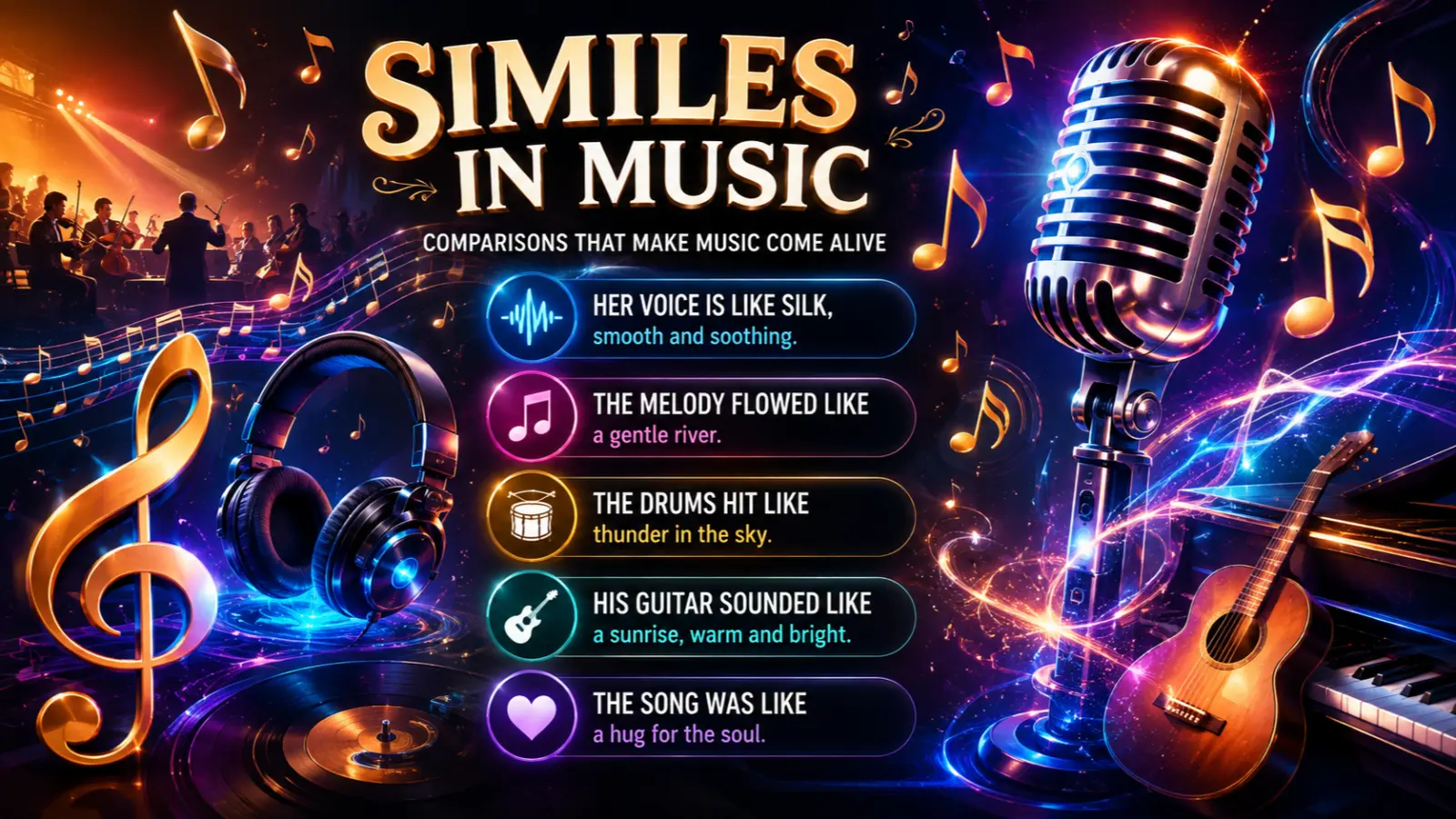
A Similes in Music songwriter can describe a voice, memory, heartbreak, celebration, or quiet night with ordinary words. But a well-chosen simile can turn that description into an image listeners can almost see.
A Similes in Music compares two different things using words such as like or as. In music, similes can make lyrics more emotional, descriptive, and memorable without explaining every feeling directly.
For example, instead of saying “Her voice was beautiful,” a songwriter might write, “Her voice floated like a lantern across the dark.” The comparison gives the listener something to imagine.
This guide explores similes in music, including original examples for lyrics, songwriting, poetry, and creative writing. More importantly, it explains why each type of comparison works and how you can create stronger ones yourself.
What Are Similes in Music?
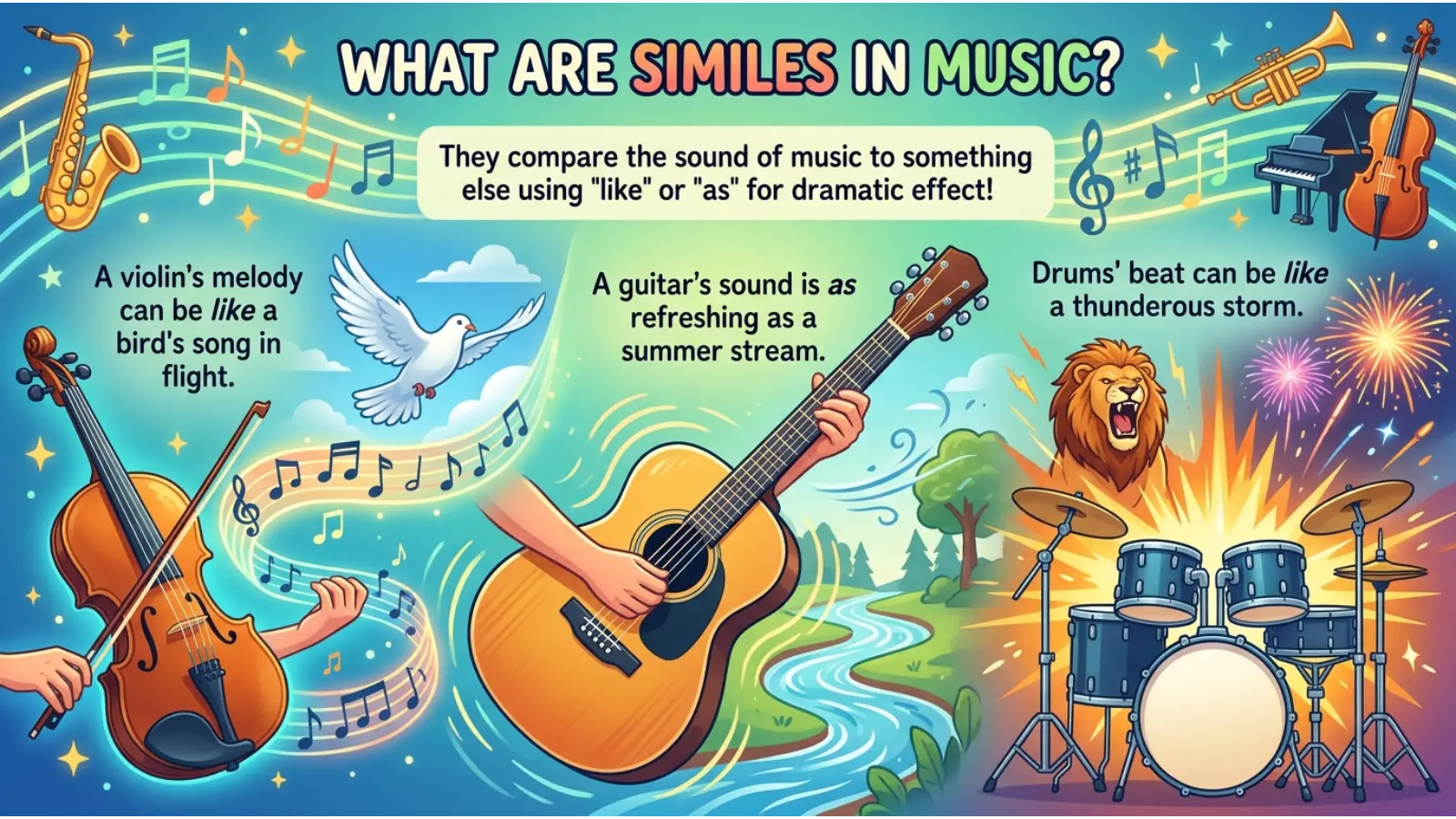
Similes in music are comparisons used in song lyrics or musical writing to connect one idea, feeling, person, sound, or experience with another using like or as.
For example:
His voice shook like a window in the storm.
The Similes in Music voice is not literally a window. The comparison suggests vulnerability, instability, and tension.
Songwriters use similes to turn abstract ideas such as love, sadness, freedom, fear, and hope into concrete images.
Why Do Songwriters Use Similes?
A strong simile can:
- Create a memorable image
- Communicate emotion indirectly
- Give lyrics personality
- Make abstract feelings easier to understand
- Add rhythm and texture to a line
- Help listeners connect their own experiences to the song
The best Similes in Music comparisons do not merely decorate a lyric. They add meaning.
30 Original Similes for Music and Songwriting
The following examples are designed as fresh writing prompts rather than quotations from existing songs.
1. “Her voice rose like a window opening at dawn.”
Meaning: The voice feels refreshing, hopeful, and full of possibility.
Why it works: A window opening suggests light, air, and a new beginning. The comparison works especially well for lyrics about hope or emotional recovery.
Writing tip: Use images associated with opening, light, or movement when you want a vocal performance to feel liberating.
2. “The bass rolled through the room like distant thunder.”
Meaning: The bass feels powerful and physically noticeable.
Why it works: Thunder is something listeners can imagine hearing and feeling. The comparison gives low-frequency sound a physical presence.
Best context: Concert scenes, dance music, energetic performances, or descriptions of powerful instrumentation.
3. “Her laughter sparkled like rain on a rooftop.”
Meaning: Her laughter sounds bright, lively, and naturally rhythmic.
The image also gives the line a gentle musical quality because falling rain creates its own pattern of sound.
Writing tip: When describing laughter, avoid always comparing it with bells or sunshine. Look for unexpected sounds that have a rhythm of their own.
4. “His goodbye hung in the air like smoke after a fire.”
Meaning: The goodbye leaves behind an emotional trace that is difficult to escape.
Emotional effect: Sad, lingering, and unresolved.
This comparison works because smoke remains after the main event has ended. It is useful for lyrics about separation or memories that refuse to disappear.
5. “The melody moved like a river finding the sea.”
Meaning: The melody feels natural, flowing, and inevitable.
Writing purpose: This is useful when describing music that gradually develops toward a satisfying ending.
The comparison also teaches an important songwriting lesson: movement creates imagery. Instead of describing a melody as merely “beautiful,” describe what it does.
6. “Her silence was as sharp as a cracked glass edge.”
Meaning: Her silence feels painful rather than peaceful.
Why it works: Silence is normally associated with quietness, but the comparison gives it an unexpected physical quality.
Best context: Arguments, breakups, tense conversations, or emotionally difficult scenes.
7. “The chorus hit like a door thrown open.”
Meaning: The chorus arrives suddenly with energy and emotional release.
Writing tip: This works particularly well when describing a song structure. Instead of simply saying the chorus is “powerful,” compare its effect to an action.
8. “His rhythm chased the night like headlights on an empty road.”
Meaning: The rhythm feels fast, persistent, and connected to nighttime movement.
Emotional effect: Energetic, restless, cinematic.
This type of simile can help establish an entire scene rather than describing only the music.
9. “Her melody curled around the room like warm steam.”
Meaning: The melody feels soft, surrounding, and intimate.
Best context: Slow songs, acoustic performances, quiet scenes, or reflective writing.
Notice that the comparison focuses on how the music occupies space. This is a useful technique for making sound descriptions more vivid.
10. “The drumbeat marched like boots across a wooden floor.”
Meaning: The rhythm feels steady, deliberate, and commanding.
Why it works: The listener can imagine both the sound and the movement behind it.
Writing tip: For percussion, physical movement can often produce stronger imagery than visual descriptions alone.
11. “His high note stretched like a kite against the wind.”
Meaning: The note feels extended, elevated, and controlled despite resistance.
Best context: Descriptions of powerful vocal performances.
The comparison also creates a sense of height, making the musical moment feel larger.
12. “The piano sounded like footsteps remembering where they had been.”
Meaning: The music feels nostalgic and connected to the past.
Emotional effect: Reflective and bittersweet.
This is a more unusual simile because it gives a sound a sense of memory. Such unexpected associations can make lyrics more distinctive.
13. “Her words fell like autumn leaves between the notes.”
Meaning: The words feel gentle, scattered, and perhaps slightly sad.
Why it works: Autumn leaves naturally suggest change, passing time, and endings.
Best context: Reflective songs, memories, aging, or emotional transitions.
14. “The guitar cried like a train leaving before sunrise.”
Meaning: The guitar sounds lonely and full of departure.
Emotional effect: Melancholic and cinematic.
The comparison connects sound with a specific moment, which gives the lyric more emotional depth.
15. “Their harmonies fit together like two paths meeting in the woods.”
Meaning: Different voices blend naturally after traveling separately.
Writing purpose: Useful for lyrics about friendship, teamwork, family, or romantic connection without directly stating the relationship.
16. “The beat pulsed like a city refusing to sleep.”
Meaning: The rhythm feels constant, energetic, and alive.
Best context: Dance music, nightlife, urban scenes, or songs about ambition.
A good simile can describe not just music but the world surrounding the music.
17. “Her sadness moved like fog beneath the streetlights.”
Meaning: Sadness spreads quietly and makes everything feel less clear.
Emotional effect: Lonely, mysterious, subdued.
This works because fog changes the environment without making a loud entrance.
18. “The final chord faded like footsteps down an empty hallway.”
Meaning: The music disappears gradually, leaving a feeling of distance.
Why it works: The comparison gives an ending a physical direction.
Writing tip: Endings often become more powerful when you compare fading sound to something that is physically moving away.
19. “His voice cracked like ice beneath a careful step.”
Meaning: His voice reveals emotional pressure or vulnerability.
Best context: Confessions, difficult conversations, grief, fear, or emotional lyrics.
The word careful adds another layer: something appears controlled but may break unexpectedly.
20. “The melody glittered like sunlight caught in a glass.”
Meaning: The melody feels bright, delicate, and visually beautiful.
Writing purpose: This can work for joyful or uplifting music.
It also demonstrates how visual imagery can describe something we normally experience through hearing.
21. “The rhythm raced like bicycles downhill.”
Meaning: The rhythm feels quick, exciting, and difficult to stop.
Best context: Upbeat songs, chase scenes, energetic performances, or youthful experiences.
Short comparisons like this can add speed to a lyric without requiring several descriptive sentences.
22. “Her lullaby rested like a blanket over the room.”
Meaning: The song creates comfort, safety, and calm.
Why it works: A blanket is associated with warmth and protection, making the emotional effect immediately understandable.
23. “The saxophone wandered like a traveler without a map.”
Meaning: The instrument sounds free, exploratory, or improvisational.
Best context: Jazz-inspired writing, improvisation, uncertainty, or journeys.
The comparison is especially useful because it describes musical behavior, not just musical sound.
24. “The chorus bloomed like flowers after a week of rain.”
Meaning: The chorus brings emotional release after a difficult buildup.
Emotional effect: Hopeful and rewarding.
This comparison is particularly effective when the verses establish struggle and the chorus provides resolution.
25. “His words landed like stones in still water.”
Meaning: His words create consequences that spread outward.
Why it works: Stones disturb water, producing ripples. The image therefore suggests that a single lyric or statement can have effects beyond the moment in which it is spoken.
26. “The violin trembled like a candle flame near an open door.”
Meaning: The sound feels fragile and vulnerable.
Best context: Sad songs, suspenseful passages, emotional instrumental descriptions, or scenes involving uncertainty.
The image combines movement and vulnerability without directly naming either emotion.
27. “Their voices climbed like birds leaving a winter field.”
Meaning: The voices rise together with a sense of freedom and departure.
Writing purpose: Useful for songs about change, escape, growth, or new beginnings.
28. “The melody circled like a thought that would not let go.”
Meaning: A musical phrase repeats or remains emotionally persistent.
Emotional effect: Obsessive, nostalgic, reflective, or haunting.
This is a strong example of using a simile to describe the listener’s experience rather than the sound itself.
29. “The applause broke over him like a sudden wave.”
Meaning: The applause arrives with force and overwhelms the performer.
Best context: Concert scenes, performances, achievement, or moments of recognition.
30. “The last note disappeared like a star before morning.”
Meaning: The music ends quietly as the surrounding atmosphere changes.
Emotional effect: Peaceful, bittersweet, and reflective.
This works particularly well as an ending image because both the note and the star suggest something beautiful that cannot remain forever.
How to Make Musical Similes More Powerful
A simile becomes memorable when the comparison contributes something beyond decoration.
Instead of asking:
“What sounds beautiful?”
ask:
“What does this sound make the listener feel?”
A soft melody might feel like mist, a secret, a sleeping room, or a hand turning a page. A loud rhythm might feel like machinery, footsteps, thunder, or a crowd moving together.
The strongest choice depends on the emotion you want.
Start With the Emotion
Suppose your lyric is about loneliness.
A weak approach might be:
The music was sad like a sad song.
The comparison tells the reader almost nothing.
A stronger approach might focus on an image associated with isolation:
The melody waited like a porch light on an empty street.
Now the reader receives an emotional setting as well as a description.
Give Sound a Physical Quality
Music cannot literally be touched, but writing can make it feel physical.
Think about whether the sound:
- Drifts
- Presses
- Crawls
- Rises
- Falls
- Trembles
- Circles
- Breaks
- Rushes
- Settles
Then compare that movement to something physical.
This technique helps transform an abstract sound into an image.
How to Avoid Cliché Similes in Lyrics
Some comparisons have been used so frequently that they can feel predictable.
Examples include comparisons involving:
- Hearts and roses
- Eyes and stars
- Love and fire
- Tears and rain
- Silence and death
These images are not automatically wrong. Context can make familiar imagery effective. The problem occurs when the comparison is used because it is convenient rather than because it is precise.
Make the Image Specific
Instead of:
Her eyes were like stars.
Consider the quality you actually mean.
Are they:
- Flickering?
- Distant?
- Bright?
- Cold?
- Difficult to look away from?
- Visible in darkness?
Specificity gives you better material.
For example:
Her eyes flickered like porch lights during a storm.
The image now suggests uncertainty as well as brightness.
Similes for Different Musical Emotions
Happiness
Happy music often benefits from images involving movement, light, openness, and energy.
The melody bounced like sunlight across a kitchen floor.
The comparison feels warm and active without simply saying that the song is cheerful.
Sadness
For sadness, choose images that suggest distance, fading, emptiness, or quiet change.
The final verse drifted like a letter no one answered.
The comparison creates sadness through absence rather than naming the emotion directly.
Love
Love songs do not always need flowers, stars, or hearts. Try images of connection and belonging.
Our voices met like two roads joining after miles apart.
This makes the relationship feel like a journey toward connection.
Anger
Angry music often benefits from images of pressure, impact, heat, or sudden movement.
The drums struck like fists against a locked gate.
The comparison communicates force without simply calling the music angry.
Nostalgia
For nostalgia, use objects and places associated with memory.
The old melody returned like a familiar street after years away.
This creates a feeling of recognition and distance at the same time.
Simile vs. Metaphor in Music
Similes and metaphors both create comparisons, but they do so differently.
A simile usually signals the comparison with like or as:
The rhythm moved like a train.
A metaphor makes the comparison directly:
The rhythm was a train.
The simile leaves a little more distance between the two ideas. That can be useful when you want readers to notice a resemblance without treating the two things as identical.
When Should You Use a Simile?
Use a simile when the comparison itself is important and you want the reader to explore the connection.
Use a metaphor when you want the image to feel more immediate or absolute.
Neither device is automatically better. The choice depends on the voice and rhythm of the lyric.
Simile and Imagery: Why the Combination Matters
Imagery uses descriptive language to create sensory experiences.
A musical simile can strengthen imagery by bringing several senses together.
For example:
The bass rolled through the room like thunder under the floor.
Although the subject is sound, the reader can almost feel the vibration.
This is one reason sensory comparisons are so useful in songwriting: they allow a listener to experience the lyric instead of merely understanding it.
Simile and Personification
Personification gives human qualities to something nonhuman.
For example:
The melody waited like a lonely traveler.
The melody is treated as if it can wait.
Combining personification with simile can make music feel emotionally alive. However, use the technique selectively. Too many human qualities can make lyrics feel crowded.
How to Create Your Own Similes for Songs
You do not need to wait for inspiration. You can build a simile deliberately.
Step 1: Identify the Musical Element
Choose one thing:
- Voice
- Beat
- Melody
- Instrument
- Chorus
- Lyrics
- Silence
- Harmony
- Final note
Step 2: Identify Its Effect
Ask what it does.
Does it:
- Comfort?
- Hurt?
- Excite?
- Frighten?
- Calm?
- Surprise?
- Remind?
- Energize?
Step 3: Find a Concrete Image
Think of something outside music that creates the same effect.
For example:
Effect: comforting
Possible images:
- A blanket
- A lamp
- A quiet room
- Warm tea
- A familiar doorway
Step 4: Connect Them
Now create the comparison:
Her voice rested like a lamp beside the bed.
The image is simple, but it communicates comfort without explaining it.
Step 5: Remove Anything Unnecessary
Compare:
Her beautiful, soft, gentle, comforting voice rested peacefully like a warm lamp beside the quiet bed.
with:
Her voice rested like a lamp beside the bed.
The second version is stronger because the image does more of the work.
A Simple Exercise for Better Musical Similes
Choose one emotion and write five objects associated with it.
For hope, you might choose:
- A sunrise
- An unlocked door
- New leaves
- A repaired bridge
- A window opening
Now describe the same melody five different ways.
The melody rose like a sunrise.
The melody opened like an unlocked door.
The melody returned like new leaves after winter.
You may discover that one comparison feels much more original than the others.
That is the point of the exercise: generate several possibilities before choosing one.
Common Mistakes Writers Make With Musical Similes
Using a Comparison That Says Nothing New
The song was good like something good.
A simile should provide information, not merely repeat the original statement.
Mixing Two Images
Avoid combining unrelated comparisons:
Her voice flowed like thunder and burned like a river.
Thunder does not normally “flow,” and the images compete with each other.
Choose one strong image instead.
Choosing an Image Only Because It Rhymes
A rhyme can be useful, but it should not control the meaning of the lyric.
A weak comparison that rhymes is still weak.
Explaining the Simile Too Much
If you write:
Her voice was like rain, meaning it was soft and calming and peaceful and comforting.
you have taken away much of the reader’s opportunity to interpret the image.
Trust a strong comparison.
Making Every Line Figurative
If every line contains an elaborate simile, the listener may have difficulty knowing which images matter.
Strong lyrics often balance figurative language with simple, direct statements.
Frequently Asked Questions About Similes in Music
What is an example of a simile in music?
An example is: “The melody moved like a river finding the sea.” It compares the movement of a melody to the natural movement of a river using the word like.
Why are similes useful in songwriting?
Similes help songwriters turn abstract emotions and sounds into concrete images. They can make lyrics easier to visualize and give familiar emotions a more distinctive expression.
Can a simile describe music itself?
Yes. A simile can describe a voice, instrument, rhythm, melody, harmony, volume, or the emotional effect of a song.
What makes a good simile in a song?
A good simile creates a clear connection, fits the emotion of the lyric, and adds information that ordinary description would not provide. Specific and unexpected comparisons are often more memorable.
Are similes and metaphors the same?
No. Both create comparisons, but a simile generally uses like or as, while a metaphor makes the comparison directly.
How do I avoid cliché similes in songwriting?
Start with the exact quality you want to communicate, then brainstorm several concrete images. Look beyond familiar comparisons and choose an image that fits your particular story.
Can similes make lyrics more emotional?
Yes. A carefully chosen comparison can suggest an emotion without naming it directly. This gives listeners room to interpret the image through their own experiences.
Conclusion
Similes give music another language: the language of images. A melody can become a river. A voice can become a window opening at dawn. A drumbeat can become footsteps. A final note can become a distant light disappearing into morning. The goal is not to make every lyric poetic. The goal is to find the one comparison that makes a particular moment clearer, stronger, or more memorable. When writing your next song, start with an emotion or sound. Ask what it reminds you of. Then test several comparisons, remove the predictable ones, and keep the image that feels both natural and surprising. The best simile does not simply tell listeners what to feel.

I am Helena Frost, a writer captivated by the beauty of language and the art of comparison. Through my words, I explore the world by turning ordinary moments into vivid similes and reflections. I enjoy crafting phrases that spark imagination, evoke emotion, and linger in the mind. My writing celebrates the subtle connections between people, nature, and the stories we live. For me, every sentence is an opportunity to reveal the extraordinary in the everyday.