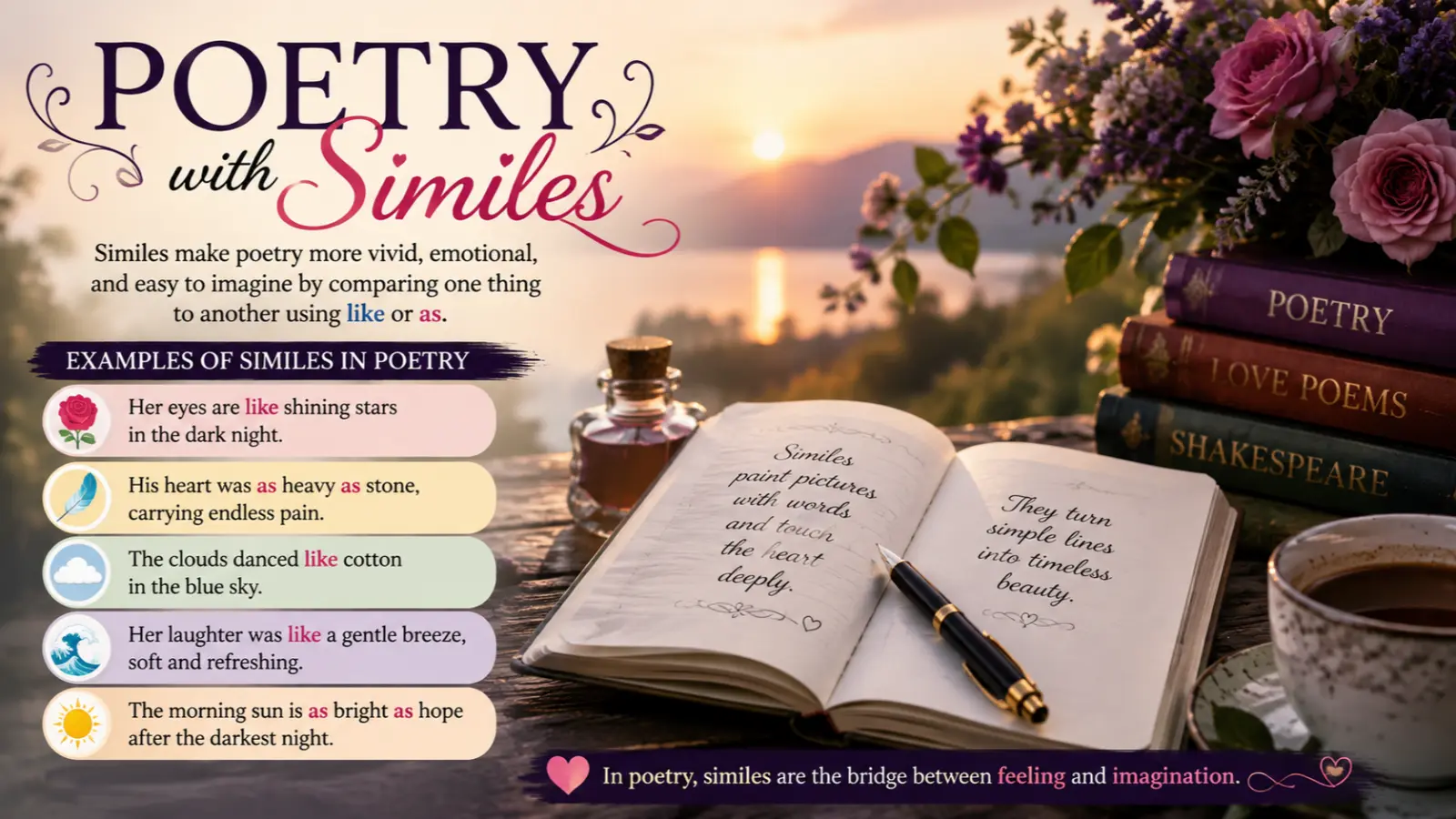
A Poetry With Similes is a comparison that connects two different things using words such as like or as. In Poetry With Similes , can turn an ordinary description into an image readers can see, hear, or feel. The second version gives the reader something concrete to imagine. Poets use Poetry With Similes to express emotions, describe nature, create atmosphere, develop characters, and make abstract ideas easier to understand. This makes poetry with similes especially useful for writers who want their poems to feel more sensory and memorable. The strongest Poetry With Similes do more than decorate a line. They reveal something about the subject and often give the reader an unexpected way to understand it.
Quick Answer: Why Are Similes Used in Poetry?
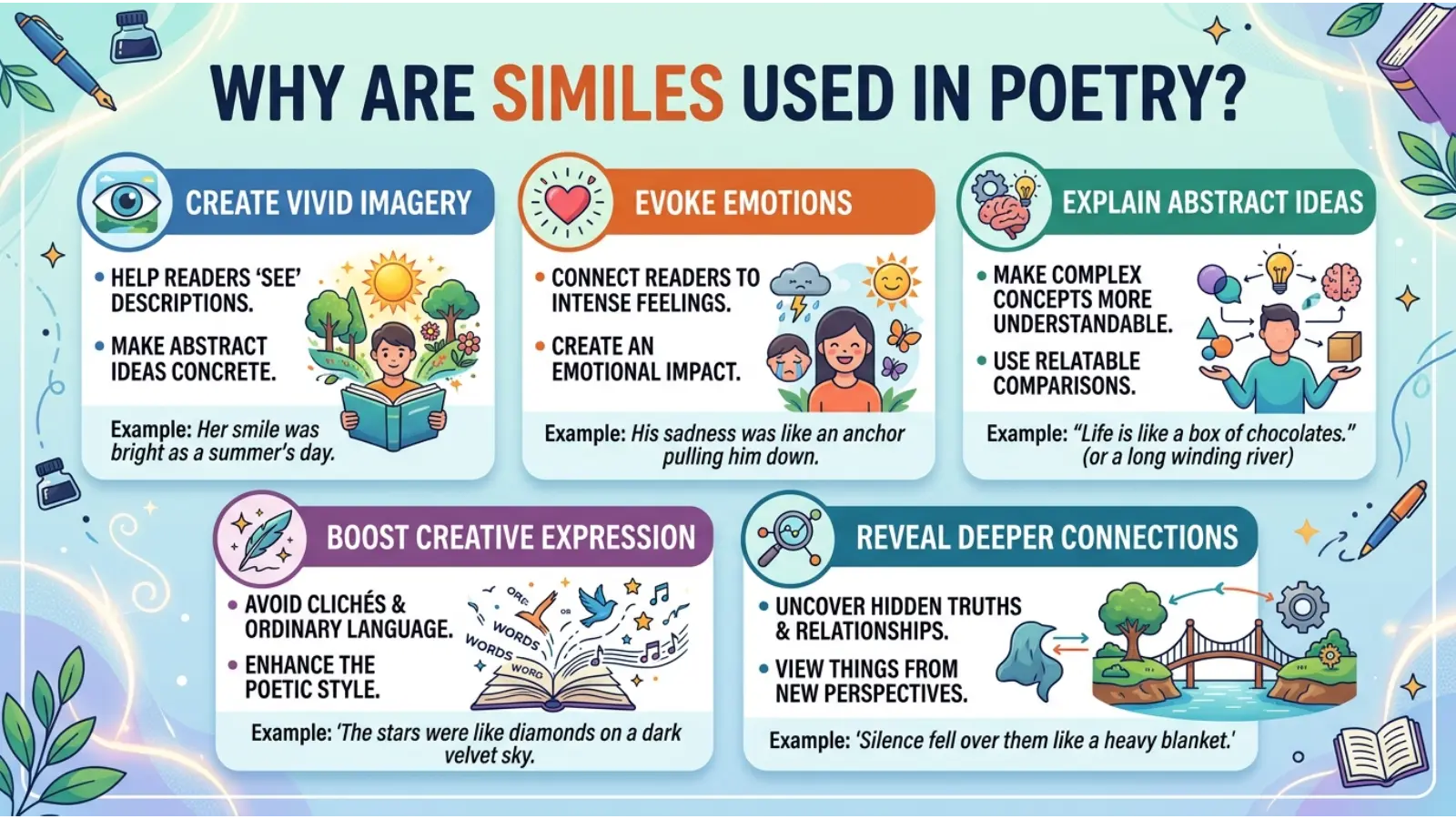
Similes help poets create vivid imagery by comparing one thing with another using like or as. They can make emotions, people, places, and experiences easier to visualize while adding tone, personality, and depth to a poem.
Why Do Similes Work So Well in Poems?
Poetry often has limited space. A Poetry With Similes single comparison can communicate an idea that might otherwise require several sentences.
Consider:
“The empty playground waited like a stage after the audience had gone.”
This comparison does more than describe an empty playground. The Poetry With Similes word stage suggests performance, absence, silence, and memory. The reader begins to imagine what happened there.
A Poetry With Similes useful poetic simile usually has at least one of three qualities:
- Specificity: It gives the reader a clear image.
- Emotional relevance: The comparison supports the feeling of the poem.
- Freshness: It avoids a comparison readers have encountered countless times.
A surprising comparison is not automatically a good one. It should still make sense within the poem.
30 Original Similes for Poetry
1. “The morning opened like a letter no one expected.”
Meaning: Morning arrives with a feeling of surprise or possibility.
Example:
The morning opened like a letter no one expected,
and sunlight spilled across the floor.
Why it works: A letter can contain news, emotion, or mystery. Comparing morning to a letter gives an ordinary sunrise a sense of anticipation.
Best context: Hopeful, reflective, or narrative poetry.
Writing tip: Use comparisons to familiar objects when you want an abstract experience to feel personal.
2. “Her laughter scattered like coins across a wooden table.”
Meaning: Her laughter is lively, bright, and impossible to keep contained.
Example:
Her laughter scattered like coins across a wooden table,
touching every quiet corner of the room.
Emotional effect: Warmth, energy, and friendliness.
Why it works: Coins create a distinct mental image of small objects moving in different directions. The comparison gives laughter movement and texture.
3. “The river carried the afternoon like a blue ribbon.”
Meaning: The river moves smoothly through the landscape.
Example:
The river carried the afternoon like a blue ribbon
beneath the patient hills.
Best context: Nature poetry and peaceful descriptions.
Writing tip: When describing movement, choose an object that naturally suggests the kind of movement you want.
4. “His silence stood between us like an unopened door.”
Meaning: His silence creates distance and prevents communication.
Example:
His silence stood between us like an unopened door,
close enough to touch,
impossible to enter.
Why it works: The door represents separation without directly explaining the emotion.
This is a useful technique in poetry: let the comparison show the emotional problem instead of naming it.
5. “The stars trembled like sparks above the sleeping town.”
Meaning: The stars appear bright and flickering in the night sky.
Example:
The stars trembled like sparks above the sleeping town,
while every window kept its secret.
Best context: Night, mystery, solitude, and atmospheric poems.
6. “Her kindness felt like warm bread on a winter morning.”
Meaning: Her kindness provides comfort and reassurance.
Why it works: Warm bread is a sensory experience. Readers can associate it with warmth, smell, comfort, and nourishment.
Writing lesson: Emotional similes become stronger when they involve sensory experiences rather than vague concepts.
7. “The old house leaned like a tired storyteller.”
Meaning: The house appears aged and worn.
Example:
The old house leaned like a tired storyteller,
carrying decades beneath its roof.
Emotional effect: Nostalgia and quiet sadness.
Best context: Poems about memory, family, history, or abandoned places.
8. “Rain tapped the windows like impatient fingers.”
Meaning: The rain produces repeated tapping sounds.
Why it works: The comparison combines sound with personification. The reader can almost hear the rain.
Writing tip: Sound-based similes are especially effective when writing about storms, cities, music, or nighttime scenes.
9. “Hope rose like a small boat after the storm.”
Meaning: Hope returns gradually after a difficult period.
Example:
Hope rose like a small boat after the storm,
fragile, but still afloat.
Emotional effect: Resilience and cautious optimism.
The small size of the boat matters. Saying “a small boat” makes the hope feel vulnerable rather than overwhelmingly powerful.
10. “The city glowed like a circuit of restless stars.”
Meaning: City lights shine across a busy urban landscape.
Best context: Modern poetry and poems about cities.
Why it works: The comparison combines the natural image of stars with the technological image of a circuit. That contrast can suggest both beauty and constant activity.
11. “Her sadness settled like dust on forgotten furniture.”
Meaning: Sadness has remained for a long time and slowly covered everything.
Example:
Her sadness settled like dust on forgotten furniture,
quiet enough to disappear,
heavy enough to stay.
Writing purpose: This simile is useful when you want to portray sadness as gradual rather than dramatic.
12. “The child ran like a red kite caught by the wind.”
Meaning: The child moves quickly, freely, and energetically.
Why it works: A kite suggests movement without control, giving the image a playful quality.
Best context: Childhood, freedom, summer, and joyful poems.
13. “Memory returned like a song heard through another room.”
Meaning: A memory comes back faintly and unexpectedly.
Emotional effect: Nostalgia and distance.
Writing tip: When writing about memory, comparisons involving sound can be particularly effective because memories often arrive through sensory triggers.
14. “The moon rested like a pale bowl in the sky.”
Meaning: The moon appears rounded and still.
Example:
The moon rested like a pale bowl in the sky,
holding the night’s quiet in its curve.
Best context: Calm nighttime poetry.
This comparison creates a simple visual shape without relying on the familiar “moon like a silver ball” type of description.
15. “His words fell like pebbles into deep water.”
Meaning: His words have a quiet but noticeable emotional impact.
Example:
His words fell like pebbles into deep water,
and the silence carried every ripple.
Why it works: The comparison suggests that speech can create effects that continue after the speaker has stopped talking.
16. “The garden breathed like someone waking from a long sleep.”
Meaning: The garden appears to come alive after winter or darkness.
Best context: Spring poetry and poems about renewal.
Related device: The verb breathed also introduces personification, giving the natural setting a living presence.
17. “Anger flashed like a match struck in a dark room.”
Meaning: Anger appears suddenly and intensely.
Example:
Anger flashed like a match struck in a dark room,
bright enough to change every face.
Why it works: A match creates sudden light. That makes it a useful image for an emotion that appears quickly.
18. “Joy moved through the room like sunlight through curtains.”
Meaning: Happiness spreads gently from one person or moment to another.
Emotional effect: Warmth, openness, and comfort.
Best context: Poems about friendship, family, celebration, or happiness.
19. “The ocean breathed like a sleeping giant.”
Meaning: The ocean appears powerful but temporarily calm.
Why it works: The comparison balances two qualities: peacefulness and strength.
Writing lesson: A good simile can hold two seemingly different ideas at once. That creates complexity without requiring a long explanation.
20. “Her voice was soft like rain arriving after midnight.”
Meaning: Her voice has a quiet, gentle quality.
Example:
Her voice was soft like rain arriving after midnight,
barely heard,
impossible to ignore.
Best context: Quiet, reflective, or intimate poetry.
21. “The road stretched like a question across the desert.”
Meaning: The road seems to lead toward an unknown destination.
Why it works: A question represents uncertainty, while the road represents a journey. Together they create an image of exploration.
Best context: Travel, identity, choices, and coming-of-age poems.
22. “His smile appeared like sunrise behind heavy clouds.”
Meaning: His smile is unexpected and brings warmth after a difficult moment.
Emotional effect: Relief and hope.
Writing tip: Weather imagery can reinforce emotional changes, but avoid using the same weather comparisons repeatedly throughout a poem.
23. “The classroom buzzed like a jar full of summer insects.”
Meaning: The classroom is full of excited voices and activity.
Best context: School poetry and childhood memories.
Why it works: The image creates both sound and movement. Readers can imagine the constant buzzing without the poet simply saying “the classroom was noisy.”
24. “Grief moved through the house like a clock with no hands.”
Meaning: The house feels suspended in time after a loss.
Emotional effect: Stillness, absence, and uncertainty.
Writing purpose: This works because the comparison does not simply say that grief is painful. Instead, it gives grief an unusual relationship with time.
25. “The trees bowed like old friends greeting one another.”
Meaning: Wind makes the trees bend toward each other.
Example:
The trees bowed like old friends greeting one another
beneath the first cold wind of autumn.
Best context: Nature poetry, seasonal poems, and reflective writing.
26. “The train vanished like a thought interrupted.”
Meaning: The train disappears suddenly, leaving something unfinished.
Why it works: The comparison connects a physical event with a mental experience.
This is one of the most useful approaches to poetic imagery: compare something visible with something invisible.
27. “Fear curled inside him like a note folded too many times.”
Meaning: Fear is hidden, private, and repeatedly carried.
Writing purpose: This is useful when a character does not openly express what they feel.
Best context: Narrative poetry and psychological writing.
28. “The beach emptied like a theater after the final scene.”
Meaning: People gradually leave the beach, creating a sudden sense of emptiness.
Emotional effect: Nostalgia and quietness.
Why it works: The theater comparison turns a normal departure into a conclusion, making the beach feel like the setting of a completed story.
29. “Her dreams scattered like paper boats in a sudden current.”
Meaning: Her hopes or plans become difficult to control.
Example:
Her dreams scattered like paper boats in a sudden current,
each carrying a name she could no longer call.
Best context: Reflective, emotional, or narrative poetry.
30. “The final bell rang like a door opening into summer.”
Meaning: The end of school feels like the beginning of freedom.
Emotional effect: Excitement, relief, and anticipation.
Best context: Poems about childhood, school, change, or new beginnings.
How to Make a Simile Feel Poetic Instead of Ordinary
Not every comparison belongs in a poem.
“The car was fast like a cheetah” is understandable, but it feels familiar because readers have encountered similar comparisons many times.
A more interesting approach is to ask:
What does the speed feel like in this particular scene?
For example:
The car cut through traffic like a needle through loose thread.
The comparison gives speed a specific direction and texture.
Start With the Exact Quality
Before writing a simile, identify what you actually want to describe.
Is the subject:
- bright?
- fragile?
- noisy?
- lonely?
- unpredictable?
- gentle?
- tense?
- energetic?
Then search for an object or experience that naturally carries that quality.
Choose an Image Readers Can Experience
Concrete images tend to work better than abstract ones.
Instead of:
Her happiness was like something wonderful.
Try:
Her happiness spilled across the kitchen like sunlight through open blinds.
The second version gives readers something to visualize.
Give the Comparison a Reason to Exist
A simile should contribute something.
Ask yourself:
What does this comparison tell the reader that the original description did not?
If the answer is “nothing,” remove it.
Strong poetry is not made better by adding comparisons everywhere. Sometimes the most powerful line is the simplest one.
How Professional Poets Avoid Cliché Similes
Clichés become weak when the reader can predict the comparison before finishing the sentence.
Examples such as “busy as a bee” or “cold as ice” are recognizable, but they rarely surprise the reader.
That does not mean familiar similes are always wrong. They can work in dialogue, children’s writing, humor, or situations where a conventional expression is intentional.
For more original poetry, try changing the source of the comparison.
Instead of asking:
“What is this commonly compared to?”
Ask:
“What unusual object behaves in the same way?”
For example, if you want to describe someone who speaks constantly, you could avoid a familiar animal comparison and write:
His stories spilled out like marbles from a torn pocket.
The image suggests abundance, movement, and a lack of control.
Simile vs. Metaphor: What’s the Difference?
A simile makes a comparison using words such as like or as.
The clouds moved like ships.
A metaphor makes a direct comparison.
The clouds were ships crossing the evening.
Both devices create imagery, but they produce slightly different effects.
Similes can feel more exploratory because they invite the reader to compare two things. Metaphors can sound more direct and confident.
A poet can use both in the same poem, but mixing the structures accidentally can make a sentence confusing.
Simile, Imagery, and Personification
Similes often work alongside other literary devices.
Imagery uses descriptive language to create sensory experiences.
The rain tapped the windows like impatient fingers.
This line creates sound imagery while also using a simile.
Personification gives human qualities to nonhuman things.
The wind complained against the door.
A poem can combine personification and simile:
The wind complained like an old neighbor at the gate.
The important point is not to collect literary devices simply for decoration. Each device should support the poem’s meaning, mood, or voice.
How to Create Your Own Poetry Similes
Creating original comparisons becomes easier when you follow a simple process.
1. Find the Subject
Choose something specific.
Instead of “emotion,” choose “nervousness before a performance.”
Instead of “nature,” choose “fog covering a street before sunrise.”
2. Identify Its Strongest Quality
Ask what makes the subject interesting.
Maybe the nervousness is:
- restless
- hidden
- repetitive
- physical
- unpredictable
3. Brainstorm Unexpected Sources
Look beyond obvious comparisons.
Think about:
- household objects
- food
- weather
- music
- machines
- childhood memories
- places
- sounds
- textures
- movement
4. Test the Comparison
Complete this sentence:
“It was like ______ because ______.”
The second part matters.
If you cannot explain why the comparison works, it may be forced.
5. Remove Anything Predictable
Look at your first comparison and ask:
“Would another writer probably use the same image?”
If yes, search for a more specific image.
6. Read the Line Aloud
Poetry depends heavily on sound. A simile may look excellent on the page but feel awkward when spoken.
Reading aloud helps you notice unnecessary words, awkward rhythm, and repeated sounds.
Creative Exercises for Writing Better Similes
Exercise 1: Describe an Emotion Without Naming It
Choose one emotion:
- excitement
- jealousy
- loneliness
- relief
- curiosity
Do not use the emotion’s name.
Write three comparisons for it.
For example:
Curiosity was like a key turning inside a locked room.
The goal is to make the reader recognize the emotion without being directly told what it is.
Exercise 2: Give a Sound a Shape
Choose a sound such as:
- thunder
- laughter
- footsteps
- whispering
- traffic
Now compare it to something visible.
For example:
Footsteps followed the hallway like dark beads on a string.
This exercise helps you connect different senses.
Exercise 3: Replace a Cliché
Write down a familiar simile.
Then ask what makes it predictable.
Create three alternatives using completely different images.
This teaches you to recognize cliché patterns and develop your own poetic voice.
Exercise 4: Write One Simile From Memory
Think of a place you remember clearly.
Choose one detail from that memory and compare it to something unrelated.
For example, the smell of an old classroom might remind you of a particular object, food, or season.
Personal memories often provide more original imagery than generic brainstorming.
Common Mistakes Writers Make With Similes
Using Too Many Comparisons
A poem does not become more poetic every time you add “like” or “as.”
If every line contains a simile, the reader may stop noticing individual images.
Give your strongest comparisons room to breathe.
Mixing Images
Be careful when two unrelated comparisons collide.
For example:
Her voice was like a stormy river, burning through the pages.
The image begins with water and suddenly shifts to fire without a clear purpose.
Choose imagery that belongs together unless the contradiction is intentional.
Choosing a Comparison That Does Not Fit
A simile may sound beautiful but still be inaccurate.
If you compare something delicate to a hammer, the reader expects strength rather than fragility.
Meaning matters more than decoration.
Explaining the Simile Too Much
Sometimes writers create an interesting comparison and then immediately explain it.
For example:
His silence was like an unopened door because he would not talk to anyone.
The explanation may weaken the image.
Trust readers to make reasonable connections.
Confusing Similes and Metaphors
Remember:
Her voice was like rain. — simile
Her voice was rain. — metaphor
Both are useful, but they create different effects.
Using a Weak Noun
A comparison becomes more vivid when the object is specific.
Compare:
Her hands were like flowers.
with:
Her hands trembled like white petals caught beneath a window fan.
The second image gives the reader movement, shape, and atmosphere.
How Similes Can Strengthen Different Kinds of Poems
Poetry About Love
Love poems often benefit from unexpected comparisons rather than generic romantic imagery.
Instead of simply comparing love to roses or stars, connect it with an ordinary experience that has personal meaning.
A shared cup of tea, a familiar street, an old photograph, or a song heard at the right moment can create more individual imagery.
Poetry About Friendship
Friendship can be described through images of reliability, comfort, shared history, or laughter.
A comparison should reveal what makes that particular friendship meaningful.
Poetry About Happiness
Happiness does not always have to appear as something loud or dramatic.
You can compare quiet happiness to:
- sunlight entering a room
- a familiar song beginning
- warm food after a long day
- an unexpected message
- a window opening after rain
The best choice depends on the poem’s voice.
Poetry About Anger
Anger can be sudden, slow, controlled, hidden, or explosive.
Choose an image that matches the particular type of anger.
A spark may suggest sudden anger. Pressure inside a sealed container may suggest anger that has been suppressed.
Poetry About Rain
Rain provides opportunities for sound, movement, reflection, atmosphere, and transformation.
Instead of describing only what rain looks like, consider what it sounds like, changes, interrupts, reveals, or reminds someone of.
FAQ About Poetry With Similes
What is an example of a simile in poetry?
An original example is:
“The river carried the afternoon like a blue ribbon.”
The simile compares the river’s movement and shape to a ribbon, creating a visual image.
Why do poets use similes?
Poets use similes to create imagery, communicate emotions, describe experiences more precisely, and help readers make connections between familiar and unfamiliar ideas.
What are some good similes for poems?
Good poetic similes are specific, meaningful, and suited to the poem’s subject. Examples include:
“Hope rose like a small boat after the storm.”
and
“Memory returned like a song heard through another room.”
How can I make my similes more original?
Start with the exact quality you want to describe, then search for less predictable objects or experiences that share that quality. Personal memories are often excellent sources of fresh comparisons.
Should every poem have similes?
No. Similes are one tool among many. A poem can be powerful without using any similes, and a poem can become weaker if comparisons are added unnecessarily.
What is the difference between a simile and a metaphor in poetry?
A simile explicitly compares two things using words such as like or as. A metaphor makes the comparison directly without those words.
Can a poem use multiple similes?
Yes, but each comparison should serve a purpose. Strong poems usually benefit more from a few memorable images than from a large number of unrelated comparisons.
How do I practice writing better similes?
Describe ordinary objects, emotions, sounds, and memories without using their names directly. Then create several comparisons and keep the ones that feel specific, believable, and emotionally relevant.
Conclusion
The most memorable similes do not simply make language prettier. They make readers notice something differently. A successful comparison can turn rain into a sound, silence into a doorway, hope into something fragile, or memory into something that seems to arrive from another room. When writing your own poetry, do not begin by searching for the most beautiful comparison. Begin by asking what you want the reader to see, hear, feel, or understand. Then find an image that carries that meaning. Experiment with ordinary objects. Use personal memories. Read your lines aloud. Remove comparisons that feel predictable. Keep the ones that reveal something new. A strong simile does not stand outside the poem as decoration. It becomes part of the poem’s world—and sometimes one carefully chosen comparison is enough to make an entire moment unforgettable.
I am Helena Frost, a writer captivated by the beauty of language and the art of comparison. Through my words, I explore the world by turning ordinary moments into vivid similes and reflections. I enjoy crafting phrases that spark imagination, evoke emotion, and linger in the mind. My writing celebrates the subtle connections between people, nature, and the stories we live. For me, every sentence is an opportunity to reveal the extraordinary in the everyday.