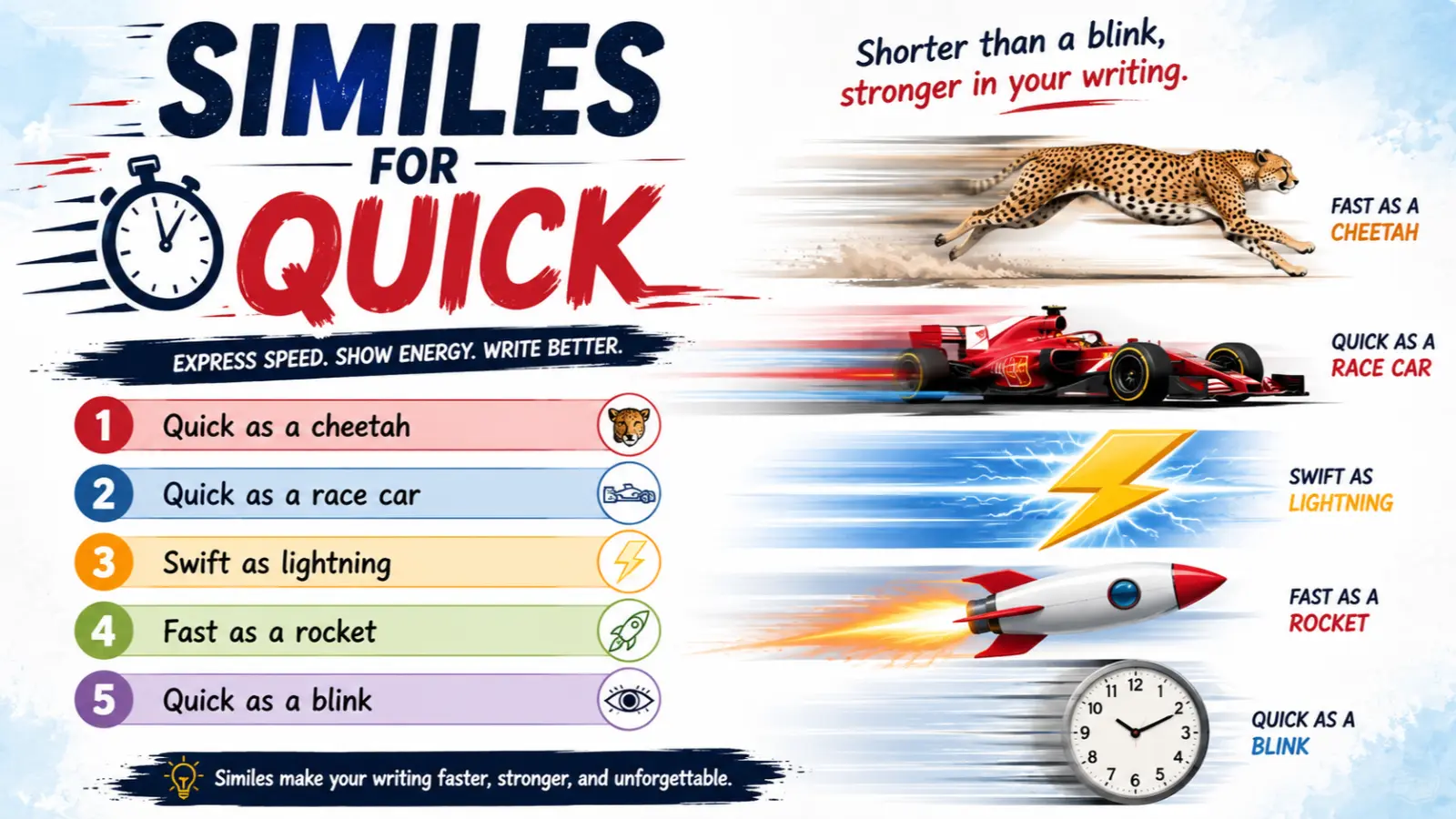
When something happens quickly, simply saying “it was fast” does not always give readers a strong picture. A well-chosen comparison can make speed feel visible, almost as if the reader is watching the action happen. Similes for quick describe speed, rapid movement, sudden reactions, or anything that happens in very little time. They use words such as like or as to connect an action with something familiar. The second sentence gives speed a shape and energy. It helps readers imagine the movement rather than simply being told about it. You can use quick similes in stories, poetry, essays, sports writing, dialogue, descriptions, and everyday conversation. The examples below are designed to help you understand why particular comparisons work and how to create your own.
What Are Similes for Quick?
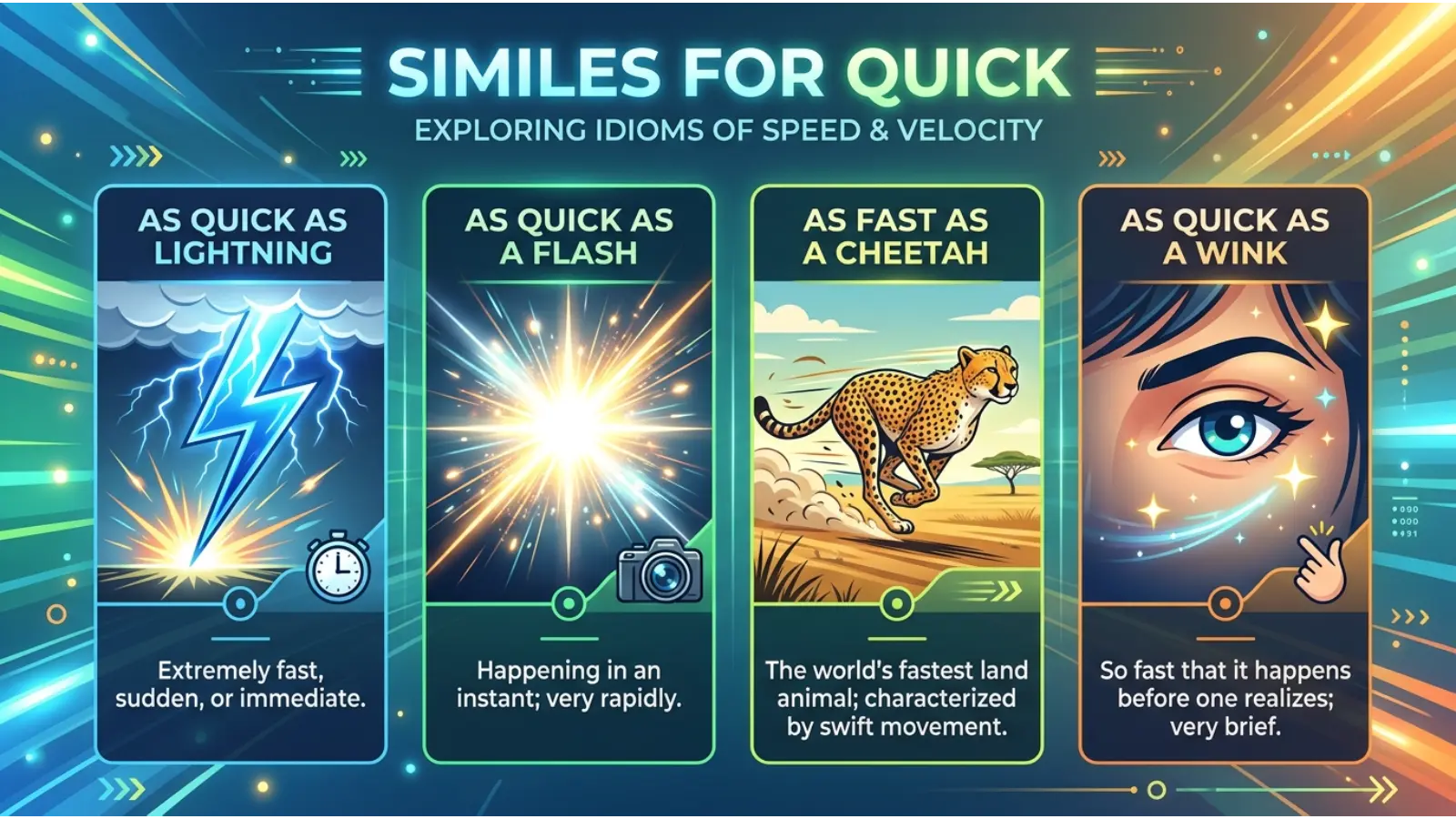
Similes for quick are comparisons that describe something happening rapidly by comparing it to something known for speed, sudden movement, or immediate action. For example, “She answered like a match catching fire” compares a rapid response to the instant ignition of a match.
The strongest quick similes do more than communicate speed. They can also suggest energy, urgency, excitement, surprise, precision, or chaos.
Fresh Similes for Quick Movement and Action
1. Quick as a match catching fire
This comparison suggests something happens almost instantly.
Example:
His idea came quick as a match catching fire.
Why it works: A match can go from unlit to burning in an instant, making it useful for sudden thoughts, reactions, or changes.
Best context: Stories, dialogue, creative nonfiction, and descriptions of sudden reactions.
Writing tip: Use this when you want quickness to feel sudden rather than simply fast.
2. Quick like a sparrow changing direction
A sparrow can shift direction rapidly and unexpectedly.
Example:
The cyclist turned quick like a sparrow changing direction.
Her attention moved from one sound to another, quick like a sparrow changing direction.
This simile works particularly well when speed involves agility, not just distance.
3. Quick as a dropped coin
A dropped coin reaches the ground almost before someone has time to react.
Example:
The glass slipped from his hand, quick as a dropped coin.
The comparison creates a feeling of instantaneous movement.
Best context: Sudden accidents, reactions, and action scenes.
4. Quick like a curtain caught by wind
This comparison suggests sudden, sweeping movement.
Example:
She turned toward the doorway quick like a curtain caught by wind.
Unlike comparisons involving racing animals, this one creates a softer visual image while still conveying speed.
Writing purpose: Use it when the movement is rapid but graceful.
5. Quick as a thought crossing a quiet mind
Thoughts can appear without warning.
Example:
The answer arrived quick as a thought crossing a quiet mind.
This works especially well for ideas, memories, decisions, and realizations.
6. Quick like a fish slipping through reeds
The image suggests speed combined with smoothness and difficulty to catch.
Example:
The little boat moved quick like a fish slipping through reeds.
Emotional effect: It can make movement feel elusive and graceful.
Best context: Nature writing, adventure stories, and descriptions of water.
7. Quick as a page turning in a breeze
This simile describes something that happens rapidly and lightly.
Example:
The afternoon disappeared quick as a page turning in a breeze.
Notice that the comparison can describe time, not only physical movement.
8. Quick like a bird startled from a branch
A startled bird can launch itself away immediately.
Example:
He jumped up quick like a bird startled from a branch.
This is especially effective for surprise and sudden reactions.
Writing tip: When writing about quickness, ask yourself whether the character is moving quickly because of excitement, fear, surprise, or confidence. The reason behind the speed can make the simile stronger.
9. Quick as rain racing down glass
Raindrops can travel rapidly down a window.
Example:
Her fingers moved across the keyboard quick as rain racing down glass.
This comparison creates both speed and visual rhythm.
10. Quick like a shadow crossing a wall
A moving shadow can appear and disappear rapidly.
Example:
A figure passed the doorway quick like a shadow crossing a wall.
Best context: Mystery, suspense, dramatic fiction, and quiet scenes containing sudden movement.
11. Quick as a door snapping shut
This comparison emphasizes abruptness.
Example:
His decision was quick as a door snapping shut.
It can describe a physical action, but it also works metaphorically for decisions, opportunities, or conversations.
12. Quick like a spark jumping from a fire
A spark can shoot away in an instant.
Example:
The children scattered quick like sparks jumping from a fire.
Why it works: Sparks suggest both speed and energy.
Use this when you want a scene to feel lively or explosive without becoming overly dramatic.
13. Quick as a rabbit disappearing into grass
The comparison focuses on sudden disappearance.
Example:
The fox vanished quick as a rabbit disappearing into grass.
This is useful when the important part of the action is not only speed but also vanishing from sight.
14. Quick like a zipper closing
A zipper can move rapidly from one end to another.
Example:
She finished the final sentence quick like a zipper closing.
This unusual comparison can add a modern, everyday quality to your writing.
Writing tip: Familiar objects can produce fresh similes when you connect them to an unexpected action.
15. Quick as a drumbeat between two songs
A drumbeat can mark a tiny interval of time.
Example:
The runner disappeared around the corner quick as a drumbeat between two songs.
This simile gives speed a musical rhythm and can work particularly well in poetic writing.
16. Quick like a pencil racing across paper
The comparison is useful for writing, drawing, note-taking, or fast thinking.
Example:
She wrote the instructions quick like a pencil racing across paper.
Best context: Classroom scenes, creative writing, exams, brainstorming, and work.
17. Quick as a candle flame in a draft
A flame can flicker rapidly when air moves around it.
Example:
His expression changed quick as a candle flame in a draft.
This is especially useful for describing facial expressions or emotions.
18. Quick like a wave pulling back from shore
The retreating water can move rapidly across sand.
Example:
The crowd moved backward quick like a wave pulling back from shore.
The comparison gives group movement a strong sense of collective motion.
19. Quick as a camera flash
A camera flash appears for only an instant.
Example:
The moment passed quick as a camera flash.
This is excellent when describing a brief event, memory, opportunity, or experience.
20. Quick like a cat slipping through an open gate
A cat can move quietly and efficiently through a narrow opening.
Example:
The boy slipped through the doorway quick like a cat slipping through an open gate.
Emotional effect: The comparison suggests speed without unnecessary noise.
21. Quick as a match struck in darkness
This image combines suddenness with contrast.
Example:
Her smile appeared quick as a match struck in darkness.
Here, quickness also suggests a sudden burst of brightness or emotion.
22. Quick like a squirrel crossing a fence
A squirrel can move rapidly while maintaining balance.
Example:
He climbed over the fence quick like a squirrel crossing a narrow rail.
Best context: Physical action, adventure, playful scenes, and energetic characters.
23. Quick as a bell ringing in an empty hall
The sound arrives immediately and changes the atmosphere.
Example:
The warning spread through the building quick as a bell ringing in an empty hall.
This shows that similes for quickness do not have to describe running. They can describe information, sounds, rumors, or reactions.
24. Quick like sunlight breaking through clouds
Sunlight can suddenly transform a landscape.
Example:
Her confidence returned quick like sunlight breaking through clouds.
This comparison adds an emotional layer to speed.
Writing purpose: Use it when something positive returns suddenly.
25. Quick as a heartbeat after a surprise
A heartbeat can accelerate immediately after an unexpected event.
Example:
His reply came quick as a heartbeat after a surprise.
This connects speed with emotion and instinct.
26. Quick like a page slipping from a notebook
A loose page can move away almost instantly in a breeze.
Example:
The plan vanished quick like a page slipping from a notebook.
This creates a feeling of something being brief, fragile, and difficult to hold onto.
27. Quick as a bee leaving a flower
A bee can move rapidly from one place to another.
Example:
She moved from table to table quick as a bee leaving a flower.
This works well for busy characters and energetic scenes.
28. Quick like a stone skipping across water
A skipping stone moves rapidly across the surface in a series of brief contacts.
Example:
His thoughts jumped quick like a stone skipping across water.
This is particularly useful for describing rapidly changing ideas.
29. Quick as a whistle cutting through noise
A whistle can suddenly become noticeable in a crowded environment.
Example:
The coach’s signal came quick as a whistle cutting through noise.
This gives speed a sense of precision and urgency.
30. Quick like a train passing a distant platform
A train can appear for a moment and then disappear from view.
Example:
The opportunity came quick like a train passing a distant platform.
This comparison is useful for moments that are brief and impossible to pause.
How to Choose the Right Quick Simile
Not every fast action should be compared to the same kind of thing.
If you write:
He ran like a rocket.
the reader understands speed, but the image may feel too broad or predictable.
Instead, think about the quality of the movement.
Is it:
- sudden?
- graceful?
- nervous?
- quiet?
- chaotic?
- powerful?
- precise?
- energetic?
- difficult to follow?
Then choose an image that carries the same quality.
For example:
Sudden:
She turned quick as a camera flash.
Graceful:
She moved quick like a fish slipping through reeds.
Energetic:
The children scattered quick like sparks jumping from a fire.
Quiet:
He slipped away quick like a cat through an open gate.
The best simile does not merely answer “How fast?” It also answers “What kind of fast?”
Similes for Quick Thinking and Reactions
Quickness is not limited to physical movement. People can think, answer, decide, notice, or react quickly.
Consider:
Her answer came quick as a match catching fire.
The comparison makes the response feel immediate and energetic.
Compare that with:
His realization arrived quick like sunlight breaking through clouds.
The second version suggests not only speed but also clarity and emotional relief.
This is an important writing principle: the comparison should match the subject’s emotional meaning.
A quick smile, a quick escape, and a quick decision may all happen in seconds, but they should not necessarily receive the same imagery.
How to Make Similes About Speed More Vivid
Give the speed a visual shape
Instead of writing:
The car was very fast.
Try asking:
What does its movement resemble?
You might imagine a streak of light, a bird changing direction, rain sliding across glass, or something else that matches the scene.
Match the comparison to the character
A child running across a playground and a professional athlete sprinting toward a finish line should not necessarily sound identical.
The surrounding details matter.
A playful scene may benefit from:
He raced around the yard quick like a squirrel crossing a fence.
A tense scene may need something sharper:
The warning spread quick as a whistle cutting through noise.
Avoid choosing an image only because it is fast
This is one of the most common beginner mistakes.
A comparison can technically communicate speed while still feeling wrong for the scene.
For example, comparing a quiet, graceful movement to an explosion creates a mismatch.
Think about speed + mood + texture together.
How Professional Writers Avoid Clichéd Speed Comparisons
Some comparisons have become so familiar that readers barely notice them. That does not mean they are always wrong, but they often have less descriptive power.
Instead of automatically reaching for the first speed comparison you remember, observe ordinary life.
Look at:
- falling objects
- moving water
- animals
- weather
- machines
- sounds
- light
- sports
- everyday objects
- human reactions
Then ask:
“What moves quickly in a way that resembles my subject?”
That question can lead to much fresher writing.
The Difference Between a Strong and Weak Quick Simile
Weak:
The boy ran like a fast animal.
The comparison is vague. Which animal? Why does that animal matter?
Stronger:
The boy ran quick like a sparrow startled from a branch.
Now the reader gets a clearer image: sudden movement, direction, and urgency.
The goal is not to make every simile complicated. It is to make the comparison specific enough to create an image.
Similes for Quick in Different Types of Writing
In storytelling
Quick similes are useful during action.
The stranger disappeared quick like a shadow crossing a wall.
They can speed up the reader’s sense of the scene.
In poetry
Poetry gives you more freedom to connect speed with emotion.
The memory returned quick as sunlight breaking through clouds.
The comparison can carry both literal and emotional meaning.
In conversation
Simple comparisons often sound more natural.
She finished that assignment quick as a match catching fire.
Conversation generally benefits from familiar images rather than highly elaborate descriptions.
In school writing
A clear, relevant simile can make descriptive writing stronger.
The rain moved down the window quick as a page turning in a breeze.
The comparison should support the subject rather than distract from it.
Simile vs. Metaphor: What Is the Difference?
A simile makes a comparison using words such as like or as.
The runner moved like a startled bird.
A metaphor makes the comparison directly.
The runner was a startled bird.
Both can create imagery, but they produce slightly different effects.
The simile signals the comparison clearly, while the metaphor makes the image more direct.
For beginning writers, similes can be an excellent way to experiment with imagery because the relationship between the two things is explicit.
Simile vs. Hyperbole
A simile does not have to exaggerate.
She moved quick like a fish slipping through reeds.
This is a comparison.
Hyperbole deliberately exaggerates:
She finished the entire project in the blink of a million stars.
The two devices can sometimes appear together, but they serve different purposes. Simile creates comparison; hyperbole creates deliberate exaggeration.
How to Create Your Own Similes for Quick
Try this five-step method.
Step 1: Identify what is moving quickly
It could be:
- a person
- an animal
- a vehicle
- an idea
- a sound
- a feeling
- a decision
- a change in weather
Step 2: Decide what kind of quickness you need
Choose one word:
sudden, graceful, frantic, silent, powerful, playful, precise, nervous, energetic
Step 3: Brainstorm five things with that quality
For “sudden,” you might think of:
- a flash
- a spark
- a dropped object
- a startled bird
- a door closing
Step 4: Connect one image to your subject
If your character suddenly remembers something:
The memory returned quick as a match struck in darkness.
Step 5: Remove anything unnecessary
A strong simile usually needs only enough detail to create the image.
Do not add extra descriptive words simply to make the sentence sound impressive.
A Simple Exercise for Better Similes
Take this sentence:
The dog ran quickly.
Write five versions, each with a different emotional quality:
- playful
- frightened
- excited
- graceful
- determined
Your goal is not to make the sentence longer. Your goal is to make the kind of speed clearer.
This exercise teaches an important creative-writing skill: description becomes stronger when you connect physical action with emotion.
Common Mistakes When Writing Similes for Quick
Using the same comparison repeatedly
If every character moves “like lightning,” the imagery quickly becomes predictable.
Explore different sources of speed.
Mixing unrelated images
Avoid creating comparisons that combine images that do not belong together.
A simile should give readers a coherent mental picture.
Making the comparison too complicated
A long comparison can bury the main sentence.
If the reader has to decode the simile, it may be doing too much.
Choosing an image only because it is fast
Speed alone is not enough.
Ask whether the image also matches the mood, character, setting, and action.
Confusing similes with metaphors
Remember:
Simile:
The idea came like a spark.
Metaphor:
The idea was a spark.
Both are useful, but they are structured differently.
Explaining the simile too much
Once the comparison creates a clear image, trust the reader.
Instead of adding several sentences explaining that something was extremely fast, let the image do some of the work.
Frequently Asked Questions
What is a good simile for quick?
A good simile depends on the type of quickness you want to describe. For sudden movement, “quick as a match catching fire” works well. For quiet movement, “quick like a cat slipping through an open gate” creates a different effect.
What is a simile for someone who moves very quickly?
You could write:
He moved quick like a fish slipping through reeds.
This suggests rapid but smooth movement.
How do you describe something happening very quickly?
Use a comparison connected with something that happens almost instantly, such as a spark, flash, falling object, sudden sound, or startled animal.
Can similes describe quick thinking?
Yes. Similes can describe thoughts, decisions, answers, memories, and reactions as well as physical movement.
For example:
Her answer came quick as a match catching fire.
Are similes useful in creative writing?
Yes. A well-chosen simile can make an ordinary description more visual and memorable. The key is to choose a comparison that adds meaning rather than simply adding decoration.
How can I make my similes less clichéd?
Look beyond familiar comparisons such as lightning and rockets. Observe ordinary objects, animals, sounds, weather, and movements around you. Specific observations often lead to fresher comparisons.
What is the difference between a simile and a metaphor?
A simile usually makes a comparison with like or as, while a metaphor directly identifies one thing with another.
Conclusion
Writing about speed is not simply a matter of finding a synonym for “fast.” Strong similes for quick help readers experience the movement through a concrete image. A sudden reaction might resemble a spark. A quiet escape might resemble a cat slipping through a gate. A rapid thought might arrive like sunlight breaking through clouds. The most effective comparison depends on what you want the reader to feel. When creating your own similes, start with the action, identify its emotional quality, observe the world for a matching image, and keep the final comparison natural. With practice, even a simple sentence such as “she moved quickly” can become a vivid moment that readers can see, hear, and remember.

I am Helena Frost, a writer captivated by the beauty of language and the art of comparison. Through my words, I explore the world by turning ordinary moments into vivid similes and reflections. I enjoy crafting phrases that spark imagination, evoke emotion, and linger in the mind. My writing celebrates the subtle connections between people, nature, and the stories we live. For me, every sentence is an opportunity to reveal the extraordinary in the everyday.