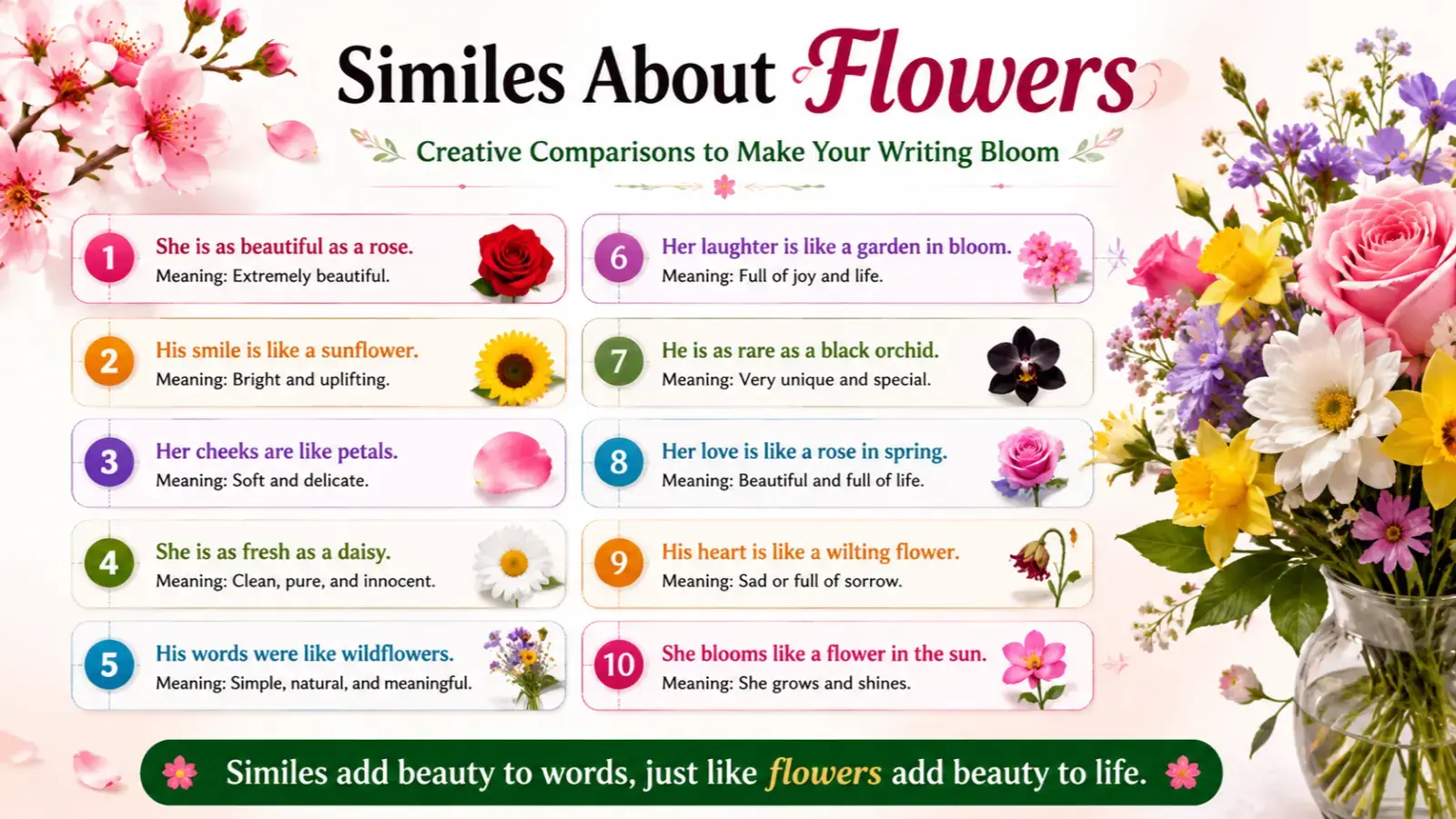
Similes About Flowers have inspired writers for centuries because they represent beauty, growth, hope, change, and even loss. One of the easiest ways to describe flowers more vividly is through similes.
A simile compares two different things using words like “like” or “as.” Instead of simply saying a flower is beautiful, a Similes About Flowers paints a clearer picture in the reader’s mind.
Whether you’re writing poetry, stories, speeches, school assignments, greeting cards, or everyday descriptions, learning fresh similes about flowers can make your writing more expressive.
This guide shares original flower similes, explains why they work, and helps you create your own meaningful comparisons.
Quick Answer
Similes about flowers compare flowers to other objects, emotions, or experiences using words such as like or as. They help readers visualize beauty, fragility, color, fragrance, growth, and emotion in a more memorable way. Original similes create stronger imagery than overused comparisons.
Why Writers Use Flower Similes
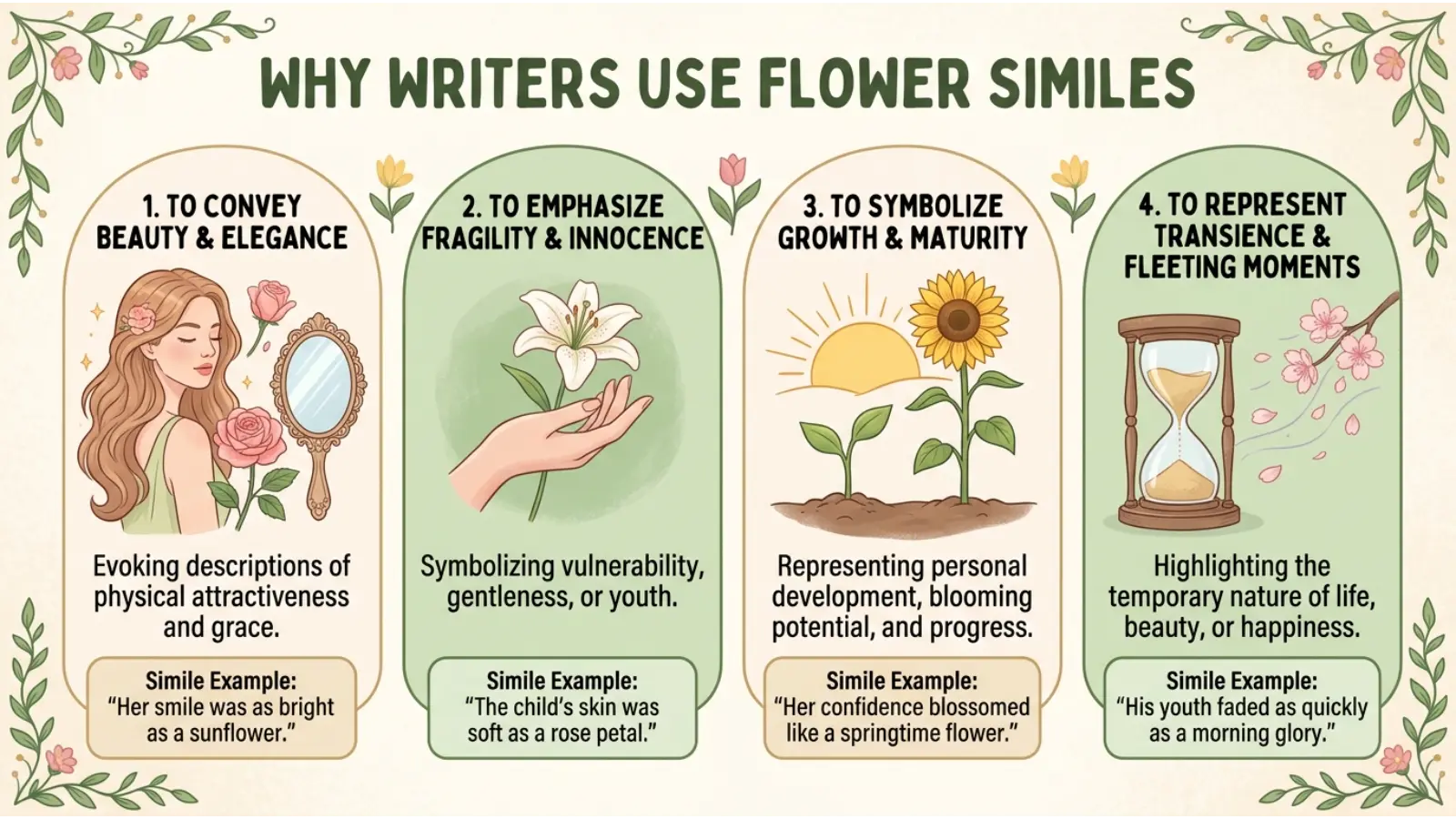
Flowers naturally symbolize many emotions and ideas.
A thoughtful flower simile can describe:
- Beauty
- Fresh beginnings
- Kindness
- Delicate emotions
- Hope
- Spring
- Love
- Peace
- Growth
- Fleeting moments
Rather than telling readers something is lovely, a good simile helps them imagine it.
30 Original Similes About Flowers
1. Like a flower waking to the morning sun
Meaning: Slowly becoming confident.
Examples
- She smiled like a flower waking to the morning sun.
- His confidence opened like a flower greeting dawn.
Best for: Character growth, optimism.
Writing Tip: Works well during moments of personal transformation.
2. As gentle as petals floating on a quiet pond
Meaning: Extremely calm and peaceful.
Examples
- Her voice was as gentle as petals floating on a quiet pond.
- The evening breeze felt as gentle as floating petals.
Creates: Peaceful imagery.
3. Like wildflowers dancing across a hillside
Meaning: Full of freedom and happiness.
Examples
- The children laughed like wildflowers dancing across a hillside.
- Ideas spread like colorful flowers in the wind.
Best for: Joyful scenes.
4. As bright as a sunflower chasing daylight
Meaning: Cheerful and optimistic.
Examples
- Her personality was as bright as a sunflower chasing daylight.
- His greeting felt as warm as sunshine itself.
Writing Purpose: Positive descriptions.
5. Like blossoms after the first spring rain
Meaning: New beginnings.
Examples
- Hope returned like blossoms after the first spring rain.
- Opportunities appeared like fresh blooms after rain.
6. As delicate as a frost-kissed orchid
Meaning: Beautiful but fragile.
Examples
- The glass ornament looked as delicate as a frost-kissed orchid.
- Trust remained as delicate as winter petals.
7. Like a garden blooming after silence
Meaning: Life returning after hardship.
Examples
- Their friendship grew like a garden blooming after silence.
- Laughter filled the home again.
8. As colorful as a basket of spring blossoms
Meaning: Full of variety.
Examples
- The festival was as colorful as a basket of spring blossoms.
- Her artwork overflowed with cheerful colors.
9. Like petals carried by a warm breeze
Meaning: Graceful movement.
Examples
- She walked like petals carried by a warm breeze.
- The dancers moved effortlessly.
10. As refreshing as flowers after rain
Meaning: Comforting and uplifting.
Examples
- His advice felt as refreshing as flowers after rain.
- The vacation renewed everyone’s energy.
11. Like roses hiding among thorns
Meaning: Beauty surrounded by difficulty.
Examples
- Kindness survived like roses hiding among thorns.
- Small victories appeared despite challenges.
12. As soft as newly opened petals
Meaning: Extremely soft.
Examples
- The blanket felt as soft as newly opened petals.
- Her hands were wonderfully gentle.
13. Like lavender calming an anxious room
Meaning: Bringing peace.
Examples
- Her words settled everyone.
- Music filled the room with calm.
14. As graceful as lilies on still water
Meaning: Elegant.
Examples
- The swan moved as graceful as lilies on still water.
- Her dance appeared effortless.
15. Like blossoms reaching toward spring skies
Meaning: Ambitious.
Examples
- Dreams stretched like blossoms reaching toward spring skies.
- Students embraced new opportunities.
16. As fragrant as a hidden flower garden
Meaning: Pleasant and inviting.
Examples
- The bakery smelled as fragrant as a hidden flower garden.
- Fresh tea filled the kitchen.
17. Like daisies smiling beneath blue skies
Meaning: Innocent happiness.
Examples
- Their excitement spread through the class.
- The children greeted visitors warmly.
18. As resilient as flowers growing through stone
Meaning: Strong despite hardship.
Examples
- She remained as resilient as flowers growing through stone.
- Hope survived every obstacle.
19. Like cherry blossoms drifting through spring air
Meaning: Beautiful but temporary.
Examples
- Childhood memories passed gently.
- The celebration ended too quickly.
20. As elegant as a white lily at sunrise
Meaning: Pure elegance.
Examples
- The wedding dress looked timeless.
- The hall felt peaceful.
21. Like tulips opening after winter
Meaning: Renewal.
Examples
- Confidence returned.
- The town slowly came alive.
22. As cheerful as marigolds in afternoon light
Meaning: Bright and welcoming.
Examples
- Her laughter filled the room.
- The café felt inviting.
23. Like bluebells ringing through a quiet forest
Meaning: Gentle beauty.
Examples
- Her melody echoed softly.
- The memory lingered peacefully.
24. As fresh as dew resting on flower petals
Meaning: Clean and new.
Examples
- The morning air felt refreshing.
- The idea sounded original.
25. Like vines wrapping around blooming flowers
Meaning: Deep connection.
Examples
- Family traditions held everyone together.
- Their friendship strengthened every year.
26. As radiant as a field of blooming poppies
Meaning: Exceptionally vibrant.
Examples
- The sunset looked unforgettable.
- The celebration sparkled with color.
27. Like a bouquet carried by spring wind
Meaning: Spreading happiness.
Examples
- Good news traveled quickly.
- Her kindness reached everyone.
28. As patient as a seed becoming a flower
Meaning: Quiet perseverance.
Examples
- Success required steady effort.
- The artist improved every day.
29. Like moonlight resting on white blossoms
Meaning: Peaceful beauty.
Examples
- The garden looked magical.
- Silence settled over the hills.
30. As hopeful as the season’s first bloom
Meaning: Optimistic about the future.
Examples
- Graduation felt like a new beginning.
- Everyone welcomed the change.
How to Write Better Flower Similes
The strongest similes begin with careful observation rather than random comparison.
Instead of asking, “What is this flower like?” ask:
- How does it move?
- What feeling does it create?
- What season fits it?
- What memory does it remind you of?
- What colors and textures stand out?
The more specific your observation, the more memorable your simile becomes.
For example:
Weak:
The flower was like a star.
Stronger:
The flower shimmered like morning dew catching the first sunrise.
Specific details make imagery come alive.
Flower Similes and Other Literary Devices
Metaphor
A metaphor says one thing is another.
Simile: The flower was like a tiny lantern.
Metaphor: The flower was a tiny lantern in the garden.
Imagery
Flower similes naturally create visual, sensory descriptions.
Example:
“The roses glowed like tiny sunsets beneath the evening sky.”
Readers can immediately picture the scene.
Personification
Flowers can also receive human qualities.
Example:
“The daisies nodded happily in the breeze.”
Combining personification with similes creates richer descriptions.
Symbolism
Flowers often symbolize:
- Love
- Hope
- Memory
- Innocence
- Growth
- Farewell
- New beginnings
Understanding symbolism helps writers choose meaningful comparisons instead of random ones.
Create Your Own Flower Similes
Follow these simple steps.
Step 1: Choose a Flower
Think about its shape, color, scent, or movement.
Step 2: Identify Its Best Quality
Ask what makes it unique.
Step 3: Find an Unexpected Comparison
Avoid the first idea that comes to mind.
Step 4: Test the Emotion
Does your simile create happiness, mystery, sadness, or wonder?
Creative Exercise
Complete these sentences with your own ideas.
- The sunflower stood like ________.
- My hope grew like ________.
- The garden smelled like ________.
- Her smile bloomed like ________.
- The petals floated like ________.
Try writing five different versions for each sentence. Variety builds creativity.
Common Mistakes When Writing Flower Similes
Using Overused Comparisons
Phrases such as “pretty as a rose” have appeared so often that they rarely surprise readers.
Choose fresher images instead.
Mixing Imagery
Avoid combining unrelated comparisons.
Confusing:
The flower was like fire sailing across the ocean.
Stay focused on one clear image.
Confusing Similes and Metaphors
Remember:
- Similes use like or as.
- Metaphors do not.
Forcing Comparisons
Not every sentence needs a simile.
Use them where they genuinely strengthen the description.
Ignoring Context
A playful flower simile may not fit a serious scene.
Match the comparison to your story’s tone.
Frequently Asked Questions
What is a simile about flowers?
A flower simile compares flowers to another object or idea using words like “like” or “as” to create vivid imagery.
Why are flower similes common in poetry?
Flowers naturally symbolize beauty, growth, emotion, and change, making them ideal for poetic comparisons.
Can flower similes be used in stories?
Absolutely. They enrich descriptions, reveal emotions, and make scenes more memorable.
How do I avoid cliché flower similes?
Observe real flowers closely, focus on unique details, and create comparisons based on movement, color, fragrance, or emotion rather than common expressions.
Are flower similes suitable for children?
Yes. Simple flower similes encourage creativity and help young writers understand descriptive language.
What’s the difference between a flower simile and a flower metaphor?
A simile uses like or as, while a metaphor directly states that one thing is another.
Conclusion
Flower similes do more than decorate writing—they help readers experience scenes through vivid imagery and emotion. By choosing fresh comparisons, paying attention to detail, and matching each simile to the mood of your writing, you can create descriptions that feel original and memorable. Use the examples in this guide as inspiration, but don’t stop there. Spend time observing real flowers, notice their colors, textures, movement, and symbolism, then turn those observations into comparisons that reflect your own voice. The most memorable similes are the ones only you could write.
I am Helena Frost, a writer captivated by the beauty of language and the art of comparison. Through my words, I explore the world by turning ordinary moments into vivid similes and reflections. I enjoy crafting phrases that spark imagination, evoke emotion, and linger in the mind. My writing celebrates the subtle connections between people, nature, and the stories we live. For me, every sentence is an opportunity to reveal the extraordinary in the everyday.