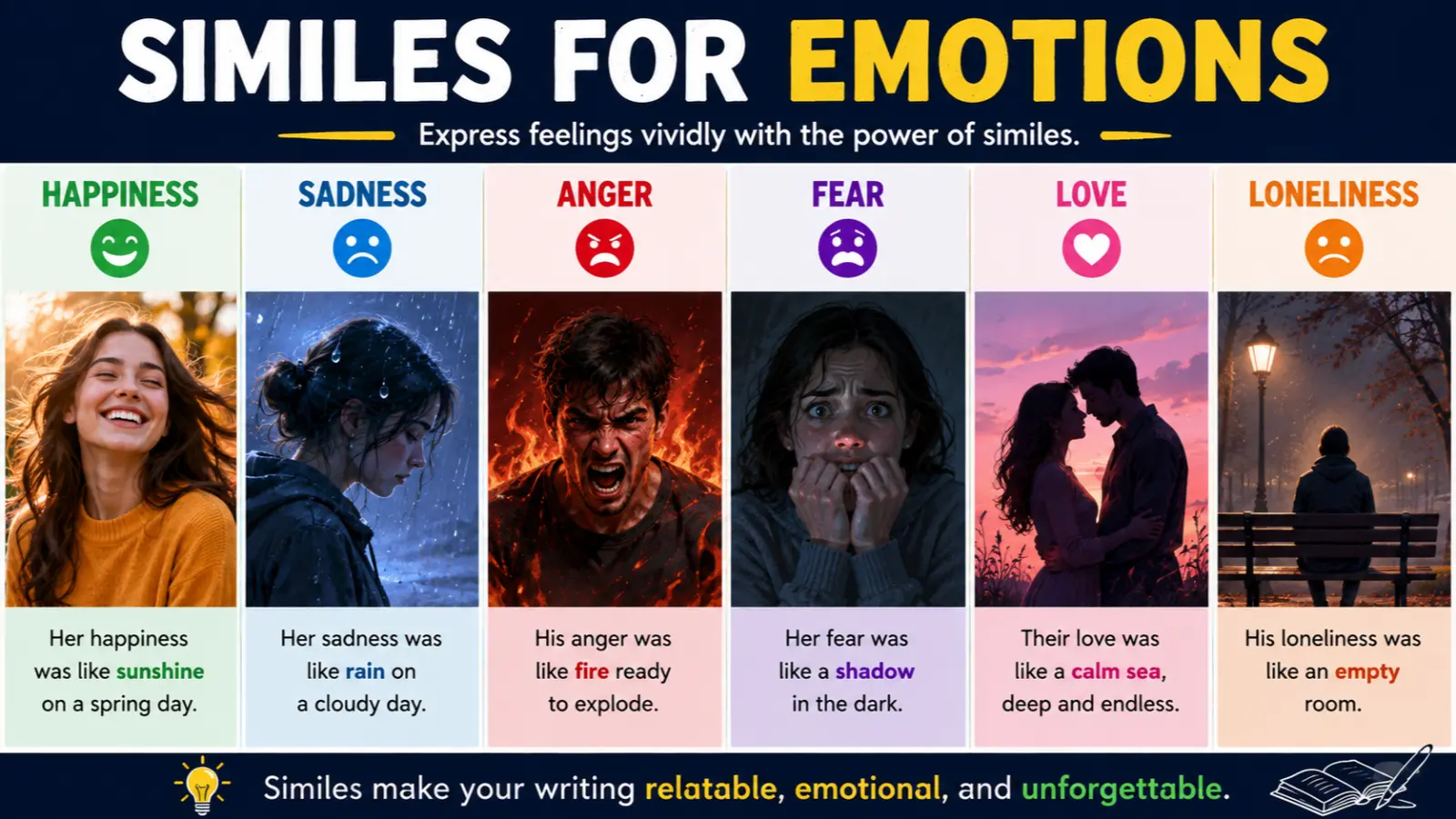
Similes for Emotions are difficult to describe because they are invisible. Readers cannot see happiness, fear, love, or regret—they can only feel them through the words you choose. That’s where similes become powerful.
A simile compares one thing to another using words such as like or as, helping readers picture an emotion instead of simply reading its name.
Whether you’re writing a novel, poem, speech, journal entry, or school assignment, strong emotional similes can make your writing more memorable. This guide introduces fresh, original similes for emotions, explains why they work, and shows you how to use them naturally.
Quick Answer
Similes for emotions compare feelings to familiar experiences using “like” or “as.” They help readers understand emotions more vividly by turning abstract feelings into clear mental images. Strong emotional similes create memorable descriptions in stories, poetry, conversations, and creative writing.
Why Emotional Similes Make Writing Stronger
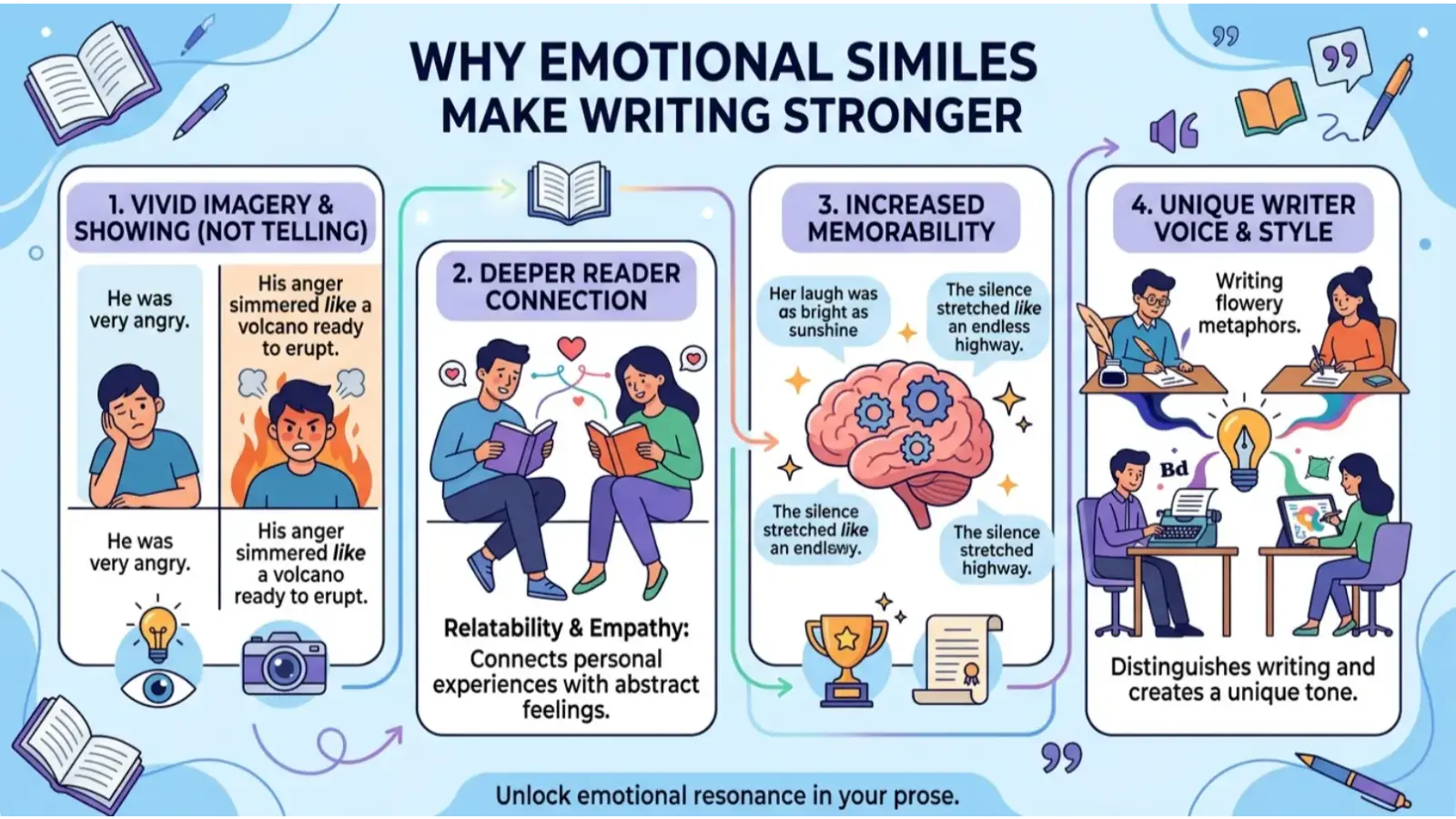
People rarely experience emotions in simple ways. Joy can burst unexpectedly. Fear can slowly creep in. Regret can quietly linger for years.
Instead of saying:
She was nervous.
You can write:
She was as restless as a candle flame in a draft.
The second version paints a picture. Readers don’t just understand the feeling—they experience it.
Professional writers often use similes because they:
- Create vivid imagery
- Build emotional connection
- Improve storytelling
- Make characters feel believable
- Help readers remember important moments
Original Similes for Emotions
1. As hopeful as a sunrise climbing through fog
Meaning
Hope slowly becomes stronger despite uncertainty.
Example Sentences
- She felt as hopeful as a sunrise climbing through fog.
- The team remained hopeful despite the setbacks.
Writing Tip
Works beautifully during moments of recovery and new beginnings.
Best Context
Stories, motivational writing, personal essays.
2. Like rain tapping softly against an old window
Meaning
Gentle sadness that refuses to disappear.
Examples
- His grief stayed like rain tapping softly against an old window.
- The memory returned quietly every evening.
Poetry Example
My sorrow lingered like rain tapping softly against an old window.
3. As joyful as birds discovering spring
Meaning
Pure excitement filled with energy.
Conversation Example
“I was as joyful as birds discovering spring.”
Storytelling
Perfect after good news or a long-awaited reunion.
4. Like a kite dancing in a fresh breeze
Meaning
Feeling completely free.
Formal Example
Her spirit lifted like a kite dancing in a fresh breeze.
Emotional Effect
Creates optimism and lightness.
5. As nervous as footsteps on thin ice
Meaning
Extreme anxiety before an important moment.
Examples
- I was as nervous as footsteps on thin ice before my interview.
- His hands shook during the speech.
6. Like smoke curling through empty halls
Meaning
Loneliness spreading quietly.
Writing Purpose
Excellent for emotional fiction.
7. As calm as moonlight resting on a lake
Meaning
Deep inner peace.
Examples
- She remained calm throughout the discussion.
- His voice stayed gentle under pressure.
8. Like thunder waiting behind distant hills
Meaning
Hidden anger building slowly.
Storytelling Example
His temper gathered like thunder waiting behind distant hills.
9. As proud as an eagle finding open skies
Meaning
Healthy confidence after achievement.
Writing Tip
Avoid using it too often in the same story.
10. Like roots holding firmly through every storm
Meaning
Emotional resilience.
Best Context
Inspirational writing.
11. As confused as stars behind heavy clouds
Meaning
Uncertainty without direction.
Example
She stared at the letter, as confused as stars behind heavy clouds.
12. Like autumn leaves searching for the wind
Meaning
Restlessness.
Conversation
“I’ve been restless all week.”
13. As grateful as dry earth welcoming rain
Meaning
Deep appreciation.
Writing Effect
Creates warmth and sincerity.
14. Like an unopened letter on a quiet shelf
Meaning
Curiosity mixed with hesitation.
Poetry
My questions waited like an unopened letter.
15. As excited as waves racing toward shore
Meaning
Overflowing enthusiasm.
Examples
The children were excited before the trip.
16. Like frost melting beneath morning light
Meaning
Fear slowly disappearing.
Best Context
Character growth.
17. As determined as ivy climbing old stone
Meaning
Persistence despite obstacles.
Writing Tip
Excellent in motivational stories.
18. Like a compass finding true north
Meaning
Relief after uncertainty.
19. As embarrassed as spilled ink on white paper
Meaning
Feeling exposed after making a mistake.
20. Like wildfire crossing dry grass
Meaning
Anger spreading quickly.
Conversation
His frustration spread like wildfire crossing dry grass.
21. As peaceful as snowfall before dawn
Meaning
Quiet contentment.
22. Like a river finally reaching the sea
Meaning
Deep satisfaction.
23. As frightened as a candle facing strong wind
Meaning
Fear mixed with vulnerability.
24. Like fresh paint catching morning sunlight
Meaning
Renewed optimism.
25. As gentle as feathers settling on still water
Meaning
Tender affection.
26. Like an echo fading through mountains
Meaning
A memory slowly disappearing.
27. As lonely as one star before sunset
Meaning
Isolation without complete despair.
28. Like branches stretching toward sunlight
Meaning
Growing confidence.
29. As relieved as heavy clouds finally raining
Meaning
Stress finally released.
30. Like a lighthouse glowing through the storm
Meaning
Hope during difficult times.
Storytelling Example
Her encouragement became like a lighthouse glowing through the storm.
What Makes an Emotional Simile Effective?
The strongest similes do more than compare two things. They create an experience.
Good emotional similes often:
- Appeal to the senses.
- Match the mood of the scene.
- Feel believable.
- Reveal something about the character.
- Leave room for the reader’s imagination.
Instead of choosing dramatic comparisons every time, choose images that naturally fit the emotion.
How Professional Writers Build Strong Emotional Imagery
Experienced writers usually follow three simple steps:
Start with the emotion
Ask yourself what the character is feeling.
Find a real-world image
Think of weather, nature, movement, sounds, light, or everyday experiences.
Match the emotional intensity
A tiny disappointment shouldn’t be compared to an earthquake. The comparison should match the emotional weight.
Related Literary Devices
Metaphor
A metaphor states one thing is another without using “like” or “as.”
Simile: Her hope was like sunrise.
Metaphor: Her hope was sunrise.
Imagery
Imagery uses descriptive language that appeals to the senses. Similes often strengthen imagery by making emotions easier to visualize.
Personification
Personification gives human qualities to non-human things.
Example:
The silence waited patiently.
It can work alongside emotional similes to deepen atmosphere.
Hyperbole
Hyperbole exaggerates for emphasis.
Example:
I was so nervous I could have floated away.
Use it sparingly so emotional moments remain believable.
Symbolism
Objects can represent emotions.
A broken clock may symbolize regret.
An open door may symbolize hope.
Combining symbolism with similes creates richer writing.
How to Create Your Own Similes for Emotions
You don’t need to memorize dozens of comparisons. You can invent your own.
Step 1
Choose the emotion.
Example:
- Joy
- Fear
- Love
- Jealousy
- Relief
Step 2
Think of something in nature or daily life that behaves similarly.
Step 3
Ask why they feel alike.
Step 4
Write the comparison using “like” or “as.”
Example:
Emotion:
Relief
Image:
Heavy rain finally ending
Simile:
I felt as relieved as a traveler seeing clear skies after days of rain.
Creative Practice Exercises
Exercise 1
Describe happiness without using the word happy.
Exercise 2
Write three different similes for fear using weather.
Exercise 3
Describe one emotion using only nature.
Exercise 4
Rewrite a plain sentence with an original simile.
Plain:
She was nervous.
Improved:
She was as nervous as a paper boat drifting toward a waterfall.
Exercise 5
Choose a favorite memory and describe the emotions using two original similes.
Common Mistakes to Avoid
Overused Comparisons
Expressions such as busy as a bee or cold as ice are familiar but often lack originality. Fresh imagery leaves a stronger impression.
Mixed Imagery
Avoid combining unrelated images.
Poor:
His anger exploded like a frozen river flying through sunshine.
Keep one clear image.
Forced Similes
If the comparison feels unnatural, readers notice. Every image should support the emotion.
Confusing Similes with Metaphors
Remember:
- Simile uses like or as.
- Metaphor makes a direct comparison.
Weak Descriptions
Don’t choose random objects.
Instead of:
Sad like a chair.
Choose:
Sad like a garden waiting for rain.
The second comparison carries emotional meaning.
Frequently Asked Questions
What are similes for emotions?
They compare feelings to familiar experiences using like or as, making emotions easier to imagine.
Why do writers use emotional similes?
They help readers connect emotionally, improve imagery, and make characters feel realistic.
Can emotional similes be used in everyday conversation?
Yes. Natural comparisons can make conversations more expressive without sounding overly dramatic.
What’s the difference between a simile and a metaphor?
A simile uses like or as, while a metaphor directly states that one thing is another.
Should emotional similes always be dramatic?
No. Quiet, subtle comparisons often create a stronger emotional impact.
How can I avoid cliché similes?
Look at the emotion from a fresh perspective. Draw inspiration from nature, everyday objects, sounds, seasons, or personal experiences instead of relying on familiar expressions.
Are similes useful in poetry?
Absolutely. They help poets create imagery, rhythm, and emotional depth while giving readers memorable visual connections.
Conclusion
Emotions become more meaningful when readers can picture them. Original similes bridge the gap between invisible feelings and vivid experiences, allowing your audience to see, hear, and sense what your characters or speakers are going through. The best similes are not the most complicated—they are the ones that feel true. Practice observing the world around you, connect emotions with everyday images, and experiment with fresh comparisons. With time, you’ll develop a unique writing style filled with memorable emotional imagery that resonates long after the final sentence.
I am Helena Frost, a writer captivated by the beauty of language and the art of comparison. Through my words, I explore the world by turning ordinary moments into vivid similes and reflections. I enjoy crafting phrases that spark imagination, evoke emotion, and linger in the mind. My writing celebrates the subtle connections between people, nature, and the stories we live. For me, every sentence is an opportunity to reveal the extraordinary in the everyday.