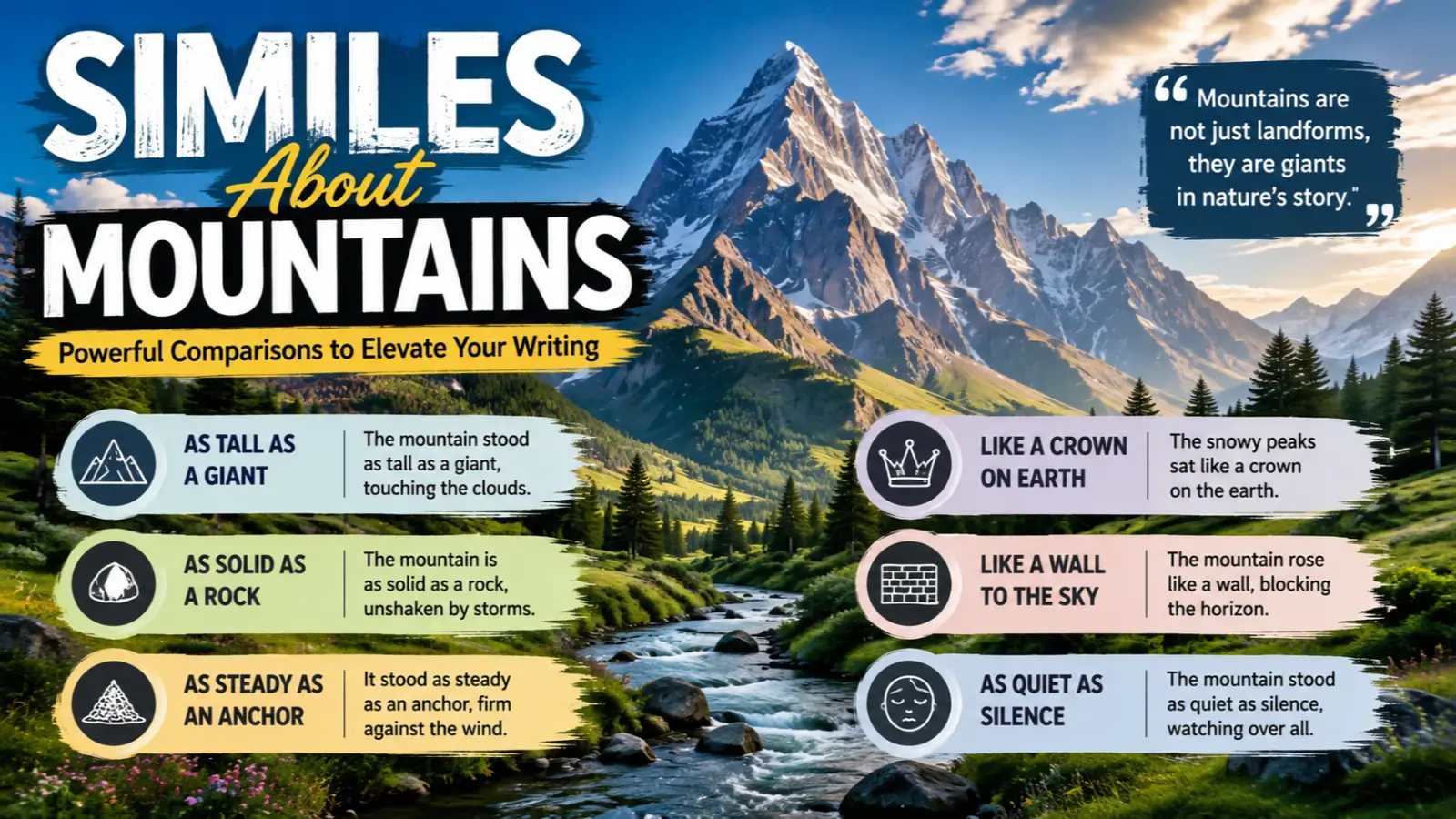
Similes About Mountains have inspired storytellers, poets, and travelers for centuries. Their towering peaks, quiet valleys, and rugged cliffs make them perfect subjects for vivid comparisons. One of the easiest ways to capture their beauty in writing is through similes.
A simile compares two different things using words like “as” or “like.” It helps readers picture a scene, feel an emotion, or understand an idea more clearly. Whether you’re writing fiction, poetry, essays, speeches, or even social media captions, strong similes can make ordinary descriptions unforgettable.
In this guide, you’ll discover original similes about mountains, learn why they work, see them used in different kinds of writing, and pick up practical techniques for creating your own.
Quick Answer
Similes about mountains compare mountains to other objects or experiences using “like” or “as” to emphasize their size, strength, beauty, mystery, or permanence. Effective mountain similes create vivid imagery that helps readers see and feel the landscape more clearly.
Why Mountains Make Powerful Similes
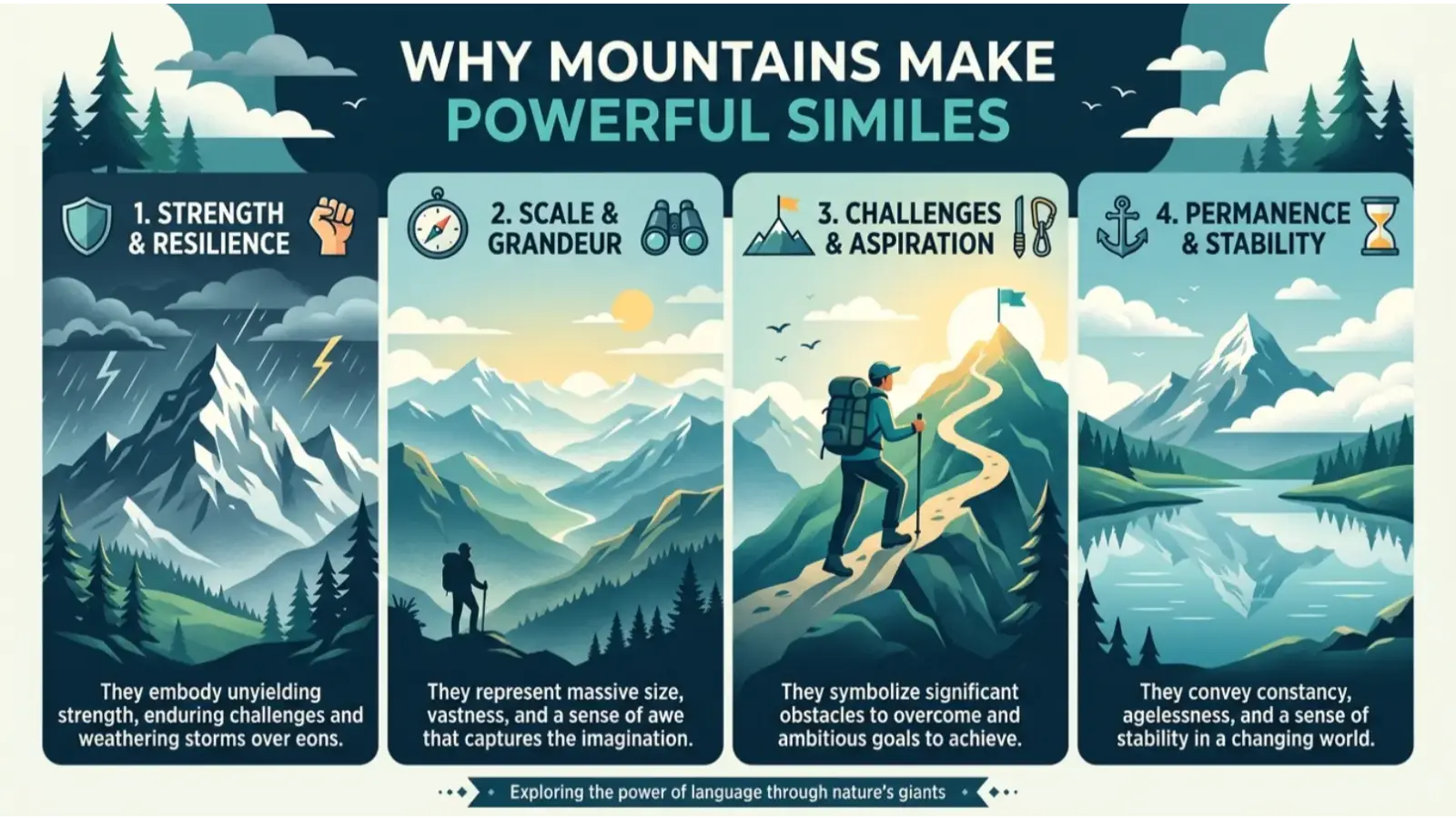
Mountains naturally symbolize many ideas:
- Strength
- Patience
- Endurance
- Mystery
- Peace
- Challenge
- Hope
- Majesty
Because they carry so many meanings, mountain similes work well in creative writing, speeches, travel writing, and poetry.
Similes That Capture the Majesty of Mountains
1. The mountain stood like a silent guardian.
Meaning: Protection and strength.
Examples
- The mountain stood like a silent guardian over the sleepy village.
- At sunset, the ridge looked like a silent guardian watching the valley.
Emotional effect: Comfort and security.
Writing tip: Perfect for peaceful landscapes.
2. The mountain rose like a giant candle reaching the sky.
Meaning: Great height with graceful shape.
Examples
- Snow covered the mountain like wax on a giant candle.
- It rose like a giant candle against the morning light.
Best for: Nature descriptions.
3. The cliffs stood like ancient castle walls.
Meaning: Strength and history.
Examples
- The cliffs surrounded the valley like ancient castle walls.
- We camped beneath rocks that looked like forgotten fortress walls.
Storytelling use: Fantasy adventures.
4. The mountain rested like a sleeping giant.
Meaning: Hidden power beneath calm.
Examples
- The volcano rested like a sleeping giant.
- It looked peaceful, yet powerful.
Writing purpose: Suspense and adventure.
5. The snowy peak shone like polished silver.
Meaning: Bright beauty.
Examples
- The summit glittered like polished silver.
- Morning sunlight made every ridge sparkle.
Similes That Highlight Mountain Strength
6. Strong as a mountain rooted in stone.
Meaning: Unshakable strength.
Examples
- Her determination was as strong as a mountain rooted in stone.
- Their friendship remained strong as a mountain.
Conversation example
“He’s as strong as a mountain when problems appear.”
7. The ridge stood like an unbreakable shield.
Meaning: Protection.
Examples
- The ridge stood like an unbreakable shield against the wind.
- The cliffs protected the village like a stone shield.
8. The mountain was like an old warrior refusing defeat.
Meaning: Endurance.
Examples
- Time had weathered it, yet it remained.
- The mountain looked like an old warrior after countless battles.
9. As steady as a mountain in winter.
Meaning: Calm under pressure.
Examples
- She remained as steady as a mountain in winter.
- His voice stayed calm during the crisis.
10. Like a pillar holding up the sky.
Meaning: Immense support.
Examples
- The mountain looked like a pillar holding up the clouds.
- The tallest peak seemed endless.
Similes Inspired by Mountain Weather
11. The clouds wrapped the mountain like a soft blanket.
Meaning: Gentle mystery.
Examples
- Morning fog hugged the mountain.
- The summit disappeared beneath white clouds.
12. Mist floated like a silk scarf across the slopes.
Meaning: Graceful movement.
Examples
- The mist drifted across the hills.
- Dawn painted delicate layers of fog.
13. Snow settled like powdered sugar on the peaks.
Meaning: Fresh snowfall.
Examples
- Overnight snow transformed the mountains.
- Every branch sparkled.
14. Rain rolled down the cliffs like strings of glass beads.
Meaning: Shimmering rainfall.
Examples
- Rain traced every crack.
- Water sparkled in the afternoon light.
15. The wind danced across the mountain like invisible music.
Meaning: Gentle movement.
Examples
- Grass bent with the breeze.
- The air carried whispers through the rocks.
Creative Similes for Storytelling
16. The mountain waited like an unopened book.
Meaning: Mystery waiting to be explored.
Examples
- Every trail promised another surprise.
- Explorers eagerly climbed higher.
17. The valley curled around the mountain like a sleeping cat.
Meaning: Peaceful landscape.
Examples
- The hills formed gentle curves.
- Nature looked perfectly balanced.
18. The mountain watched like an old storyteller.
Meaning: Wisdom.
Examples
- It had witnessed generations pass.
- Every stone seemed to hold memories.
19. The peaks reached like curious hands toward the stars.
Meaning: Ambition.
Examples
- The tallest ridge touched the clouds.
- Night transformed the landscape.
20. The mountain echoed like a forgotten song.
Meaning: Loneliness and memory.
Examples
- Every shout returned softly.
- The canyon carried distant voices.
Fresh Similes for Poetry
21. Like a dream carved from stone.
A poetic image for timeless beauty.
22. As patient as an ancient mountain.
Suggests endurance over centuries.
23. Like frozen waves reaching heaven.
Highlights dramatic ridges.
24. As quiet as snow on a mountain trail.
Creates peaceful imagery.
25. Like a crown resting on Earth’s head.
Perfect for majestic landscapes.
26. Like a lighthouse built from stone.
Suggests guidance and hope.
27. As fearless as a mountain facing storms.
Represents courage.
28. Like an artist’s masterpiece painted by time.
Emphasizes natural beauty.
29. As timeless as the tallest peak.
Expresses permanence.
30. Like a staircase leading into the clouds.
Ideal for travel writing.
31. The mountain stood like a patient teacher.
Shows wisdom gained through time.
32. The ridge curved like the spine of a giant dragon.
Excellent for fantasy settings.
33. The cliffs glowed like warm embers at sunset.
Captures evening colors.
34. The mountain reflected the sunrise like a polished mirror.
Ideal for peaceful scenes.
35. The distant peaks looked like folded blue velvet.
Creates soft visual imagery.
How to Make Mountain Similes More Vivid
Strong similes rely on observation rather than exaggeration.
Instead of writing:
The mountain was like something huge.
Try:
The mountain rose like a cathedral carved by nature.
Notice how the second version gives readers a clearer picture.
Professional writers often focus on one striking quality:
- Shape
- Color
- Movement
- Texture
- Emotion
- Light
- Sound
Choosing one dominant feature creates stronger imagery than describing everything at once.
Why These Similes Work
Each comparison highlights a specific quality instead of relying on overused expressions. Some emphasize strength, while others focus on peace, mystery, beauty, or resilience. By matching the comparison to the mood of your scene, your writing feels more intentional and memorable.
For example:
- A mountain compared to a guardian conveys safety.
- A mountain compared to an unopened book sparks curiosity.
- A mountain compared to folded blue velvet paints a gentle, visual image.
The best similes help readers experience the landscape rather than simply read about it.
Related Literary Devices
Metaphor
Unlike a simile, a metaphor states that one thing is another.
- Simile: The mountain stood like a guardian.
- Metaphor: The mountain was the valley’s guardian.
Imagery
Imagery appeals to the senses. Mountain similes often strengthen visual, auditory, and tactile imagery.
Personification
Giving mountains human qualities can make descriptions more engaging.
Example:
The mountain welcomed the first light of dawn.
Symbolism
Mountains frequently symbolize determination, wisdom, spiritual growth, or life’s challenges. A well-chosen simile can reinforce these symbolic meanings without overwhelming the reader.
Create Your Own Mountain Similes
Writing original similes becomes easier with a simple process.
Step 1: Observe
Notice a mountain’s:
- Shape
- Texture
- Height
- Colors
- Sounds
- Weather
Step 2: Choose One Feature
Focus on the single quality that stands out most.
Step 3: Find an Unexpected Comparison
Ask yourself:
- What else feels this solid?
- What else reaches upward?
- What else remains calm through change?
Step 4: Read It Aloud
If it sounds forced or confusing, simplify it.
Creative Exercise
Choose a mountain photo and write:
- One simile about its size.
- One simile about its color.
- One simile about its mood.
- One simile about the weather around it.
- One simile that could fit a fantasy novel.
Compare your results and revise the strongest one until it feels natural.
Common Mistakes to Avoid
Using Overused Comparisons
Readers have seen the same expressions countless times. Look for fresh, specific images instead.
Mixing Imagery
Avoid combining unrelated comparisons in a single sentence. Keep the image focused.
Forcing the Comparison
A simile should feel natural. If readers pause to figure it out, it probably needs revision.
Confusing Similes with Metaphors
Remember that similes use words such as like or as, while metaphors make direct comparisons.
Choosing Weak Details
Generic descriptions create generic writing. Focus on distinctive features that readers can easily imagine.
Frequently Asked Questions
What are similes about mountains?
They are comparisons that use like or as to describe mountains or qualities associated with mountains, such as strength, beauty, or endurance.
Why are mountain similes popular in creative writing?
Mountains symbolize resilience, peace, adventure, and grandeur, making them rich subjects for vivid comparisons.
Can mountain similes be used outside nature writing?
Yes. They work well when describing people, emotions, goals, relationships, and challenges because mountains often represent stability and perseverance.
How can I avoid cliché mountain similes?
Observe real landscapes, focus on one distinctive feature, and compare it with something unexpected yet believable.
Are mountain similes suitable for children?
Absolutely. Simple, visual comparisons help young writers develop descriptive skills and make their stories more engaging.
What’s the difference between a mountain simile and a mountain metaphor?
A simile uses words like like or as, while a metaphor directly states that one thing is another.
Can I use mountain similes in poetry?
Yes. Poets often use mountain similes to create mood, symbolism, and vivid imagery while keeping descriptions concise.
Conclusion
Mountains offer endless inspiration for creative comparisons because they embody strength, beauty, mystery, and endurance. The most effective similes about mountains do more than describe a landscape—they reveal emotion, deepen imagery, and help readers connect with your words. As you practice, focus on fresh observations, avoid familiar clichés, and experiment with unexpected comparisons. Over time, you’ll develop a unique style that makes your descriptions as memorable as the mountains themselves.

I am Helena Frost, a writer captivated by the beauty of language and the art of comparison. Through my words, I explore the world by turning ordinary moments into vivid similes and reflections. I enjoy crafting phrases that spark imagination, evoke emotion, and linger in the mind. My writing celebrates the subtle connections between people, nature, and the stories we live. For me, every sentence is an opportunity to reveal the extraordinary in the everyday.