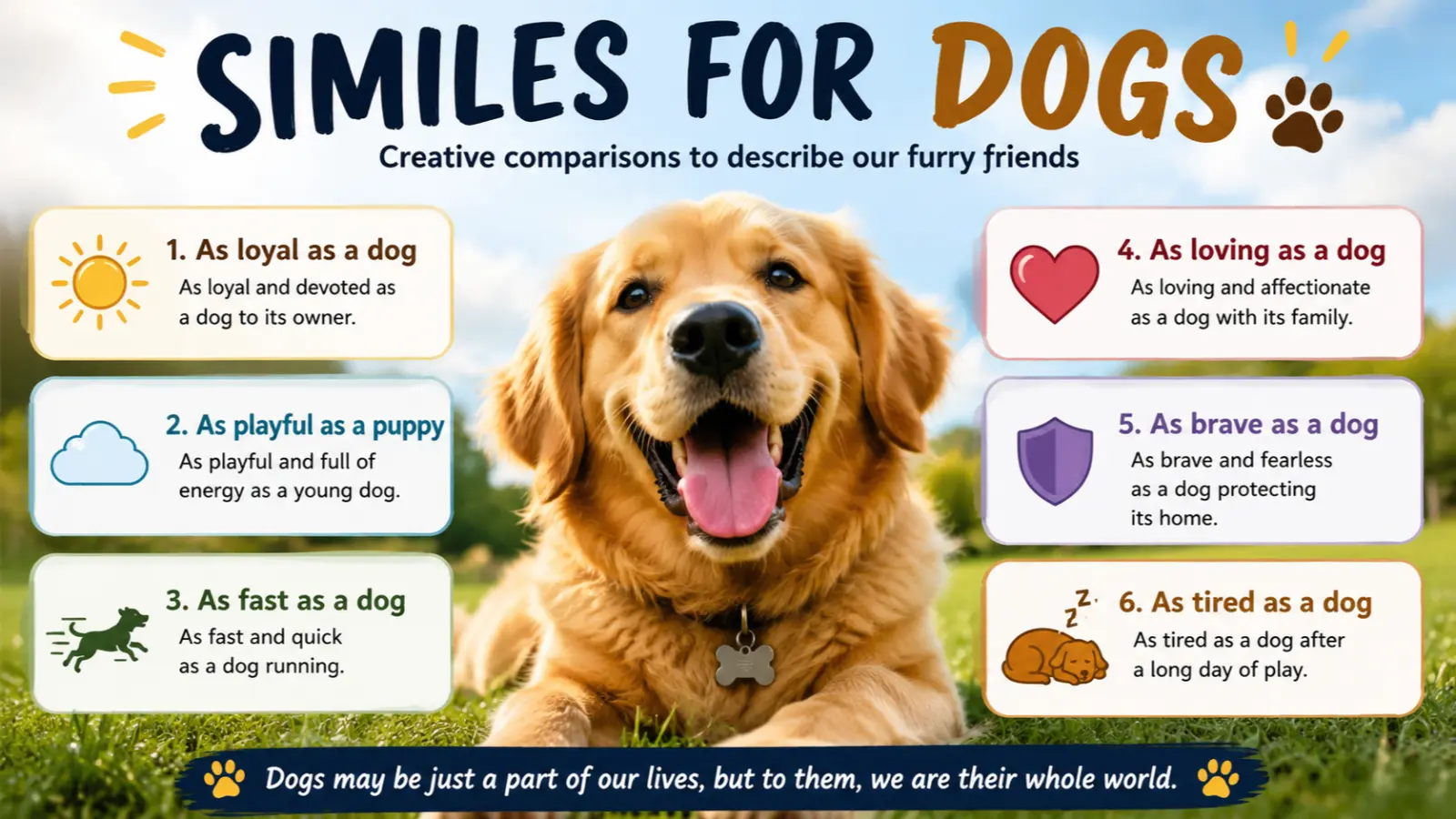
Similes for Dogs appear in stories, poems, conversations, and everyday descriptions because they naturally express loyalty, energy, curiosity, and emotion. A well-crafted simile can turn an ordinary sentence into a memorable image that readers instantly understand. A simile compares two different things using words like “as” or “like.” Instead of simply saying a dog is fast or friendly, a simile paints a picture that helps readers feel the moment. Whether you’re writing fiction, poetry, school assignments, or simply looking for creative ways to describe dogs, this collection offers original ideas that you can adapt to your own style.
What Is a Simile?
A simile is a figure of speech that compares one thing to another using like or as.
Examples:
- The puppy bounced like popcorn in a hot pan.
- The old dog rested as peacefully as a boat on a calm lake.
Rather than stating facts, similes create images that make writing more vivid and memorable.
Quick Answer
Similes for dogs are creative comparisons that describe a dog’s appearance, personality, movement, or behavior using words such as like or as. They help readers imagine scenes more clearly and add emotion, humor, and originality to stories, poems, and everyday writing.
Why Use Similes When Describing Dogs?
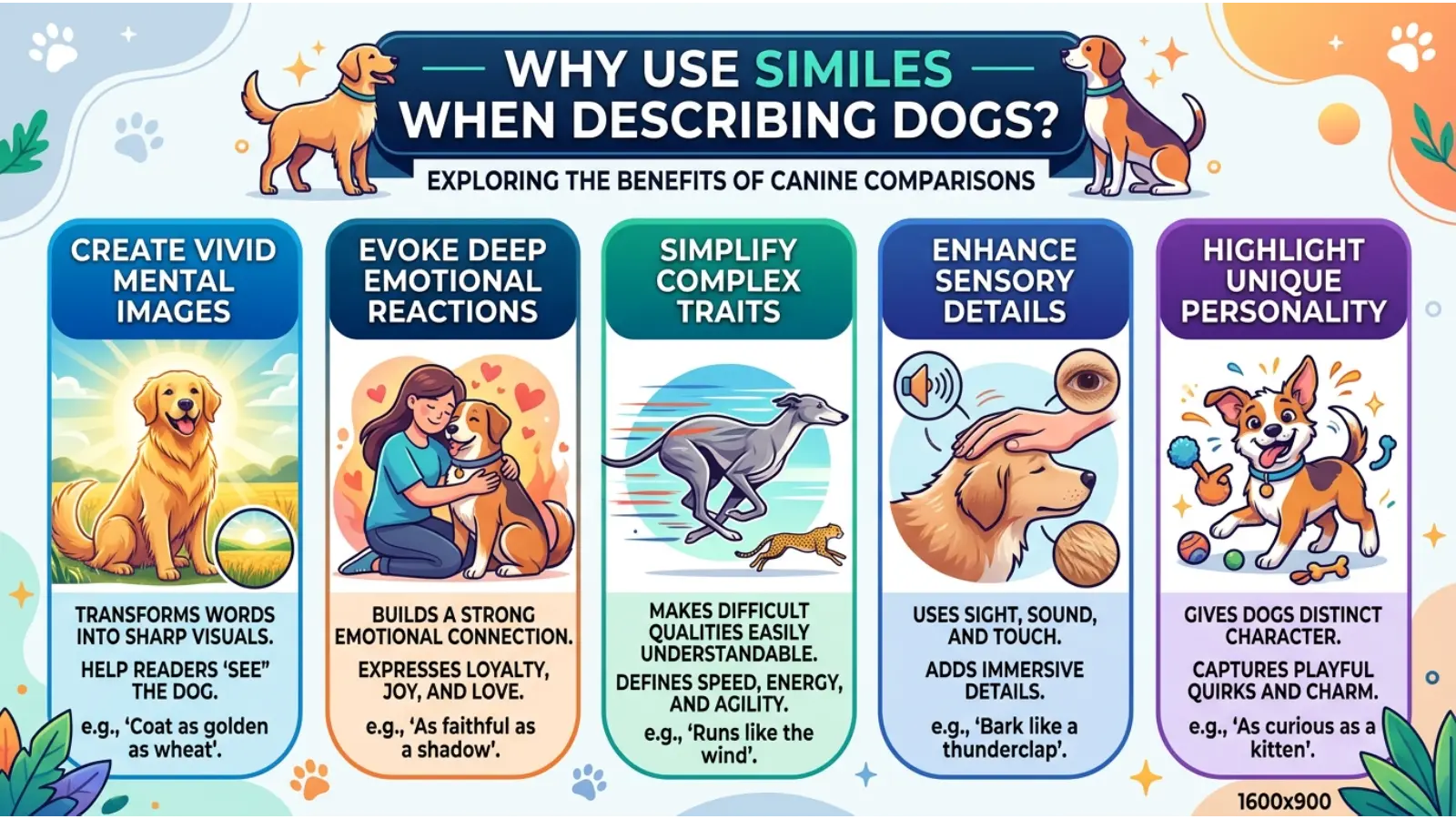
Dogs show a remarkable range of emotions and behaviors. One moment they sprint across a yard, and the next they quietly rest beside their owner. Similes help capture these changing moods in ways that plain adjectives cannot.
They are especially useful for:
- Creative writing
- Children’s stories
- Poetry
- Pet blogs
- School assignments
- Animal descriptions
- Everyday conversation
30 Original Similes for Dogs
1. Busy Like a Wind-Up Toy
Meaning
A dog that never seems to stop moving.
Examples
- The puppy raced around the yard like a wind-up toy.
- He greeted every guest like a wind-up toy that had just been released.
Writing Tip
Perfect for energetic puppies.
Best Context
Stories, pet blogs, conversations.
2. Loyal Like a Lighthouse
Meaning
Always dependable no matter the situation.
Examples
- She stayed beside her owner like a lighthouse through every storm.
- The rescue dog remained loyal like a lighthouse guiding ships home.
Emotional Effect
Trust and security.
3. Curious Like a Detective
Meaning
Constantly exploring.
Examples
- The beagle sniffed every corner like a detective.
- He inspected the garden like a detective solving a mystery.
Best Context
Adventure stories.
4. Soft Like Fresh Snow
Meaning
Exceptionally soft fur.
Examples
- The puppy’s ears felt like fresh snow.
- Her coat was soft like fresh snow under morning light.
Writing Purpose
Sensory description.
5. Fast Like a Falling Star
Meaning
Extremely quick.
Examples
- The greyhound shot across the field like a falling star.
- He disappeared after the ball like a falling star.
6. Happy Like Morning Sunshine
Meaning
Radiates joy.
Examples
- The Labrador greeted everyone like morning sunshine.
- His wagging tail spread happiness like morning sunshine.
7. Brave Like an Oak Tree
Meaning
Strong and fearless.
Examples
- The shepherd stood like an oak tree protecting the family.
- She faced danger like an oak tree in a storm.
8. Quiet Like Gentle Rain
Meaning
Calm and peaceful.
Examples
- The old dog slept like gentle rain falling at night.
- He walked beside me like gentle rain.
9. Gentle Like a Feather Floating
Meaning
Kind and careful.
Examples
- The therapy dog approached like a feather floating through the air.
- She carried the kitten like a feather floating.
10. Bright Like a Lantern
Meaning
Intelligent and alert.
Examples
- His eyes shone like a lantern.
- The border collie learned commands like a lantern lighting a room.
11. Playful Like Bubbles in the Breeze
Meaning
Full of fun.
Examples
- The puppies scattered like bubbles in the breeze.
- Every jump looked like bubbles dancing.
12. Patient Like an Old Clock
Meaning
Calm and steady.
Examples
- The service dog waited like an old clock.
- He remained still like an old clock keeping time.
13. Proud Like a Parade Leader
Meaning
Confident posture.
Examples
- The husky walked like a parade leader.
- She carried herself like a parade leader.
14. Friendly Like an Open Gate
Meaning
Welcoming everyone.
Examples
- The golden retriever greeted strangers like an open gate.
- His smile felt like an open gate.
15. Watchful Like a Mountain Eagle
Meaning
Always alert.
Examples
- The guard dog stood like a mountain eagle.
- His eyes searched the yard like a mountain eagle.
16. Calm Like Still Water
Meaning
Peaceful and relaxed.
Examples
- The elderly dog rested like still water.
- She waited quietly like still water.
17. Excited Like Fireworks
Meaning
Overflowing with enthusiasm.
Examples
- The puppy exploded from the doorway like fireworks.
- He welcomed visitors like fireworks lighting the sky.
18. Determined Like Flowing Rivers
Meaning
Never gives up.
Examples
- The tracking dog searched like a flowing river finding its path.
- She continued like a flowing river.
19. Cheerful Like Spring Birds
Meaning
Always uplifting.
Examples
- The puppy greeted everyone like spring birds singing.
- His bark sounded cheerful like spring birds.
20. Steady Like a Stone Bridge
Meaning
Reliable.
Examples
- The guide dog walked like a stone bridge.
- She remained dependable like a stone bridge.
21. Gentle Like Candlelight
Meaning
Comforting presence.
Examples
- The rescue dog comforted the child like candlelight.
- His touch felt like candlelight.
22. Brave Like the First Sunrise
Meaning
Hopeful courage.
Examples
- The search dog entered the forest like the first sunrise.
- She faced challenges like the first sunrise.
23. Quick Like a Skipping Pebble
Meaning
Fast and agile.
Examples
- The terrier darted like a skipping pebble.
- He changed direction like a skipping pebble.
24. Faithful Like the North Star
Meaning
Always dependable.
Examples
- The dog waited outside like the North Star.
- His loyalty stayed like the North Star.
25. Warm Like a Cozy Blanket
Meaning
Comforting companion.
Examples
- The dog curled beside me like a cozy blanket.
- Her presence felt like a cozy blanket.
26. Curious Like a New Explorer
Meaning
Always discovering.
Examples
- The puppy sniffed every leaf like a new explorer.
- He investigated every sound like a new explorer.
27. Strong Like River Current
Meaning
Powerful.
Examples
- The sled dog pulled like a river current.
- His muscles worked like a river current.
28. Silent Like Moonlight
Meaning
Moves quietly.
Examples
- The hunting dog crossed the field like moonlight.
- She appeared like moonlight across the grass.
29. Faithful Like a Favorite Song
Meaning
Always close to the heart.
Examples
- My old dog remained like a favorite song.
- His companionship felt like a favorite song.
30. Joyful Like a Picnic Afternoon
Meaning
Creates happiness wherever it goes.
Examples
- The puppy arrived like a picnic afternoon.
- Every walk felt like a picnic afternoon because of him.
How Great Writers Create Better Dog Similes
Strong similes do more than compare two things. They connect emotion with imagery. Instead of choosing random comparisons, think about what makes the dog unique.
Ask yourself:
- How does the dog move?
- What emotion does it create?
- What object or scene produces the same feeling?
- Will readers immediately understand the comparison?
The strongest similes are simple enough to imagine but original enough to surprise.
Related Literary Devices
Metaphor
Unlike a simile, a metaphor says something is another thing.
- Simile: The puppy was like a bouncing ball.
- Metaphor: The puppy was a bouncing ball.
Personification
Personification gives human qualities to animals or objects.
Example:
The sleepy dog smiled at the sunrise.
Imagery
Imagery appeals to the senses.
Instead of writing:
The dog ran.
Write:
The dog raced like a skipping pebble across the grass.
Hyperbole
Hyperbole uses exaggeration for emphasis.
Example:
The dog barked loud enough to wake the whole neighborhood.
Alliteration
Alliteration repeats beginning sounds.
Example:
Playful puppies pounced proudly.
Symbolism
Dogs often symbolize:
- Loyalty
- Protection
- Friendship
- Trust
- Courage
Combining symbolism with similes can create deeper emotional meaning.
Create Your Own Dog Similes
You don’t need to memorize dozens of comparisons. You can invent your own.
Step 1
Choose one trait.
Examples:
- Fast
- Gentle
- Loyal
- Curious
- Protective
Step 2
Think of something that naturally shares that quality.
For example:
Fast → shooting star
Gentle → floating feather
Loyal → lighthouse
Step 3
Connect them using like or as.
Example:
The rescue dog stayed beside her like a lighthouse through every storm.
Creative Exercise
Describe the same dog in five different ways:
- Running
- Sleeping
- Playing
- Protecting
- Greeting someone
Challenge yourself to use a different comparison each time.
Common Mistakes to Avoid
Using Overused Comparisons
Avoid relying on the same familiar similes. Fresh imagery leaves a stronger impression.
Mixing Images
Keep one clear comparison instead of blending unrelated ideas into a single simile.
Forcing a Comparison
Choose images that naturally match the dog’s behavior or personality.
Confusing Metaphors with Similes
Remember that similes use like or as, while metaphors do not.
Choosing Weak Descriptions
General comparisons create forgettable writing. Specific images make readers pause and picture the scene.
Frequently Asked Questions
What are similes for dogs?
They are comparisons using like or as to describe a dog’s appearance, personality, actions, or emotions.
Why should writers use similes when describing dogs?
Similes make descriptions more vivid, memorable, and emotionally engaging.
Can children use dog similes in school writing?
Yes. They help students develop descriptive language and creative thinking.
What’s the difference between a dog simile and a metaphor?
A simile uses like or as, while a metaphor makes a direct comparison without those words.
How can I create original dog similes?
Focus on one characteristic of the dog, find a matching image from nature or everyday life, and connect them with like or as.
Are dog similes useful in poetry?
Absolutely. They add rhythm, imagery, and emotional depth while helping readers visualize each scene.
Can I use similes in everyday conversation?
Yes. Creative comparisons make stories and conversations more colorful and memorable.
Conclusion
The best similes for dogs do more than describe wagging tails or playful behavior—they help readers experience loyalty, excitement, courage, and companionship through vivid imagery. By observing a dog’s unique traits and pairing them with fresh, believable comparisons, you can write descriptions that feel original and memorable. Use the examples in this guide as inspiration, then experiment with your own similes to develop a distinctive writing style that captures every dog’s personality.

I am Helena Frost, a writer captivated by the beauty of language and the art of comparison. Through my words, I explore the world by turning ordinary moments into vivid similes and reflections. I enjoy crafting phrases that spark imagination, evoke emotion, and linger in the mind. My writing celebrates the subtle connections between people, nature, and the stories we live. For me, every sentence is an opportunity to reveal the extraordinary in the everyday.