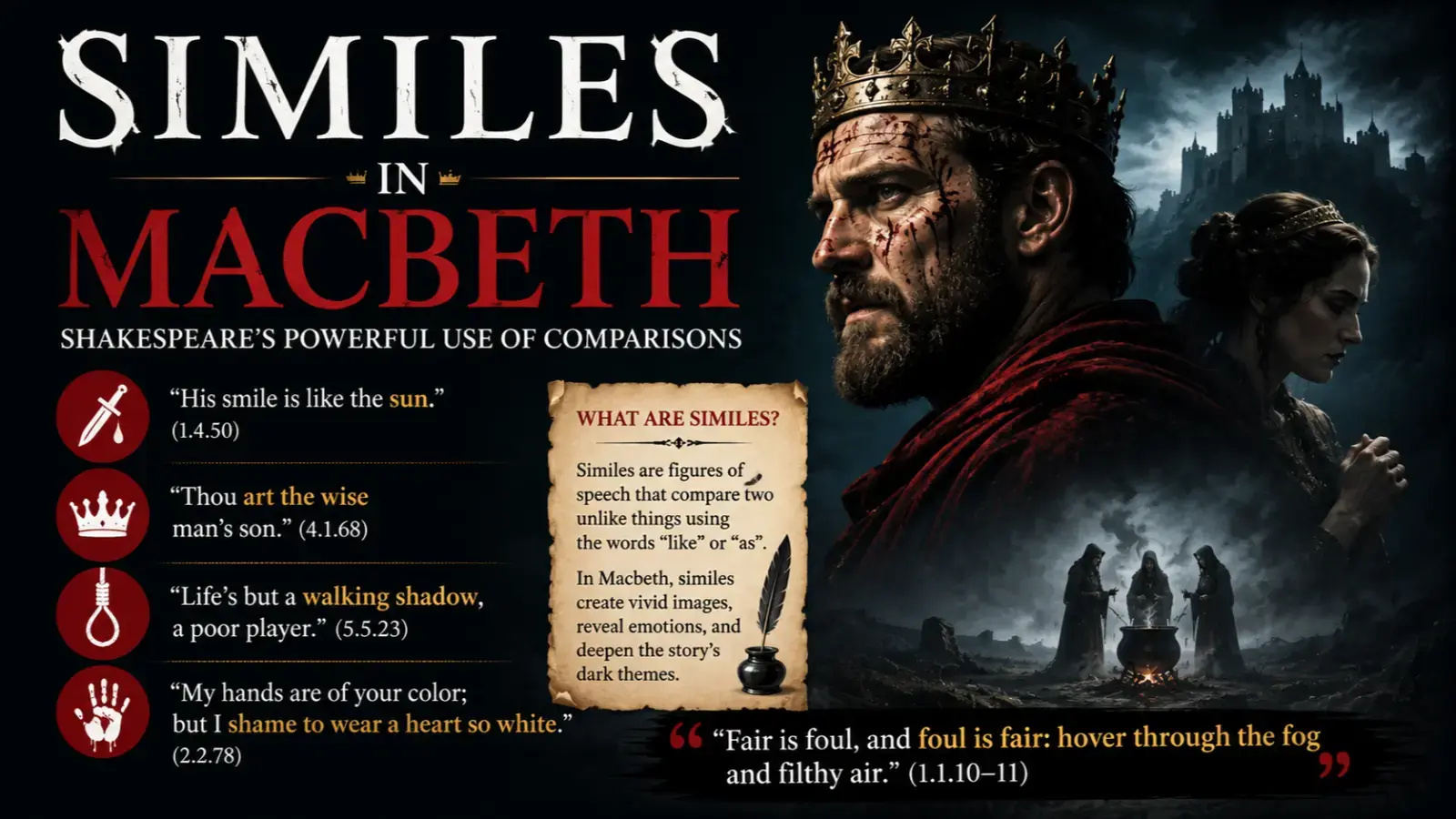
Smiles in Macbeth is famous for its dark imagery, memorable metaphors, and powerful language. While readers often remember the play for its symbolism and metaphors, similes also help create vivid pictures of ambition, guilt, fear, violence, and fate. A simile compares two unlike things using “like” or “as.” These comparisons make emotions easier to imagine and scenes more memorable. Whether you’re studying Macbeth, writing a literary essay, or creating your own dramatic stories, understanding how similes work can strengthen your writing. This guide explores original similes in Macbeth, explains why they are effective, and shows you how to create similar comparisons in your own work.
Quick Answer
Similes in Macbeth compare people, emotions, or events using “like” or “as” to create vivid imagery. They highlight themes such as ambition, fear, guilt, darkness, fate, and violence. Writers can use similar techniques to make descriptions more emotional and memorable.
Why Similes Matter in Macbeth
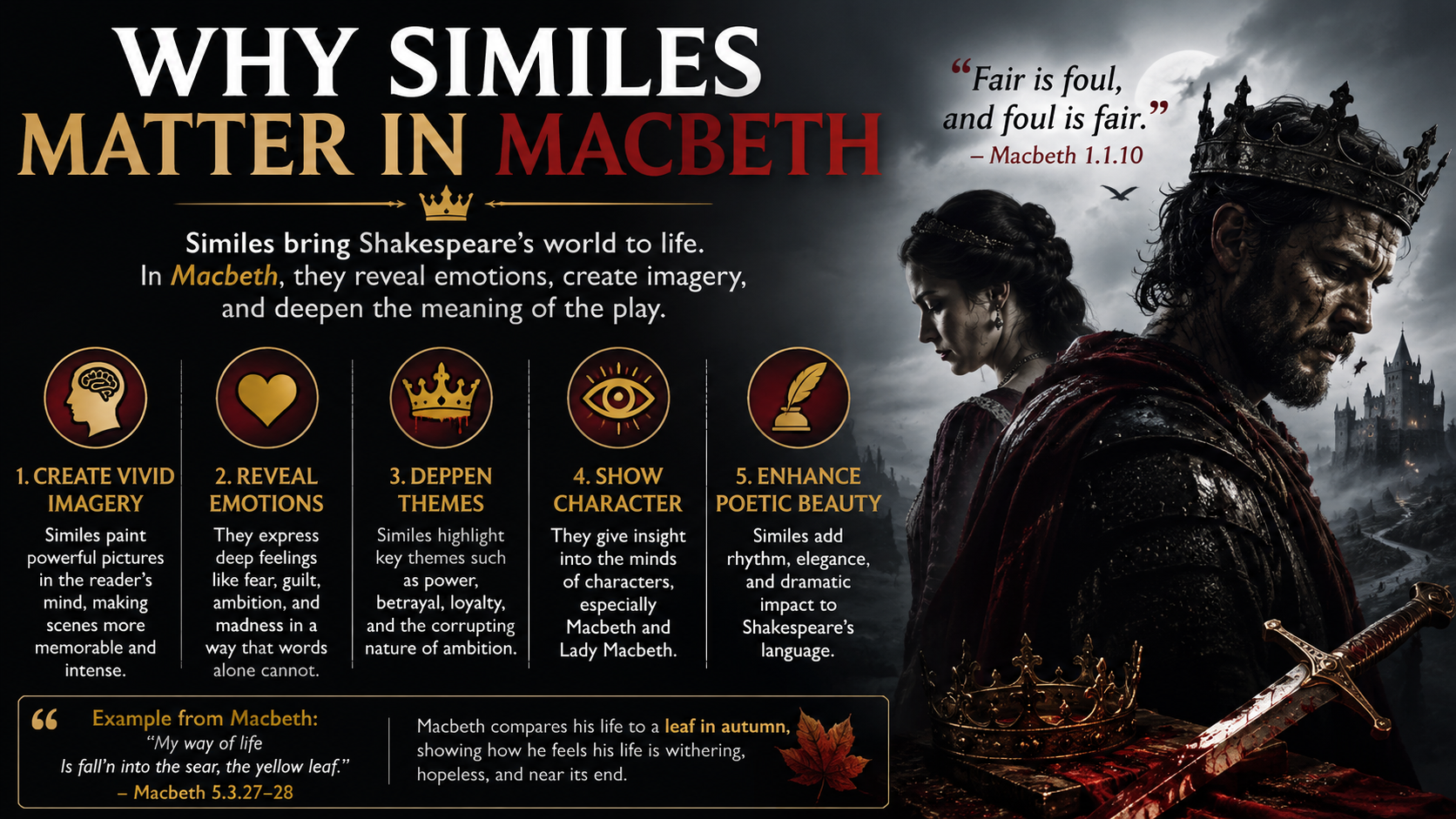
The world of Macbeth is filled with emotional extremes. Characters experience overwhelming ambition, crushing guilt, terrifying visions, and violent conflict.
Similes help readers picture these emotions instead of simply being told about them.
A strong simile can:
- Make fear feel immediate.
- Turn abstract emotions into visual images.
- Reveal a character’s state of mind.
- Build suspense.
- Strengthen dramatic scenes.
Instead of saying someone is frightened, a simile allows readers to experience that fear through comparison.
Themes That Inspire Similes in Macbeth
Many original similes inspired by Macbeth focus on recurring themes such as:
- Ambition
- Guilt
- Darkness
- Blood
- Fate
- Power
- Fear
- Kingship
- Betrayal
- Madness
Keeping these themes in mind helps writers produce comparisons that match Shakespeare’s dramatic atmosphere.
Original Similes Inspired by Macbeth
1. Ambition burned like a hidden wildfire.
Meaning
Unchecked ambition grows quietly before becoming destructive.
Example Sentences
- His ambition burned like a hidden wildfire beneath every polite smile.
- Macbeth’s desire for the throne spread like a hidden wildfire through his thoughts.
Writing Tip
Use this when ambition begins subtly before causing disaster.
2. Fear clung to him like cold mist.
Meaning
Fear surrounds someone and refuses to leave.
Examples
- Fear clung to him like cold mist after the strange prophecy.
- The soldiers carried fear like cold mist into battle.
Best Context
Psychological tension.
3. Her guilt echoed like footsteps in an empty castle.
Meaning
Guilt repeatedly returns to someone’s thoughts.
Examples
- Her guilt echoed like footsteps in an empty castle.
- Every memory echoed like footsteps after the crime.
Emotional Effect
Loneliness and regret.
4. The night spread like spilled ink across the sky.
Meaning
Darkness arrives completely.
Examples
- The night spread like spilled ink before the murder.
- Silence followed as darkness spread like spilled ink.
Storytelling Use
Scene transitions.
5. His conscience cracked like thin ice.
Meaning
Moral strength suddenly collapses.
Examples
- His conscience cracked like thin ice after the murder.
- Every lie made his conscience crack like thin ice.
6. The prophecy glittered like a dangerous jewel.
Meaning
Something attractive hides great danger.
Examples
- The witches’ words glittered like a dangerous jewel.
- Power glittered like a dangerous jewel before him.
7. Suspicion grew like thorny vines.
Meaning
Doubt spreads and becomes difficult to escape.
Examples
- Suspicion grew like thorny vines around the court.
- Every whisper allowed suspicion to grow.
8. Hope faded like the last candle in a storm.
Meaning
Hope slowly disappears.
Examples
- Hope faded like the last candle in a storm.
- The kingdom watched hope disappear.
9. His crown rested like borrowed armor.
Meaning
Power feels unnatural or undeserved.
Examples
- The crown rested like borrowed armor upon his head.
- Leadership felt like borrowed armor.
10. Revenge followed him like a hungry wolf.
Meaning
Consequences constantly pursue someone.
Examples
- Revenge followed him like a hungry wolf.
- Every decision fed the wolf of revenge.
11. Lies multiplied like shadows at sunset.
Meaning
One lie creates many more.
Examples
- Lies multiplied like shadows at sunset.
- The court became crowded with growing lies.
12. Courage flashed like lightning through dark clouds.
Meaning
Bravery appears suddenly.
Examples
- Courage flashed like lightning before the final battle.
- His resolve appeared unexpectedly.
13. Doubt settled like heavy snow.
Meaning
Uncertainty becomes overwhelming.
Examples
- Doubt settled like heavy snow over the kingdom.
- Every conversation added another layer.
14. Power slipped through his fingers like river water.
Meaning
Control cannot be held forever.
Examples
- Power slipped through his fingers like river water.
- His influence disappeared quickly.
15. Anger exploded like a breaking dam.
Meaning
Emotion becomes impossible to control.
Examples
- Anger exploded like a breaking dam.
- Years of frustration burst free.
16. Silence stood between them like a locked gate.
Meaning
Communication completely stops.
Examples
- Silence stood between husband and wife.
- No apology crossed the locked gate.
17. Betrayal cut like winter wind.
Meaning
Betrayal causes deep emotional pain.
Examples
- Betrayal cut like winter wind.
- The truth felt painfully cold.
18. Madness drifted over him like dark smoke.
Meaning
Mental confusion gradually increases.
Examples
- Madness drifted over him like dark smoke.
- His thoughts became impossible to control.
19. The battlefield roared like an angry sea.
Meaning
Battle feels chaotic and overwhelming.
Examples
- The battlefield roared like an angry sea.
- Soldiers disappeared into the noise.
20. Fate waited like a patient hunter.
Meaning
Destiny cannot be escaped.
Examples
- Fate waited like a patient hunter.
- Every choice brought him closer to his end.
21. Blood stained his memory like permanent paint.
Meaning
Violence cannot be forgotten.
Examples
- Blood stained his memory forever.
- Every dream carried the same stain.
22. The castle watched like a silent witness.
Meaning
The setting seems to observe every event.
Examples
- The castle watched like a silent witness.
- Ancient walls remembered every crime.
23. His promises shattered like fragile glass.
Meaning
Trust is destroyed instantly.
Examples
- His promises shattered after the betrayal.
- Every broken oath left sharp pieces behind.
24. Despair settled like thick fog over the kingdom.
Meaning
Sadness affects everyone.
Examples
- Despair settled across Scotland.
- No one could see hope ahead.
How Shakespearean Similes Create Strong Imagery
Effective dramatic similes often share three qualities:
They match the mood.
Dark scenes use images of storms, shadows, winter, smoke, or blood.
They reveal emotion.
Instead of describing feelings directly, they let readers experience them through vivid comparisons.
They stay believable.
Even imaginative comparisons should make emotional sense within the story.
How to Write Your Own Macbeth-Style Similes
Follow this simple process.
Step 1: Pick an emotion.
Examples include:
- Fear
- Guilt
- Pride
- Rage
- Ambition
Step 2: Find an image.
Choose something readers can easily picture.
Examples:
- Ice
- Fire
- Storm
- Forest
- Raven
- Smoke
- Moonlight
Step 3: Connect them naturally.
Instead of forcing a comparison, ask:
“What does this emotion behave like?”
For example:
- Fear spread like frost.
- Ambition climbed like ivy.
- Hope flickered like a lantern.
Practice Exercise
Write one simile for each emotion:
- Guilt
- Jealousy
- Courage
- Revenge
- Despair
Then revise each comparison by replacing ordinary objects with more vivid images from nature or history.
Common Mistakes When Writing Dramatic Similes
Using clichés
Comparisons such as “as brave as a lion” rarely surprise readers.
Instead, look for fresh imagery that matches your story.
Mixing unrelated images
Avoid combining comparisons that create confusing mental pictures.
Stay focused on one clear image.
Comparing things without purpose
Every simile should reveal character, emotion, or atmosphere.
If it adds nothing, remove it.
Confusing metaphors and similes
A simile uses like or as.
Example:
Fear spread like smoke.
A metaphor states the comparison directly.
Example:
Fear became smoke.
Understanding the difference improves literary analysis and writing accuracy.
Related Literary Devices in Macbeth
Metaphor
Shakespeare frequently uses metaphors to deepen themes of ambition, fate, and guilt by making direct comparisons.
Imagery
Visual descriptions of blood, darkness, weather, and supernatural events create unforgettable scenes.
Personification
Nature often appears alive, reflecting the emotional turmoil of the characters.
Symbolism
Objects such as blood, crowns, daggers, and sleep represent larger ideas throughout the play.
Alliteration
Repeated consonant sounds increase rhythm and dramatic intensity in speeches.
Frequently Asked Questions
Does Macbeth contain similes?
Yes. While Macbeth is especially known for its metaphors and symbolism, Shakespeare also uses similes to create vivid descriptions and emotional impact.
Why are similes important in Macbeth?
They help readers visualize emotions, strengthen dramatic scenes, and reveal characters’ thoughts more clearly.
What themes do Macbeth similes usually explore?
Common themes include ambition, guilt, fear, violence, betrayal, power, darkness, and fate.
How can students identify a simile?
Look for comparisons that use the words like or as.
Are similes different from metaphors?
Yes. Similes compare using “like” or “as,” while metaphors make direct comparisons without those words.
Can I create my own Macbeth-inspired similes?
Absolutely. Focus on the play’s themes and combine them with vivid natural or symbolic imagery to create fresh, meaningful comparisons.
Conclusion
Studying similes in Macbeth is about more than identifying literary devices. It reveals how carefully chosen comparisons can transform ordinary descriptions into unforgettable moments. By understanding why these comparisons work—and practicing your own—you can enrich essays, stories, poems, and dramatic writing with imagery that feels vivid, purposeful, and emotionally powerful. The best similes don’t simply decorate a sentence; they deepen meaning and stay with the reader long after the page is turned.

I am Helena Frost, a writer captivated by the beauty of language and the art of comparison. Through my words, I explore the world by turning ordinary moments into vivid similes and reflections. I enjoy crafting phrases that spark imagination, evoke emotion, and linger in the mind. My writing celebrates the subtle connections between people, nature, and the stories we live. For me, every sentence is an opportunity to reveal the extraordinary in the everyday.