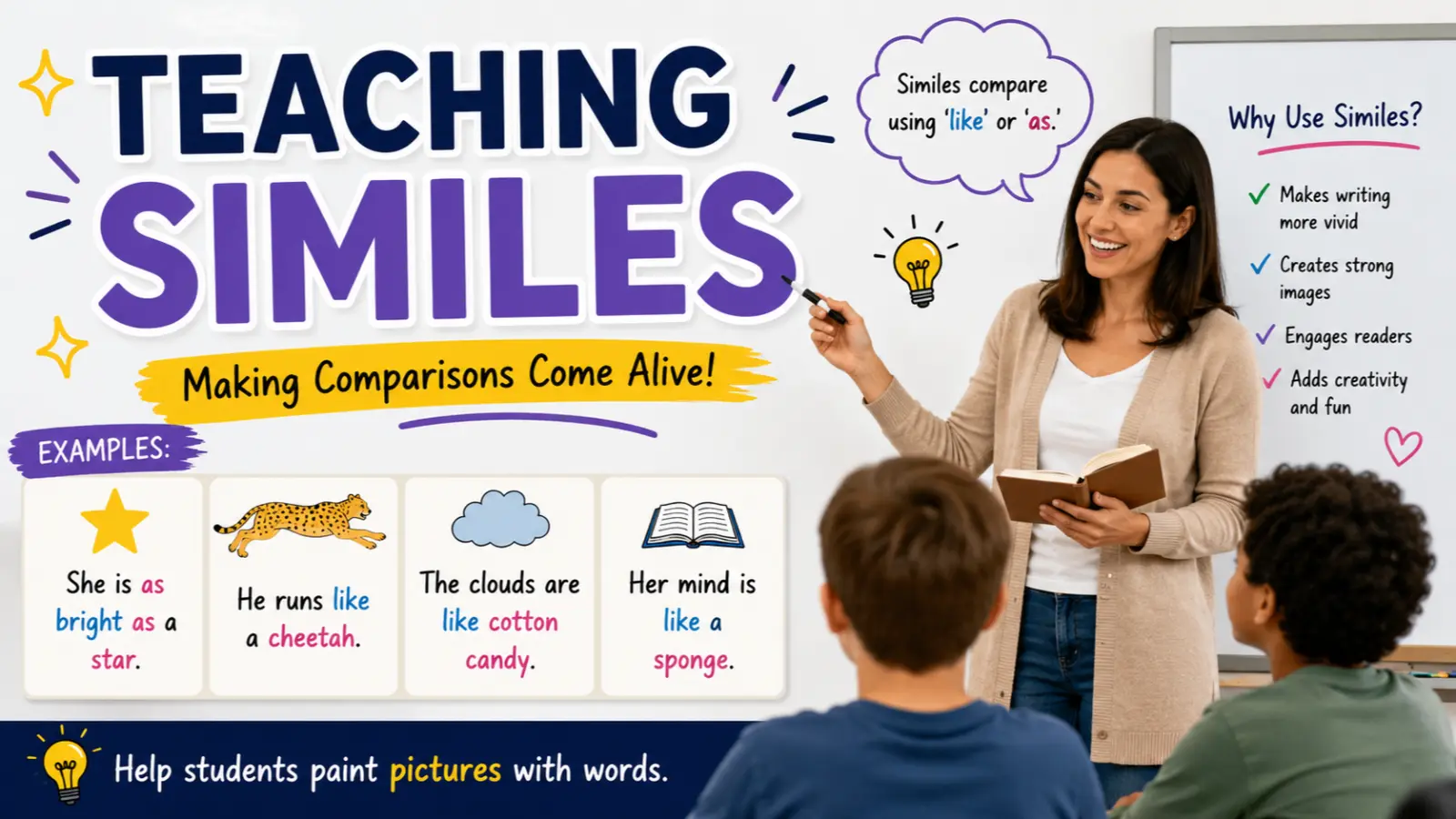
Teaching similes is one of the most enjoyable ways to help students discover the power of descriptive language. A simple comparison can turn an ordinary sentence into one that sparks imagination and emotion.
A simile compares two different things using the words like or as. Instead of saying, “The classroom was quiet,” a writer might say, “The classroom was as quiet as a library at sunrise.“ The comparison paints a clearer picture in the reader’s mind.
Whether you’re a teacher, parent, homeschool educator, or student, this guide will help you understand how to teach similes effectively, encourage creativity, and inspire stronger writing.
What Is a Simile?
A simile is a figure of speech that compares two unlike things using like or as to highlight a shared quality.
Instead of telling readers something directly, similes help them imagine it through comparison.
Example:
- “Her smile was like the first ray of morning sunlight.”
Rather than simply saying she smiled beautifully, the comparison creates warmth and optimism.
Why Teaching Similes Matters
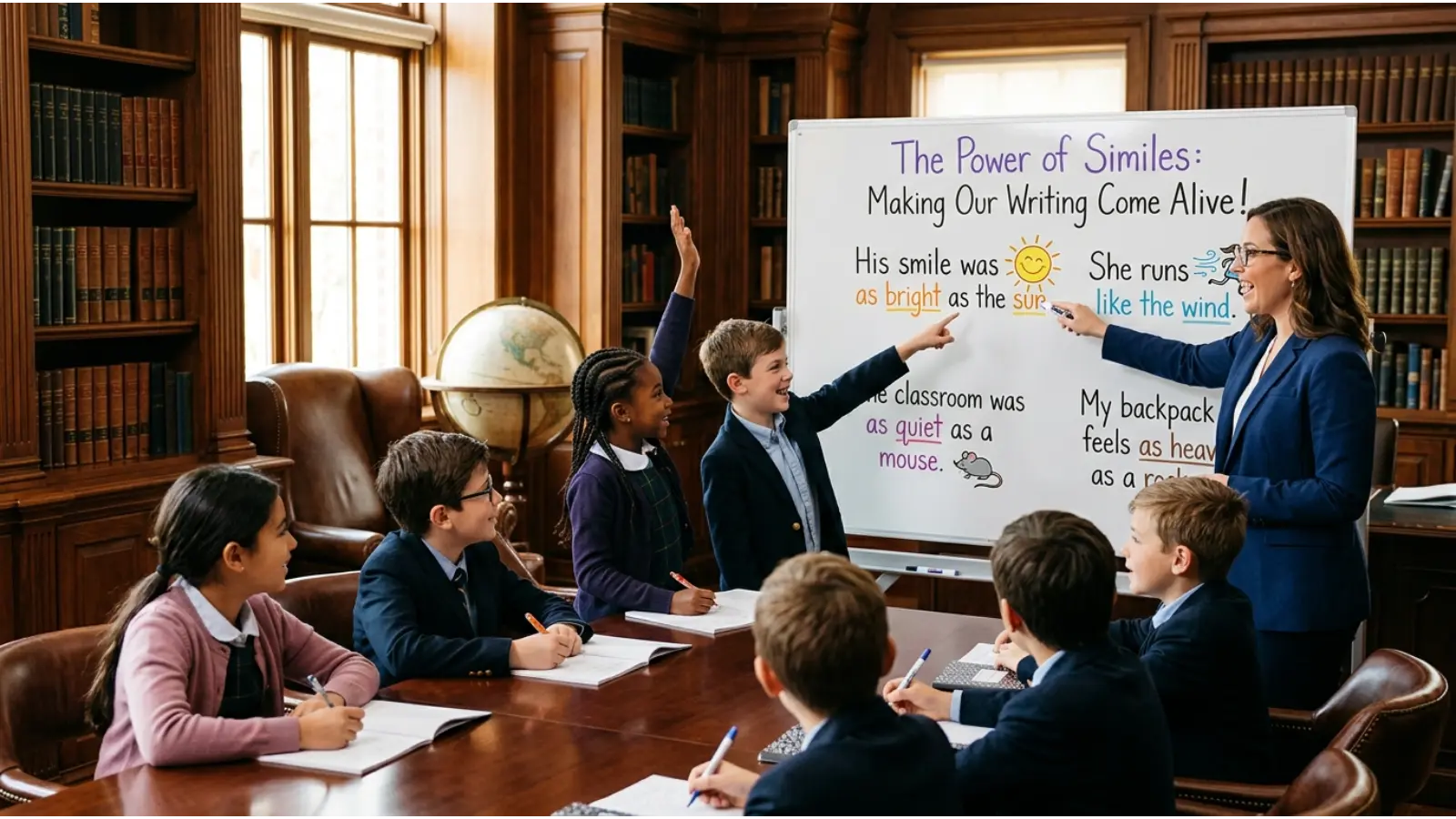
Students often begin writing with plain descriptions.
Teaching similes helps them:
- Develop richer vocabulary
- Improve descriptive writing
- Build creativity
- Understand figurative language
- Make stories more engaging
- Read literature with greater understanding
Once students recognize how comparisons create imagery, they begin noticing similes in books, poems, songs, and everyday conversations.
How to Introduce Similes to Students
Begin with familiar objects.
Instead of explaining literary terms immediately, ask students simple questions.
For example:
How is ice cream like a cloud?
Possible answers:
- Soft
- Light
- Sweet
- Makes people happy
Students naturally begin making comparisons before learning the formal definition.
After several examples, introduce the rule:
A simile compares two unlike things using like or as.
Learning through discovery often makes the concept easier to remember.
25 Original Similes for Teaching
1. As curious as a squirrel at a picnic
Meaning: Extremely interested in everything.
Examples
- Mia was as curious as a squirrel at a picnic during the science experiment.
- The puppy explored every corner, as curious as a squirrel at a picnic.
Best for: Character descriptions
Writing Tip: Use for energetic personalities.
2. Like a lantern in thick fog
Meaning: Giving hope during confusion.
Examples
- Her advice was like a lantern in thick fog.
- The teacher’s explanation felt like a lantern in thick fog.
Emotional Effect: Comfort
3. As gentle as falling feathers
Meaning: Very soft or kind.
Examples
- His voice was as gentle as falling feathers.
- She placed the kitten down as gentle as falling feathers.
Best Context: Emotional scenes
4. Like rain waking a sleepy garden
Meaning: Bringing new energy.
Examples
- Fresh ideas spread like rain waking a sleepy garden.
- Her encouragement felt like rain waking a sleepy garden.
5. As steady as an old lighthouse
Meaning: Dependable.
Examples
- Grandpa remained as steady as an old lighthouse.
- The captain stayed as steady as an old lighthouse.
6. Like a kite finding the wind
Meaning: Suddenly becoming successful.
Examples
- His confidence rose like a kite finding the wind.
- The project moved like a kite finding the wind.
7. As bright as fresh paint
Meaning: Full of energy and color.
Examples
- Her artwork looked as bright as fresh paint.
- The classroom became as bright as fresh paint after decorating.
8. Like footprints after fresh snow
Meaning: Easy to notice.
Examples
- His mistakes stood out like footprints after fresh snow.
- Kindness spread like footprints after fresh snow.
9. As calm as a sleeping lake
Meaning: Completely peaceful.
Examples
- She stayed as calm as a sleeping lake.
- The room became as calm as a sleeping lake.
10. Like stars hiding behind clouds
Meaning: Great potential not yet visible.
Examples
- His talent was like stars hiding behind clouds.
- Their ideas were like stars hiding behind clouds.
11. As playful as leaves in the breeze
Meaning: Cheerful.
Examples
- The children were as playful as leaves in the breeze.
- The puppy acted as playful as leaves in the breeze.
12. Like warm bread on a cold morning
Meaning: Comforting.
Examples
- Her hug felt like warm bread on a cold morning.
- His words were like warm bread on a cold morning.
13. As patient as a tree growing quietly
Meaning: Extremely patient.
Examples
- The coach stayed as patient as a tree growing quietly.
- Dad remained as patient as a tree growing quietly.
14. Like a bookmark in a favorite novel
Meaning: Always remembered.
Examples
- Her kindness stayed like a bookmark in a favorite novel.
- The lesson remained like a bookmark in a favorite novel.
15. As focused as an eagle choosing its path
Meaning: Deep concentration.
Examples
- Ava was as focused as an eagle choosing its path.
- The artist became as focused as an eagle choosing its path.
16. Like fresh footprints on a beach
Meaning: Leaving a lasting impression.
Examples
- His speech stayed like fresh footprints on a beach.
- Their teamwork remained like fresh footprints on a beach.
17. As welcoming as an open gate
Meaning: Friendly.
Examples
- The librarian was as welcoming as an open gate.
- Their home felt as welcoming as an open gate.
18. Like a candle lighting another candle
Meaning: Sharing knowledge.
Examples
- Teaching is like a candle lighting another candle.
- Her encouragement spread like a candle lighting another candle.
19. As fresh as the first page of a notebook
Meaning: Full of possibilities.
Examples
- Monday felt as fresh as the first page of a notebook.
- Their idea was as fresh as the first page of a notebook.
20. Like a bridge across rushing water
Meaning: Bringing people together.
Examples
- Kindness is like a bridge across rushing water.
- Conversation became like a bridge across rushing water.
21. As cheerful as birds greeting sunrise
Meaning: Very happy.
Examples
- Lily arrived as cheerful as birds greeting sunrise.
- The campers sounded as cheerful as birds greeting sunrise.
22. Like a compass pointing home
Meaning: Giving direction.
Examples
- Her values were like a compass pointing home.
- The mentor became like a compass pointing home.
23. As flexible as young bamboo
Meaning: Adaptable.
Examples
- Good leaders stay as flexible as young bamboo.
- The team remained as flexible as young bamboo.
24. Like sunshine finding a window
Meaning: Bringing unexpected joy.
Examples
- His laugh spread like sunshine finding a window.
- Good news arrived like sunshine finding a window.
25. As dependable as tomorrow’s sunrise
Meaning: Reliable.
Examples
- My best friend is as dependable as tomorrow’s sunrise.
- The school bus was as dependable as tomorrow’s sunrise.
How Great Writers Build Strong Similes
Strong similes focus on one clear quality.
Instead of comparing everything, choose one feature that readers can immediately recognize.
Ask yourself:
- What does it look like?
- What emotion does it create?
- What familiar object shares that quality?
Unexpected but believable comparisons are often the most memorable.
Classroom Activities for Teaching Similes
Finish the Comparison
Provide half of a simile.
Example:
- As brave as ________
- Like ________ in the rain
Students complete the comparison creatively.
Simile Hunt
Ask students to find similes in:
- Picture books
- Poems
- Song lyrics
- Novels
- Advertisements
Discuss why each comparison works.
Object Challenge
Place random classroom objects on a table.
Examples:
- Pencil
- Balloon
- Rock
- Leaf
- Clock
Students write one original simile for each object.
Story Expansion
Give students a plain sentence.
“The forest was dark.”
Possible revision:
“The forest was as mysterious as a forgotten hallway beneath an old castle.”
Students quickly see how imagery improves writing.
Related Literary Devices
Metaphor
A metaphor compares without using like or as.
- Simile: “She was like sunshine.”
- Metaphor: “She was sunshine.”
Imagery
Imagery appeals to the senses.
Similes often strengthen imagery by making descriptions easier to picture.
Personification
Personification gives human qualities to non-human things.
Example:
“The wind whispered.”
It can work beautifully alongside similes.
Hyperbole
Hyperbole exaggerates for emphasis.
Example:
“I waited forever.”
Unlike similes, hyperbole is not always a comparison.
Symbolism
A symbol represents a larger idea.
Similes may include symbolic images, but their primary purpose is comparison.
How to Create Your Own Similes
Follow these steps:
- Choose a subject.
- Decide what quality you want to describe.
- Think of something readers already know.
- Compare them using like or as.
- Read it aloud.
- Replace ordinary comparisons with more surprising ones.
Practice Exercise
Describe these using original similes:
- A rainy afternoon
- A nervous student
- A loyal friend
- A noisy cafeteria
- A successful team
Try writing three different comparisons for each subject. The first idea is rarely the most original.
Common Mistakes When Teaching Similes
Relying on Overused Comparisons
Students often repeat familiar similes they’ve heard before.
Encourage fresh observations instead.
Mixing Different Images
A comparison should stay focused.
Avoid combining unrelated images in one sentence.
Confusing Similes with Metaphors
Remember:
- Similes use like or as.
- Metaphors do not.
Forcing Comparisons
Not every sentence needs figurative language.
A few well-placed similes are usually stronger than many weak ones.
Ignoring Context
A humorous simile may not fit a serious story.
Always match the comparison to the tone of the writing.
Frequently Asked Questions
What is the easiest way to teach similes?
Start with familiar objects and simple comparisons before introducing the formal definition. Hands-on activities help students understand the concept quickly.
At what age should students learn similes?
Many children begin learning simple similes in elementary school, although older students can explore more creative and complex comparisons.
What’s the difference between a simile and a metaphor?
A simile uses like or as, while a metaphor makes a direct comparison without those words.
How can students avoid cliché similes?
Encourage them to observe everyday life and create comparisons based on personal experiences instead of memorized phrases.
Why are similes important in writing?
They make descriptions more vivid, improve imagery, create emotional connections, and help readers visualize ideas.
Can similes be used in nonfiction?
Yes. They can clarify complex ideas, explain unfamiliar concepts, and make educational writing more engaging when used appropriately.
Conclusion
Teaching similes is about more than introducing a literary device. It encourages students to notice details, think creatively, and express ideas with greater precision. By practicing original comparisons, experimenting with different images, and reading widely, writers of all ages can develop a stronger, more engaging style. The best similes don’t simply decorate a sentence—they help readers see the world from a fresh perspective.

I am Helena Frost, a writer captivated by the beauty of language and the art of comparison. Through my words, I explore the world by turning ordinary moments into vivid similes and reflections. I enjoy crafting phrases that spark imagination, evoke emotion, and linger in the mind. My writing celebrates the subtle connections between people, nature, and the stories we live. For me, every sentence is an opportunity to reveal the extraordinary in the everyday.