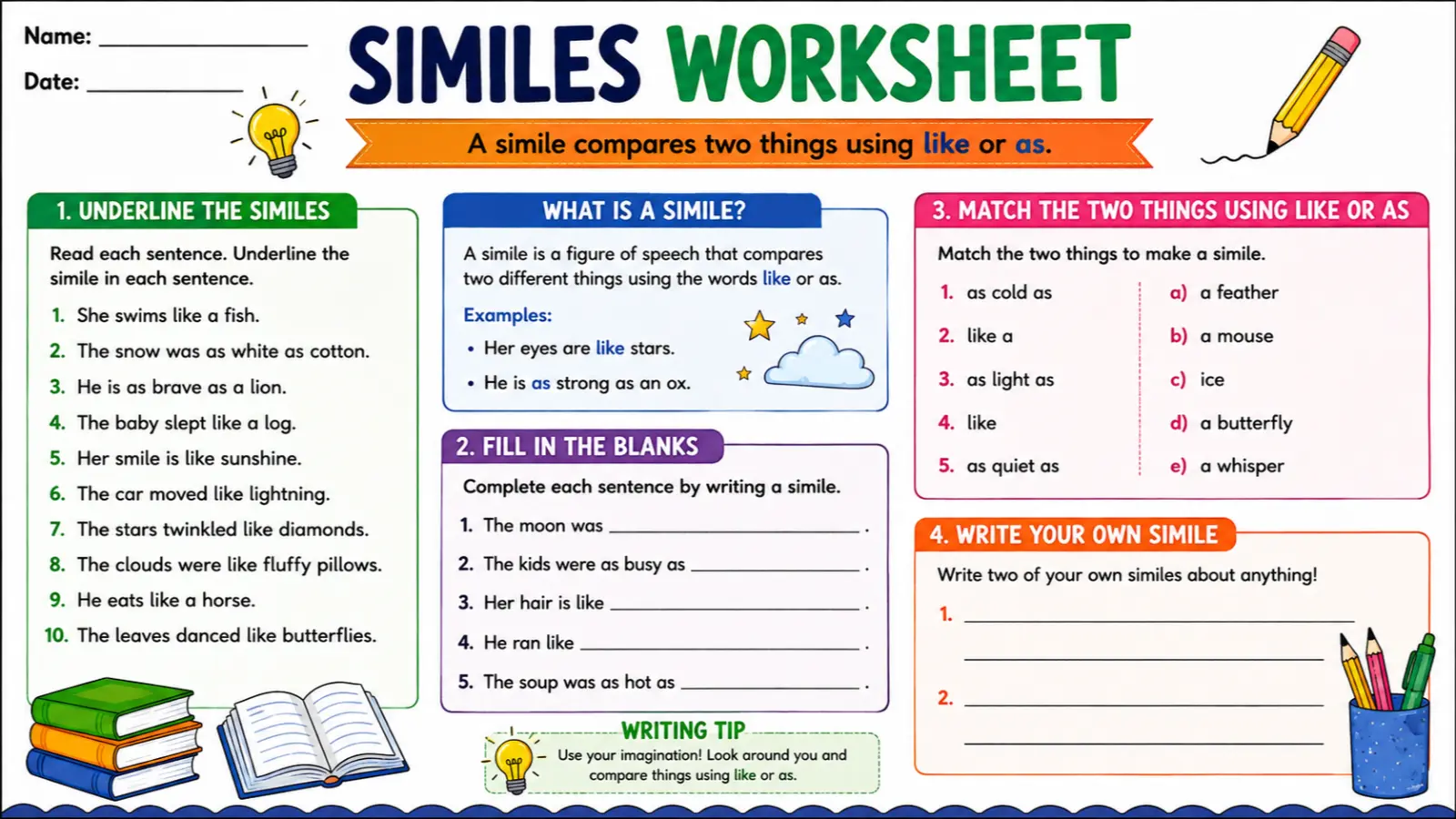
Learning similes becomes much easier when you use a worksheet that encourages creativity instead of simple memorization. A good similes worksheet helps students recognize comparisons, understand their meaning, and create original descriptions that make writing more engaging. Whether you’re a student, teacher, parent, or aspiring writer, this guide offers practical worksheet activities, fresh examples, and creative exercises that build confidence while making figurative language enjoyable.
Quick Answer
A similes worksheet is a learning resource that teaches students how to recognize, understand, complete, and create similes using the words like or as. The best worksheets combine reading, writing, discussion, and creative thinking so learners can apply similes naturally in stories, poems, and everyday conversations.
What Is a Simile?
A simile compares two different things using like or as.
Instead of simply saying someone is happy, a simile paints a picture.
Example:
Her smile spread like morning sunshine across a quiet field.
The comparison helps readers imagine the feeling rather than simply reading about it.
Why Practice with a Similes Worksheet?
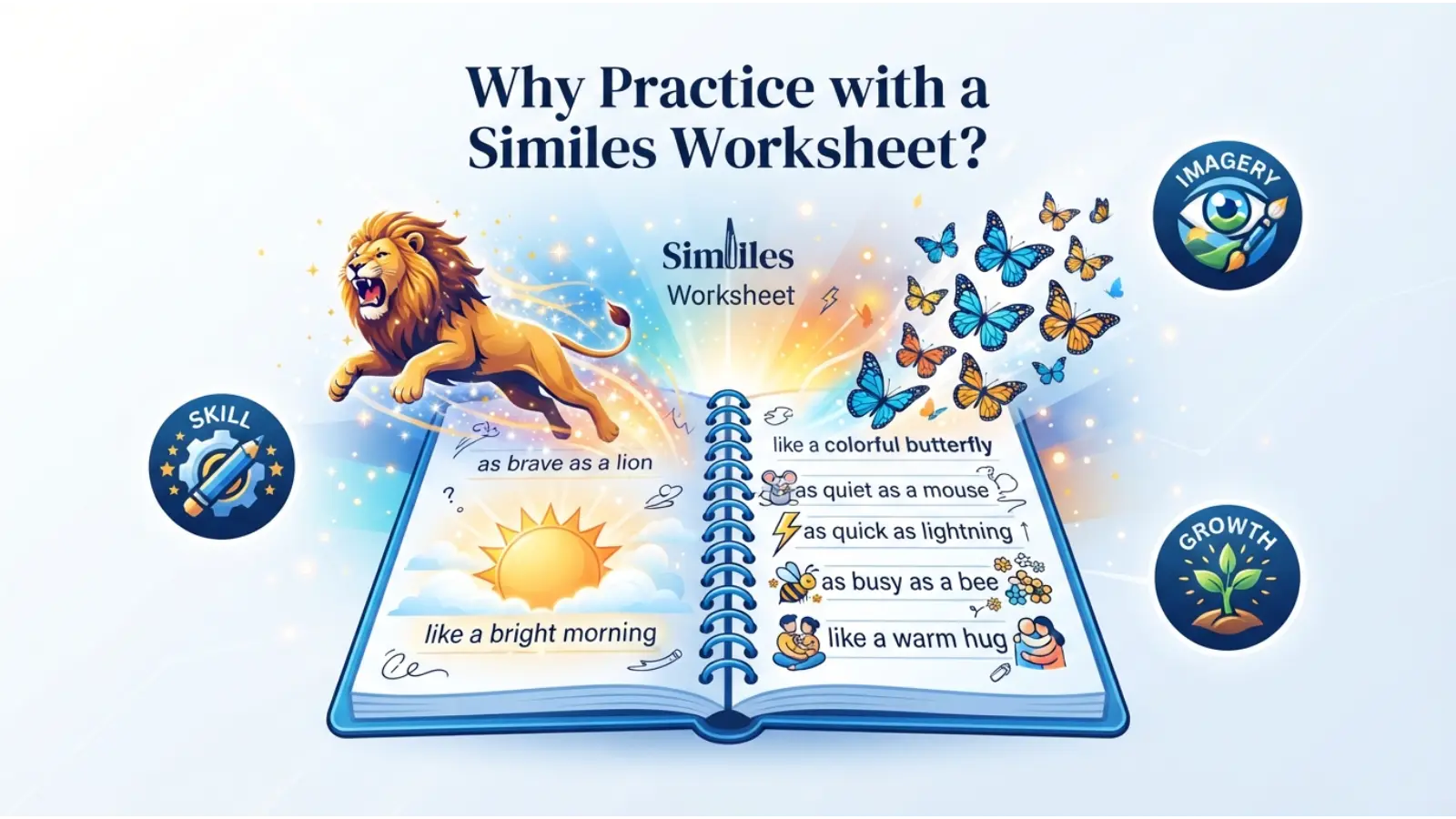
Reading examples is helpful, but writing your own similes develops stronger creative thinking.
A worksheet encourages learners to:
- Notice descriptive language
- Build vocabulary
- Improve storytelling
- Make essays more interesting
- Write memorable poems
- Express emotions more clearly
- Develop imagination
Instead of copying familiar comparisons, students learn how to invent fresh imagery.
How to Use This Similes Worksheet
Work through the activities in order.
- Read each simile carefully.
- Think about why the comparison works.
- Explain the meaning in your own words.
- Write an original sentence.
- Create a completely new simile using the same idea.
This process strengthens both reading and writing skills.
Original Similes Worksheet Examples
1. Quiet as fresh snowfall
Meaning
Complete silence.
Writing Purpose
Creates a peaceful atmosphere.
Story Example
The classroom became as quiet as fresh snowfall after the teacher entered.
Conversation Example
The house was quiet as fresh snowfall after everyone left.
Writing Tip
Choose settings that naturally suggest silence.
2. Like a kite chasing the wind
Meaning
Someone full of excitement.
Emotional Effect
Energetic and joyful.
Poetry Example
Her dreams flew like a kite chasing the wind.
3. Bright as a lighthouse at midnight
Meaning
Very noticeable.
Best Context
Describing hope or guidance.
Formal Example
His ideas were as bright as a lighthouse at midnight.
4. Like warm tea on a rainy afternoon
Meaning
Comforting.
Story Example
Her voice felt like warm tea on a rainy afternoon.
5. As steady as an old oak tree
Meaning
Reliable and dependable.
Writing Tip
Nature often provides strong comparisons.
6. Like footsteps across fresh sand
Meaning
Leaving a lasting impression.
Conversation Example
His advice stayed with me like footsteps across fresh sand.
7. As playful as sunlight on water
Meaning
Full of cheerful energy.
Poetry Example
The children laughed as playful as sunlight on water.
8. Like a lantern in heavy fog
Meaning
Providing hope during confusion.
Best Context
Motivational writing.
9. As gentle as falling feathers
Meaning
Kind and careful.
Writing Purpose
Character description.
10. Like rain waking sleepy flowers
Meaning
Giving someone new energy.
Story Example
Her encouragement was like rain waking sleepy flowers.
11. As curious as a bird exploring a new garden
Meaning
Eager to learn.
12. Like stars appearing after a storm
Meaning
Hope returning after difficulty.
13. As patient as the tide meeting the shore
Meaning
Calm persistence.
14. Like fresh paint on a blank wall
Meaning
A completely new beginning.
15. As fearless as dawn climbing the mountains
Meaning
Brave and determined.
16. Like music drifting through open windows
Meaning
Pleasant and welcoming.
17. As colorful as autumn leaves in sunlight
Meaning
Full of life and variety.
18. Like a compass finding true north
Meaning
Clear direction.
19. As refreshing as cool water after a long walk
Meaning
Relieving and satisfying.
20. Like a bridge joining two distant places
Meaning
Bringing people together.
Writing Tip
Good similes connect emotions with familiar experiences.
Similes Worksheet Activity 1: Complete the Similes
Fill in the blank with your own comparison.
- The baby slept as peacefully as ____________.
- My backpack felt as heavy as ____________.
- The river moved like ____________.
- His laughter sounded like ____________.
- The stars shone as brightly as ____________.
- The cake smelled like ____________.
- The classroom became as quiet as ____________.
- The puppy ran like ____________.
There is no single correct answer. Focus on creating vivid, believable comparisons.
Similes Worksheet Activity 2: Match the Meaning
Match each simile with its meaning.
| Simile | Meaning |
|---|---|
| Like a lantern in fog | Hope |
| As gentle as falling feathers | Kindness |
| Like warm tea on a rainy afternoon | Comfort |
| As fearless as dawn climbing the mountains | Courage |
| Like a compass finding true north | Direction |
Similes Worksheet Activity 3: Create Your Own
Write original similes for each topic.
- Happiness
- Friendship
- Rain
- School
- Summer
- Winter
- Music
- Family
- Adventure
- Success
Challenge yourself to avoid comparisons you’ve heard before.
How Professional Writers Create Strong Similes
Great writers rarely choose the first comparison that comes to mind.
Instead, they ask questions such as:
- What feeling do I want readers to experience?
- What image is unexpected but believable?
- Which comparison creates the clearest picture?
- Can I connect this emotion to nature, sound, movement, or color?
The strongest similes help readers see familiar ideas in a new way.
Make Your Similes More Vivid
Instead of writing:
Happy as a child.
Try adding detail:
Happy as a child discovering seashells along the shore.
Specific images stay in readers’ minds much longer than general ones.
Common Mistakes Students Make
Using Overused Comparisons
Repeated expressions can lose their impact.
Instead of copying familiar similes, invent your own using personal observations.
Mixing Images
Avoid combining unrelated ideas.
Weak
She floated like thunder.
Better
She floated like a feather on calm water.
Keep your imagery consistent.
Confusing Similes and Metaphors
A simile uses like or as.
A metaphor states that one thing is another.
Simile
The clouds were like giant pillows.
Metaphor
The clouds were giant pillows.
Knowing the difference improves both reading and writing.
Forcing Comparisons
Every simile should improve understanding.
If the comparison feels confusing, choose a clearer image.
Forgetting the Emotion
A comparison should do more than decorate a sentence.
Ask yourself what feeling it creates.
Does it make the reader feel peaceful, excited, nervous, hopeful, or curious?
Related Literary Devices
Imagery
Imagery creates pictures using descriptive language. Similes are one of the easiest ways to build vivid imagery.
Personification
Personification gives human qualities to nonhuman things.
Example:
The wind whispered through the trees.
Hyperbole
Hyperbole exaggerates for emphasis.
Example:
I waited forever.
A simile can include exaggeration, but its main purpose is comparison.
Symbolism
Sometimes the object used in a simile carries deeper meaning.
For example, a lighthouse often symbolizes hope or guidance.
Creative Exercise
Choose one emotion.
Examples:
- Excitement
- Fear
- Peace
- Pride
- Loneliness
Now follow these steps.
Step 1
Think of something in nature that shares that feeling.
Step 2
Write three possible comparisons.
Step 3
Choose the clearest image.
Step 4
Use it in a paragraph.
Step 5
Read it aloud.
If the comparison sounds natural, you’ve created a successful simile.
Frequently Asked Questions
What is a similes worksheet?
A similes worksheet is a practice activity that teaches students to identify, understand, complete, and write similes using creative exercises.
At what age should students learn similes?
Most students begin learning similes in elementary school, but writers of every age benefit from practicing descriptive comparisons.
Can adults use similes worksheets?
Absolutely. Many creative writing courses use worksheets to improve storytelling, poetry, speeches, and fiction writing.
What makes a good simile?
A good simile is original, easy to understand, emotionally meaningful, and closely connected to the idea being described.
Should every paragraph contain a simile?
No. Similes are most effective when used naturally. Too many comparisons can distract readers.
How can I create original similes?
Observe everyday life, think about the emotion you want to express, and compare it with something readers can easily picture.
Why are similes important in creative writing?
They help readers visualize ideas, connect emotionally with characters, and remember descriptions long after they’ve finished reading.
Conclusion
A well-designed similes worksheet does far more than teach grammar. It develops imagination, strengthens descriptive writing, and helps learners communicate ideas with greater clarity. The best comparisons come from careful observation and original thinking, not memorized phrases. As you practice, experiment with different emotions, settings, and experiences. Every new simile you create is another step toward becoming a more confident and expressive writer.
I am Helena Frost, a writer captivated by the beauty of language and the art of comparison. Through my words, I explore the world by turning ordinary moments into vivid similes and reflections. I enjoy crafting phrases that spark imagination, evoke emotion, and linger in the mind. My writing celebrates the subtle connections between people, nature, and the stories we live. For me, every sentence is an opportunity to reveal the extraordinary in the everyday.