Mountains have inspired storytellers, poets, and travelers for centuries. Their towering heights, rugged cliffs, peaceful valleys, and changing seasons make them perfect subjects for vivid comparisons. One of the simplest ways to capture that beauty is through similes. A simile compares two different things using “like” or “as.” It helps readers picture a scene, feel an emotion, or understand an idea more clearly. Whether you’re writing a novel, poem, travel journal, school assignment, or nature blog, these similes for mountains will help your descriptions feel more imaginative and memorable.
Quick Answer
Similes for mountains compare mountains to familiar objects or experiences using words like “like” or “as.” They help describe a mountain’s size, strength, beauty, mystery, or peacefulness. For example: “The mountain stood like an ancient guardian watching over the valley.”
Why Mountains Inspire Powerful Similes
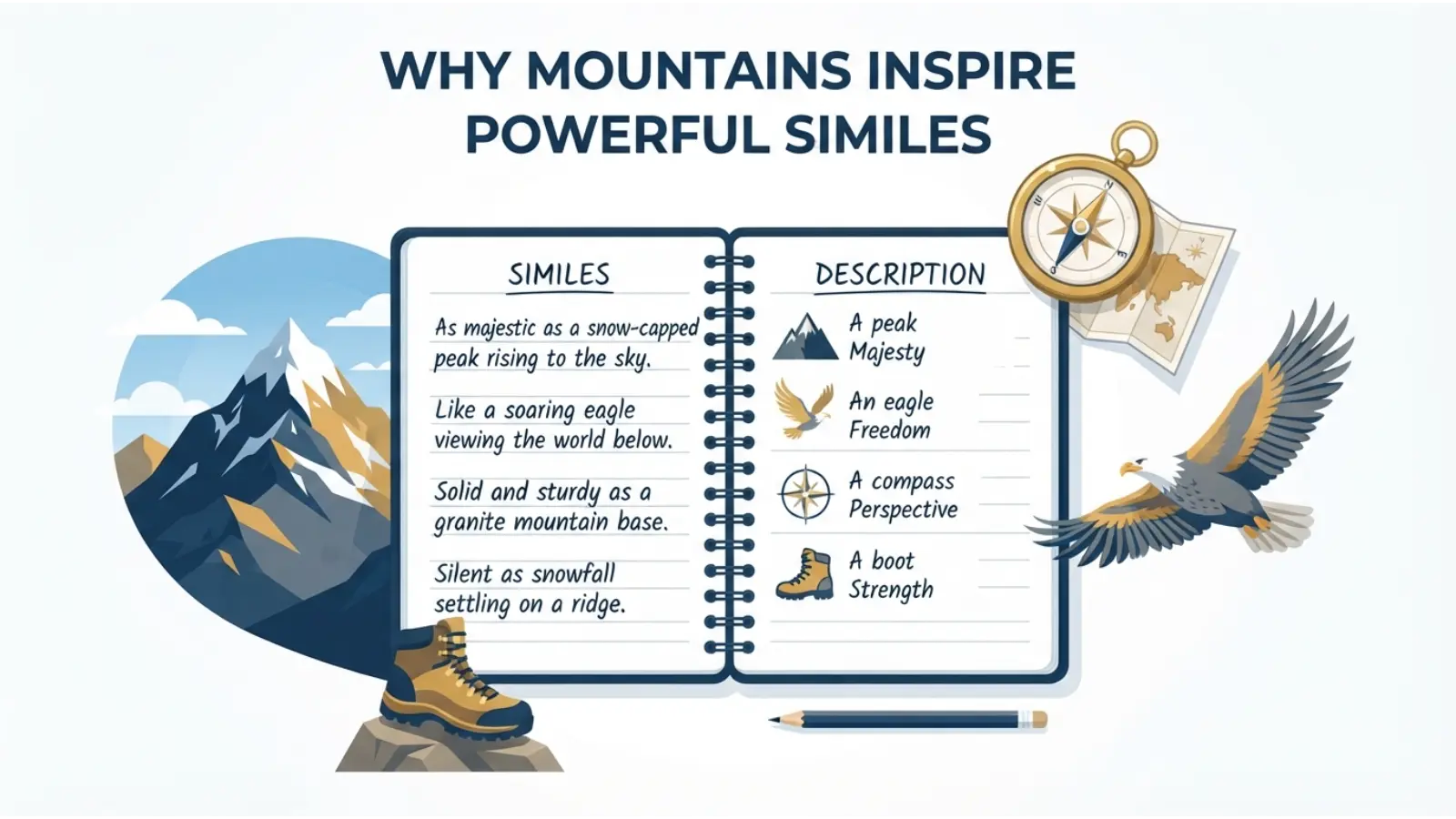
Mountains are more than large landforms. They symbolize strength, endurance, peace, mystery, adventure, and timelessness.
Different kinds of mountain scenes create different moods:
- Snow-covered peaks suggest purity.
- Rocky cliffs express strength.
- Misty mountains feel mysterious.
- Green slopes create calm.
- Jagged ridges add tension.
A thoughtful simile helps readers experience those emotions instead of simply reading about them.
30 Original Similes for Mountains
1. The mountain stood like an ancient guardian protecting the valley.
Meaning: Strength and protection.
Works best for: Adventure stories and travel writing.
Story example:
The mountain stood like an ancient guardian protecting every village beneath it.
Writing tip: Use this when the mountain feels comforting rather than threatening.
2. The snowy peak shone like polished silver beneath the morning sun.
Meaning: Brightness and elegance.
Poetry example:
Its summit glowed like polished silver greeting the dawn.
3. The cliffs rose like the walls of a forgotten kingdom.
Meaning: Grandeur and mystery.
Conversation:
Those cliffs look like the walls of a forgotten kingdom.
4. The mountain rested like a sleeping giant beneath the clouds.
Meaning: Hidden power.
Best for: Fantasy and storytelling.
5. The ridge stretched like a dragon’s spine across the horizon.
Meaning: Rugged and dramatic.
Writing purpose: Creates exciting visual imagery.
6. The mountain towered like a cathedral built by nature.
Meaning: Majesty and awe.
Formal example:
The mountain towered like a cathedral built by nature itself.
7. The peak pierced the sky like a sharpened spear.
Meaning: Height and determination.
Writing tip: Works well for dramatic landscapes.
8. The mountain stood as steady as an old lighthouse.
Meaning: Reliability and endurance.
Conversation:
That mountain is as steady as an old lighthouse.
9. The rocky slope looked like wrinkled fabric spread across the earth.
Meaning: Detailed texture.
Best context: Nature descriptions.
10. The mountain rose like hope after a long storm.
Meaning: Optimism and renewal.
Poetry example:
It rose like hope after endless rain.
11. The summit floated like an island above the clouds.
Meaning: Height and isolation.
12. The mountain echoed like an empty cathedral.
Meaning: Powerful silence.
Writing insight: Sound-based similes make scenes more immersive.
13. The hillside curved like a giant green wave.
Meaning: Gentle movement.
Conversation:
The whole hillside looked like one giant green wave.
14. The cliffs stood like pages from Earth’s oldest history book.
Meaning: Age and geological history.
15. The mountain watched over the forest like a patient teacher.
Meaning: Wisdom and calm.
16. The rocky summit sparkled like scattered diamonds after rain.
Meaning: Beauty and freshness.
17. The mountain trail twisted like a loose ribbon.
Meaning: Curving pathways.
Storytelling example:
The trail curled like a loose ribbon through the pine trees.
18. The towering peak stood like a king among hills.
Meaning: Dominance and importance.
19. The mountain shadows spread like giant wings.
Meaning: Mystery and drama.
20. The cliffs rose like frozen waves caught in time.
Meaning: Unique geological formations.
21. The mountain wore clouds like a soft winter scarf.
Meaning: Peaceful scenery.
22. The rocky face looked like an artist’s unfinished sculpture.
Meaning: Natural texture.
23. The mountain stood like a silent witness to history.
Meaning: Timelessness.
Formal example:
The mountain stood like a silent witness to countless generations.
24. The snow drifted across the peak like powdered sugar.
Meaning: Light snowfall.
Conversation:
The snow looked like powdered sugar on the mountain.
25. The mountain reflected the sunset like glowing copper.
Meaning: Warm evening colors.
26. The narrow ridge balanced like a tightrope across the sky.
Meaning: Danger and excitement.
27. The mountain valley opened like welcoming arms.
Meaning: Comfort and invitation.
28. The distant peaks faded like watercolor paintings.
Meaning: Atmospheric perspective.
Writing tip: Excellent for describing distance.
29. The mountain stood like an anchor holding the landscape together.
Meaning: Stability and permanence.
30. The mountain seemed as endless as a dream that refused to fade.
Meaning: Wonder and imagination.
Poetry example:
It stretched as endless as a dream that refused to fade into morning.
What Makes a Mountain Simile Feel Original?
Many writers rely on familiar comparisons such as “as high as a mountain.” While understandable, these comparisons rarely surprise readers.
Instead, focus on one specific quality:
- Shape
- Color
- Texture
- Silence
- Light
- Weather
- Emotion
- Scale
For example, instead of saying:
“The mountain was huge.”
You might write:
“The mountain rose like a library filled with stone stories waiting to be read.”
Specific details make imagery memorable.
How Professional Writers Build Strong Nature Similes
Strong similes usually connect two things that share one clear characteristic.
Ask yourself:
- What stands out first?
- What emotion does the mountain create?
- Which everyday object shares that feeling?
Rather than comparing everything, highlight one feature. Readers remember focused imagery better than overloaded descriptions.
Related Literary Devices That Pair Well with Mountain Similes
Metaphor
Unlike similes, metaphors make a direct comparison.
Simile:
The mountain stood like a guardian.
Metaphor:
The mountain was the valley’s guardian.
Imagery
Imagery appeals to the senses.
Instead of describing only appearance, include:
- Cold air
- Echoing sounds
- Pine scents
- Rough stone
- Bright snow
Together with similes, sensory details create immersive scenes.
Personification
Mountains often feel alive.
Example:
“The mountain stretched its snowy shoulders toward the sunrise.”
Pairing personification with similes creates rich, expressive nature writing.
Symbolism
Mountains often symbolize:
- Strength
- Patience
- Faith
- Achievement
- Obstacles
- Wisdom
- Endurance
Understanding symbolism helps you choose comparisons that support your story’s deeper meaning.
Create Your Own Mountain Similes
You don’t need to wait for inspiration. Build original similes with a simple process.
Step 1: Observe Carefully
Notice one feature:
- Height
- Snow
- Wind
- Rocks
- Trees
- Light
- Color
Step 2: Think Beyond Nature
Compare the mountain to something unexpected:
- Musical instrument
- Building
- Animal
- Piece of clothing
- Artwork
- Tool
- Ancient object
Unexpected comparisons often create the strongest imagery.
Step 3: Keep One Clear Focus
Avoid comparing several qualities at once.
Good:
“The ridge curled like a sleeping snake.”
Less effective:
“The ridge curled like a snake, stood like a tower, and sparkled like glass.”
One image is easier for readers to picture.
Practice Exercises
Exercise 1
Describe a snowy mountain without using the words:
- Tall
- Big
- High
Use only similes.
Exercise 2
Write three mountain similes that express:
- Peace
- Danger
- Hope
Exercise 3
Look at a mountain photograph and write five comparisons based on:
- Color
- Shape
- Texture
- Weather
- Light
Common Mistakes to Avoid
Using Overused Comparisons
Readers have seen the same examples many times. Fresh imagery leaves a stronger impression.
Mixing Unrelated Images
Avoid combining conflicting comparisons in one sentence.
Instead of piling images together, choose the one that best matches the mood.
Confusing Similes and Metaphors
Remember:
- Simile: uses like or as
- Metaphor: makes a direct comparison
Knowing the difference keeps your writing clear.
Forcing the Comparison
A simile should feel natural.
If readers stop to figure out what it means, simplify it.
Ignoring the Mood
Choose comparisons that fit your scene.
A playful simile may not belong in a tense survival story, while a dramatic one may feel out of place in a peaceful travel journal.
Frequently Asked Questions
What is a simile for mountains?
A simile for mountains compares a mountain to another object using like or as, helping readers imagine its appearance or emotional impact.
Why are mountains commonly used in similes?
Mountains naturally represent strength, beauty, endurance, mystery, and adventure, making them excellent subjects for vivid comparisons.
Can mountain similes be used in poetry?
Yes. They are especially effective in poetry because they create strong visual imagery and emotional depth in just a few words.
How can I make my mountain similes more original?
Focus on one unique feature, avoid common comparisons, and connect the mountain to an unexpected but believable object or experience.
What’s the difference between a mountain simile and a mountain metaphor?
A simile uses like or as to compare, while a metaphor states that one thing is another without those words.
Are mountain similes suitable for children’s writing?
Absolutely. Simple, colorful comparisons make landscapes easier for young readers to imagine and enjoy.
Can mountain similes improve travel writing?
Yes. Well-crafted similes help readers visualize landscapes, making travel articles, journals, and destination guides more engaging.
Conclusion
The best similes for mountains do more than describe towering peaks—they reveal emotion, atmosphere, and perspective. Whether you’re writing a poem, story, essay, or travel journal, a fresh comparison can transform an ordinary landscape into a memorable scene. Observe carefully, focus on one defining quality, and don’t be afraid to make unexpected yet believable connections. With practice, you’ll create mountain similes that feel as natural and enduring as the landscapes themselves.

I am Helena Frost, a writer captivated by the beauty of language and the art of comparison. Through my words, I explore the world by turning ordinary moments into vivid similes and reflections. I enjoy crafting phrases that spark imagination, evoke emotion, and linger in the mind. My writing celebrates the subtle connections between people, nature, and the stories we live. For me, every sentence is an opportunity to reveal the extraordinary in the everyday.