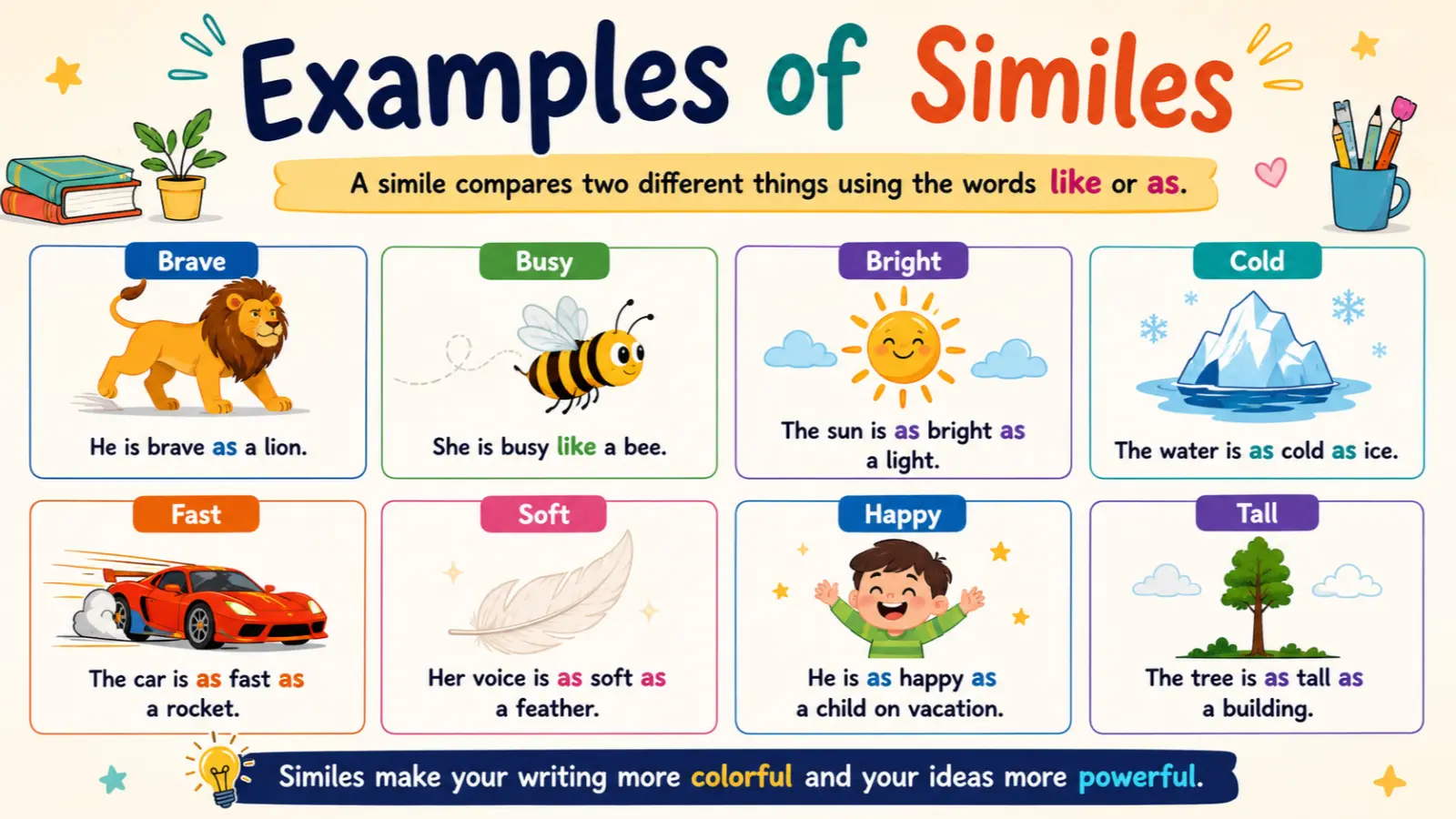
Similes are one of the easiest ways to make writing more colorful and memorable. A simple comparison can turn an ordinary sentence into one that readers can picture instantly. Whether you’re writing a story, poem, essay, speech, or even a social media caption, a well-crafted simile helps your ideas come alive. This guide explores original samples of similes, explains why they work, and shows you how to create your own. You’ll also learn common mistakes to avoid and practical techniques that professional writers use to create vivid imagery.
Quick Answer
A simile is a figure of speech that compares two different things using “like” or “as.” It helps readers understand an idea by connecting it with something familiar. For example:
Her laughter danced through the room like sunlight on water.
Good similes create clear mental images, add emotion, and make writing easier to remember.
Why Similes Make Writing Stronger
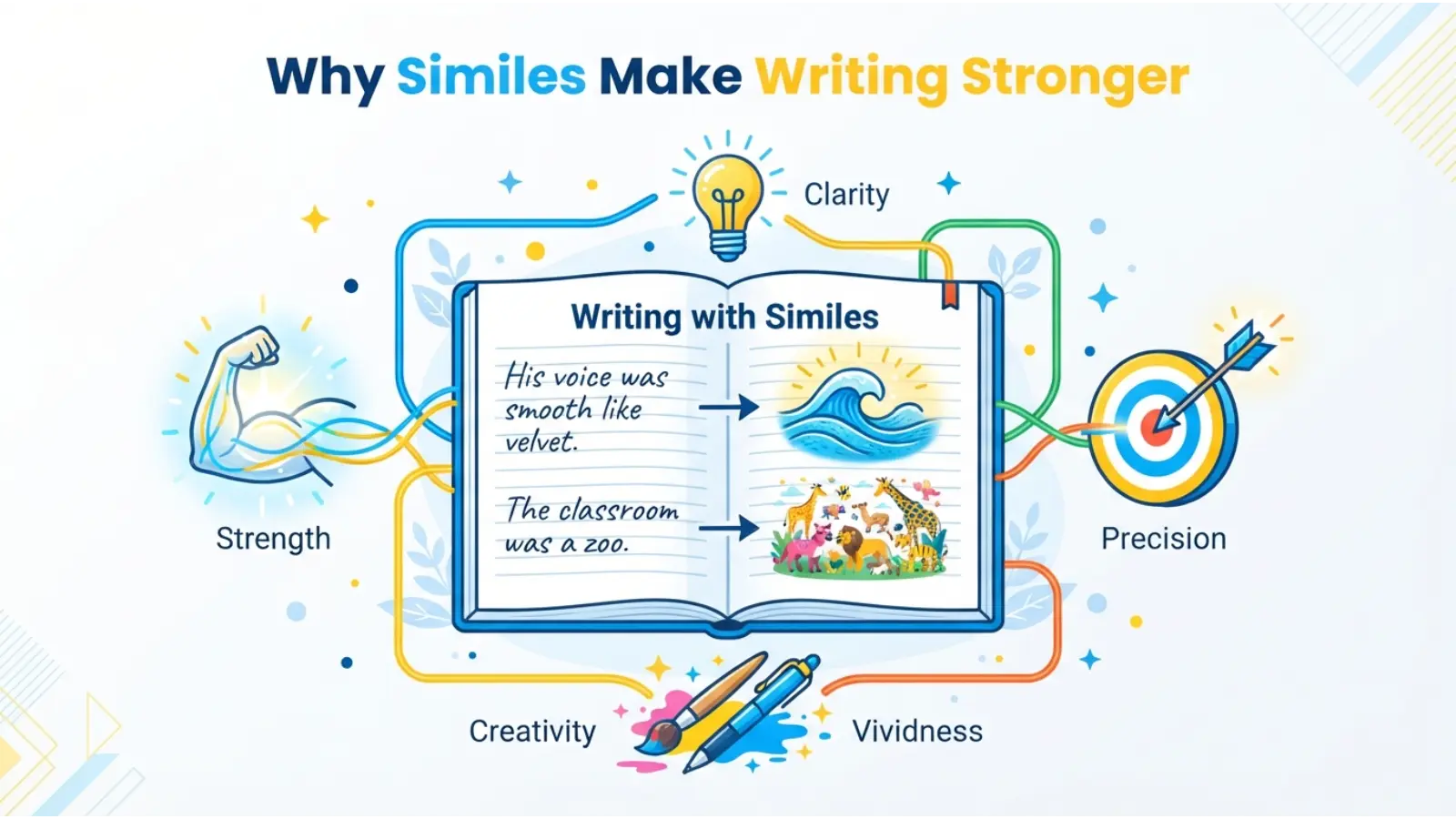
Good writing isn’t just about choosing the right words. It’s about helping readers experience what you’re describing.
Similes can:
- Create vivid imagery
- Add emotion
- Clarify difficult ideas
- Make characters memorable
- Strengthen storytelling
- Improve poems and speeches
- Make everyday conversations more expressive
Instead of saying someone was nervous, a simile lets readers feel that nervousness.
Original Samples of Similes
Similes That Describe People
1. She smiled like the first sunrise after a storm.
Meaning: A warm smile that brings hope.
Story example:
Her smile spread across the room like the first sunrise after a storm.
2. His patience was as deep as an ancient forest.
This comparison suggests calmness and quiet strength.
3. She moved like a feather carried by a gentle breeze.
Perfect for graceful movement.
4. His confidence shined like polished glass in the morning light.
Ideal for describing someone who appears self-assured.
5. Her voice was as comforting as rain on a quiet rooftop.
Works well in emotional stories.
Similes for Nature
6. The river curled like a sleeping snake.
7. The clouds floated like forgotten dreams.
8. The stars sparkled like tiny promises.
9. The wind whispered like an old storyteller.
10. The mountain stood as proudly as a silent guardian.
Similes That Express Emotions
11. Joy spread through him like warm tea on a cold morning.
12. Her sadness hung like heavy curtains.
13. Anger burst like fireworks trapped inside a bottle.
14. Hope grew like flowers between cracked stones.
15. Fear crept through him like cold water under a door.
Similes for Everyday Situations
16. The classroom buzzed like a busy marketplace.
17. Ideas arrived like birds landing on a fence.
18. Time slipped away like sand between open fingers.
19. The baby slept like a kitten beside a fireplace.
20. The old book smelled like memories locked inside wood.
Creative Similes for Stories
21. Her thoughts scattered like leaves before a storm.
22. The secret rested between them like an unopened letter.
23. His words fell like smooth stones into a quiet lake.
24. The castle rose like a dream carved from clouds.
25. The silence stretched like an empty road at midnight.
Fresh Similes for Creative Writing
26. Curiosity glowed like a lantern in the dark.
27. The promise floated like a paper boat on calm water.
28. Memories returned like birds finding their old nest.
29. Determination burned like steady candlelight.
30. Kindness spread like ripples across a peaceful pond.
Imaginative Similes for Poetry
31. Love bloomed like wildflowers after spring rain.
32. The moon rested like silver paint across the sky.
33. Dreams drifted like glowing lanterns.
34. Morning arrived like soft music through an open window.
35. The horizon stretched like an endless promise.
Modern Similes for Daily Conversation
36. My phone battery disappeared like ice in summer.
37. He laughed like he’d discovered hidden treasure.
38. She focused like an artist finishing the final brushstroke.
39. The meeting moved like traffic during rush hour.
40. The weekend vanished like smoke in the wind.
Why These Similes Work
Strong similes don’t compare random things. They connect two ideas that naturally share a quality.
For example:
Weak:
The car was like a banana.
Readers struggle to understand the comparison.
Better:
The car slid like a hockey puck across wet pavement.
The movement is easy to imagine.
Good similes create an immediate picture.
How Professional Writers Create Better Similes
Instead of asking:
“What can I compare this to?”
Ask:
“What feeling do I want the reader to experience?”
Once you know the emotion, think about real-life experiences that create the same feeling.
For example:
Feeling → Relief
Possible comparisons:
- opening a window after summer heat
- finding light during a blackout
- hearing familiar footsteps
These experiences produce stronger imagery than common comparisons.
Avoiding Clichés
Many similes have become so common that readers barely notice them.
Examples include:
- Busy as a bee
- Cold as ice
- Brave as a lion
- Quiet as a mouse
Instead, search for fresh observations from everyday life.
Fresh writing captures attention.
Related Literary Devices
Metaphor
A metaphor says something is another thing.
Metaphor:
The classroom was a jungle.
Simile:
The classroom was like a jungle.
Imagery
Imagery uses descriptive language that appeals to the senses.
Similes often strengthen imagery by creating visual pictures.
Personification
Personification gives human qualities to non-human things.
Example:
The wind sighed through the trees.
A simile and personification can appear together when used naturally.
Hyperbole
Hyperbole is intentional exaggeration.
Example:
I’ve waited forever.
A simile may also exaggerate for effect, but its main purpose is comparison.
Create Your Own Similes
Follow these simple steps.
Step 1
Choose what you want to describe.
Example:
Rain
Step 2
Think about its strongest quality.
Is it gentle?
Heavy?
Cold?
Unexpected?
Step 3
Find something that shares that quality.
Gentle rain:
- soft music
- falling feathers
- whispered words
Step 4
Build the comparison.
“The rain drifted like soft music across the rooftops.”
Creative Exercise
Choose one word from each column.
| Subject | Feeling | Object |
|---|---|---|
| Ocean | Calm | Candle |
| Snow | Excited | Mirror |
| Wind | Lonely | Lantern |
| Smile | Hopeful | Feather |
| Forest | Curious | River |
Create five original similes using different combinations.
Common Mistakes
Using Overused Comparisons
Readers have seen them countless times.
Look for fresh observations instead.
Mixing Images
Example:
Her thoughts flew like fish through the clouds.
The images don’t connect naturally.
Comparing Unrelated Things
Every comparison should highlight one clear shared quality.
Confusing Similes with Metaphors
Remember:
Like or as = simile
Direct comparison = metaphor
Adding Too Many Similes
A few strong comparisons create more impact than filling every paragraph with them.
Frequently Asked Questions
What is a simple example of a simile?
“Her eyes sparkled like stars.”
What words usually introduce a simile?
Most similes use like or as.
Why are similes important?
They help readers visualize ideas and connect emotionally with your writing.
Are similes only used in poetry?
No. They appear in stories, speeches, novels, songs, essays, conversations, and advertising.
How can I write better similes?
Focus on shared qualities rather than obvious comparisons. Use real experiences for inspiration.
What is the difference between a simile and a metaphor?
A simile uses like or as, while a metaphor makes a direct comparison.
Can children learn similes easily?
Yes. Similes are often one of the first literary devices taught because they make language more imaginative and engaging.
Conclusion
Great similes do more than decorate your writing—they help readers see, hear, and feel your ideas. The strongest comparisons come from careful observation rather than familiar expressions. As you practice, look for everyday moments that reveal surprising similarities. Over time, you’ll develop a style that feels fresh, memorable, and uniquely your own.
I am Helena Frost, a writer captivated by the beauty of language and the art of comparison. Through my words, I explore the world by turning ordinary moments into vivid similes and reflections. I enjoy crafting phrases that spark imagination, evoke emotion, and linger in the mind. My writing celebrates the subtle connections between people, nature, and the stories we live. For me, every sentence is an opportunity to reveal the extraordinary in the everyday.