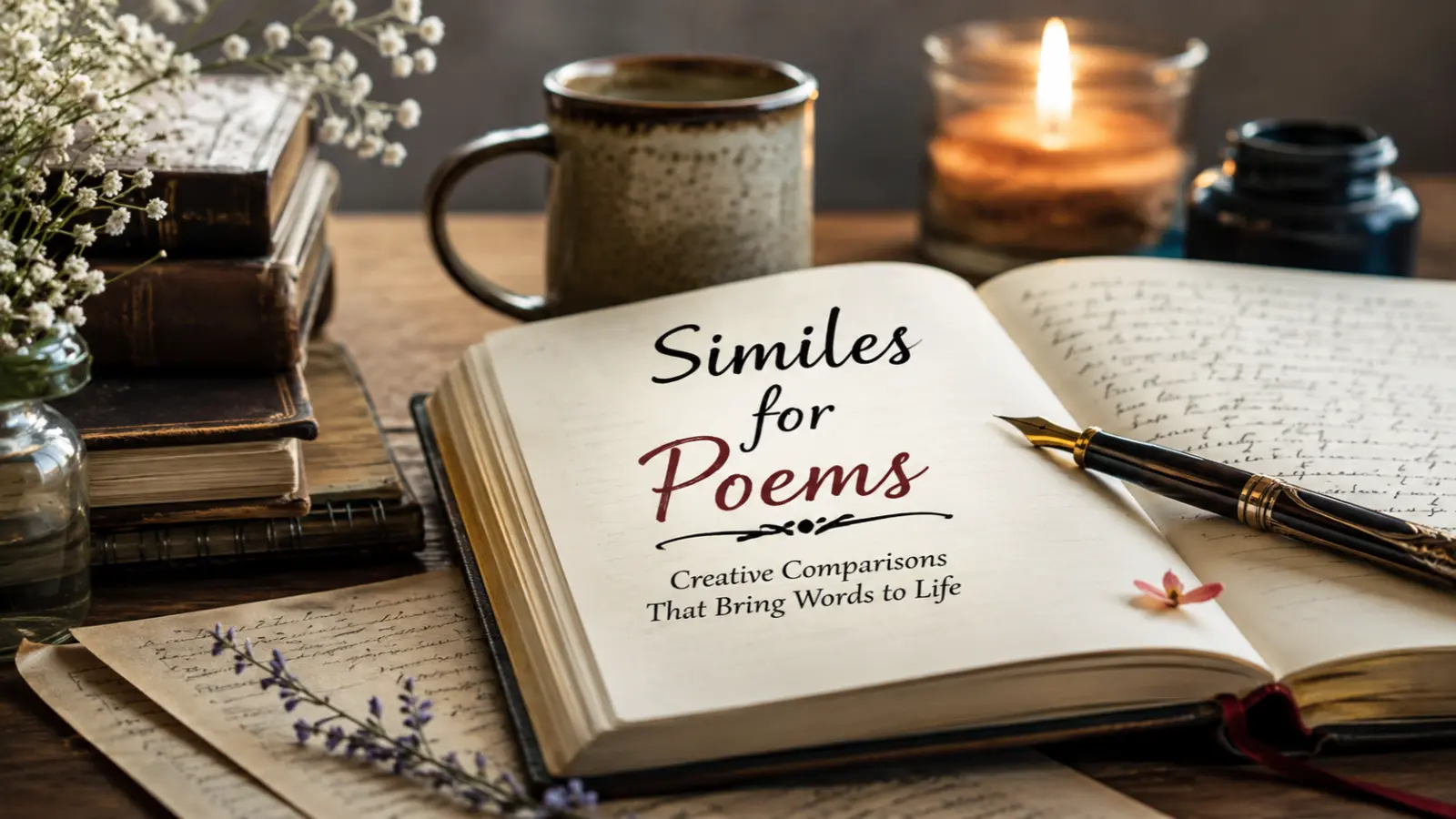
Similes are one of the most powerful tools in poetry, allowing writers to paint vivid pictures with just a few carefully chosen words. By comparing one thing to another using “like” or “as,” similes help readers instantly feel emotions, visualize scenes, and connect with the writer’s imagination. In poetry, where every word carries weight, similes can turn simple lines into unforgettable imagery.
Think of how a poet might describe sadness not just as sadness, but “as heavy as a rain-soaked sky.” Suddenly, the reader feels it. Whether you’re a student, blogger, or aspiring poet, understanding similes for poems can elevate your writing from ordinary to expressive storytelling that resonates deeply with audiences.
Quick Reference Table: Similes for Poems
| Simile Phrase | Meaning |
|---|---|
| As bright as the morning sun | Full of hope and energy |
| As quiet as falling snow | Deep silence and peace |
| As fast as lightning | Extremely quick |
| As soft as a whisper | Gentle and delicate |
| As deep as the ocean | Profound emotion or thought |
| As strong as an oak tree | Very strong and stable |
Why Similes Matter in Poetry (Expert Insight)
Literary experts consistently emphasize that similes are essential for building emotional depth in writing. According to creative writing principles used in modern literature classrooms, comparisons help readers “anchor abstract ideas in familiar imagery.” In simpler terms, similes take something invisible—like emotion—and turn it into something visible and relatable.
For example, instead of saying “she was nervous,” a poet might write: “She was as nervous as a candle flickering in the wind.” This transforms a flat statement into a living image.
Writers from Shakespeare to contemporary poets have used similes to add rhythm, texture, and emotional resonance to their work. In poetry workshops, beginners are often encouraged to master similes first because they train the brain to think metaphorically and creatively.
Creative Similes for Poems (With Meaning, Examples & Tips)
Below are carefully crafted examples of similes for poems, designed to inspire poets, writers, and storytellers.
1. As bright as the morning sun
Meaning: Represents hope, positivity, and new beginnings.
Example in Prose:
- Formal: Her ideas were as bright as the morning sun, bringing clarity to the discussion.
- Casual: He walked in with a smile as bright as the morning sun.
Example in Poetry:
Her laughter rose with dawn’s first light,
As bright as the morning sun in flight.
Tip/Use: Use this simile when describing optimism, happiness, or fresh starts in poetry.
2. As quiet as falling snow
Meaning: Deep silence, peace, or stillness.
Example in Prose:
- Formal: The library remained as quiet as falling snow during exams.
- Casual: The room went as quiet as falling snow when she entered.
Example in Poetry:
The world paused in silver glow,
As quiet as falling snow.
Tip/Use: Ideal for calm or emotional stillness in scenes.
3. As fast as lightning
Meaning: Extremely quick movement or reaction.
Example in Prose:
- Formal: The athlete moved as fast as lightning across the field.
- Casual: She replied as fast as lightning to the message.
Example in Poetry:
Across the sky he broke the night,
As fast as lightning, sharp and bright.
Tip/Use: Great for action scenes or energetic descriptions.
4. As soft as a whisper
Meaning: Extremely gentle or quiet sound or feeling.
Example in Prose:
- Formal: Her voice was as soft as a whisper during the meeting.
- Casual: He spoke as soft as a whisper so no one could hear.
Example in Poetry:
Her words drift through evening air,
As soft as a whisper, light and rare.
Tip/Use: Best for emotional, romantic, or tender writing.
5. As deep as the ocean
Meaning: Profound, vast, or emotionally intense.
Example in Prose:
- Formal: His thoughts were as deep as the ocean, difficult to understand.
- Casual: Her love is as deep as the ocean.
Example in Poetry:
Within her eyes, emotions sleep,
As deep as the ocean, dark and deep.
Tip/Use: Use for love, mystery, or intense emotions.
6. As strong as an oak tree
Meaning: Strength, resilience, and stability.
Example in Prose:
- Formal: The leader stood as strong as an oak tree during the crisis.
- Casual: My father is as strong as an oak tree.
Example in Poetry:
Storms may rage and winds may roar,
He stands as strong as an oak tree’s core.
Tip/Use: Ideal for describing courage and endurance.
7. As light as a feather
Meaning: Very light in weight or feeling.
Example in Prose:
- Formal: The fabric felt as light as a feather.
- Casual: This bag is as light as a feather!
Example in Poetry:
She danced where dreams take flight,
As light as a feather in morning light.
Tip/Use: Useful for describing softness or ease.
8. As sharp as a needle
Meaning: Very precise or intelligent; also physically sharp.
Example in Prose:
- Formal: His observations were as sharp as a needle.
- Casual: That remark was as sharp as a needle!
Example in Poetry:
His thoughts cut through the air so clear,
As sharp as a needle, crystal near.
Tip/Use: Great for intellect or cutting emotions.
9. As warm as summer rain
Meaning: Comforting, soothing warmth.
Example in Prose:
- Formal: Her welcome was as warm as summer rain.
- Casual: The hug felt as warm as summer rain.
Example in Poetry:
Your voice falls soft, a gentle flame,
As warm as summer rain you came.
Tip/Use: Perfect for emotional comfort.
10. As cold as winter ice
Meaning: Emotionally distant or physically cold.
Example in Prose:
- Formal: His response was as cold as winter ice.
- Casual: She looked at me as cold as winter ice.
Example in Poetry:
No warmth remains within your gaze,
As cold as winter ice’s haze.
Tip/Use: Use for heartbreak or emotional distance.
11. As golden as autumn leaves
Meaning: Represents beauty, change, and the warm glow of transformation.
Example in Prose:
- Formal: The sunset was as golden as autumn leaves falling gently in the park.
- Casual: Her dress looked as golden as autumn leaves.
Example in Poetry:
The world turned soft in fading light,
As golden as autumn leaves in flight.
Tip/Use: Use this simile for seasonal imagery, nostalgia, or emotional change.
12. As restless as the sea
Meaning: Symbolizes emotional turbulence, anxiety, or constant movement.
Example in Prose:
- Formal: His thoughts were as restless as the sea during a storm.
- Casual: I felt as restless as the sea before the exam.
Example in Poetry:
My heart would not stay calm or free,
As restless as the endless sea.
Tip/Use: Perfect for expressing inner conflict or emotional instability.
13. As fragile as glass
Meaning: Represents vulnerability, emotional sensitivity, or delicacy.
Example in Prose:
- Formal: The agreement was as fragile as glass under pressure.
- Casual: Her feelings are as fragile as glass.
Example in Poetry:
A single word could break the tone,
As fragile as glass, alone.
Tip/Use: Best used for emotional relationships or delicate situations.
14. As steady as a mountain
Meaning: Symbolizes strength, patience, and unwavering stability.
Example in Prose:
- Formal: His leadership remained as steady as a mountain during the crisis.
- Casual: She is as steady as a mountain in tough times.
Example in Poetry:
Through winds that howl and skies that fight,
He stands as steady as a mountain’s height.
Tip/Use: Ideal for describing strong personalities or endurance.
15. As sweet as honey
Meaning: Represents kindness, affection, or pleasing behavior.
Example in Prose:
- Formal: Her words were as sweet as honey during the negotiation.
- Casual: He talks as sweet as honey when he wants something.
Example in Poetry:
Your voice still lingers in the air,
As sweet as honey, warm and rare.
Tip/Use: Great for love poetry or describing gentle personalities.
16. As dark as midnight sky
Meaning: Symbolizes mystery, fear, sadness, or the unknown.
Example in Prose:
- Formal: The room was as dark as a midnight sky without stars.
- Casual: It felt as dark as a midnight sky outside.
Example in Poetry:
No guiding light, no stars nearby,
As dark as midnight’s endless sky.
Tip/Use: Use for suspense, mystery, or emotional depth.
17. As pure as morning dew
Meaning: Represents innocence, freshness, and purity.
Example in Prose:
- Formal: Her intentions were as pure as morning dew on grass.
- Casual: That child’s smile is as pure as morning dew.
Example in Poetry:
She walks where silence learns to grow,
As pure as morning’s gentle glow.
Tip/Use: Ideal for innocence, spirituality, or new beginnings.
18. As loud as thunder
Meaning: Represents power, intensity, or strong presence.
Example in Prose:
- Formal: His speech was as loud as thunder, commanding attention.
- Casual: The music was as loud as thunder!
Example in Poetry:
His voice broke skies with force and sound,
As loud as thunder rolling round.
Tip/Use: Use for dramatic impact or powerful emotions.
19. As smooth as silk
Meaning: Represents elegance, softness, or refined quality.
Example in Prose:
- Formal: The negotiation process was as smooth as silk.
- Casual: Her hair feels as smooth as silk.
Example in Poetry:
Her words fell soft, without a fight,
As smooth as silk in pale moonlight.
Tip/Use: Great for elegance, beauty, or luxury imagery.
20. As bright as stars
Meaning: Symbolizes hope, inspiration, or brilliance.
Example in Prose:
- Formal: His future looked as bright as stars in the night sky.
- Casual: Your idea is as bright as stars!
Example in Poetry:
Dreams awaken in skies so far,
As bright as stars that guide afar.
Tip/Use: Ideal for ambition, dreams, or inspiration.
21. As silent as a shadow
Meaning: Represents secrecy, stealth, or quiet presence.
Example in Prose:
- Formal: He moved as silent as a shadow through the corridor.
- Casual: She was as silent as a shadow in the room.
Example in Poetry:
No sound disturbed the empty air,
As silent as a shadow there.
Tip/Use: Best for suspense, mystery, or stealth scenes.
22. As wild as the wind
Meaning: Symbolizes freedom, unpredictability, or raw emotion.
Example in Prose:
- Formal: Her spirit was as wild as the wind across the hills.
- Casual: He’s as wild as the wind when he plays music.
Example in Poetry:
No chain can hold, no hand can bind,
As wild as wind that roams unconfined.
Tip/Use: Use for freedom, adventure, or untamed energy.
23. As slow as melting ice
Meaning: Represents patience, delay, or slow emotional change.
Example in Prose:
- Formal: The decision process was as slow as melting ice.
- Casual: Time felt as slow as melting ice.
Example in Poetry:
Each second drips, each moment sighs,
As slow as ice beneath warm skies.
Tip/Use: Ideal for suspense or emotional waiting.
24. As heavy as grief
Meaning: Represents deep sadness or emotional burden.
Example in Prose:
- Formal: His heart felt as heavy as grief after the loss.
- Casual: The news made me feel as heavy as grief.
Example in Poetry:
The silence fell, no words to say,
As heavy as grief that won’t drift away.
Tip/Use: Use for sorrowful or emotional poetry.
25. As quick as a bird in flight
Meaning: Represents speed, agility, and freedom.
Example in Prose:
- Formal: The messenger moved as quick as a bird in flight.
- Casual: She ran as quick as a bird in flight.
Example in Poetry:
Across the wind, through skies so wide,
As quick as a bird in flight, he glides.
Tip/Use: Great for movement, freedom, or energy.
26. As endless as time
Meaning: Represents infinity, eternity, or something without limits.
Example in Prose:
- Formal: Their love felt as endless as time itself.
- Casual: The wait felt as endless as time.
Example in Poetry:
No start, no end, no final line,
As endless as forever’s time.
Tip/Use: Ideal for philosophical, romantic, or reflective writing.
If you want, I can now:
✔ Convert this into a fully SEO blog post (WordPress-ready)
✔ Add internal linking + meta description + schema FAQ markup
✔ Or expand it into 50+ similes mega guide for ranking
Practical Writing Tips for Using Similes in Poetry
Experienced writers agree that similes should enhance—not overwhelm—your writing. Here are key expert tips:
- Avoid overusing similes in a single poem; balance is essential.
- Choose comparisons that are familiar to your readers.
- Ensure emotional relevance—don’t use random imagery.
- Mix nature, emotions, and daily life for richness.
- Read your similes aloud to test rhythm and flow.
As literary critic I.A. Richards once suggested, figurative language works best when it “creates a bridge between thought and feeling.” That bridge is exactly what similes achieve in poetry.
FAQ
1. What is a simile in poetry?
A simile is a literary device that compares two different things using “like” or “as” to create vivid imagery.
2. How do similes improve poems?
They make abstract emotions clearer and help readers visualize and feel the poet’s message more deeply.
3. Can I create my own similes for poems?
Yes. The best similes come from personal experience and creative imagination.
4. What are examples of similes for poems?
Examples include “as bright as the morning sun” or “as quiet as falling snow.”
5. How many similes should I use in a poem?
There is no fixed rule, but using 1–3 strong similes is often more effective than overloading a poem.
Conclusion
Similes are the heartbeat of expressive poetry. They allow writers to transform simple emotions into powerful visual and emotional experiences. By learning and practicing similes for poems, you develop the ability to turn ordinary writing into something deeply memorable and artistic.
Whether you are describing love, sadness, joy, or nature, similes help your words breathe life. The key is creativity and observation—look at the world around you and find unique comparisons that feel fresh and meaningful.
Now it’s your turn: experiment with your own similes, blend emotions with imagery, and craft poetry that speaks not just to the mind, but to the heart.
See Also
- Metaphors in Poetry Explained
- How to Write Descriptive Poems
- Literary Devices Every Writer Should Know
- Imagery Techniques in Creative Writing