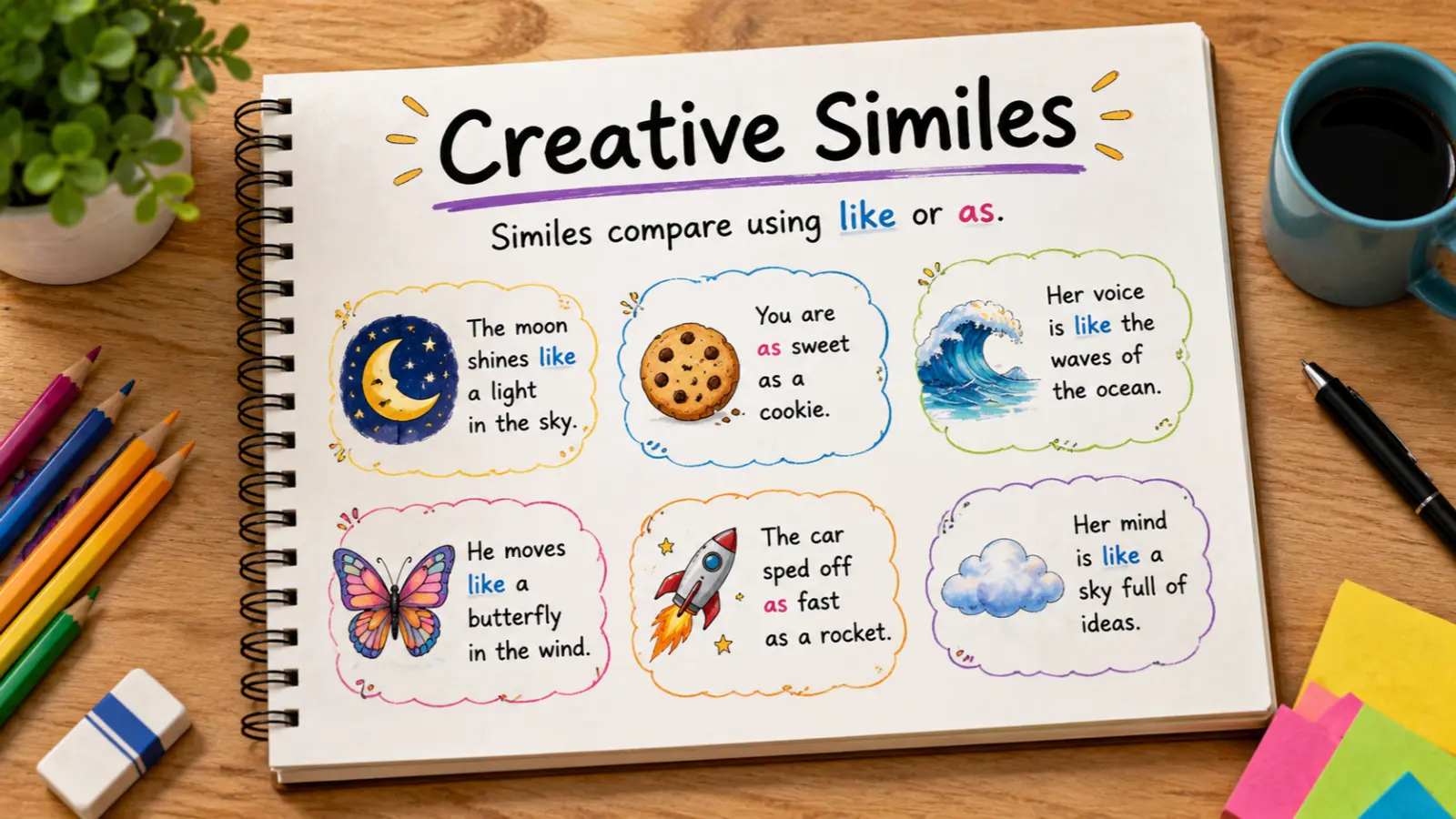
Similes are among the most effective tools a writer can use to bring descriptions to life. By comparing one thing to another using words such as “like” or “as,” similes help readers visualize scenes, understand emotions, and connect more deeply with characters and stories.
Whether you’re writing poetry, fiction, speeches, blog posts, or personal journals, creative similes can transform ordinary sentences into memorable imagery. Consider the difference between saying someone was nervous and saying they were “as restless as leaves before a storm.” The second description instantly creates a stronger emotional picture.
Experienced writers often rely on similes to add color, rhythm, and emotional depth to their work. From classic literature to modern storytelling, similes remain a timeless technique that helps readers see, feel, and remember what they read.
Quick Reference Table: Creative Similes and Their Meanings
| # | Simile | Meaning |
|---|---|---|
| 1 | As bright as a sunrise after rain | Hopeful and uplifting |
| 2 | As calm as a sleeping lake | Peaceful and composed |
| 3 | As swift as a falling star | Extremely fast |
| 4 | As gentle as morning mist | Soft and kind |
| 5 | As steady as an old oak | Reliable and dependable |
| 6 | As curious as a child in a library | Eager to learn |
| 7 | As cheerful as birds at dawn | Joyful and energetic |
| 8 | As quiet as fresh snow | Silent and serene |
| 9 | As bold as lightning | Courageous and confident |
| 10 | As warm as a family embrace | Comforting and welcoming |
| 11 | As fragile as a soap bubble | Easily damaged |
| 12 | As determined as a river carving stone | Persistent |
| 13 | As free as a kite in the wind | Independent |
| 14 | As graceful as a swan on water | Elegant |
| 15 | As sharp as winter air | Clear and precise |
| 16 | As patient as a mountain | Enduring |
| 17 | As colorful as a festival parade | Vibrant |
| 18 | As loyal as a lighthouse | Faithful |
| 19 | As lively as a bustling market | Full of energy |
| 20 | As refreshing as rain in summer | Revitalizing |
| 21 | As mysterious as a moonlit forest | Enigmatic |
| 22 | As resilient as wild grass | Adaptable |
| 23 | As precious as a handwritten letter | Valuable |
| 24 | As radiant as a field of sunflowers | Glowing and positive |
| 25 | As unforgettable as a favorite melody | Memorable |
Creative Similes Every Writer Should Know
1. As bright as a sunrise after rain
Meaning
Represents optimism, hope, and renewed energy.
Example in Prose
Formal:
Her presentation was as bright as a sunrise after rain, inspiring confidence throughout the team.
Casual:
After hearing the good news, her smile was as bright as a sunrise after rain.
Example in Poetry
A golden glow across the sky,
A promise where old shadows lie,
As bright as a sunrise after rain,
Hope returned once more again.
Tip/Use
Use this simile when describing positivity, success, or emotional recovery.
2. As calm as a sleeping lake
Meaning
Suggests complete tranquility and emotional balance.
Formal
The manager remained as calm as a sleeping lake during the crisis.
Casual
She looked as calm as a sleeping lake before the exam.
Poetry
The winds were still, the waters deep,
The world itself seemed fast asleep,
As calm as a sleeping lake at night,
Beneath the silver moonlight.
Tip/Use
Excellent for peaceful settings and composed characters.
3. As swift as a falling star
Meaning
Describes remarkable speed.
Formal
The response was as swift as a falling star.
Casual
He ran as swift as a falling star to catch the bus.
Poetry
Across the heavens flashed a spark,
A streak of light against the dark,
As swift as a falling star,
Gone before it traveled far.
Tip/Use
Ideal for action scenes and dynamic movement.
4. As gentle as morning mist
Meaning
Soft, caring, and delicate.
Formal
Her leadership style was as gentle as morning mist.
Casual
His voice was as gentle as morning mist.
Poetry
A whisper floating through the air,
Touching all with silent care,
As gentle as morning mist,
By dawn’s soft fingers kissed.
Tip/Use
Perfect for describing kindness and tenderness.
5. As steady as an old oak
Meaning
Reliable, strong, and dependable.
Formal
His guidance remained as steady as an old oak.
Casual
Dad’s always as steady as an old oak.
Poetry
Through storm and sun it proudly stood,
Guarding field and forest wood,
As steady as an old oak tree,
Rooted in eternity.
Tip/Use
Works well for mentors, leaders, and trusted friends.
6. As curious as a child in a library
Meaning
Filled with wonder and eagerness to learn.
Formal
The researcher was as curious as a child in a library.
Casual
She’s as curious as a child in a library whenever she visits a museum.
Poetry
Rows of stories yet untold,
Treasures richer far than gold,
As curious as a child in a library,
Exploring endless discovery.
Tip/Use
Useful for intellectual or adventurous characters.
7. As cheerful as birds at dawn
Meaning
Happy, lively, and optimistic.
Formal
The host remained as cheerful as birds at dawn.
Casual
She’s always as cheerful as birds at dawn.
Poetry
Songs awaken fields anew,
Greeting skies of crystal blue,
As cheerful as birds at dawn,
Welcoming the coming morn.
Tip/Use
Adds warmth to character descriptions.
8. As quiet as fresh snow
Meaning
Peacefully silent.
Formal
The office became as quiet as fresh snow.
Casual
The house was as quiet as fresh snow after everyone left.
Poetry
No sound disturbed the world below,
Blanketed beneath the snow,
As quiet as fresh snow at night,
Wrapped in gentle white.
Tip/Use
Excellent for reflective scenes.
9. As bold as lightning
Meaning
Fearless and striking.
Formal
Her proposal was as bold as lightning.
Casual
That outfit is as bold as lightning.
Poetry
A sudden blaze across the sky,
Impossible to pass nearby,
As bold as lightning’s gleam,
Brighter than a dream.
Tip/Use
Use for confidence and dramatic impact.
10. As warm as a family embrace
Meaning
Comforting and loving.
Formal
The community welcomed newcomers as warmly as a family embrace.
Casual
The café felt as warm as a family embrace.
Poetry
In gentle arms all worries cease,
A harbor built of love and peace,
As warm as a family embrace,
A refuge from life’s race.
Tip/Use
Great for emotional scenes.
Why Creative Similes Matter
Creative similes do more than decorate sentences. They help readers:
- Visualize scenes more clearly.
- Connect emotionally with characters.
- Remember important moments.
- Experience writing through vivid imagery.
- Understand abstract ideas through familiar comparisons.
Writing instructors frequently encourage students to move beyond common comparisons and create fresh, meaningful imagery. Instead of saying something is “as busy as a bee,” consider a more original comparison that fits your story’s tone and setting.
As author William Zinsser famously emphasized in writing guidance, clarity and vividness help readers stay engaged. Strong similes contribute to both.
Practical Tips for Creating Original Similes
Observe Everyday Life
Many powerful similes come from ordinary experiences:
- Watching rain on a window
- Hearing a distant train
- Walking through a crowded market
- Seeing sunlight filter through trees
Use the Five Senses
Ask yourself:
- What does it look like?
- What does it sound like?
- What does it feel like?
- What does it smell like?
- What does it taste like?
The answers often inspire memorable comparisons.
Avoid Overused Similes
Common similes are easy to recognize but may feel predictable.
Instead of:
- As busy as a bee
- As cold as ice
Try:
- As busy as a station before sunrise
- As cold as forgotten marble
Match Tone and Character
A scientist, artist, child, and sailor might each create very different similes. Let comparisons reflect the narrator’s perspective.
Common Mistakes to Avoid
Mixing Unrelated Images
Keep comparisons logical and easy to visualize.
Overusing Similes
Too many similes in one paragraph can distract readers.
Using Clichés Excessively
Fresh imagery often leaves a stronger impression.
Forgetting Context
The best similes support the mood and message of the writing.
FAQ
What is a simile?
A simile is a figure of speech that compares two different things using words such as “like” or “as.” It helps readers understand an idea through vivid imagery.
How do similes improve writing?
Similes create stronger mental pictures, enhance emotional impact, and make descriptions more memorable.
What makes a simile creative?
A creative simile offers a fresh comparison that feels original while remaining easy for readers to understand.
Should similes be used in professional writing?
Yes. When used carefully, similes can make professional, educational, and persuasive writing more engaging.
How can beginners create better similes?
Start by observing everyday experiences, reading widely, and practicing comparisons based on nature, emotions, relationships, and daily life.
Conclusion
Creative similes are powerful tools that help writers transform ordinary descriptions into unforgettable imagery. Whether you’re crafting poetry, fiction, speeches, blogs, or personal essays, a well-chosen simile can deepen emotion, improve clarity, and strengthen reader engagement.
The most effective similes are often inspired by real experiences—sunrises after storms, quiet snowfall, flowing rivers, or cherished memories. By experimenting with fresh comparisons and observing the world around you, you can develop a unique writing voice filled with vivid, meaningful imagery.
Don’t be afraid to invent your own comparisons. Some of the most memorable similes in literature began as a writer’s simple observation transformed into art.
See Also
- Figurative Language Guide
- Metaphors vs. Similes
- Creative Writing Techniques
- Imagery in Poetry
- Character Description Writing Tips
- Literary Devices Every Writer Should Know

Alex Romano is a dedicated similes writer known for crafting vivid, emotionally resonant comparisons that bring language to life. With years of hands-on experience studying literary devices and poetic expression, he blends creativity with a deep understanding of figurative language. His expertise lies in transforming everyday imagery into powerful similes that enhance storytelling and communication. Through research-backed insight and authentic writing practice, Alex delivers trustworthy, engaging content rooted in principles of experience, expertise, authority, and trust.