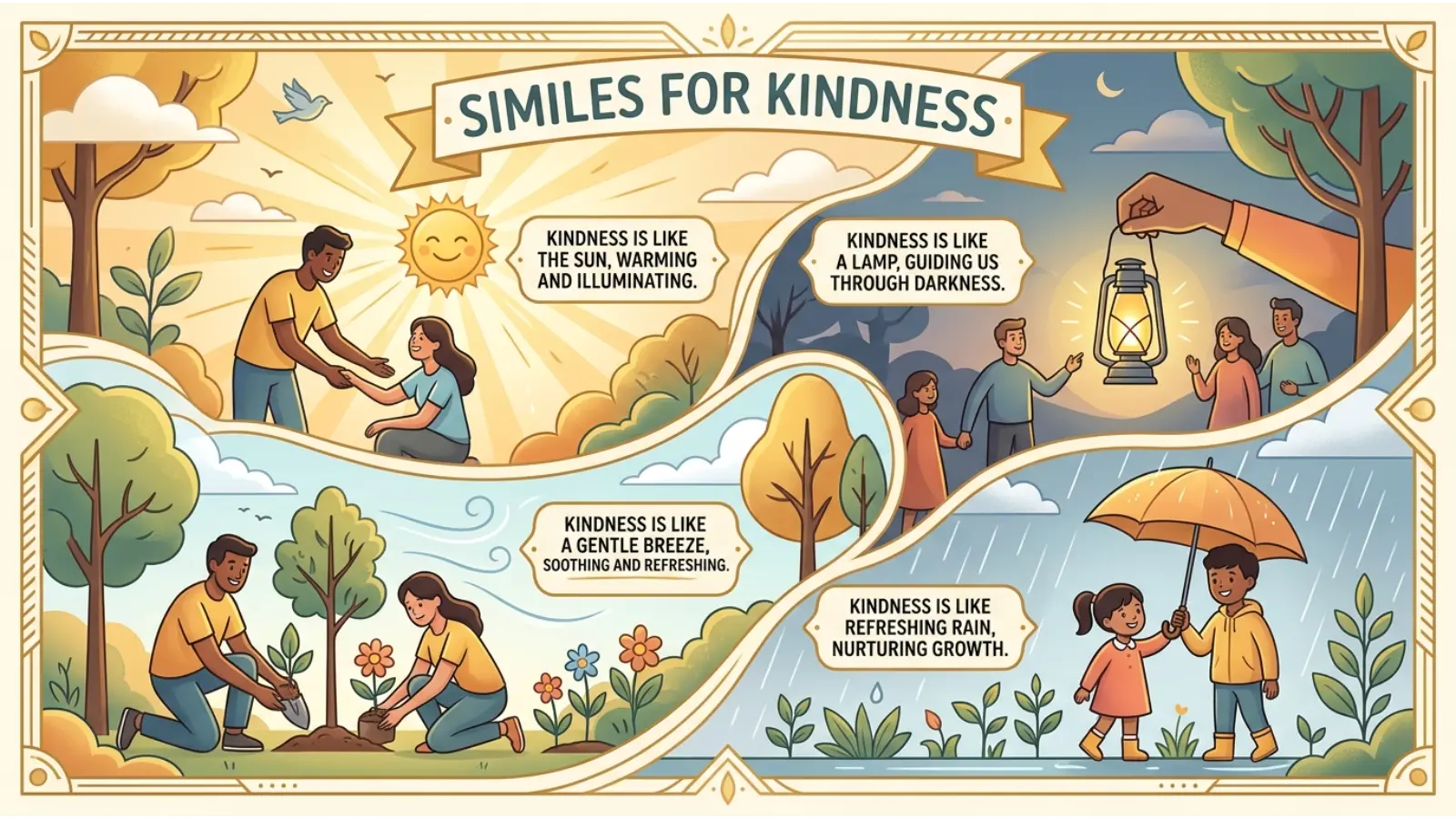
Similes for Kindness can be difficult to describe because it is often quiet. A person may offer a seat, listen without interrupting, share what they have, or say exactly the words someone needs to hear. The action may take only a few seconds, but its emotional effect can last much longer.
A good simile gives that invisible quality a shape readers can imagine. Instead of simply writing “She was kind,” you might write, “Her kindness was like a lamp left glowing in a dark hallway.” The comparison lets readers feel the warmth and understand what the kindness does.
Similes for kindness are especially useful in stories, essays, poems, speeches, personal writing, and everyday descriptions. They can help you describe generosity, compassion, patience, warmth, encouragement, and quiet support without relying on ordinary adjectives.
This collection focuses on fresh comparisons rather than familiar clichés. You will find original examples, explanations of why they work, sample sentences, and practical techniques for creating your own.
What Is a Simile for Kindness?
A simile compares one thing with another using words such as like or as. A simile for kindness compares an act, person, feeling, or expression of kindness with something that creates a similar impression.
For example:
“Her kindness was like a warm window on a cold evening.”
The kindness is not literally a window. The comparison emphasizes comfort, warmth, and welcome.
A strong kindness simile does more than say that someone is nice. It shows how the kindness feels, what it does, or what effect it has on another person.
Why Similes Make Kindness More Vivid
The word kind tells readers a fact. A well-chosen comparison gives them an experience.
Compare these two sentences:
- He was kind to everyone.
- His kindness was like shade appearing just when the afternoon became unbearable.
The first sentence gives information. The second creates an image.
This difference matters in creative writing. Readers remember concrete images more easily than vague descriptions. When the comparison is specific, the emotion becomes easier to see.
A useful rule is:
Don’t compare kindness merely to something pleasant. Compare it to something that performs the same emotional job.
If kindness brings comfort, compare it with shelter, warmth, or a steady light. If it gives someone courage, compare it with a handrail, a bridge, or a small flame.
30 Original Similes for Kindness
1. Kindness Like a Lamp in a Dark Hallway
“Her kindness was like a lamp left glowing in a dark hallway.”
Meaning: Her kindness provides comfort and guidance when someone feels lost.
Example sentences:
- When Marcus felt alone at school, her kindness was like a lamp left glowing in a dark hallway.
- His simple message was like a lamp in a dark hallway after a difficult day.
Emotional effect: Warm, reassuring, hopeful.
Best context: Stories, personal essays, emotional scenes, and poetry.
Writing tip: This comparison works particularly well when the recipient of kindness is experiencing uncertainty.
2. Kindness Like a Blanket Around Cold Shouldes
“Her kindness wrapped around him like a blanket around cold shoulders.”
Meaning: The kindness makes someone feel protected and emotionally comfortable.
Example sentences:
- After the disappointing news, her kindness wrapped around him like a blanket around cold shoulders.
- His grandmother’s quiet encouragement felt like a blanket around cold shoulders.
Emotional effect: Safe, intimate, comforting.
Best context: Family stories and emotional fiction.
The strength of this simile comes from physical sensation. Readers know what warmth feels like, so they can transfer that feeling to emotional support.
3. Kindness Like Rain on Dry Ground
“His kindness fell like rain on dry ground.”
Meaning: The kindness arrives when it is deeply needed.
Example sentences:
- Her generous words fell like rain on dry ground.
- After weeks of disappointment, his encouragement came like rain on dry ground.
Emotional effect: Relief, renewal, gratitude.
Best context: Poetry and reflective writing.
Instead of simply saying that someone needed kindness, the dry-ground image shows a state of emotional need.
4. Kindness Like a Handrail on Steep Stairs
“Her kindness was like a handrail on a steep staircase.”
Meaning: Her support does not remove the difficulty, but it makes the difficult journey easier.
Example sentences:
- His advice was like a handrail on a steep staircase.
- During the hardest part of the project, her patience became a handrail on steep stairs.
Writing purpose: Use this when kindness helps someone continue rather than completely solving a problem.
This is a useful alternative to comparisons involving rescue. Sometimes kindness does not save a person; it simply gives them something steady to hold.
5. Kindness Like a Window Opening in a Stuffy Room
“Her kindness was like a window opening in a stuffy room.”
Meaning: Her presence brings relief to an uncomfortable situation.
Example sentences:
- His apology was like a window opening in a stuffy room.
- One thoughtful question brought kindness into the tense meeting like fresh air through an open window.
Emotional effect: Relief and freshness.
Best context: Workplace writing, dialogue, and stories involving tension.
6. Kindness Like a Cup of Water After a Long Walk
“His kindness was like a cup of water after a long walk.”
Meaning: The kindness offers simple but meaningful relief.
Example sentences:
- Her offer to help was like a cup of water after a long walk.
- That small favor felt like a cup of water after a long journey.
Writing tip: Use ordinary objects when you want kindness to feel genuine rather than dramatic.
7. Kindness Like a Bridge Over Troubled Water
“Her kindness was like a narrow bridge over a difficult river.”
Meaning: Her compassion helps people move from a difficult situation toward safety or understanding.
Example sentence:
- Her willingness to listen became a narrow bridge over a difficult river between the two friends.
Best context: Reconciliation and relationship stories.
The bridge image emphasizes connection. It is especially effective when kindness brings two people closer.
8. Kindness Like a Seed Planted in Quiet Soil
“His kindness was like a seed planted in quiet soil.”
Meaning: A small kind action may grow into something much larger over time.
Example sentences:
- Her encouragement was like a seed planted in quiet soil.
- The teacher’s patience became a seed that slowly grew into confidence.
Emotional effect: Hopeful and reflective.
Best context: Essays, speeches, and stories about personal growth.
9. Kindness Like a Door Held Open
“Her kindness was like a door held open when everyone else had already walked through.”
Meaning: She notices and helps someone who might otherwise be left behind.
Example sentence:
- His invitation was like a door held open for someone who thought they no longer belonged.
Writing tip: Specific circumstances make a simile stronger. The detail about being left behind creates the emotional contrast.
10. Kindness Like a Quiet Fireplace
“His kindness glowed like a quiet fireplace on a winter night.”
Meaning: His kindness creates steady warmth without demanding attention.
Example sentences:
- Her presence glowed like a quiet fireplace during the family gathering.
- His friendship was like a quiet fireplace—never loud, but always warm.
Best context: Character descriptions and reflective prose.
This comparison is useful for describing people whose kindness is consistent rather than dramatic.
11. Kindness Like a Compass in Fog
“Her kindness was like a compass in thick fog.”
Meaning: Her support gives someone direction when they are confused.
Example sentence:
- His patient advice was like a compass in thick fog when I did not know what to do next.
Emotional effect: Trust, stability, guidance.
12. Kindness Like Birds Returning at Dawn
“Their kindness sounded like birds returning at dawn.”
Meaning: Their kindness brings a sense of hope after a quiet or difficult period.
Best context: Poetry and lyrical descriptions.
This comparison focuses on sound and atmosphere rather than physical warmth, making it different from many comfort-based similes.
13. Kindness Like a Path Through Tall Grass
“Her kindness was like a path through tall grass.”
Meaning: She makes a difficult experience easier to navigate.
Example sentence:
- His guidance created a path through tall grass when the new student did not know where to begin.
Writing purpose: Excellent for describing teachers, mentors, friends, or helpful strangers.
14. Kindness Like a Small Boat in Rough Water
“His kindness was like a small boat carrying her through rough water.”
Meaning: The kindness provides enough support to help someone endure a difficult period.
Emotional effect: Vulnerability, dependence, and hope.
Best context: Emotional fiction and personal narratives.
15. Kindness Like Fresh Bread Shared at a Crowded Table
“Her kindness was like fresh bread shared at a crowded table.”
Meaning: Her generosity creates a feeling of belonging and abundance.
Example sentence:
- The stranger’s invitation was like fresh bread shared at a crowded table.
This simile connects kindness with hospitality rather than simply comfort.
16. Kindness Like a Note Found in an Old Book
“His kindness was like a hopeful note discovered inside an old book.”
Meaning: The kindness feels unexpected and meaningful.
Example sentence:
- Her message arrived like a hopeful note found inside an old book.
Best context: Unexpected acts of kindness and reflective writing.
17. Kindness Like a Candle Passed From Hand to Hand
“Kindness moved through the room like a candle passed from hand to hand.”
Meaning: One person’s kindness encourages others to become kind as well.
Example sentence:
- After one student helped another, kindness spread through the classroom like a candle passed from hand to hand.
Writing insight: This is useful when the story is about the ripple effect of compassion.
18. Kindness Like Soft Footsteps in a Sleeping House
“Her kindness arrived like soft footsteps in a sleeping house.”
Meaning: Her kindness is gentle, quiet, and careful.
Best context: Poetry and subtle character descriptions.
This works because it avoids making kindness loud or heroic. It suggests a person who helps without seeking attention.
19. Kindness Like a Stitch Closing a Small Tear
“His kindness was like a careful stitch closing a small tear.”
Meaning: His actions help repair emotional damage.
Example sentence:
- Her apology was a careful stitch closing a small tear in their friendship.
Best context: Relationship stories and reconciliation.
20. Kindness Like a Shadow Beside a Traveler
“Her kindness followed him like a cool shadow beside a traveler.”
Meaning: Her support remains close and offers relief without becoming intrusive.
Emotional effect: Quiet companionship.
Writing tip: This is especially effective for describing a loyal friend.
21. Kindness Like a Porch Light in the Evening
“His kindness was like a porch light waiting in the evening.”
Meaning: It communicates welcome and reminds someone that they have somewhere safe to go.
Example sentence:
- Her open invitation was like a porch light waiting in the evening.
Best context: Home, family, friendship, and belonging.
22. Kindness Like Warm Sand Beneath Bare Feet
“Her kindness felt like warm sand beneath bare feet.”
Meaning: The kindness creates immediate comfort and ease.
Example sentence:
- Talking to him after the argument felt like warm sand beneath bare feet.
Emotional effect: Peaceful, relaxed, reassuring.
23. Kindness Like a Bookmark in a Long Story
“His kindness was like a bookmark in a long story, quietly helping her remember where she belonged.”
Meaning: The kindness gives someone continuity and a sense of place during a complicated experience.
Best context: Literary fiction and reflective essays.
24. Kindness Like Music From Another Room
“Her kindness was like music drifting from another room.”
Meaning: The kindness creates comfort even without demanding direct attention.
Example sentence:
- His small gestures were like music drifting from another room—easy to overlook, but strangely comforting.
Writing purpose: Use this when kindness is subtle rather than obvious.
25. Kindness Like a Pocket of Shade on a Hot Road
“His kindness was like a pocket of shade on a hot road.”
Meaning: The kindness gives temporary but valuable relief during hardship.
Example sentence:
- The stranger’s offer of help was a pocket of shade on a hot road.
This image is particularly useful because the road suggests an ongoing journey while the shade represents a brief moment of relief.
26. Kindness Like a Thread Through a Torn Sleeve
“Her kindness was like a strong thread running through a torn sleeve.”
Meaning: Her support helps hold something together when it is damaged.
Best context: Friendship, family, and difficult relationships.
27. Kindness Like Snow Falling on a Noisy City
“His kindness was like snow falling over a noisy city.”
Meaning: His calm compassion temporarily softens a chaotic environment.
Emotional effect: Peace, stillness, surprise.
Best context: Poetry and atmospheric storytelling.
28. Kindness Like a Garden Gate Left Unlocked
“Her kindness was like a garden gate left unlocked.”
Meaning: She makes people feel welcome and gives them permission to enter without fear.
Example sentence:
- Her smile was like a garden gate left unlocked, inviting everyone to feel at home.
29. Kindness Like a Small Star Seen Through Clouds
“His kindness was like a small star visible through heavy clouds.”
Meaning: Even a small act of compassion can become noticeable during a difficult time.
Best context: Hopeful stories, poems, and inspirational writing.
30. Kindness Like Morning Light Across a Messy Room
“Her kindness was like morning light spreading across a messy room.”
Meaning: Her presence does not erase every problem, but it makes the situation feel more manageable and hopeful.
Example sentence:
- Her cheerful encouragement was like morning light across a messy room.
Writing insight: This is a useful reminder that kindness does not need to solve everything to matter.
How to Choose the Right Kindness Simile
The best comparison depends on what kind of kindness you are describing.
If someone provides comfort, try images associated with warmth:
- a blanket
- a fireplace
- sunlight
- warm sand
- fresh bread
A someone provides guidance, consider:
- a compass
- a handrail
- a path
- a bridge
- a lamp
If kindness creates hope, use images such as:
- a candle
- a star
- morning light
- a seed
- birds at dawn
A kindness creates belonging, think about:
- an open door
- a porch light
- a shared table
- an unlocked gate
- a welcoming room
This approach is more effective than choosing a random pleasant object. Match the image to the emotional function of the kindness.
How to Make a Kindness Simile More Powerful
A common beginner mistake is stopping at the first comparison that comes to mind.
For example:
“She was as kind as an angel.”
The sentence communicates goodness, but the image is familiar and vague. What exactly does her kindness do?
Try asking three questions:
What does the kindness change?
Does it make someone feel safer? Less lonely? More confident? More welcome?
What physical experience feels similar?
Comfort might feel like warmth. Guidance might feel like a handrail. Encouragement might feel like a spark.
What specific image fits the scene?
A teacher might be compared with a compass. A friend at midnight might be compared with a porch light. A stranger helping someone on a difficult journey might be compared with shade on a hot road.
Specificity turns a generic simile into a memorable one.
How to Avoid Clichés in Kindness Writing
Some comparisons have been used so often that readers may barely notice them.
Examples include:
- as kind as an angel
- kindness like sunshine
- a heart of gold
- kindness like a warm hug
These aren’t automatically wrong. They can work in children’s writing, casual conversation, or situations where simplicity matters. But if your goal is fresh creative writing, look for a less predictable image.
Instead of:
“Her kindness was like sunshine.”
Try:
“Her kindness was like a porch light waiting for someone after dark.”
The second image gives readers a situation. They can imagine the person returning home and seeing that light.
Freshness often comes from adding context, not from using complicated vocabulary.
Similes for Different Forms of Kindness
Kindness That Comforts
“Her words were like warm tea held between tired hands.”
This works when someone provides emotional comfort after stress, sadness, or disappointment.
Kindness That Encourages
“His encouragement was like a match struck in a room that had forgotten fire.”
The comparison suggests that encouragement creates energy and possibility.
Kindness That Welcomes
“Her smile was like an unlocked gate at the end of a long road.”
This emphasizes acceptance and belonging.
Kindness That Forgives
“His forgiveness was like a door opened after years of silence.”
The comparison works because forgiveness can restore access to a relationship.
Kindness That Guides
“Her advice was like a trail marker appearing before a difficult turn.”
This is useful for mentors, teachers, parents, and supportive friends.
Using Kindness Similes in Different Types of Writing
In Stories
In fiction, avoid explaining the emotion immediately after the simile.
Instead of:
“Her kindness was like a porch light in the evening. This meant that she was very welcoming.”
Let the image do the work.
“She left the porch light on for him, even though she knew he might not come home until midnight.”
The action can communicate kindness more naturally than an explanation.
In Poetry
Poetry gives you more freedom to compress an idea:
Your kindness,
a candle passed quietly
from hand to hand,
until the whole room remembered light.
The comparison becomes part of the poem’s larger image.
In Essays
In an essay, keep the comparison purposeful.
“A teacher’s encouragement can be like a handrail on steep stairs: it does not climb the steps for a student, but it can make the climb feel possible.”
Here, the simile explains an idea rather than simply decorating the sentence.
In Speeches
Choose clear, emotionally accessible comparisons.
“A small act of kindness can be like a candle passed from one person to another. The first flame does not become weaker because it creates another light.”
The image is easy for an audience to understand and remember.
Kindness Similes vs. Metaphors
A simile makes a direct comparison using words such as like or as.
“Her kindness was like a porch light.”
A metaphor makes the comparison directly.
“Her kindness was a porch light.”
Both can create imagery, but they produce slightly different effects.
The simile signals the comparison openly, making it especially useful when you want readers to understand the connection immediately.
Common Mistakes When Writing Similes for Kindness
1. Using a comparison that says almost nothing
“He was kind like something nice.”
The comparison is too vague to create an image.
Choose something concrete that performs a similar emotional function.
2. Choosing an image only because it sounds beautiful
A beautiful image can still be the wrong image.
Ask whether the comparison actually matches the kind of kindness you mean.
3. Mixing unrelated images
Avoid combining several metaphors in one sentence:
“Her kindness was a lighthouse, a blanket, a river, and a bird.”
Each image suggests something different. Choose the one that best fits the scene.
4. Explaining the simile too much
If the comparison is clear, trust the reader.
Instead of explaining every detail, let the image create the feeling.
5. Making every act of kindness dramatic
Not every kind person needs to be compared with a hero, angel, or miracle.
Quiet kindness can be more believable:
“His kindness was like a bookmark in a long story.”
Small images often make characters feel more human.
How to Create Your Own Similes for Kindness
Creating an original simile becomes easier when you use a simple process.
Step 1: Name the kind of kindness
Write one word:
comfort, patience, generosity, forgiveness, guidance, welcome, courage, support
Step 2: Describe its effect
Ask:
What happens because of this kindness?
Maybe someone feels calmer, stronger, safer, less lonely, or more hopeful.
Step 3: Find a physical experience
Think about something in the real world that creates the same effect.
For comfort:
blanket → warmth
For guidance:
compass → direction
For welcome:
open door → belonging
For relief:
shade → rest
Step 4: Make the image specific
Don’t stop at “like light.”
Ask what kind of light.
- a porch light
- morning light
- candlelight
- light under a doorway
- a lamp in an empty hallway
Specific details give the reader something to see.
Step 5: Test the sentence
Read it aloud.
If the comparison sounds forced, replace it. A strong simile should feel natural enough that readers can understand the connection without stopping to decode it.
Creative Exercises for Writing Better Kindness Similes
Exercise 1: Five Kinds of Kindness
Write one simile for each:
- Comfort
- Encouragement
- Forgiveness
- Generosity
- Friendship
Try to use a different type of image each time.
Exercise 2: Replace the Cliché
Start with:
“She was as kind as an angel.”
Rewrite it three times without using angels, sunshine, hearts, or gold.
Exercise 3: Use the Setting
Choose a setting:
- hospital waiting room
- crowded classroom
- rainy bus stop
- family kitchen
- lonely apartment
Now create a kindness simile that belongs naturally in that environment.
Exercise 4: Show the Ripple Effect
Write a simile describing one small act of kindness that causes other people to become kinder.
For example, imagine one person sharing food and another person helping someone else because of it.
Exercise 5: Remove the Simile
Write a sentence using a kindness simile. Then rewrite the sentence without the simile.
Compare both versions.
This exercise teaches you when imagery genuinely strengthens your writing rather than simply adding decoration.
How Professional Writers Use Kindness Imagery
Strong writers usually connect comparisons to the larger purpose of a scene.
Suppose a character is afraid to return home. A generic description might say:
“Her mother was very kind.”
A more developed scene might show:
“Her mother left the kitchen light on and kept a plate covered beside the stove.”
You could then use a simile:
“The waiting light was like a small promise that she still had somewhere to return to.”
The simile works because it grows naturally from the action.
This is one of the most useful lessons in creative writing:
Let the scene create the comparison.
If your character is standing in rain, use rain-related imagery. If the scene happens in a kitchen, consider food, warmth, or shared space. When the image belongs to the world of the story, it feels less artificial.
Frequently Asked Questions
What is a good simile for kindness?
A good simile for kindness is “Her kindness was like a lamp left glowing in a dark hallway.” It suggests warmth, guidance, comfort, and hope without directly stating those emotions.
What are some simple similes for kindness?
Simple examples include “kindness like a warm blanket,” “kindness like a helping hand,” “kindness like rain on dry ground,” and “kindness like a light in the dark.” For original writing, adding a specific situation can make these ideas more distinctive.
How do you describe a kind person with a simile?
Focus on what the person’s kindness does. For example: “She was like a porch light, making everyone feel there was a place for them.” This describes both personality and emotional effect.
What is a metaphor for kindness?
A metaphor describes kindness directly as something else, such as “Her kindness was a bridge.” Unlike a simile, it does not use like or as.
How can I make a kindness simile sound less cliché?
Choose a specific image connected to the situation instead of relying on familiar comparisons. Think about objects, sounds, places, weather, or actions that create the same emotional effect as the kindness.
Can kindness similes be used in essays?
Yes. They can make an explanation more memorable, especially when discussing relationships, leadership, education, community, or personal experiences. Keep the comparison clear and relevant to the point you are making.
What is a poetic simile for kindness?
A poetic example is: “Kindness moved through the room like a candle passed from hand to hand.” It creates an image of compassion spreading from one person to another.
Why are similes useful in creative writing?
Similes turn abstract ideas into concrete images. Instead of merely telling readers that someone is kind, a carefully chosen comparison can help them visualize the warmth, relief, guidance, or belonging that the kindness creates.
Conclusion
The most effective similes for kindness do not simply make kindness sound beautiful. They help readers experience it. A person can be kind in hundreds of different ways. They can listen, forgive, encourage, welcome, protect, share, guide, or simply stay when someone else needs company. Each kind of action suggests different imagery. When you write your own similes, start with the emotional effect rather than the comparison itself. Ask what the kindness changes, find a physical experience that creates the same feeling, and then make the image specific to your scene. A quiet porch light may say more than a dozen adjectives. A handrail can describe support better than a paragraph of explanation. A small candle can show how one generous act encourages another. That is the real power of a simile: it gives an invisible feeling something readers can see, hear, touch, and remember.

I am Helena Frost, a writer captivated by the beauty of language and the art of comparison. Through my words, I explore the world by turning ordinary moments into vivid similes and reflections. I enjoy crafting phrases that spark imagination, evoke emotion, and linger in the mind. My writing celebrates the subtle connections between people, nature, and the stories we live. For me, every sentence is an opportunity to reveal the extraordinary in the everyday.