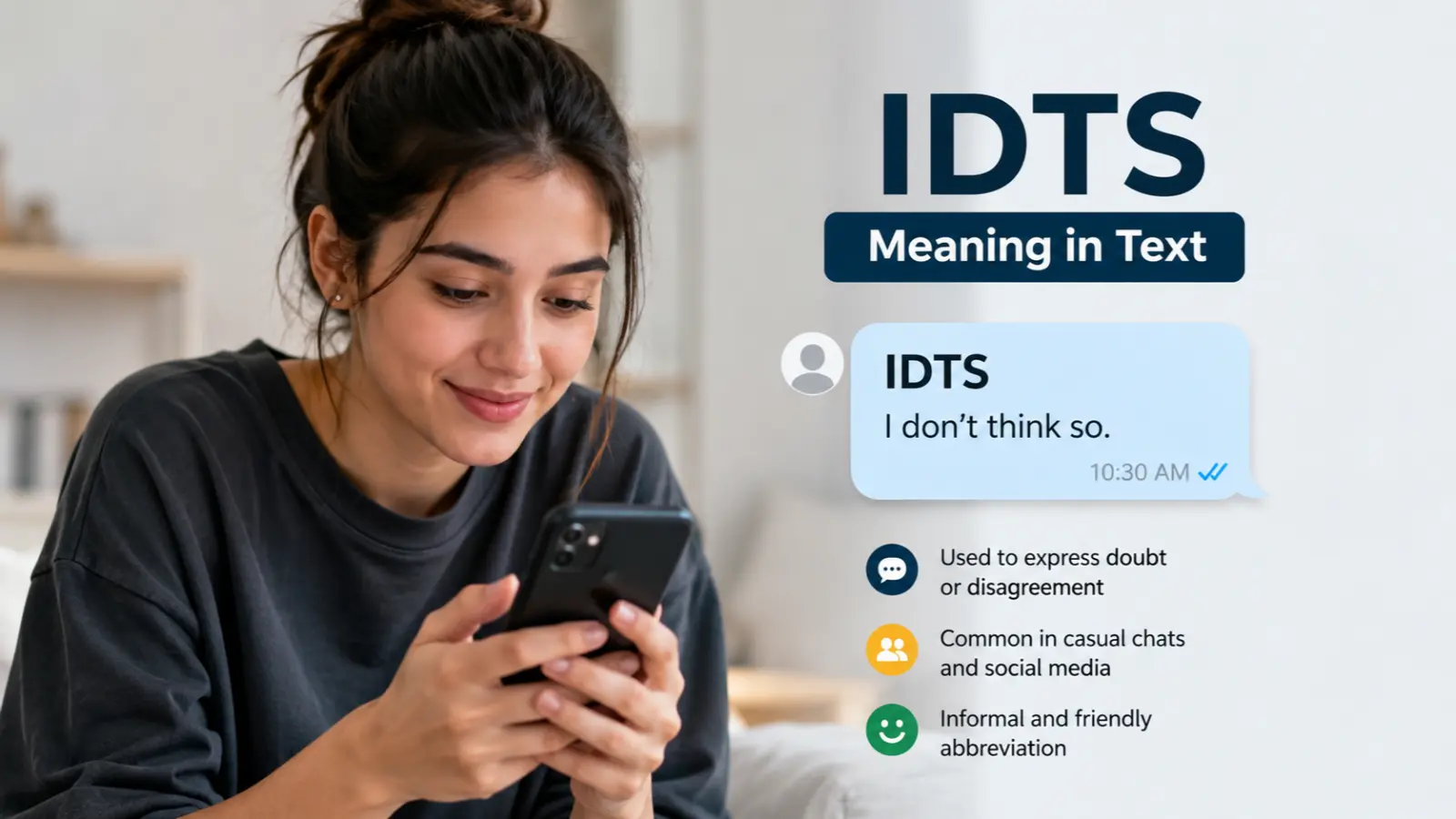
IDTS meaning in text is a common question for people who see this abbreviation in text messages, social media posts, comments, or online chats.
Internet slang can be confusing because short forms often have meanings that are not obvious from their letters.
IDTS usually appears in casual conversations when someone wants to express doubt or disagreement without writing a complete sentence.
You may see it when a friend questions an idea, disagrees with a statement, or simply says that they do not think something is true.
Understanding the meaning is easy once you know the full form. However, the exact tone can change depending on the conversation. IDTS may sound friendly, uncertain, skeptical, or slightly argumentative.
Quick Answer
IDTS means “I Don’t Think So” in text messages and online conversations. It is a casual way to disagree, express doubt, or say that you do not believe something is likely to happen.
What Does IDTS Mean in Text?
The most common IDTS meaning in text is “I Don’t Think So.”
It is an abbreviation made from the first letters of:
- I = I
- D = Don’t
- T = Think
- S = So
For example:
Friend: “Do you think Jake is coming tonight?”
You: “IDTS.”
Here, IDTS means “I don’t think so.”
The abbreviation is especially common in texting because people often use shortened words to communicate quickly.
IDTS Full Form and Definition
The IDTS full form is:
I Don’t Think So
It can be used to communicate:
- Doubt
- Disagreement
- Uncertainty
- A negative opinion
- A belief that something is unlikely
The expression does not always mean a strong “no.” Sometimes it simply means, “I don’t believe that is true” or “I don’t think that will happen.”
What Does IDTS Stand For?
If you are wondering what does IDTS stand for, the answer is “I Don’t Think So.”
It is normally used in informal communication rather than formal writing.
IDTS Meaning Slang: Different Contexts
The IDTS meaning slang can change slightly depending on the situation.
1. Expressing Disagreement
Someone might use IDTS when they disagree with another person’s opinion.
Example:
“I think this is the best restaurant in town.”
“IDTS. The one downtown is better.”
Here, IDTS means, “I don’t think so.”
2. Expressing Doubt
IDTS can show that someone is not convinced.
“Do you think she knows about the surprise?”
“IDTS.”
The speaker believes she probably does not know.
3. Saying Something Is Unlikely
It can also suggest that something probably will not happen.
“Will they finish the project today?”
“IDTS.”
This means, “I don’t think so.”
4. Soft Disagreement
IDTS can make disagreement sound less direct than simply saying “No.”
“Is Tom angry with us?”
“IDTS.”
The speaker is giving an opinion rather than making an absolute claim.
Is IDTS Rude, Offensive, or Neutral?
IDTS is generally neutral and not offensive.
However, its tone depends heavily on context.
A friendly conversation may make IDTS sound relaxed:
“Think we can finish this before dinner?”
“IDTS 😂”
In an argument, the same abbreviation might sound dismissive:
“You’re definitely wrong.”
“IDTS.”
So, IDTS itself is not rude, but the surrounding conversation can make it sound blunt or argumentative.
If you want to sound warmer, add a short explanation:
“IDTS, but I could be wrong.”
That makes your response feel more open-minded.
Where Is IDTS Commonly Used?
IDTS is most common in informal digital communication, including:
- Text messages
- Instagram comments and DMs
- Snapchat
- TikTok comments
- Facebook Messenger
- Discord
- Online forums
- Gaming chats
- Group chats
- Casual conversations
It is much less appropriate for formal emails, academic writing, business reports, or professional documents.
Real-Life IDTS Conversation Examples
Friendly Example
Alex: “Do you think we should order pizza?”
Sam: “IDTS. We just ate!”
Here, IDTS is casual and friendly.
Casual Example
Mia: “Is the movie starting at 8?”
Leo: “IDTS. I think it’s at 8:30.”
The speaker politely expresses uncertainty.
Argumentative Example
Person A: “Everyone agrees with me.”
Person B: “IDTS.”
Here, IDTS can sound more challenging because it directly disagrees with the statement.
Social Media Example
“This is definitely the best song of the year.”
“IDTS 😂”
The person is casually disagreeing.
Gaming Example
“Can our team win this match?”
“IDTS. Their defense is too strong.”
Here, IDTS introduces a negative prediction.
Emotional and Psychological Meaning of IDTS
IDTS does not have a special psychological meaning by itself. Its emotional meaning depends on the person’s intention and the conversation.
Someone using IDTS may be:
- Doubtful
- Skeptical
- Uncertain
- Calmly disagreeing
- Trying to avoid a direct “no”
- Making a casual negative prediction
For example, “IDTS” may communicate uncertainty, while “Absolutely not” communicates much stronger disagreement.
This is why context matters when interpreting texting slang.
Origin and Background of IDTS
IDTS developed as part of the broader culture of internet and texting abbreviations. As online communication became faster and more informal, people began shortening common phrases.
Expressions such as:
- IDK = I Don’t Know
- IMO = In My Opinion
- TBH = To Be Honest
- BTW = By The Way
- IDTS = I Don’t Think So
are examples of this abbreviation style.
IDTS became useful because “I don’t think so” is already a common everyday expression. Shortening it makes casual conversations quicker.
IDTS vs. Similar Slang
Several abbreviations can communicate uncertainty or disagreement, but they are not exactly interchangeable.
| Slang | Full Form | Main Meaning | Tone |
|---|---|---|---|
| IDTS | I Don’t Think So | Doubt or disagreement | Casual |
| IDK | I Don’t Know | Uncertainty or lack of knowledge | Casual |
| IMO | In My Opinion | Personal opinion | Casual |
| TBH | To Be Honest | Introducing an honest opinion | Casual |
| NGL | Not Gonna Lie | Honest statement | Casual |
| Nah | No / Not really | Informal disagreement | Very casual |
For example, IDK means you do not know the answer, while IDTS means you have an opinion that something is probably not true or will probably not happen.
When Should You Use IDTS?
Use IDTS when you are communicating casually with people who understand texting abbreviations.
Good situations include:
- Talking with friends
- Messaging family members
- Casual group chats
- Social media conversations
- Gaming
- Informal online discussions
When Should You Avoid IDTS?
Avoid IDTS in formal situations where complete words are expected.
For example, instead of writing:
“IDTS this proposal is suitable.”
in a professional email, write:
“I don’t think this proposal is suitable.”
This sounds clearer and more professional.
Polite Alternatives to IDTS
If you want to express the same idea more politely or professionally, try:
- “I don’t think so.”
- “I don’t believe so.”
- “I’m not sure about that.”
- “I don’t think that’s likely.”
- “I have a different opinion.”
- “I’m not convinced.”
- “I don’t believe that is the case.”
The best alternative depends on how formal the conversation is.
Why Do People Use IDTS?
People use IDTS mainly because it is short, convenient, and easy to understand among people familiar with texting slang.
Common reasons include:
- Speed: It takes less time to type.
- Convenience: Four letters replace a full phrase.
- Informal tone: It fits naturally into casual chats.
- Digital culture: Internet users commonly shorten phrases.
- Soft disagreement: It can sound less forceful than “No.”
However, not everyone knows every abbreviation. If there is a chance of confusion, writing the complete phrase is better.
Impact of Using IDTS in Communication
IDTS can make online communication quick and natural, but it can also create misunderstandings.
For example:
“IDTS.”
may sound playful to one person but dismissive to another.
Adding context can make your meaning clearer:
“IDTS, but I’m not completely sure.”
or:
“IDTS 😂 I think they’re coming tomorrow.”
The extra words or emoji help communicate the intended tone.
Is IDTS Safe for Social Media?
Yes. IDTS is generally harmless and safe to use on social media. It is not inherently offensive, sexual, threatening, or inappropriate.
Still, consider your audience. An abbreviation that works perfectly in a group chat may not be suitable for a professional account or public-facing business communication.
Common Misunderstandings About IDTS
People sometimes misunderstand IDTS because they are unfamiliar with texting abbreviations.
Misunderstanding 1: IDTS Means “I Don’t Know”
It does not. IDK means “I Don’t Know.”
IDTS means “I Don’t Think So.”
Misunderstanding 2: IDTS Always Means “No”
Not necessarily. It can express uncertainty or a prediction rather than absolute disagreement.
Misunderstanding 3: IDTS Is Always Rude
No. It is normally neutral. Tone depends on the situation.
Misunderstanding 4: IDTS Is Formal English
No. It is primarily an informal texting and internet abbreviation.
Variations and Types of IDTS Usage
Although the full form remains the same, people can use IDTS in different ways.
Short Response
“IDTS.”
This is direct and simple.
With Explanation
“IDTS. I think she already left.”
This is clearer.
With an Emoji
“IDTS 😂”
This can make the response sound playful.
With Uncertainty
“IDTS, but I’m not 100% sure.”
This shows that the speaker is not completely certain.
How to Respond When Someone Uses IDTS
Your response depends on the conversation.
If someone says:
“IDTS.”
you can reply:
- “Why not?”
- “Really? I thought so.”
- “You might be right.”
- “I guess we’ll see.”
- “What makes you think that?”
- “Fair enough.”
If you are discussing something important, asking for an explanation can prevent misunderstandings.
Regional and Cultural Usage
IDTS is primarily associated with English-language digital communication. Because texting slang spreads through social media, gaming, messaging apps, and online communities, its use is not limited to one specific country.
However, familiarity can differ between age groups and communities. Younger internet users may recognize IDTS immediately, while someone who rarely uses texting abbreviations may not understand it.
When communicating with an international or mixed audience, using the complete phrase can be safer.
FAQs About IDTS Meaning in Text
What does IDTS mean in text?
IDTS means “I Don’t Think So.” It is commonly used to express doubt, disagreement, or the belief that something is unlikely.
What is the IDTS full form?
The IDTS full form is “I Don’t Think So.”
What does IDTS stand for in texting?
IDTS stands for “I Don’t Think So.” It is an informal abbreviation used in texts, chats, and social media.
Is IDTS rude?
Usually, no. IDTS is generally neutral, but it can sound blunt or dismissive depending on the context and tone.
Is IDTS the same as IDK?
No. IDTS means “I Don’t Think So,” while IDK means “I Don’t Know.”
Can I use IDTS in a professional email?
It is better to avoid it in professional writing. Use “I don’t think so,” “I don’t believe so,” or another complete phrase instead.
Conclusion
The idts meaning in text is simple: IDTS means “I Don’t Think So.” It is a casual abbreviation used in texting, social media, gaming chats, and other informal online conversations.
People use IDTS to express doubt, disagreement, or the belief that something is unlikely. It is generally neutral and not offensive, but its tone can change depending on the conversation.
Remember that IDTS is different from IDK. IDTS means you don’t think something is true or likely, while IDK means you do not know.
For friends and casual chats, IDTS is perfectly natural. In professional, academic, or formal communication, writing “I don’t think so” is clearer and more appropriate.