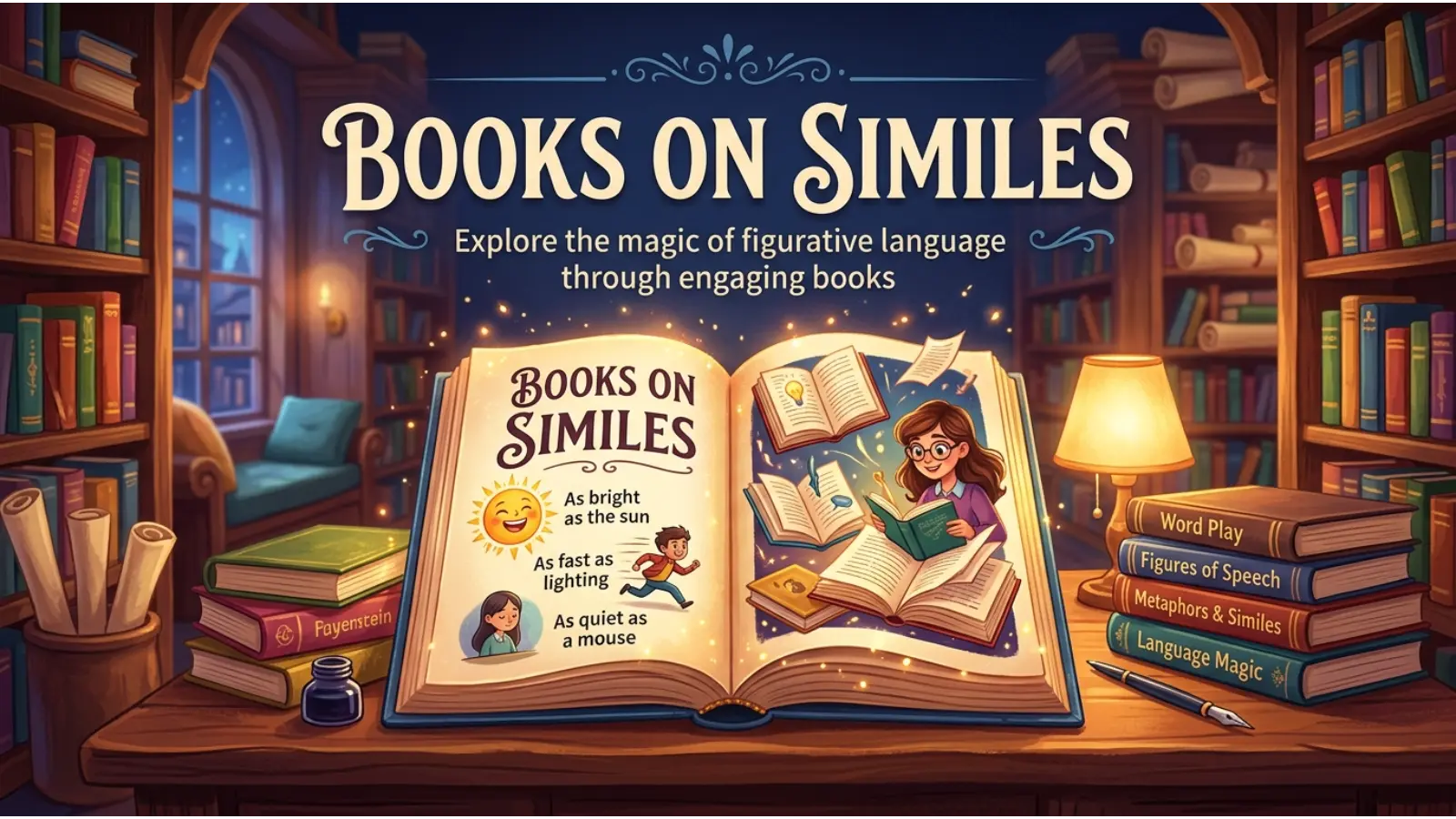
A Books on Similes is a comparison that connects two different things using words such as like or as. Instead of simply saying that someone is nervous, a writer might say, “Her thoughts scattered like leaves in a sudden wind.”
The comparison gives the reader something concrete to imagine.
Books on Similes appear in novels, poetry, children’s books, classroom exercises, speeches, songs, advertisements, and everyday conversation. They can make an ordinary description more visual, humorous, emotional, or memorable.
For readers looking for books on similes, the best resources do more than provide long lists of comparisons. A useful Books on Similes should explain why a comparison works, show how writers use figurative language, and give you enough practice to create your own.
This guide brings those ideas together. It explains how to study similes effectively, offers original examples, and shows how to turn simple comparisons into stronger writing.
Quick Answer: What Should You Look for in Books on Similes?
The most useful books on similes usually combine clear explanations, literary examples, exercises, and guidance on creating original comparisons. Look for resources that teach figurative language, imagery, creative writing, and literary devices, rather than books that only provide lists of similes.
Why Read a Book About Similes?
A Books on Similes dictionary can tell you what a simile means, but learning to use one well requires more than a definition.
A good Books on Similes has a purpose. It might reveal a character’s mood, establish a setting, create humor, emphasize movement, or make an abstract idea easier to understand.
Reading about similes can help you notice those choices.
Similes Turn Abstract Ideas Into Images
Consider the difference:
The hallway was quiet.
and:
The hallway was as quiet as a room waiting for someone to speak.
The second sentence gives silence a situation. The reader can almost feel the anticipation.
Similes Can Reveal Character
A character does not always need to say exactly what they feel.
He moved through the meeting like a guest who had forgotten why he was invited.
The comparison suggests discomfort, uncertainty, and social awkwardness without explaining all three directly.
Similes Can Improve Storytelling
In fiction, a well-placed simile can slow a scene for a moment and draw attention to something important.
For example:
The old gate groaned like a tired voice waking from a long sleep.
The comparison adds atmosphere while keeping the action moving.
What Makes a Simile Effective?
Not every comparison improves a sentence. Strong similes usually share several qualities.
1. The Connection Is Easy to Understand
Readers should be able to recognize the relationship between the two things being compared.
2. The Comparison Adds Something New
A simile should contribute an image, feeling, tone, or idea rather than simply decorate a sentence.
3. The Image Fits the Context
A playful comparison might work beautifully in a children’s story but feel inappropriate in a serious report.
4. The Language Feels Natural
If readers notice the writer struggling to create the comparison, the simile may distract from the message.
5. The Comparison Has a Specific Quality
Instead of comparing something generally to “a storm,” identify what makes the storm useful.
Is it unpredictable? Loud? Fast? Restless? Difficult to escape?
That specific quality gives the comparison power.
25 Original Similes to Study and Adapt
The following examples are original comparisons created for this guide. Each demonstrates a different writing possibility.
1. “Her ideas opened like windows at sunrise.”
Meaning: Her thoughts became clearer and more expansive.
Best use: Creative writing, essays, and descriptions of inspiration.
Why it works: The comparison connects mental clarity with the gradual opening of a bright view.
Example:
After reading the first chapter, her ideas opened like windows at sunrise.
Writing tip: Compare an abstract mental process with a physical action readers can easily picture.
2. “The classroom buzzed like a jar full of restless bees.”
Meaning: The room was filled with energetic conversation and movement.
Best use: School stories and lively scene descriptions.
Why it works: The sound and movement of bees immediately suggest constant activity.
Example:
Before the teacher arrived, the classroom buzzed like a jar full of restless bees.
Writing tip: Sound-based comparisons are especially useful when describing crowded places.
3. “His apology landed like a pebble in deep water.”
Meaning: His apology had a small but noticeable emotional effect.
Best use: Emotional fiction and reflective writing.
Why it works: A pebble creates ripples, suggesting that the apology may have consequences beyond the initial moment.
Example:
His apology landed like a pebble in deep water, creating feelings neither of them expected.
Writing tip: Think about what happens after the thing you are describing.
4. “The rain tapped the roof like impatient fingers.”
Meaning: The rain sounded persistent and rhythmic.
Best use: Nature writing and atmosphere.
Why it works: The comparison gives the rain a human quality without turning it into a full personification.
Example:
All afternoon, the rain tapped the roof like impatient fingers.
Writing tip: For weather similes, listen to the sound before choosing the image.
5. “Her smile appeared like a small lamp in a dark room.”
Meaning: Her smile brought warmth or comfort.
Best use: Character description.
Why it works: Light naturally suggests hope, kindness, and relief.
Example:
Her smile appeared like a small lamp in a dark room.
Writing tip: Use familiar physical experiences to express emotions.
6. “The runner moved like a pencil drawing a straight line.”
Meaning: The runner moved quickly and directly.
Best use: Sports writing.
Why it works: The image emphasizes direction and smooth movement rather than simply saying the runner was fast.
Example:
At the final turn, the runner moved like a pencil drawing a straight line.
Writing tip: When describing movement, decide whether speed, direction, balance, or rhythm matters most.
7. “The old photograph felt like a doorway into yesterday.”
Meaning: Looking at the photograph brought the past vividly to mind.
Best use: Memoir, historical writing, and reflective essays.
Why it works: A doorway suggests entering another place, while “yesterday” makes the past feel close.
Example:
To her, the old photograph felt like a doorway into yesterday.
Writing tip: Comparisons involving doors, paths, windows, or bridges can work well for ideas about memory and change.
8. “His laughter rolled through the kitchen like marbles across a wooden floor.”
Meaning: His laughter was lively, audible, and irregular.
Best use: Character-focused storytelling.
Why it works: The sound of rolling marbles creates a playful rhythm.
Example:
His laughter rolled through the kitchen like marbles across a wooden floor.
Writing tip: Choose an object whose movement resembles the sound you want readers to imagine.
9. “The unanswered question sat between them like an unopened letter.”
Meaning: An important issue remained unresolved.
Best use: Dialogue and emotional scenes.
Why it works: An unopened letter represents information that exists but has not yet been confronted.
Example:
The unanswered question sat between them like an unopened letter.
Writing tip: Objects associated with waiting can create strong emotional comparisons.
10. “The city glittered like scattered coins after rain.”
Meaning: Lights reflected across the city and created a sparkling appearance.
Best use: Setting descriptions.
Why it works: Coins provide a familiar visual reference for small points of reflected light.
Example:
From the hill, the city glittered like scattered coins after rain.
Writing tip: Look for ordinary objects that share the visual quality you need.
11. “Her confidence grew like a path appearing beneath fresh snow.”
Meaning: Her confidence gradually became clearer and stronger.
Best use: Character development.
Why it works: A path under snow suggests something that was already there but becomes visible through movement.
Example:
With every successful presentation, her confidence grew like a path appearing beneath fresh snow.
Writing tip: For growth, compare the emotion with something that develops gradually.
12. “The little boat rocked like a toy in a bathtub.”
Meaning: The boat moved noticeably on the water.
Best use: Children’s stories and gentle adventure scenes.
Why it works: The comparison creates a simple, accessible image.
Example:
Near the shore, the little boat rocked like a toy in a bathtub.
Writing tip: Simple comparisons are often stronger for young readers.
13. “The news spread through the neighborhood like a spark jumping between dry leaves.”
Meaning: Information traveled very quickly.
Best use: Fiction and narrative writing.
Why it works: The comparison emphasizes speed and the inability to easily stop the spread.
Example:
By lunchtime, the news had spread through the neighborhood like a spark jumping between dry leaves.
Writing tip: When describing information spreading, focus on speed, reach, or inevitability.
14. “His voice was as thin as a thread pulled too far.”
Meaning: His voice sounded weak or strained.
Best use: Character and emotional description.
Why it works: A stretched thread suggests fragility and tension.
Example:
After the long speech, his voice was as thin as a thread pulled too far.
Writing tip: Comparisons become more vivid when the second object has a physical state that matches the emotion.
15. “The puppy followed her like a tiny shadow with paws.”
Meaning: The puppy stayed very close to her.
Best use: Children’s writing and humorous descriptions.
Why it works: The familiar idea of a shadow is given a playful twist.
Example:
All afternoon, the puppy followed her like a tiny shadow with paws.
Writing tip: Adding one unexpected detail can make a familiar comparison feel fresh.
16. “The library smelled like rain trapped inside old paper.”
Meaning: The library had a cool, earthy, paper-rich atmosphere.
Best use: Creative descriptions and literary fiction.
Why it works: It combines scent and texture to create an unusual sensory impression.
Example:
The library smelled like rain trapped inside old paper.
Writing tip: Sensory similes can make settings feel much more immersive.
17. “His anger flashed like a match struck in a quiet room.”
Meaning: His anger appeared suddenly and dramatically.
Best use: Character conflict.
Why it works: A match produces sudden light and heat, which parallels a quick emotional reaction.
Example:
His anger flashed like a match struck in a quiet room.
Writing tip: For intense emotions, short-lived sources of heat or light can create strong imagery.
18. “The idea bounced around her mind like a coin inside a closed box.”
Meaning: She could not stop thinking about the idea.
Best use: Internal narration.
Why it works: The repeated movement suggests persistent thoughts.
Example:
The possibility bounced around her mind like a coin inside a closed box.
Writing tip: Use movement to represent repetitive thoughts.
19. “The sunset spread across the horizon like paint released from a broken brush.”
Meaning: The colors expanded widely and irregularly.
Best use: Nature writing and poetry.
Why it works: The image suggests both color and movement.
Example:
At the end of the day, the sunset spread across the horizon like paint released from a broken brush.
Writing tip: Visual similes work best when the comparison explains both appearance and motion.
20. “The silence grew like frost along a window.”
Meaning: The silence gradually became more noticeable and uncomfortable.
Best use: Suspense and emotional scenes.
Why it works: Frost develops quietly but changes the entire appearance of a window.
Example:
After his question, the silence grew like frost along a window.
Writing tip: For abstract conditions such as silence, tension, or doubt, compare them with something that gradually spreads.
21. “Her excitement fizzed like a freshly opened soda.”
Meaning: She felt energetic and eager.
Best use: Casual writing, children’s stories, and dialogue.
Example:
Her excitement fizzed like a freshly opened soda when she saw the surprise.
Writing tip: Physical sensations can make emotional descriptions feel immediate.
22. “The narrow road curled like a ribbon dropped on the floor.”
Meaning: The road curved gently and irregularly.
Best use: Travel and landscape descriptions.
Example:
The narrow road curled like a ribbon dropped on the floor.
Writing tip: For landscapes, compare shapes with familiar objects.
23. “His memory was as slippery as a fish in shallow water.”
Meaning: He struggled to hold onto a memory.
Best use: Reflective writing and fiction.
Example:
The name was as slippery as a fish in shallow water.
Writing tip: Avoid explaining an abstract problem twice; let the comparison carry some of the meaning.
24. “The team worked like gears turning inside one careful machine.”
Meaning: Everyone coordinated efficiently.
Best use: Sports, teamwork, and business writing.
Example:
During the final minutes, the team worked like gears turning inside one careful machine.
Writing tip: Comparisons are useful for explaining relationships between people, not just physical appearances.
25. “The unfinished story waited like a suitcase beside the door.”
Meaning: The story was ready to continue but had been left untouched.
Best use: Creative writing and reflection.
Example:
For months, the unfinished story waited like a suitcase beside the door.
Writing tip: Choose an object that implies an action still waiting to happen.
How to Choose Books on Similes
If you are searching for books on similes, decide first what you want to learn.
A student may need a simple introduction to figurative language. A teacher may want classroom exercises. A poet may need help developing imagery. A fiction writer may benefit more from studying how comparisons affect character and atmosphere.
For Beginners
Look for resources that explain:
- What a simile is
- How “like” and “as” comparisons work
- The difference between similes and metaphors
- Basic examples
- Short exercises
A beginner-friendly book should make you want to try writing immediately.
For Creative Writers
Look for books that discuss imagery, description, sensory language, figurative language, and style.
A resource that teaches these wider skills can be more valuable than one containing hundreds of isolated examples.
For Students
Prioritize clear definitions, examples, practice questions, and explanations of why an answer works.
The goal should not be memorizing lists. It should be learning to recognize and create effective comparisons.
For Teachers
Books with classroom activities, writing prompts, age-appropriate examples, and exercises can make similes easier to teach.
A good activity should allow students to experiment rather than simply identify the word “like.”
How to Study a Simile Like a Writer
When you encounter a strong simile in a book, don’t just copy it into your notes.
Ask five questions:
- What is being described?
- What is it compared with?
- What quality connects the two?
- What emotion does the comparison create?
- Could I create a different comparison for the same idea?
That final question is particularly useful.
Suppose a sentence compares someone’s voice to a bell. Instead of copying that comparison, think about what quality matters: clarity, volume, sharpness, warmth, or persistence.
Then find your own image.
This turns reading into a writing exercise.
How Professional Writers Build Better Similes
Strong writers often begin with observation rather than a clever phrase.
Instead of asking, “What sounds poetic here?” ask:
What does this actually look, sound, feel, smell, or move like?
Imagine describing a crowded train station.
You might first notice noise. Then movement. The impatience. Then flashes of conversation.
Those observations give you several possible directions:
The station sounded like dozens of radios tuned to different channels.
That comparison focuses on sound.
Another writer might focus on movement:
People flowed through the station like water finding cracks in a stone wall.
Neither is automatically better. The best choice depends on what the scene needs.
The Most Useful Question: Why This Comparison?
A simile becomes stronger when you know exactly why you chose it.
If your character is nervous, don’t simply compare them to something “shaky.”
Ask what their nervousness actually does.
Do they speak too quickly?
A they avoid eye contact?
A their thoughts jump from one subject to another?
Do they feel trapped?
Each answer can lead to a different image.
How to Avoid Cliché Similes
Some comparisons have been used so often that they may no longer create a strong image.
Common expressions can still be useful when they are appropriate, but creative writing often benefits from specificity.
Instead of automatically reaching for a familiar comparison, pause and ask:
What would this character notice?
A fisherman, musician, athlete, child, scientist, and chef might describe the same event differently because each person notices different things.
That is one of the easiest ways to make your similes feel personal.
Replace General Images With Specific Details
Weak:
The room was cold like ice.
More specific:
The room felt like a refrigerator someone had forgotten to close.
The second comparison gives the reader a stronger situation to imagine.
Similes and Other Literary Devices
Similes work especially well when you understand how they differ from related techniques.
Simile vs. Metaphor
A simile makes an explicit comparison:
The clouds moved like ships.
A metaphor makes the comparison directly:
The clouds were ships crossing the sky.
Both can create imagery, but they create it differently.
Simile vs. Hyperbole
Hyperbole deliberately exaggerates:
I waited forever.
A simile compares:
I waited like a traveler watching the last bus disappear.
A sentence can contain both techniques, but they are not the same device.
Simile and Imagery
Imagery is broader. It involves language that helps readers experience a scene through the senses.
A simile can be one tool for creating imagery.
Simile and Personification
Personification gives human qualities to nonhuman things.
For example:
The wind whispered through the trees.
A simile might say:
The wind moved like someone whispering behind a door.
The two techniques can appear together, but they have different functions.
Create Your Own Similes in Five Steps
You do not need to wait for inspiration. You can build a useful simile deliberately.
Step 1: Choose the Subject
Start with something you want to describe.
Examples:
- A nervous student
- A busy street
- A winter morning
- A difficult decision
- A loud crowd
Step 2: Identify the Main Quality
Ask what matters most.
Is it:
- Fast?
- Quiet?
- Bright?
- Fragile?
- Confusing?
- Persistent?
- Unpredictable?
Step 3: Brainstorm Unrelated Objects
Don’t search for a perfect answer immediately.
For “quiet,” you might think of:
- An empty theater
- Fresh snow
- A closed book
- A sleeping house
- A paused recording
Step 4: Test the Comparison
Put it into a sentence.
The street was quiet like a closed theater.
Then ask whether it adds something useful.
Step 5: Make It Specific
Try improving the image.
At dawn, the street was quiet like a theater after the final audience had gone home.
Now the comparison has a stronger atmosphere.
Creative Exercises for Practicing Similes
Exercise 1: Five Senses
Choose one object and create five comparisons:
- One based on sight
- One based on sound
- One based on smell
- One based on touch
- One based on movement
This teaches you to avoid relying on visual imagery alone.
Exercise 2: One Emotion, Three Images
Choose an emotion such as excitement.
Write three similes for it using completely different sources:
- Nature
- Technology
- Food
The exercise forces your brain to explore different imagery.
Exercise 3: Rewrite a Plain Sentence
Start with:
The child was nervous.
Create three versions:
- A gentle comparison
- A humorous comparison
- A dramatic comparison
This demonstrates how word choice changes tone.
Exercise 4: Remove the Simile
Write a paragraph containing three similes.
Then remove all three.
Finally, put back only the comparison that genuinely improves the paragraph.
This is an excellent way to learn restraint.
Common Mistakes When Writing Similes
Overused Comparisons
A familiar phrase may communicate an idea quickly, but it can also make your writing predictable.
Better approach: Search for a fresh image connected to your character or setting.
Mixed Imagery
Avoid combining unrelated images so that the reader cannot tell what the sentence means.
For example, a comparison that jumps between ocean, machinery, and fire can become confusing.
Better approach: Keep the image focused.
Forced Similes
Not every sentence needs a comparison.
If a direct sentence is stronger, use it.
The door slammed.
may be more effective than adding a simile simply because you think every paragraph needs figurative language.
Confusing Similes With Metaphors
Remember:
- Simile: uses an explicit comparison, often with “like” or “as.”
- Metaphor: states or implies that one thing is another.
Understanding the distinction makes literary analysis easier.
Weak Descriptions
A comparison should reveal something.
Instead of:
The tree was like a tree.
choose an image that communicates shape, movement, age, texture, or mood.
Are Books on Similes Useful for Creative Writing?
Yes, especially when they teach you how to think about comparisons rather than simply memorize examples.
For creative writers, simile resources are most useful when paired with broader study of imagery, characterization, description, poetry, and storytelling.
A single simile rarely transforms a paragraph. The real skill is learning to choose details that make readers see and feel the scene.
How Many Similes Should You Use in a Story?
There is no universal number.
Some passages may need several comparisons because the writing is highly descriptive. Other passages may be stronger with none.
Use a simile when it performs a job.
If removing the comparison makes the sentence less vivid, less emotional, or less precise, it is probably earning its place.
Can Similes Be Used in Academic Writing?
Yes, but they should be used carefully.
Academic writing generally prioritizes precision and clarity, so figurative language should support the explanation rather than obscure it.
In literary analysis, creative writing instruction, speeches, and reflective essays, similes can be particularly useful.
What Is the Difference Between a Good and Bad Simile?
A good simile gives readers a useful connection they can understand and remember.
A weak simile may be:
- Too obvious
- Unrelated to the subject
- Overused
- Too complicated
- Grammatically awkward
- Unnecessary
The difference is usually not whether the comparison sounds “fancy.” It is whether the comparison helps the reader.
Where Can I Find Good Simile Examples?
You can find similes in novels, poetry, children’s literature, essays, speeches, songs, advertisements, and everyday conversation.
When reading, look for comparisons that make you stop because the image feels especially clear or unexpected.
Instead of collecting hundreds of examples, collect a smaller number and study why each one works.
Can Children Learn Similes Easily?
Yes. Similes are often accessible to young learners because they connect unfamiliar ideas with familiar objects and experiences.
Children can start with simple comparisons:
The puppy was as playful as a bouncing ball.
As their writing develops, they can experiment with more specific and imaginative comparisons.
How Can I Make My Similes More Original?
Start with your own observations.
Think about the character, setting, culture, experience, or situation you are writing about. Then look for an image that naturally belongs to that world.
Originality usually comes from specific observation, not from making a comparison as complicated as possible.
Conclusion
The best books on similes should leave you with more than a collection of phrases. They should teach you how comparisons create images, reveal emotions, establish atmosphere, and make writing easier to remember. When studying similes, read like a writer. Notice the connection between the subject and comparison. Ask why the image works. Then put the book aside and create a different comparison of your own. Start with something simple—a sound, a movement, a memory, or an emotion. Find an unexpected but believable image for it. Test the sentence. Remove it if it does not help. That habit will take you much further than memorizing lists of similes. The goal is not to use more comparisons. The goal is to make the right comparison at the right moment.
I am Helena Frost, a writer captivated by the beauty of language and the art of comparison. Through my words, I explore the world by turning ordinary moments into vivid similes and reflections. I enjoy crafting phrases that spark imagination, evoke emotion, and linger in the mind. My writing celebrates the subtle connections between people, nature, and the stories we live. For me, every sentence is an opportunity to reveal the extraordinary in the everyday.






1 thought on “Books on Similes: Learn, Practice, and Write Better”