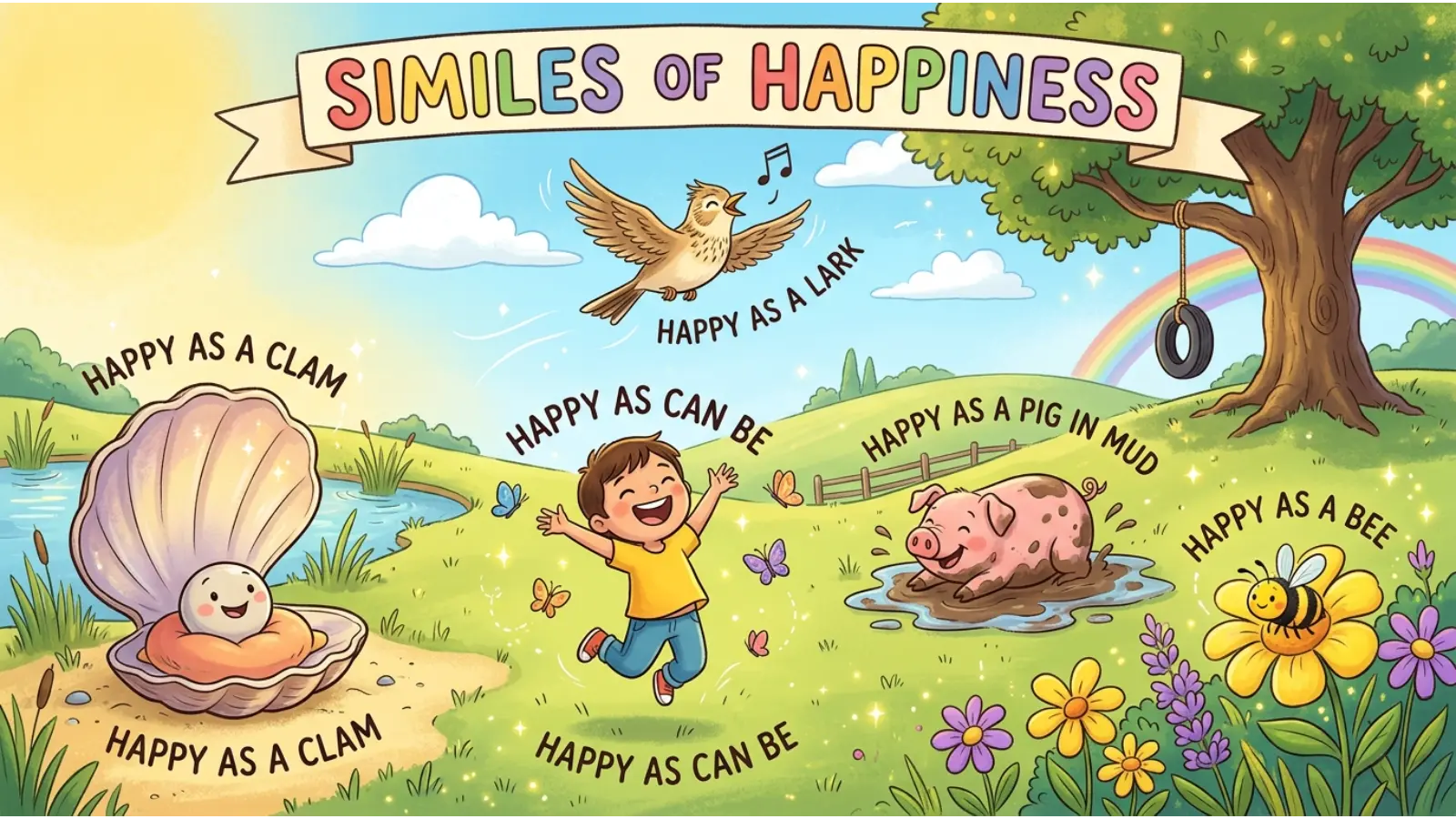
Similes of Happiness can be surprisingly difficult to describe. Saying someone is “happy” tells the reader the emotion, but it does not always make them feel it. A strong simile can turn that simple emotion into a picture, sound, movement, or moment that readers can imagine.
Similes of happiness compare joy to something familiar, often using words such as like or as. For example, “Her smile spread like sunlight across a quiet room” gives happiness a visual quality that the word happy alone cannot provide.
You can use these comparisons in stories, poems, personal essays, speeches, conversations, greeting cards, and creative writing. This collection offers original examples while showing how to adapt them instead of simply copying them.
What Is a Simile of Happiness?
A simile of happiness is a comparison that describes joy by connecting it to another image, object, experience, sound, or feeling.
For example:
His happiness bubbled like a fountain in spring.
The comparison makes the emotion seem energetic, fresh, and impossible to contain.
A useful happiness simile usually does more than say that someone feels good. It gives the reader a clue about what that happiness feels, looks, sounds, or behaves like.
Quick Answer: What Are Some Good Similes for Happiness?
Here are a few original examples:
- Her happiness glowed like a lantern in the evening.
- His excitement bounced like a rubber ball on pavement.
- She felt as light as a leaf carried by a warm breeze.
- Their laughter rose like birds startled into flight.
- His joy opened like a window after a long storm.
- The children were as cheerful as sparrows around a garden.
- Her smile shimmered like sunlight on moving water.
- Their happiness spread like warm tea through cold hands.
The best choice depends on the kind of happiness you want to express. Quiet contentment needs a different comparison from wild excitement.
35 Original Similes of Happiness
1. Happiness glowing like a lantern
Simile: Her happiness glowed like a lantern in a dark hallway.
Meaning: Her joy was warm, noticeable, and comforting.
This works especially well when happiness affects the atmosphere around a character.
Example:
“When Maya heard the good news, her happiness glowed like a lantern in a dark hallway.”
Writing tip: Use light imagery when happiness brings hope or comfort.
Best context: Stories, personal essays, reflective writing.
2. Joy rising like morning sunlight
Simile: His joy rose like morning sunlight over the hills.
This comparison suggests happiness that gradually becomes stronger and brighter.
Example:
“At first he smiled quietly, but his joy rose like morning sunlight over the hills.”
Emotional effect: Warm, hopeful, peaceful.
Best context: Poetry and emotional storytelling.
3. Happiness bubbling like a fountain
Simile: Her happiness bubbled like a fountain in spring.
The word bubbled gives the emotion movement and energy.
Example:
“She could hardly sit still; her happiness bubbled like a fountain in spring.”
Writing purpose: This is useful when a character cannot hide their excitement.
4. A smile spreading like sunlight
Simile: His smile spread across his face like sunlight across a quiet room.
Rather than merely saying that someone smiled, this comparison shows the smile gradually changing their expression.
Best context: Character descriptions and fiction.
Adapt it: Replace quiet room with a setting that matches your scene.
5. Feeling light as a floating leaf
Simile: She felt as light as a leaf drifting on a gentle breeze.
This suggests relief as well as happiness.
Example:
“After finishing the difficult exam, she felt as light as a leaf drifting on a gentle breeze.”
Writing tip: This works particularly well when happiness follows stress.
6. Laughter ringing like little bells
Simile: Their laughter rang like little bells across the garden.
The comparison uses sound rather than appearance.
Why it works: Readers can almost hear the scene.
Best context: Children’s stories, family scenes, celebrations, and poetry.
7. Joy opening like a window
Simile: His joy opened like a window after a long winter.
This presents happiness as a release after a difficult period.
Emotional effect: Relief, renewal, and hope.
Best context: Stories involving change or emotional recovery.
8. Excitement bouncing like a ball
Simile: Her excitement bounced like a ball from one thought to another.
This makes excitement feel energetic and restless.
Example:
“She kept imagining the trip, her excitement bouncing like a ball from one thought to another.”
Writing tip: Movement-based comparisons are useful for energetic emotions.
9. Happiness spreading like warm tea
Simile: The happiness spread through the room like warmth from a cup of tea.
This is a gentle comparison for shared happiness.
Best context: Family gatherings, friendship scenes, and cozy moments.
10. Joy shining like polished glass
Simile: His joy shone like polished glass beneath the afternoon sun.
This suggests visible brightness and intensity.
Writing purpose: Use it when the character’s happiness is easy for others to notice.
11. Cheerfulness fluttering like a bird
Simile: Her cheerfulness fluttered through the morning like a bird in an open garden.
The image makes happiness feel free and lively.
Best context: Poetry and descriptive prose.
12. Happiness blooming like a garden
Simile: Her happiness bloomed like a garden after the first spring rain.
This suggests happiness that develops gradually.
Example:
“Every kind word made her happiness bloom like a garden after the first spring rain.”
Writing tip: Growth imagery works well for emotions that build over time.
13. Joy dancing like sunlight on water
Simile: Joy danced across his face like sunlight skipping over water.
The comparison gives the emotion movement without making it overly dramatic.
Best context: Character descriptions.
14. Feeling as free as a kite
Simile: After the final bell rang, she felt as free as a kite above an open field.
This expresses happiness mixed with freedom.
Best context: School stories, coming-of-age writing, and personal narratives.
15. Laughter rolling like summer thunder
Simile: Their laughter rolled through the house like gentle summer thunder.
Unlike a harsh storm comparison, the word gentle keeps the image playful.
Writing tip: Adding a precise adjective can completely change the emotional tone of a comparison.
16. Happiness sparkling like dew
Simile: His happiness sparkled like dew on the grass at sunrise.
This creates a quiet, delicate image.
Best context: Poetry, nature writing, and peaceful scenes.
17. Excitement fizzing like a fresh drink
Simile: Her excitement fizzed like a freshly opened drink.
This gives the feeling a lively, restless quality.
Best context: Informal writing and dialogue.
18. Joy warming the heart like a fireplace
Simile: The news warmed her heart like a fireplace on a cold evening.
This is especially useful for happiness caused by kindness, reunion, or good news.
Emotional effect: Comfort and affection.
19. Happiness rushing like a river
Simile: Happiness rushed through him like a river released from a narrow valley.
The comparison suggests powerful emotion arriving suddenly.
Best context: Dramatic moments and storytelling.
20. A happy mood floating like a balloon
Simile: Her mood floated like a bright balloon above the worries of the day.
This suggests temporary escape from everyday problems.
Writing tip: Compare the emotion to something that physically moves when you want the sentence to feel dynamic.
21. Joy arriving like unexpected sunshine
Simile: The good news arrived like unexpected sunshine through the clouds.
This works when happiness comes suddenly.
Best context: Stories, personal writing, and reflective essays.
22. Happiness humming like a favorite song
Simile: A quiet happiness hummed inside her like a favorite song.
The comparison is subtle rather than dramatic.
Best context: Quiet satisfaction, peaceful moments, and internal thoughts.
23. Smiling like a child discovering a secret garden
Simile: He smiled like a child discovering a secret garden.
This suggests wonder and genuine delight.
Writing purpose: Useful when happiness includes curiosity or amazement.
24. Happiness moving like a warm breeze
Simile: A soft happiness moved through the group like a warm breeze.
This describes shared contentment without exaggerating it.
Best context: Group scenes and peaceful gatherings.
25. Joy bursting like confetti
Simile: Her joy burst through her words like confetti at a celebration.
This is a lively comparison for intense excitement.
Best context: Celebrations and humorous or energetic writing.
26. Happiness settling like snow
Simile: A peaceful happiness settled over him like fresh snow.
This is a quieter image. Instead of explosive excitement, it suggests calm contentment.
Writing tip: Not every happiness simile needs to be bright or energetic.
27. A smile bright as a summer morning
Simile: Her smile was as bright as a summer morning.
This simple structure is useful when you need a clear, easy-to-understand comparison.
Best context: Children’s writing, school assignments, and straightforward descriptions.
28. Joy skipping like a stone
Simile: His joy skipped through his thoughts like a stone across a calm lake.
The image suggests happiness moving quickly from one thought to another.
Best context: Creative fiction and poetry.
29. Happiness filling the room like music
Simile: Their happiness filled the room like music from an open window.
This shows how one person’s or group’s happiness can influence an entire setting.
Writing purpose: Good for scenes where emotion becomes part of the atmosphere.
30. Contentment resting like a cat in sunlight
Simile: Her contentment rested on her like a cat curled in a patch of sunlight.
This is better suited to peaceful happiness than excitement.
Best context: Reflective prose and quiet domestic scenes.
31. Excitement flashing like a spark
Simile: Excitement flashed through him like a spark catching dry leaves.
This creates a sense of sudden emotional intensity.
Best context: Unexpected opportunities, discoveries, or surprising news.
32. Happiness unfolding like a letter
Simile: His happiness unfolded like a letter carrying long-awaited news.
The comparison emphasizes anticipation and discovery.
Writing tip: Choose an image that matches the way the emotion develops.
33. Joy shining through her voice like sunlight
Simile: Joy shone through her voice like sunlight through thin curtains.
This is useful when you want to show happiness without describing a facial expression.
Best context: Dialogue and character development.
34. Happiness skipping like a child
Simile: Happiness skipped through his afternoon like a child with nowhere to hurry.
This creates a playful sense of freedom.
Best context: Personal essays, poetry, and lighthearted stories.
35. Peaceful happiness drifting like a cloud
Simile: A peaceful happiness drifted through her thoughts like a slow cloud across a blue sky.
This expresses gentle, unhurried contentment.
Best context: Reflective writing and endings to emotional scenes.
How to Choose the Right Happiness Simile
Not every kind of happiness feels the same.
A character who wins an important competition may feel electric, explosive, or restless. Someone sitting with family on a quiet evening may experience warm, steady contentment.
Think about four qualities before choosing a comparison:
1. Intensity
Ask whether the happiness is mild, strong, or overwhelming.
- Mild: like a warm breeze
- Strong: like sunlight breaking through clouds
- Intense: like sparks racing through dry grass
2. Speed
Does the emotion arrive slowly or suddenly?
For gradual happiness, use images such as blooming flowers or rising sunlight.
For sudden happiness, use images such as sparks, bursts, or flashes.
3. Texture
Some happiness feels soft and comforting. Other happiness feels energetic.
Soft imagery might involve blankets, sunlight, gardens, or warm air.
Energetic imagery might involve fireworks, bouncing objects, rushing water, or dancing movement.
4. Source
Consider why the character is happy.
Happiness from friendship may feel warm.
Happiness from success may feel triumphant.
A from freedom may feel light.
A from good news may feel sudden.
Happiness from peace may feel quiet.
The source of the emotion can guide the comparison.
How to Make Happiness Similes More Vivid
A weak sentence says:
She was happy like a flower.
The image is understandable, but it does not tell us much.
A more specific comparison gives the reader something to picture:
Her happiness opened like a garden after the first rain.
The second version contains movement, setting, season, and renewal.
When creating your own similes, ask:
- What does happiness physically resemble?
- Does it move?
- Does it make a sound?
- Does it create light?
- Does it have warmth?
- Does it grow?
- Does it arrive suddenly?
- Does it affect other people?
Specific details usually create stronger imagery than generic objects.
How to Avoid Cliché Happiness Comparisons
Common comparisons are not automatically bad, but familiar imagery can lose its impact when used too often.
Instead of repeatedly writing:
Her smile was like sunshine.
Try identifying something more specific about the scene.
For example:
Her smile flickered across the breakfast table like sunlight reflected from a moving window.
The goal is not to make every sentence complicated. The goal is to make the comparison appropriate and memorable.
A useful technique is to look around the scene for inspiration. If your character is standing near a train station, you might compare excitement to a departing train. If they are cooking, happiness might be compared to the warmth spreading from an oven.
A Simple Formula for Original Similes
Try this pattern:
Emotion + movement + specific image + relevant detail
For example:
His happiness + spread + like light + beneath a doorway.
Then refine it:
His happiness spread like morning light beneath a closed doorway.
This method gives you a starting point without forcing your writing into a formula.
Simile vs. Metaphor: What’s the Difference?
A simile makes an explicit comparison, usually with like or as.
Her happiness was like sunlight.
A metaphor makes the comparison directly.
Her happiness was sunlight.
Both can create imagery, but they produce slightly different effects.
A simile leaves a little distance between the subject and comparison. A metaphor can feel more direct and powerful.
Other Literary Devices That Work With Happiness
Imagery
Imagery uses sensory details to help readers imagine an experience.
Instead of writing:
He felt happy.
You might describe his expression, voice, movement, surroundings, and actions.
Personification
Personification gives human qualities to something nonhuman.
The morning seemed to welcome her with open arms.
Hyperbole
Hyperbole intentionally exaggerates an idea.
He was so excited that he felt ready to run around the world.
Use exaggeration carefully so the tone remains believable.
Symbolism
An object can represent a larger idea.
A sunrise, open door, growing plant, or clear sky might symbolize hope or happiness depending on the context.
The strongest writing often combines these devices naturally rather than forcing several into one sentence.
How to Create Your Own Similes of Happiness
You can create fresh comparisons in a few steps.
Step 1: Name the exact emotion
Don’t stop at happy. Decide whether the character feels:
- joyful
- relieved
- excited
- peaceful
- grateful
- proud
- playful
- hopeful
- delighted
Step 2: Decide how the emotion behaves
Does it:
- glow?
- rush?
- float?
- bloom?
- whisper?
- dance?
- settle?
- sparkle?
- burst?
Step 3: Find an unexpected but believable comparison
Think beyond the usual sun, stars, and flowers.
Look at everyday experiences:
- a favorite song beginning
- a door opening
- a fresh notebook
- a message from a friend
- warm food on a cold day
- a bicycle gaining speed
- a window opening after rain
Step 4: Connect the image to the situation
A good simile belongs to its scene.
If a character has just received a letter, a comparison involving a letter or unfolding paper may feel more natural than an unrelated image.
Step 5: Read it aloud
A simile should sound natural inside the sentence. If it feels decorative rather than useful, simplify it.
Creative Exercises for Better Happiness Similes
Exercise 1: Change the intensity
Start with:
She was happy like ______.
Write three versions: one for mild happiness, one for strong happiness, and one for overwhelming happiness.
Exercise 2: Use the five senses
Create one happiness simile based on:
- something you can see
- something you can hear
- something you can touch
- something you can smell
- something you can taste
This prevents your writing from relying only on visual comparisons.
Exercise 3: Remove the obvious image
Write a sentence using sunshine. Then rewrite it without sunshine, stars, rainbows, or flowers.
This forces you to search for fresher imagery.
Exercise 4: Match the character
Write a happiness simile for:
- a nervous student who receives good news
- a child on the first day of vacation
- a person reuniting with an old friend
- someone quietly enjoying a peaceful morning
Notice how the comparison changes with the situation.
Common Mistakes When Writing Happiness Similes
Using the same comparisons repeatedly
Sunshine, rainbows, and flowers can work, but relying on them in every paragraph makes descriptions predictable.
Making the comparison too complicated
A simile should clarify or intensify an idea. If readers have to decode it, the image may be doing too much.
Mixing unrelated images
Avoid combining several comparisons that pull the reader in different directions.
For example, a sentence that compares happiness to a bird, a river, a burning candle, and a train at the same time will probably feel cluttered.
Choose the strongest image and let it breathe.
Forcing a simile into every sentence
Not every sentence needs figurative language. A well-placed simile is often more effective than five crowded together.
Confusing a simile with a metaphor
Remember:
Simile: Her happiness was like sunlight.
Metaphor: Her happiness was sunlight.
Both are useful, but they are not identical.
Frequently Asked Questions
What is a good simile for happiness?
A good happiness simile connects joy to a vivid and relevant image, such as light, warmth, movement, sound, or growth. For example, “Her happiness bloomed like a garden after spring rain.”
What are some similes for extreme happiness?
For intense happiness, you can use energetic comparisons such as “His excitement flashed like a spark” or “Her joy burst through her words like confetti.”
What is a simile for feeling happy and peaceful?
A gentle comparison works best, such as “Her contentment rested on her like a cat curled in sunlight.” It suggests comfort rather than excitement.
Can similes describe different types of happiness?
Yes. Similes can distinguish excitement, relief, gratitude, pride, peacefulness, affection, and other forms of positive emotion.
How do you write a unique simile for happiness?
Start with the specific kind of happiness, decide how it behaves, and then compare it with an image connected to the character or setting. Specific details usually make the comparison feel more original.
Are happiness similes useful in poems?
Absolutely. Similes can give abstract emotions a physical image, making poems more sensory and memorable.
Can children use happiness similes?
Yes. Simple comparisons are especially useful for helping students understand figurative language and practice descriptive writing.
What is the difference between a happiness simile and a metaphor?
A simile explicitly compares happiness to something using words such as like or as. A metaphor makes the comparison directly without those comparison words.
Conclusion
Happiness is an abstract emotion, but a strong simile gives it something readers can see, hear, touch, or imagine. Instead of simply telling readers that a character is happy, you can show whether that happiness glows, dances, settles, rushes, blooms, or quietly warms the moment. The most effective similes of happiness are not necessarily the fanciest ones. They are the comparisons that fit the character, emotion, and setting. When writing your own, start with the exact kind of happiness you want to express. Then look for an image that behaves in a similar way. Make it specific, keep it natural, and avoid adding figurative language simply for decoration. A simple comparison can transform an ordinary sentence into an image readers remember.
I am Helena Frost, a writer captivated by the beauty of language and the art of comparison. Through my words, I explore the world by turning ordinary moments into vivid similes and reflections. I enjoy crafting phrases that spark imagination, evoke emotion, and linger in the mind. My writing celebrates the subtle connections between people, nature, and the stories we live. For me, every sentence is an opportunity to reveal the extraordinary in the everyday.