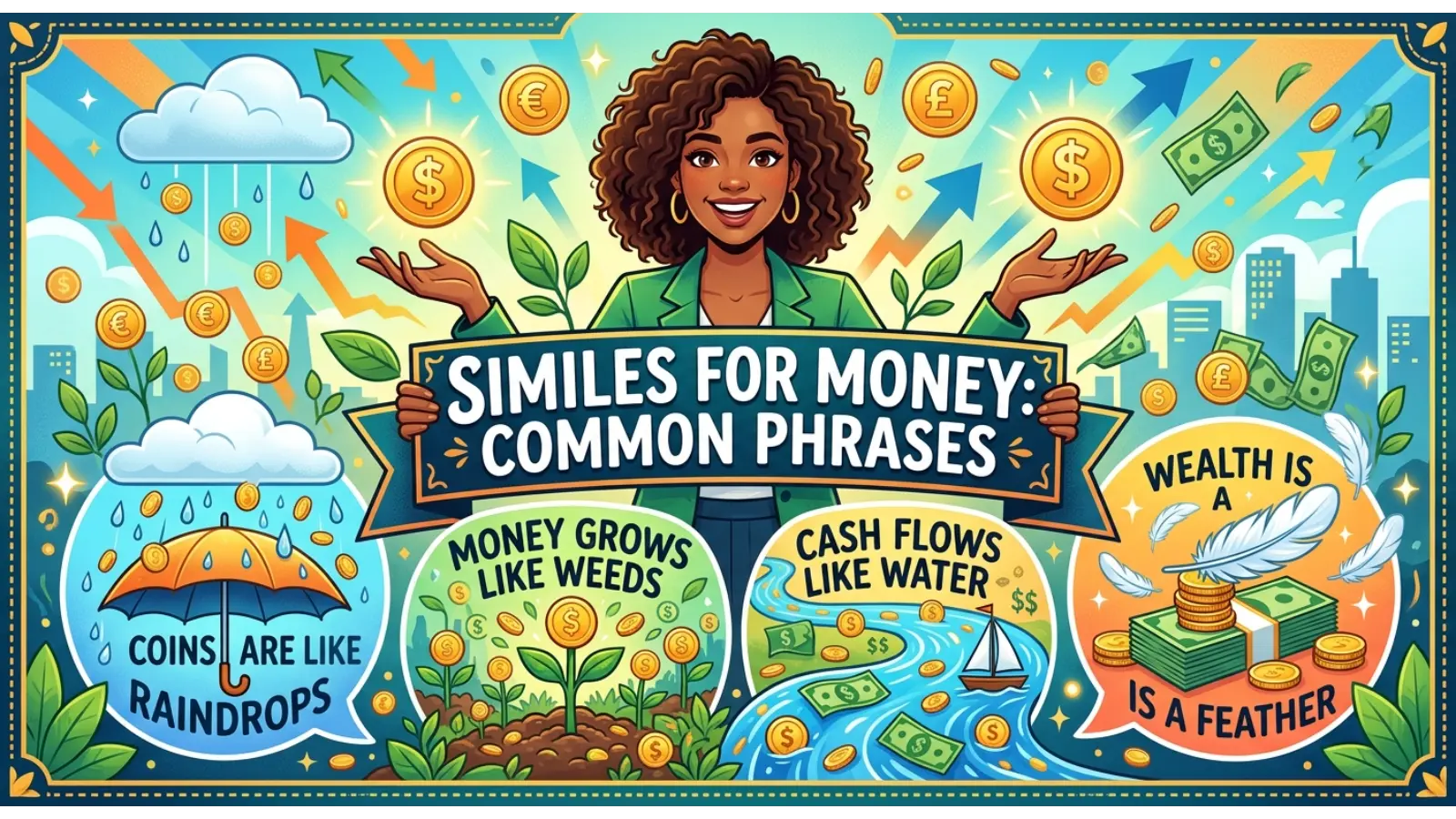
Similes for Money can be described in more interesting ways than simply saying someone is rich, poor, careful, or wasteful. A well-crafted comparison can turn an ordinary financial idea into an image readers can immediately understand.
A simile compares two different things using words such as “like” or “as.” For example, “His savings grew like a quiet garden after spring rain.” The comparison does more than describe money—it creates a feeling and gives the reader something visual to imagine.
People use money-related similes in stories, poems, speeches, conversations, essays, advertising, and everyday writing. This collection of similes for money focuses on fresh comparisons that can help you describe wealth, spending, saving, financial pressure, generosity, and the emotional power of money.
Quick Answer: What Are Some Good Similes for Money?
Here are a few original examples:
- Money flowed through his hands like water through a cracked cup.
- Her savings sat quietly like seeds waiting beneath the soil.
- The unexpected payment felt like sunlight breaking through heavy clouds.
- His spending habits were as restless as a bird searching for a place to land.
- Every dollar mattered to him like a single candle in a dark room.
- The family budget stretched like an old blanket over a wide bed.
The best money simile depends on what you want the reader to feel. A comparison about saving may suggest patience, while one about reckless spending can suggest speed, loss, or lack of control.
How Similes Make Money Easier to Describe
Money is an abstract idea. You cannot physically see “financial security” or “financial pressure” in the same way you can see a tree, river, or storm.
Similes give those abstract ideas a physical shape.
Compare these sentences:
She was worried about money.
Now consider:
Her worries about money followed her like a shadow that never lost its owner.
The second sentence gives the emotion movement and presence. The comparison helps readers experience the character’s situation rather than simply receiving information.
A strong simile usually connects money with something familiar—water, weather, objects, nature, movement, light, or everyday experiences.
Original Similes for Money
1. Money flowed through his hands like water through a cracked cup.
Meaning: He spent money quickly and struggled to keep it.
Example:
His paycheck arrived on Friday, but money flowed through his hands like water through a cracked cup.
By Monday, he was already wondering where it had gone.
Emotional effect: This creates a feeling of frustration and waste.
Writing purpose: Use it when describing someone who spends without planning.
Best context: Stories, personal essays, and character descriptions.
2. Her savings grew like seeds beneath patient soil.
Meaning: Her savings increased slowly through patience and consistency.
Example:
She never became wealthy overnight. Her savings grew like seeds beneath patient soil.
Every small deposit eventually gave her more financial security.
Emotional effect: The image feels hopeful and calm.
Writing tip: Nature comparisons work particularly well when describing long-term financial goals.
3. His wallet was as empty as a deserted room.
Meaning: He had very little money available.
Example:
After paying the bills, his wallet was as empty as a deserted room.
He checked it twice, although he already knew what he would find.
Emotional effect: It creates a quiet sense of scarcity.
Best context: Fiction and conversational writing.
4. The bonus felt like sunlight after a week of rain.
Meaning: Unexpected money brought relief and happiness.
Example:
The year-end bonus felt like sunlight after a week of rain.
It gave her enough breathing room to replace her broken laptop.
Writing purpose: This works especially well when money solves a temporary problem.
5. His expenses multiplied like rabbits in a garden.
Meaning: His costs increased rapidly.
Example:
Once he moved into the apartment, his expenses multiplied like rabbits in a garden.
Rent, utilities, repairs, and groceries seemed to appear all at once.
Emotional effect: The comparison adds humor while showing how quickly costs can grow.
6. Every dollar was as precious as a drop of water in a drought.
Meaning: Every small amount of money mattered greatly.
Example:
During that difficult month, every dollar was as precious as a drop of water in a drought.
She planned every purchase before spending anything.
Best context: Writing about financial hardship, careful budgeting, or sacrifice.
7. His wealth stood around him like a tall stone wall.
Meaning: His money gave him protection and security.
Example:
His wealth stood around him like a tall stone wall.
Problems that frightened others rarely threatened his daily life.
Writing insight: A simile can reveal a character’s relationship with money, not just their financial status.
8. The old coin gleamed like a tiny moon.
Meaning: The coin looked bright, valuable, or special.
Example:
The old coin gleamed like a tiny moon beneath the lamp.
She wondered how many hands had held it before hers.
Best context: Historical fiction, descriptive writing, and poetry.
9. His spending was as wild as a storm at sea.
Meaning: He spent unpredictably and without restraint.
Example:
His spending was as wild as a storm at sea.
One weekend he saved carefully, and the next he bought things he did not need.
Emotional effect: The storm image suggests instability and lack of control.
10. Her emergency fund waited like a quiet umbrella before the storm.
Meaning: Savings were prepared for future problems.
Example:
She kept her emergency fund untouched, waiting like a quiet umbrella before the storm.
When the car suddenly needed repairs, she was ready.
Writing purpose: This comparison emphasizes preparation rather than wealth.
11. The inheritance arrived like an unexpected door opening.
Meaning: The money created a new opportunity.
Example:
The inheritance arrived like an unexpected door opening.
For the first time, he could consider returning to school.
Emotional effect: It suggests possibility and change.
12. His debt followed him like a heavy backpack.
Meaning: Debt created a constant burden.
Example:
His debt followed him like a heavy backpack.
Even ordinary purchases made him think about what he still owed.
Best context: Serious stories, essays, and discussions of financial pressure.
13. Her generosity spread like ripples across a pond.
Meaning: Her willingness to give helped many people.
Example:
Her generosity spread like ripples across a pond.
One small donation inspired several friends to contribute as well.
Writing insight: This shows how money can affect relationships and communities.
14. The price tag hung over him like a dark cloud.
Meaning: The cost of something caused worry.
Example:
The price tag hung over him like a dark cloud.
He loved the house, but he was unsure whether he could afford it.
Emotional effect: The comparison creates tension without directly saying “he felt anxious.”
15. His paycheck disappeared as quickly as a spark in the wind.
Meaning: His money was gone almost immediately.
Example:
His paycheck disappeared as quickly as a spark in the wind.
Bills consumed most of it before he had a chance to enjoy the money.
Best context: Financial storytelling and relatable everyday situations.
16. Her budget was as carefully balanced as a stack of books.
Meaning: She managed her money carefully.
Example:
Her budget was as carefully balanced as a stack of books.
One unnecessary expense could force her to rearrange the entire month.
Writing purpose: Useful when portraying discipline and planning.
17. The savings account became a small lighthouse in a sea of uncertainty.
Meaning: Savings provided guidance and security during difficult times.
Example:
The savings account became a small lighthouse in a sea of uncertainty.
Knowing it was there made unexpected expenses less frightening.
Emotional effect: This creates a hopeful and reassuring image.
18. His cash was as scarce as shade on an open road.
Meaning: He had very little available money.
Example:
By the end of the month, his cash was as scarce as shade on an open road.
He decided to postpone every purchase that was not essential.
Best context: Creative nonfiction and storytelling.
19. Their financial plan moved like a train on a steady track.
Meaning: Their money management followed a consistent plan.
Example:
Their financial plan moved like a train on a steady track.
They saved regularly and avoided unnecessary changes.
Writing insight: Movement-based similes are useful when describing progress.
20. The sudden expense hit like a stone dropped into still water.
Meaning: An unexpected cost disturbed an otherwise stable situation.
Example:
The medical bill hit like a stone dropped into still water.
Suddenly, the family had to reconsider its plans for the month.
Emotional effect: It suggests disruption without exaggerating the situation.
21. Money became as slippery as wet soap.
Meaning: It was difficult to hold onto money.
Example:
After moving out on his own, money became as slippery as wet soap.
Every week seemed to bring another expense.
Best context: Informal writing, humor, and personal storytelling.
22. Her financial discipline was as steady as a clock.
Meaning: She consistently followed her financial habits.
Example:
Her financial discipline was as steady as a clock.
She saved part of every paycheck before spending anything else.
Writing purpose: This works when praising consistency rather than wealth.
23. The expensive lifestyle glittered like a shop window.
Meaning: Wealthy living looked attractive but could be superficial.
Example:
The expensive lifestyle glittered like a shop window.
From the outside, everything looked perfect, but maintaining it was exhausting.
Writing insight: Similes can reveal contrast between appearance and reality.
24. His financial worries buzzed like flies around a summer picnic.
Meaning: Money worries were persistent and difficult to ignore.
Example:
His financial worries buzzed like flies around a summer picnic.
Even during dinner with his family, he kept thinking about unpaid bills.
Emotional effect: The comparison creates irritation and mental distraction.
25. Her first paycheck felt like a key to a new room.
Meaning: Earning money gave her independence or opportunity.
Example:
Her first paycheck felt like a key to a new room.
It represented more than money—it represented independence.
Best context: Coming-of-age stories and personal essays.
26. The family’s budget stretched like a rubber band.
Meaning: Their available money had to cover many needs.
Example:
The family’s budget stretched like a rubber band.
They had to make careful choices whenever another bill appeared.
Emotional effect: It communicates pressure while remaining easy to understand.
27. His fortune rose like a tide beneath the moon.
Meaning: His wealth gradually increased.
Example:
Over several successful years, his fortune rose like a tide beneath the moon.
He reinvested much of what he earned instead of spending it immediately.
Writing purpose: This gives financial growth a calm, gradual quality.
28. The donation was a small bridge across a wide gap.
Meaning: A modest financial contribution helped someone overcome a difficult situation.
Example:
Her donation was a small bridge across a wide gap.
It did not solve every problem, but it helped the community begin rebuilding.
Emotional effect: The image emphasizes usefulness and connection.
Similes for Saving Money
Saving is often about patience rather than excitement, so comparisons involving nature, time, and steady movement can work particularly well.
A few useful examples
- Saving money is like building a staircase one step at a time.
- Her savings grew like rings around an old tree.
- He treated every saved dollar like a brick in a future home.
- Their emergency fund rested like a spare tire waiting in the trunk.
- Small savings gathered like pebbles along a riverbank.
These comparisons help readers understand that small financial actions can matter even when the results are not immediately visible.
Similes for Spending Money
Spending can be described through movement, speed, weather, or disappearing objects.
- His money vanished like footprints beneath a rising tide.
- She spent as quickly as leaves falling in an autumn wind.
- Their shopping bills piled up like books on an already crowded shelf.
- His spending habits raced like a bicycle downhill.
- The cash left his account like birds leaving a suddenly opened cage.
Choose the comparison according to the mood. A “racing” image feels energetic, while “vanishing footprints” feels more regretful.
Similes for Wealth and Riches
When describing wealth, avoid automatically treating money as happiness. A character can have financial security, social status, freedom, pressure, loneliness, or responsibility.
Try comparisons such as:
- His wealth surrounded him like a private garden.
- Her fortune shone like polished glass under bright lights.
- Their riches sat quietly like gold beneath the earth.
- His expensive possessions gathered around him like trophies.
- The family’s wealth was as visible as a lighthouse on a dark coast.
The strongest comparison should reveal something about the person, not merely announce that they have money.
Similes for Being Poor or Short on Money
Writing about financial difficulty requires care. Comparisons should communicate the situation without turning a person’s hardship into a joke.
- His pockets were as quiet as an empty hallway.
- Their resources were stretched like thin fabric.
- Her bank balance looked as bare as a winter branch.
- His remaining cash was as small as a candle nearing its end.
- Their budget felt like a narrow bridge over deep water.
These work particularly well in serious fiction, reflective writing, and personal narratives.
How to Create Your Own Money Similes
You do not need to memorize hundreds of comparisons. You can create better ones yourself by following a simple process.
1. Decide what aspect of money you want to describe
Do you mean:
- Wealth?
- Saving?
- Spending?
- Debt?
- Generosity?
- Financial stress?
- Opportunity?
- Security?
- Scarcity?
A clear target produces a clearer image.
2. Identify the feeling
Ask what the money situation feels like.
Is it:
calm, exciting, frightening, restrictive, hopeful, unstable, liberating, exhausting, or comforting?
The emotional answer can guide your comparison.
3. Find a concrete image
Choose something readers can easily picture.
For example:
Financial pressure → heavy backpack
Then build the simile:
Debt followed him like a heavy backpack.
4. Add a specific detail
Instead of:
Money was like water.
Try:
His paycheck slipped away like water through a cracked cup.
The second version gives the reader a clearer picture.
5. Test the comparison
Ask:
- Does the comparison make sense?
- Does it create a useful image?
- Does it match the tone?
- Is it more interesting than the original sentence?
- Would removing it make the writing weaker?
If the answer is yes, keep it.
How to Make Money Similes More Vivid
A vivid simile usually contains more than a random object.
Compare:
Money was like a river.
with:
Her savings moved like a narrow river that never stopped finding its way forward.
The second comparison gives the reader movement and direction.
You can strengthen a simile by adding:
- Movement
- Texture
- Sound
- Light
- Weather
- Scale
- Emotional contrast
For example, instead of saying money was “like fire,” decide what the fire is doing. Is it warming someone, spreading uncontrollably, flickering, dying out, or lighting a path?
Specific action makes an image memorable.
Avoiding Cliché Money Comparisons
Some financial comparisons have become so familiar that they may no longer surprise readers.
That does not mean familiar similes are always wrong. They can be useful when the goal is clarity, especially for young readers or beginners.
But creative writing benefits from specificity.
Instead of automatically reaching for a familiar comparison, ask:
What would this character personally compare money to?
A mechanic might compare savings to spare parts. A gardener might compare financial growth to planting seeds. A traveler might compare a budget to a packed suitcase with limited room.
Personal experience makes imagery feel fresh.
Money Similes vs. Metaphors
A simile explicitly compares two things using words such as like or as.
Her savings grew like seeds beneath the soil.
A metaphor makes the comparison directly.
Her savings were seeds beneath the soil.
Both devices create imagery, but they produce slightly different effects.
Simile: clearer and more explanatory.
Metaphor: more direct and sometimes more powerful.
Choose the form that best fits your sentence and audience.
Common Mistakes When Writing Similes About Money
Using a comparison that says nothing new
If the comparison does not add emotion, imagery, or meaning, it may not be necessary.
Mixing unrelated images
Avoid combining several images that compete with one another.
For example, moving from a river to a storm to a burning candle in one sentence can confuse the reader.
Choose one strong image.
Making every financial character sound the same
A careful saver, reckless spender, generous donor, and wealthy entrepreneur should not all be described with identical imagery.
Let the comparison reflect the character.
Overexplaining the simile
Once readers understand the image, move on.
A strong comparison usually does not need three sentences explaining what it means.
Using similes everywhere
A page filled with comparisons can become tiring. Similes work best when they highlight important moments.
Creative Exercises for Writers
Exercise 1: Turn a Plain Sentence Into a Simile
Start with:
I was worried about money.
Create three versions with different moods:
Fear:
My money worries followed me like footsteps in an empty hallway.
Hope:
My savings waited like a small lamp at the end of a dark corridor.
Frustration:
My expenses chased my paycheck like a dog chasing a thrown ball.
Notice how changing the image changes the emotion.
Exercise 2: Use Your Character’s World
Imagine a farmer, musician, athlete, chef, or student.
Ask:
What would this person naturally compare money to?
A chef might think of ingredients.
A musician might think of rhythm.
An athlete might think of training.
A gardener might think of seeds.
This technique creates more believable character voice.
Exercise 3: Create One Simile From Each Category
Write your own comparison for:
- Saving
- Spending
- Debt
- Wealth
- Generosity
- Financial stress
Then underline the concrete noun in each simile. If you cannot picture it clearly, replace it with something more specific.
Related Literary Devices
Money-related descriptions can become stronger when you understand nearby literary devices.
Metaphor
A metaphor makes a direct comparison without using “like” or “as.”
His debt was a shadow.
Hyperbole
Hyperbole deliberately exaggerates for effect.
She had a mountain of bills.
Personification
Personification gives human qualities to nonhuman things.
The unpaid bills waited impatiently on the table.
Imagery
Imagery uses sensory language to help readers picture or experience something.
Coins clicked against the wooden drawer as she counted her savings.
Symbolism
Money can symbolize freedom, status, security, temptation, power, or responsibility depending on the story.
Using these devices alongside similes can make financial writing much richer.
Frequently Asked Questions
What is a good simile for money?
A useful example is: “Money flowed through his hands like water through a cracked cup.” It clearly suggests that someone spends money quickly and struggles to save it.
What is a simile for saving money?
“Her savings grew like seeds beneath patient soil.” This comparison emphasizes gradual growth through patience and consistency.
What is a simile for being rich?
“His wealth stood around him like a tall stone wall.” It suggests that money provides protection, security, or separation from everyday problems.
What is a simile for having no money?
“His wallet was as empty as a deserted room.” The comparison creates a simple image of financial scarcity.
How do you describe money creatively?
Use a concrete comparison connected to the specific financial situation. Think about movement, weather, nature, objects, light, or physical weight, then connect that image to the emotion you want to create.
Are money similes useful in poetry?
Yes. Similes can give abstract ideas such as wealth, debt, greed, generosity, and financial pressure a concrete image that works well in poetry.
What makes a money simile effective?
An effective simile is clear, relevant, specific, and emotionally appropriate. It should add something that a plain description cannot easily communicate.
Conclusion
The most effective similes for money do more than decorate a sentence. They reveal how money feels, moves, changes relationships, creates pressure, or opens new possibilities. A savings account can become a garden. Debt can become a heavy backpack. A paycheck can feel like a key. A sudden expense can disturb a quiet life like a stone dropped into still water. When creating your own similes, start with the emotion or idea you want to communicate. Then find a concrete image that naturally expresses it. The more specific the connection, the more memorable the writing becomes. Experiment with different comparisons, change the mood, and let your characters see money through their own experiences. A single fresh simile can turn an ordinary financial sentence into an image a reader remembers.

I am Helena Frost, a writer captivated by the beauty of language and the art of comparison. Through my words, I explore the world by turning ordinary moments into vivid similes and reflections. I enjoy crafting phrases that spark imagination, evoke emotion, and linger in the mind. My writing celebrates the subtle connections between people, nature, and the stories we live. For me, every sentence is an opportunity to reveal the extraordinary in the everyday.











1 thought on “Similes for Money: to Make Your Writing More Powerful”