Similes of Love can be difficult to describe because it is both deeply personal and hard to see. A good comparison gives that invisible feeling a shape, sound, texture, or movement readers can imagine.
A simile compares two different things using words such as like or as. When writers use similes of love, they can turn an abstract emotion into something concrete and memorable. Love might move like a tide, settle like warm light, or grow like a garden that needs attention.
You can find love similes in poetry, novels, songs, greeting cards, conversations, speeches, and personal writing. The strongest comparisons do more than say that love is “strong” or “beautiful.” They reveal what kind of love it is and what that love feels like.
This collection offers original examples while also showing how to build your own comparisons without relying on tired clichés.
What Are Similes of Love?
Similes of love are comparisons that use like or as to describe romantic affection, emotional connection, devotion, longing, tenderness, or other experiences associated with love.
For example:
Her love was like a quiet lamp left burning for someone who had not come home yet.
The comparison does not simply say that she loved someone. The lamp suggests patience, hope, and continued care.
That is what makes a strong simile useful: the second image adds information about the first.
30 Original Similes of Love
1. Love was like sunlight resting on a cold windowsill.
This comparison presents love as warmth arriving in a quiet place.
Example:
After months of loneliness, his friendship felt like sunlight resting on a cold windowsill.
Writing purpose: Use this when you want love to feel gentle, comforting, and restorative.
2. Her affection grew like ivy finding an old brick wall.
The image suggests gradual growth. Ivy does not cover a wall instantly; it spreads little by little.
Example:
Their affection grew like ivy finding an old brick wall, slowly turning unfamiliar spaces into something shared.
Best context: Stories about relationships that develop gradually.
Writing tip: Comparisons involving natural growth work especially well when the emotion changes over time.
3. His love was like a bookmark holding open her favorite chapter.
A bookmark represents returning, remembering, and keeping something important in place.
Example:
Even after years apart, his love remained like a bookmark holding open her favorite chapter.
Emotional effect: Tender and nostalgic.
4. Their laughter was like rain tapping gently on a summer roof.
This comparison connects happiness with a familiar, soothing sound.
Example:
Their laughter was like rain tapping gently on a summer roof, impossible to mistake once you heard it.
Best context: Romantic stories and descriptive prose.
5. Her love arrived like a letter from a place she had almost forgotten.
This creates a feeling of surprise and emotional discovery.
Example:
His kindness arrived like a letter from a place she had almost forgotten.
Writing purpose: Useful for unexpected affection or renewed relationships.
6. Their trust was like a bridge built plank by plank.
The comparison emphasizes that trust develops through repeated actions.
Example:
Their trust was like a bridge built plank by plank, strengthened every time they kept a promise.
Why it works: The image gives an abstract idea a visible structure.
7. His voice was like a familiar song heard through an open window.
The comparison suggests comfort and recognition without directly explaining either feeling.
Example:
Her name sounded different in his voice, like a familiar song heard through an open window.
Best context: Romantic poetry and reflective storytelling.
8. Their love was as steady as footsteps on a familiar road.
Unlike comparisons that make love dramatic, this one presents it as dependable.
Example:
Their love was as steady as footsteps on a familiar road.
Emotional effect: Security and trust.
9. Her smile was like a match struck in a room full of shadows.
The sudden light creates a stronger emotional contrast.
Example:
Her smile was like a match struck in a room full of shadows.
Writing tip: Contrasting images—light against darkness, warmth against cold—can make emotional descriptions more powerful.
10. His devotion was like a tree keeping its shade through the hottest afternoon.
The tree suggests protection and persistence.
Example:
His devotion was like a tree keeping its shade through the hottest afternoon.
Best context: Writing about long-lasting love.
11. Their first conversation was like opening a window in a room that had felt too small.
This simile makes connection feel liberating.
Example:
Meeting her was like opening a window in a room that had felt too small.
Writing purpose: Use it when love changes someone’s emotional perspective.
12. Her affection was like warm bread shared after a long journey.
The image combines comfort, nourishment, and companionship.
Example:
Her affection felt like warm bread shared after a long journey.
Best context: Cozy romantic writing and character development.
13. His love moved like a river that never needed applause.
This describes quiet devotion without making it seem weak.
Example:
His love moved like a river that never needed applause.
Emotional effect: Calm, mature, and selfless.
14. Their memories were like pressed flowers between the pages of an old book.
Pressed flowers preserve something from the past.
Example:
Their memories were like pressed flowers between the pages of an old book—faded in places but still recognizable.
Writing tip: Objects that preserve memories are useful for describing nostalgia.
15. Her kindness was like a coat offered before the cold arrived.
The comparison emphasizes anticipation and care.
Example:
His kindness was like a coat offered before the cold arrived.
Best context: Writing about thoughtful love rather than dramatic romance.
16. Their connection was like two melodies discovering they belonged in the same song.
This is especially effective for relationships involving music, rhythm, or artistic settings.
Example:
Their connection felt like two melodies discovering they belonged in the same song.
Writing purpose: Shows compatibility without simply saying “they were perfect together.”
17. His affection settled like snow on a quiet street.
The slow, soft movement gives the feeling a peaceful quality.
Example:
His affection settled like snow on a quiet street, changing everything without making a sound.
Emotional effect: Quiet, delicate, reflective.
18. Her love was like a compass that never chose the destination for him.
This comparison presents love as guidance rather than control.
Example:
Her love was like a compass that never chose the destination for him.
Why it works: It expresses support while preserving independence.
19. Their relationship was like a garden that remembered every season.
A garden naturally suggests growth, difficulty, patience, and renewal.
Example:
Their relationship was like a garden that remembered every season, including the ones when nothing seemed to bloom.
Best context: Long-term relationships.
20. His apology was like rain finally reaching thirsty soil.
The rain represents something needed after a period of emotional dryness.
Example:
His apology was like rain finally reaching thirsty soil.
Writing tip: Match the comparison to the emotional situation. Rain works particularly well for relief, renewal, and reconciliation.
21. Her presence was like a chair pulled closer to the fire.
The image suggests comfort and emotional closeness.
Example:
Her presence was like a chair pulled closer to the fire on a winter evening.
Best context: Warm, intimate storytelling without becoming overly dramatic.
22. Their love was like a road repaired after every storm.
This comparison acknowledges difficulty instead of pretending that strong relationships never face problems.
Example:
Their love was like a road repaired after every storm, imperfect but still carrying them forward.
Writing purpose: Use this for resilient relationships.
23. His affection was as soft as a page turned carefully in a quiet room.
The comparison focuses on gentleness.
Example:
His affection was as soft as a page turned carefully in a quiet room.
Emotional effect: Delicate and peaceful.
24. Her memory followed him like music from a distant room.
The image suggests something emotionally present even when it cannot be fully reached.
Example:
Her memory followed him like music from a distant room.
Best context: Longing, separation, or reflective scenes.
25. Their happiness rose like bread beneath a patient baker’s hands.
This unusual image makes happiness feel gradual and carefully developed.
Example:
Their happiness rose like bread beneath a patient baker’s hands.
Writing tip: Unexpected comparisons can make familiar emotions feel fresh.
26. His promise was like a stone placed carefully into a foundation.
The comparison connects words with dependable action.
Example:
Every promise he kept was like a stone placed carefully into the foundation of their life together.
Best context: Trust, commitment, and mature relationships.
27. Her love was like a window left open for morning air.
The open window suggests welcome, freedom, and renewal.
Example:
Her love was like a window left open for morning air.
Emotional effect: Hopeful and refreshing.
28. Their reunion felt like finding a familiar path after getting lost.
This simile works particularly well when characters reconnect.
Example:
Seeing him again felt like finding a familiar path after getting lost.
Writing purpose: Shows recognition and emotional relief.
29. His care was like a small fire protected from the wind.
The comparison emphasizes attention and preservation.
Example:
Their relationship survived because his care was like a small fire protected from the wind.
Best context: Stories in which love survives difficult circumstances.
30. Their love was like two clocks learning the same rhythm.
The image suggests people gradually adjusting to each other.
Example:
At first they lived by different rhythms, but their love became like two clocks learning the same rhythm.
Why it works: It describes compatibility as something developed rather than automatically given.
How to Make a Love Simile Feel Original
The easiest way to create a weak simile is to reach for the first comparison that comes to mind.
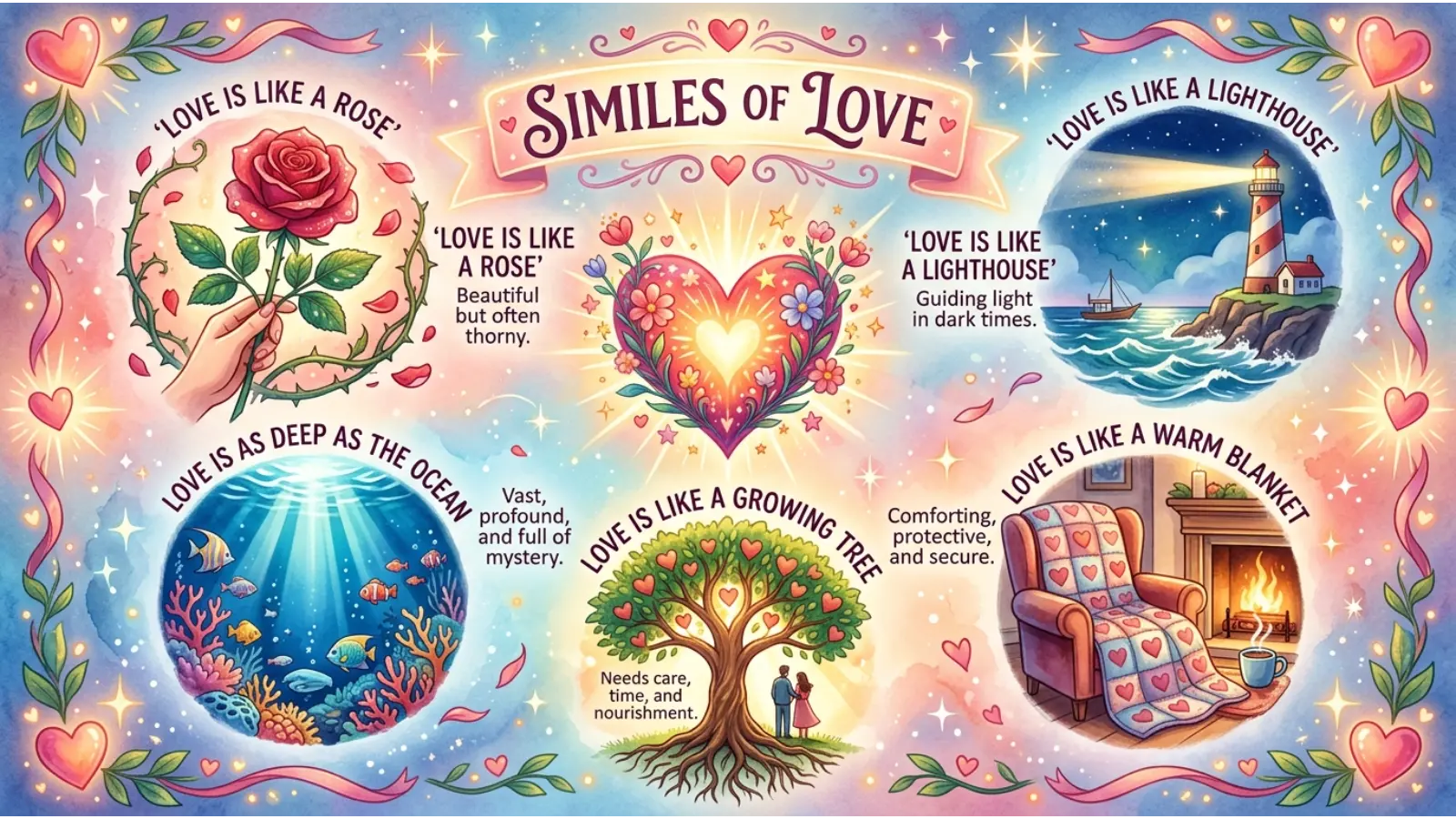
Love is often compared with roses, stars, fire, oceans, and other familiar images. Those images are not automatically bad, but they have been used so often that they may fail to surprise the reader.
Instead, ask yourself:
What does this particular kind of love actually do?
If love makes someone feel safe, you might compare it to a familiar place.
A love grows slowly, choose something that develops gradually.
If love survives hardship, look for an image that shows endurance.
If love is unexpected, choose something that arrives without warning.
For example, instead of:
Her love was like a flower.
Try identifying the specific quality:
Her love was like a garden gate that was always unlocked.
The second image tells the reader more about the relationship. It suggests welcome and accessibility rather than simply “beauty.”
Use Concrete Images Instead of Abstract Adjectives
Writers often describe love with words such as:
- beautiful
- strong
- deep
- powerful
- wonderful
- eternal
These words can be useful, but they do not always create a picture.
Compare:
His love was strong.
with:
His love was like a bridge that remained standing after the river rose.
The second sentence lets readers see strength instead of merely being told about it.
This is one of the central purposes of imagery: transform an abstract emotion into something readers can experience through their imagination.
Match the Simile to the Type of Love
Not every love simile should sound soft and dreamy.
Different relationships create different emotional textures.
Tender love
Choose images involving warmth, quietness, shelter, softness, or familiar objects.
Exciting love
Use movement, sudden light, music, weather, or unexpected changes.
Long-lasting love
Consider trees, roads, buildings, seasons, rivers, or objects that endure.
Complicated love
Use images containing contrast, tension, distance, or imperfect structures.
Lost love
Images involving fading sounds, empty rooms, distant lights, unfinished journeys, or changing seasons can create a sense of absence.
The best comparison is not necessarily the prettiest one. It is the one that tells the truth about the emotion in the scene.
Similes of Love in Poetry and Songs
Love and music naturally work together because both depend heavily on rhythm, emotion, repetition, and imagery.
Songwriters may use comparisons to make a feeling easier to visualize. A comparison can turn an emotion into something listeners can immediately picture.
For example, an original songwriting-style line might be:
Your memory moves like a melody I cannot quite finish.
The comparison works because an unfinished melody suggests both familiarity and incompleteness.
When writing a song or poem, keep similes relatively focused. A complicated comparison can interrupt rhythm, while a carefully chosen image can become a memorable emotional detail.
How Similes Can Improve Storytelling
A simile should usually do more than decorate a sentence.
Imagine a character entering a room after receiving difficult news.
A plain description might say:
She sat down and felt sad.
A more vivid version could be:
She sat beneath the kitchen light, her silence like a closed door no one wanted to knock on.
The comparison gives the silence a physical quality and creates a sense of emotional distance.
This technique works especially well when the character’s feelings are difficult to explain directly.
Simile vs. Metaphor: What’s the Difference?
A simile makes a comparison using words such as like or as.
His love was like a shelter in the rain.
A metaphor makes the comparison more directly.
His love was a shelter in the rain.
Both can create imagery, but they have different effects.
Similes often make the comparison feel exploratory: the writer is asking the reader to connect two images.
Metaphors can sound more direct and emphatic.
Neither device is automatically better. Choose the form that fits the voice and rhythm of your writing.
Other Literary Devices That Work With Love Similes
Imagery
Imagery creates sensory pictures. A strong love simile often depends on imagery because the comparison gives the reader something to see, hear, touch, taste, or imagine.
Personification
Personification gives human qualities to nonhuman things.
The old house seemed to welcome their reunion.
You can combine it with a simile:
The old house welcomed them like a patient friend.
Hyperbole
Hyperbole intentionally exaggerates.
I could wait a thousand years for you.
Use exaggeration carefully. Too much can make emotional writing sound generic.
Symbolism
An object can represent a larger idea. A key might symbolize trust, a doorway might suggest opportunity, or a light might represent hope.
Similes become more powerful when the image has meaning beyond its surface appearance.
How to Create Your Own Similes of Love
Try this five-step process.
1. Name the exact emotion
Don’t begin with “love.”
Ask whether the feeling is:
- affection
- excitement
- comfort
- longing
- trust
- admiration
- devotion
- forgiveness
- loneliness
- hope
Specific emotions produce more specific comparisons.
2. Describe what the emotion does
Does it grow?
Does it return?
it protect?
A surprise?
it disappear?
Does it make the character brave?
This question often produces better ideas than simply asking what love “looks like.”
3. Search your everyday experience
Think about ordinary objects, places, sounds, weather, food, travel, school, sports, music, or nature.
A fresh simile does not require a spectacular image. Sometimes an ordinary object creates the most believable comparison.
4. Find a meaningful connection
Suppose you want to describe dependable love.
You think of a porch light.
Why?
Because it stays visible, welcomes someone home, and can make a dark place feel safer.
Now you have a foundation:
Her love was like a porch light waiting through the evening.
5. Remove anything unnecessary
A simile should serve the sentence.
If several adjectives surround the comparison, ask whether each one is necessary.
Strong imagery often becomes stronger after unnecessary words are removed.
Creative Exercises for Better Similes
Exercise 1: The Five Senses
Describe love without using the words love, romance, relationship, or heart.
Write one comparison involving:
- sight
- sound
- touch
- smell
- taste
This forces you to move beyond familiar emotional vocabulary.
Exercise 2: Change the Mood
Take this basic idea:
Her love was like a light.
Rewrite it five ways so the light represents:
- comfort
- excitement
- loneliness
- hope
- uncertainty
The goal is to discover how changing the surrounding image changes the emotional meaning.
Exercise 3: Make the Familiar Strange
Start with an ordinary comparison:
His love was like rain.
Now ask what kind of rain.
Is it the first rain after a drought? Rain against a window at midnight? A sudden summer shower? A storm that changes the landscape?
Specificity turns a general image into a story.
Common Mistakes When Writing Love Similes
Relying on clichés
Comparisons involving roses, stars, oceans, and eternal flames can work, but they are familiar. Use them only when they genuinely suit your voice or context.
Mixing images
Avoid combining unrelated comparisons in one sentence.
For example, a sentence that begins with a storm, shifts to a garden, and ends with a machine can confuse the reader.
Choose one central image and develop it clearly.
Forcing a clever comparison
Not every sentence needs a surprising simile.
If a comparison feels unnatural, remove it. Plain, precise writing is better than an impressive-looking image that does not fit.
Explaining the simile too much
Once the image works, trust the reader.
For example:
Her love was like a lighthouse, because lighthouses are tall structures that guide ships and therefore her love guided him emotionally.
The explanation destroys much of the effect.
Let the image carry some of the meaning.
Confusing similes and metaphors
Remember:
Simile: Her love was like a lighthouse.
Metaphor: Her love was a lighthouse.
The distinction is simple, but knowing it helps you choose the right literary device.
Using a comparison that says nothing new
Ask:
What does this simile reveal that the original sentence did not?
If the answer is “nothing,” the comparison probably needs revision.
How Professional Writers Make Comparisons Memorable
A memorable simile often contains three ingredients:
A clear emotion + a specific image + a meaningful connection
For example:
Their trust was like a bridge built plank by plank.
The emotion is trust.
The image is a bridge.
The connection is construction: trust develops through repeated effort.
That final connection is what gives the comparison its strength.
The goal is not to make the reader think, “What a clever sentence.”
The deeper goal is to make the reader feel or understand something more clearly.
Frequently Asked Questions
What is a good simile for love?
A good love simile connects love with a specific image that reveals its character. For example, “Their trust was like a bridge built plank by plank” presents love as something developed through patience and reliability.
What are 5 examples of similes about love?
Here are five original examples:
- Love was like sunlight resting on a cold windowsill.
- Their trust was like a bridge built plank by plank.
- Her smile was like a match struck in a room full of shadows.
- His devotion was like a tree keeping its shade through the hottest afternoon.
- Their connection was like two melodies discovering they belonged in the same song.
How do you describe love using a simile?
First identify the specific quality of the love, such as comfort, excitement, trust, longing, or devotion. Then find an object, action, place, or natural event that behaves in a similar way.
What is a romantic simile?
A romantic simile is a comparison used to express affection, attraction, emotional connection, devotion, or longing. It can appear in poetry, fiction, songs, cards, speeches, and personal writing.
Can similes make love poems better?
Yes. A carefully chosen simile can turn an abstract feeling into a concrete image. However, adding more similes does not automatically improve a poem. One precise comparison can be more effective than several unrelated ones.
What is the difference between a love simile and a love metaphor?
A love simile usually uses like or as to make its comparison, while a metaphor makes the comparison directly. For example, “Her love was like a shelter” is a simile, while “Her love was a shelter” is a metaphor.
How can I avoid cliché love similes?
Focus on the specific relationship rather than using familiar romantic symbols. Think about a private memory, an ordinary object, a distinctive sound, or an action that captures the exact feeling you want to express.
Conclusion
The strongest similes of love do not simply make writing sound romantic. They help readers understand what the love feels like, how it behaves, and why it matters. Instead of asking, “What is love like?” ask a more useful question: What does this particular love do? Does it wait? Protect? Surprise? Heal? Challenge? Grow? Return? Once you answer that question, look for something in the physical world that behaves in a similar way. That is where original imagery begins. Experiment with unexpected objects, familiar places, sounds, seasons, and everyday experiences. Keep the comparisons believable, specific, and connected to the emotion. A successful simile does not merely decorate a sentence. It gives an invisible feeling somewhere for the reader to see.

I am Helena Frost, a writer captivated by the beauty of language and the art of comparison. Through my words, I explore the world by turning ordinary moments into vivid similes and reflections. I enjoy crafting phrases that spark imagination, evoke emotion, and linger in the mind. My writing celebrates the subtle connections between people, nature, and the stories we live. For me, every sentence is an opportunity to reveal the extraordinary in the everyday.