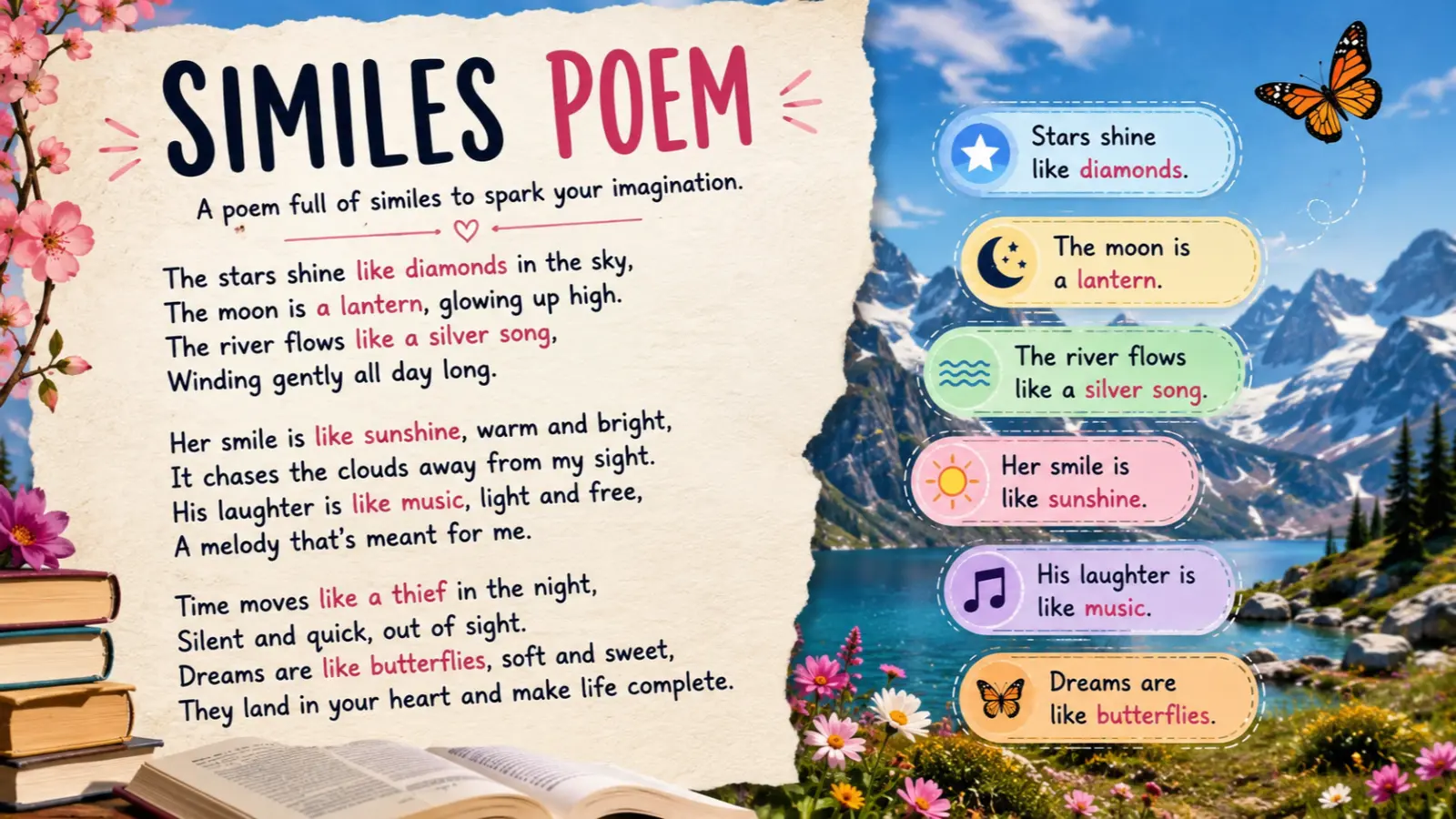
similes poem imagine it. One of the simplest ways poets create that effect is through a simile.
A similes poem compares two different things using words such as like or as. In poetry, this familiar technique can turn an ordinary description into an image that stays with the reader.
For example, instead of saying the morning was peaceful, a poet might write:
The morning similes poem rested like a quiet room after the music stopped.
The comparison gives the reader a mood, not just information.
This guide explores similes in poems through original examples about happiness, friendship, rain, love, anger, nature, and everyday life. More importantly, it similes poem explains why each comparison works and how you can create stronger ones of your own.
What Is a Simile in Poetry?
A similes poem is a comparison between two unlike things, usually introduced by like or as.
For example:
Her laughter scattered like birds startled from a rooftop.
The laughter does not literally become birds. The comparison suggests that it was sudden, lively, and difficult to contain.
similes poem are especially useful in poetry because poems often communicate several ideas at once. A similes poem carefully chosen comparison can suggest emotion, movement, atmosphere, sound, texture, or personality without explaining everything directly.
Simile vs. Metaphor
A similes poem generally signals its comparison:
The similes poem river moved like a silver ribbon.
A similes poem metaphor makes the comparison more directly:
The similes poem river was a silver ribbon.
Both can create imagery. The similes poem difference is in how directly the comparison is presented.
Why Do Poets Use Similes?
Poets use similes poem for more than decoration. A strong comparison can perform several jobs at once.
It can:
- create a memorable visual image
- communicate an emotion indirectly
- make an abstract idea easier to understand
- establish a poem’s atmosphere
- reveal something about a speaker or character
- add rhythm and movement
- make ordinary subjects feel fresh
The key is specificity. A comparison becomes more powerful when the chosen image has a meaningful connection to what you are describing.
30 Original Similes for Poems
The following examples are original comparisons designed to demonstrate different poetic possibilities. They are not meant to be copied mechanically. Use them as starting points for developing your own imagery.
1. Happiness
Simile:
Her happiness rose like sunlight finding its way through a half-open curtain.
Meaning: The comparison presents happiness as something warm and gradually emerging.
Example:
Her happiness rose like sunlight finding its way through a half-open curtain.
After the good news, his smile spread like morning across the room.
Writing purpose: This works well when happiness is gentle rather than explosive. The sunlight image creates warmth without simply saying that someone was happy.
2. Friendship
Simile:
Their friendship held like two old trees sharing the same patch of wind.
Meaning: The trees suggest strength, history, and mutual support.
Example:
Their friendship held like two old trees sharing the same patch of wind.
Even after years apart, their conversation returned like a familiar song.
Writing tip: For friendship poems, choose images that suggest reliability, not just closeness. Bridges, roots, shelters, paths, and shared journeys can all offer different emotional possibilities.
3. Rain
Simile:
Rain tapped against the window like impatient fingers asking to be let inside.
Meaning: The comparison gives the rain a human sense of urgency.
Example:
Rain tapped against the window like impatient fingers asking to be let inside.
Best context: This works particularly well in poems where weather reflects anticipation, loneliness, or suspense.
4. Love
Simile:
Love entered quietly, like a lamp switched on in a room no one had noticed was dark.
Meaning: Love is presented as something that changes the emotional environment rather than arriving dramatically.
Example:
Love entered quietly, like a lamp switched on in a room no one had noticed was dark.
Writing insight: Abstract subjects such as love become easier to write about when you give them a physical consequence. Instead of describing love directly, show what changes because of it.
5. Anger
Simile:
His anger climbed like heat trapped beneath a closed roof.
Meaning: The image suggests pressure building with nowhere to escape.
Example:
His anger climbed like heat trapped beneath a closed roof.
Her frustration flickered like a warning light that refused to go out.
Why it works: The comparison communicates rising tension without relying on a generic phrase such as angry as a lion.
6. Hope
Simile:
Hope glowed like a small window at the end of a long hallway.
The small window creates a sense of distance while still suggesting possibility.
This kind of simile is useful when you want hope to feel fragile but present rather than overwhelming.
7. Sadness
Simile:
Sadness settled over the afternoon like dust on furniture in an empty house.
The dust suggests stillness and neglect. It gives sadness a physical presence without describing it directly.
8. Fear
Simile:
Fear moved through her thoughts like a cold draft beneath a locked door.
The locked door suggests that the source of fear may not be visible or easily controlled.
This is a useful technique: pair an emotional state with a physical sensation.
9. Silence
Simile:
The silence stretched between them like a road neither person wanted to cross.
Instead of treating silence as merely the absence of sound, the comparison turns it into a barrier.
10. Night
Simile:
Night folded over the neighborhood like dark fabric covering a forgotten chair.
The unusual image makes the night feel tangible and slightly mysterious.
Writing tip: Unexpected comparisons often make poems more memorable. Ask yourself, What could this thing resemble that readers would not expect?
11. Morning
Simile:
Morning opened like a letter whose message had not yet been read.
This comparison creates curiosity. The new day becomes an unanswered possibility.
12. Wind
Simile:
The wind raced through the trees like a child late for an important secret.
The comparison gives movement a personality and creates playful energy.
13. Snow
Simile:
Snow covered the garden like a blank page waiting for its first sentence.
This image works especially well in poetry because it connects nature with the act of writing.
14. Memories
Simile:
Old memories returned like coins discovered in the pocket of a winter coat.
The image suggests something forgotten but unexpectedly recovered.
Writing purpose: Concrete objects are excellent tools for expressing abstract ideas such as memory, regret, time, and nostalgia.
15. Time
Simile:
Time slipped past like water through loosely closed hands.
The comparison emphasizes how difficult time is to hold onto.
Because this idea is common in literature, writers should be careful not to use familiar wording without adding a personal detail.
16. A Smile
Simile:
Her smile appeared like a bright mark on an otherwise unfinished page.
The image connects expression with writing and suggests that the smile changes the entire scene.
17. A Child’s Imagination
Simile:
His imagination jumped like sparks from a newly lit fire.
The comparison suggests speed, energy, and creativity.
18. Music
Simile:
The melody moved through the room like colored light across water.
This is an example of cross-sensory imagery. Music is heard, but the comparison allows readers to imagine it visually.
19. A Broken Heart
Simile:
Her heart felt like a house with one room suddenly emptied.
The image expresses loss without describing it in a literal or overly dramatic way.
20. Courage
Simile:
Courage stood quietly like a candle refusing to go dark in an open window.
The comparison emphasizes persistence rather than physical strength.
21. Loneliness
Simile:
Loneliness followed him like an unopened message.
This works because an unopened message suggests connection that is possible but absent.
22. Curiosity
Simile:
Curiosity pulled at her thoughts like a loose thread on a favorite sweater.
The loose thread suggests something small that becomes impossible to ignore.
23. A Storm
Simile:
The storm gathered above the town like a crowd arriving before an important announcement.
The comparison creates anticipation rather than simply describing dark clouds.
24. A Busy City
Simile:
The city moved like a giant clock with thousands of impatient hands.
This simile communicates constant movement and coordination.
25. A Quiet Lake
Simile:
The lake rested like a sheet of glass placed carefully beneath the sky.
The image emphasizes stillness and reflection.
26. An Old House
Simile:
The old house leaned like a tired storyteller reaching the end of a long tale.
Personifying the house through comparison gives it a history and personality.
27. A Secret
Simile:
The secret sat between them like a sealed envelope on the table.
The physical object creates tension because the reader can imagine something important being deliberately kept closed.
28. A Difficult Decision
Simile:
The decision stood before him like two doors opening into different seasons.
The seasons suggest that either choice could lead to a completely different future.
29. A Beautiful Voice
Simile:
Her voice drifted through the room like warm air beneath a door in winter.
The comparison focuses on how the voice feels rather than merely saying it was beautiful.
30. A New Beginning
Simile:
The new beginning waited like fresh paper beside an unfinished pencil.
This image connects possibility with creativity and leaves room for the reader to imagine what comes next.
How to Make a Simile More Vivid
A weak simile often tells readers what something resembles without giving them a reason to care.
Compare:
The garden was like a paradise.
with:
The garden opened around her like a secret room built entirely from green.
The second version gives the reader something to picture.
Start With the Emotion
Before choosing a comparison, identify the feeling you want to create.
Is the scene:
- peaceful?
- tense?
- playful?
- lonely?
- mysterious?
- hopeful?
- overwhelming?
Then choose an image that produces the same emotional response.
Use Specific Details
Instead of comparing something to a bird, consider what kind of bird, movement, or sound might fit the scene.
Instead of:
He moved like a bird.
Try:
He darted through the crowd like a sparrow escaping an open door.
The second comparison creates movement, speed, and a visual situation.
Give the Image a Reason to Exist
A good simile should contribute something.
Ask:
What does this comparison help the reader understand that a plain description would not?
If the answer is nothing, remove it.
How to Avoid Cliché Similes
Clichés are familiar comparisons that have been used so often that they may no longer create a strong image.
Common examples include comparisons involving:
- ice-cold emotions
- eyes shining like stars
- hearts beating like drums
- someone being busy as a bee
These phrases are not automatically wrong. They can work in casual speech, children’s writing, comedy, or situations where familiarity is intentional.
But poetry often benefits from a more personal image.
Instead of asking:
What is this usually compared to?
ask:
What does this remind me of from real life?
Personal observation is one of the best sources of fresh imagery.
Similes for Poetry About Happiness, Friendship, Rain, Love, and Anger
Different subjects call for different kinds of comparisons.
Happiness
Use images associated with light, movement, opening, warmth, music, or growth.
Friendship
Consider roots, shelter, shared paths, familiar objects, or things that endure weather.
Rain
Think beyond water. Rain can become rhythm, interruption, memory, anticipation, cleansing, or conversation.
Love
Rather than automatically using hearts and roses, explore light, distance, home, trust, seasons, or unexpected change.
Anger
Images of pressure, heat, sparks, storms, locked spaces, or unstable objects can communicate rising tension.
The best comparison depends on the particular poem. There is no single “correct” simile for an emotion.
How Similes Create Emotional Effects
A simile does not have one universal meaning. Context changes how readers interpret it.
For example, darkness can suggest fear in one poem but comfort in another. A storm can represent anger, excitement, renewal, or freedom.
That is why poets should consider the emotional associations of their images.
Try this exercise:
Choose one subject, such as rain, and write three different comparisons:
Rain fell like…
One should feel peaceful.
A should feel sad.
One should feel exciting.
You will quickly discover that the object stays the same while the emotional meaning changes.
Simile, Imagery, Personification, and Other Literary Devices
Similes often work alongside other literary techniques.
Imagery
Imagery uses descriptive language to create sensory experiences.
The rain smelled like wet stone after a long summer.
The simile strengthens the sensory image.
Metaphor
A metaphor makes a direct comparison:
The city was a restless machine.
A simile might say:
The city moved like a restless machine.
Personification
Personification gives human qualities to something nonhuman.
The wind argued with the shutters.
A simile can create a similar effect:
The wind rattled the shutters like an angry neighbor.
Alliteration
Alliteration repeats beginning consonant sounds.
Soft snow settled silently.
When combined with a simile, sound and imagery can reinforce each other:
Soft snow settled like feathers on the sleeping field.
Symbolism
A comparison can also become symbolic. A door might represent opportunity, separation, secrecy, or change depending on the poem.
The important lesson is not to add every literary device you know. Choose techniques that serve the poem’s purpose.
How to Create Your Own Poetic Similes
You can build stronger comparisons with a simple process.
1. Choose the Subject
Start with something you want to describe:
loneliness
2. Identify Its Qualities
Ask what loneliness feels like.
Perhaps it feels:
- distant
- quiet
- empty
- repetitive
- invisible
3. Brainstorm Physical Experiences
What physical things have those qualities?
Maybe:
- an empty station
- an unlit room
- a single chair
- a closed mailbox
- a distant window
4. Make the Comparison
Now experiment:
Loneliness waited like a single chair beneath a darkened stage.
5. Test the Image
Ask whether the comparison adds something new.
Does it create an emotion?
Can you picture it?
Does it fit the poem’s voice?
If not, keep experimenting.
Three Creative Exercises for Better Similes
Exercise 1: Five-Sense Similes
Choose an emotion and create one comparison for each sense.
For example, ask what happiness might:
- look like
- sound like
- feel like
- smell like
- taste like
This prevents your writing from depending only on visual imagery.
Exercise 2: Remove the Obvious Comparison
Write the first simile that comes to mind.
Then reject it.
Now create three alternatives without using the obvious image.
This forces your imagination beyond familiar patterns.
Exercise 3: Turn an Object Into Emotion
Choose an ordinary object such as a key, cup, shoe, window, or notebook.
Connect it to an abstract idea.
For example:
Regret sat in his mind like a key to a door he had already left behind.
The object gives the abstract emotion a physical shape.
Common Mistakes Writers Make With Similes
Using Too Many Similes
A poem does not become more poetic simply because every line contains a comparison.
If every sentence introduces a new image, readers may struggle to focus.
Use your strongest comparisons and let ordinary language carry the rest.
Mixing Unrelated Images
A comparison can become confusing when its imagery changes direction.
For example, moving from ocean imagery to machinery to gardening within a few words may create unnecessary mental friction.
A poem can contain different images, but deliberate connections make them easier to follow.
Explaining the Simile Too Much
Sometimes writers create an interesting image and then explain exactly what it means.
Trust the reader when the image is clear enough.
Choosing a Comparison Only Because It Sounds Pretty
Beautiful language is not automatically useful language.
A poetic comparison should fit the subject, voice, mood, and surrounding imagery.
Confusing Similes and Metaphors
If you write:
The moon was a lantern.
you are using a metaphor.
If you write:
The moon hung like a lantern.
you are using a simile.
Both are valuable. Learn to choose based on the effect you want.
Frequently Asked Questions About Similes in Poems
What is an example of a simile in a poem?
An example is:
Hope glowed like a small window at the end of a long hallway.
It compares hope with a distant window to suggest possibility during a difficult moment.
Why are similes important in poetry?
Similes help poets turn abstract ideas and ordinary descriptions into concrete images. They can make emotions easier to visualize and poems more memorable.
How do I write a good simile for a poem?
Start with the subject, identify its important qualities, brainstorm physical objects or experiences with similar qualities, and then test several comparisons before choosing the strongest one.
Can a poem have more than one simile?
Yes. A poem can contain multiple similes, but each should contribute something meaningful. Too many unrelated comparisons can make the writing feel crowded.
What is the difference between a simile and a metaphor?
A simile usually makes its comparison with words such as like or as. A metaphor makes the comparison directly.
Can similes be about emotions?
Absolutely. Emotions are often difficult to describe directly, so comparisons can give them physical form. Happiness, sadness, anger, love, fear, and hope can all be developed through imagery.
Should similes in poems always use “like” or “as”?
Traditional similes commonly use like or as, although poetic comparisons can sometimes be more flexible. The important feature is that the language clearly establishes a comparison rather than simply making an identity statement.
How can I make my similes less cliché?
Base comparisons on specific observations, memories, sensory details, and unusual but believable connections. If the first comparison everyone might think of is a star, rose, storm, or fire, challenge yourself to find another image.
Conclusion
The best similes poems do more than make language sound beautiful. They give readers something to see, feel, hear, or remember. A strong comparison can turn happiness into light, loneliness into an empty space, anger into pressure, friendship into something enduring, or rain into a rhythm that changes the entire mood of a scene. When writing your own poetry, do not search only for the most impressive comparison. Search for the most precise one. Observe ordinary things. Notice how emotions feel in the body. Pay attention to sounds, objects, weather, movement, and memories. Then experiment with unexpected connections. A simile becomes powerful when the reader does not simply understand the comparison—they can experience the image.
I am Helena Frost, a writer captivated by the beauty of language and the art of comparison. Through my words, I explore the world by turning ordinary moments into vivid similes and reflections. I enjoy crafting phrases that spark imagination, evoke emotion, and linger in the mind. My writing celebrates the subtle connections between people, nature, and the stories we live. For me, every sentence is an opportunity to reveal the extraordinary in the everyday.