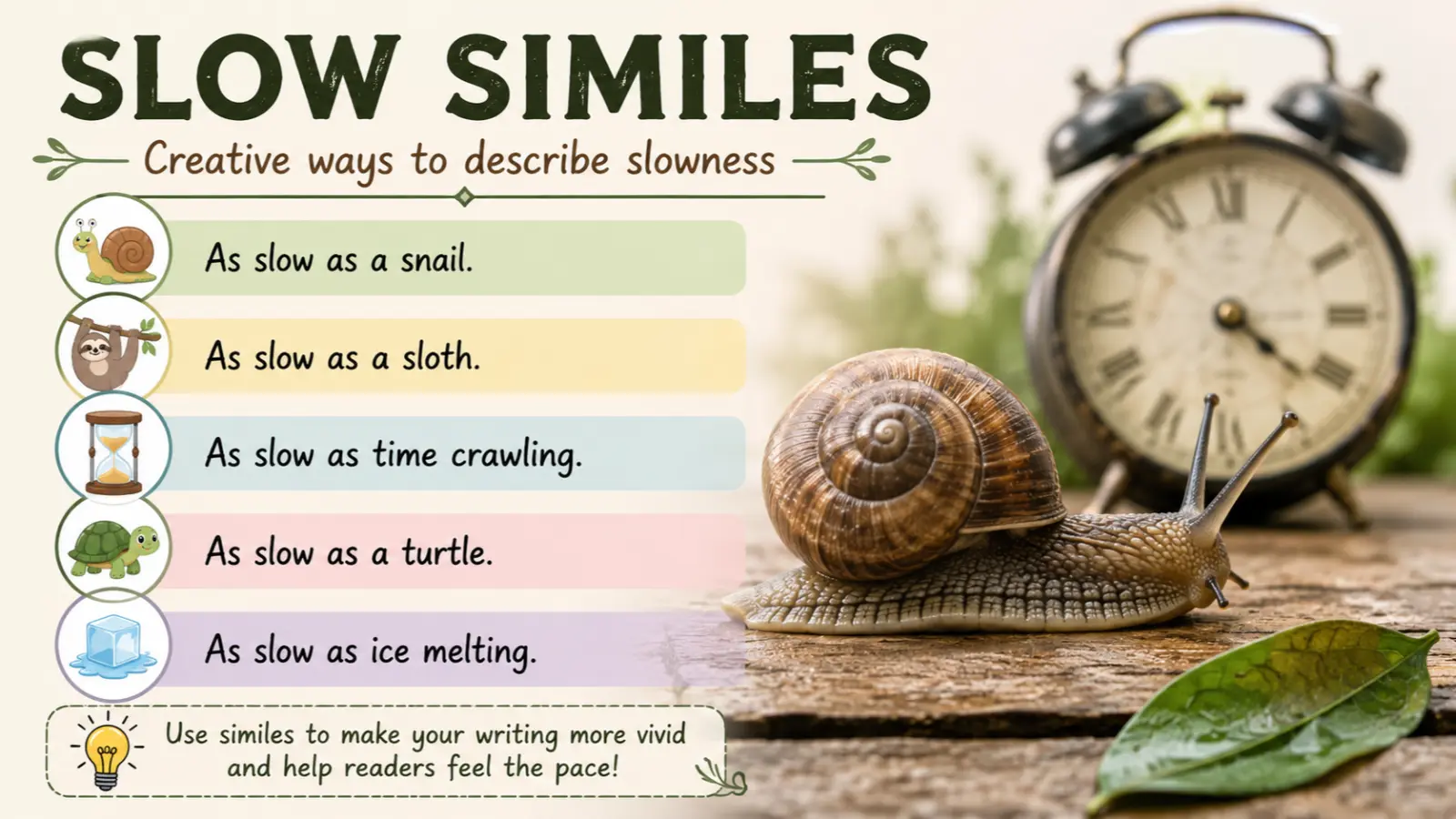
Slow similes are comparisons that describe something moving, happening, or changing gradually. They use words such as like or as to connect a slow action, feeling, sound, or moment with something readers can easily imagine.
For example:
The afternoon moved like a bicycle rolling gently downhill.
The comparison does more than tell readers that the afternoon was slow. It gives the passage a relaxed rhythm and creates a visual image.
Similes matter because they turn plain descriptions into experiences. Instead of saying the conversation was slow, a writer might say:
The conversation unfolded like a ribbon being pulled carefully from a box.
Slow similes work especially well in creative writing, poetry, storytelling, reflective essays, descriptions of nature, and scenes where time seems to stretch.
This collection offers original slow similes, explains why they work, and shows how you can adapt them to your own writing without making your descriptions feel forced.
Quick Answer: What Is a Good Simile for Slow?
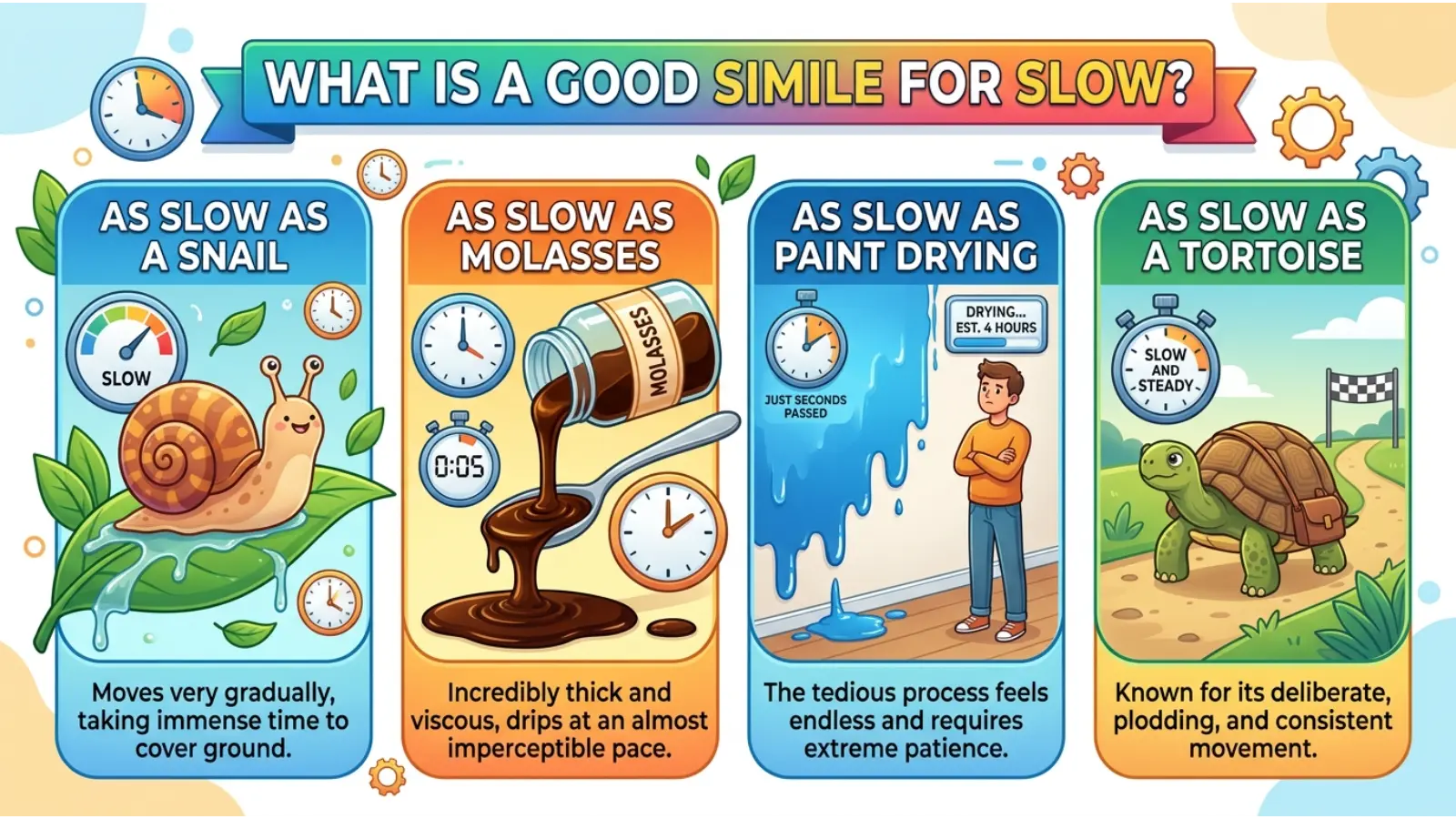
A good slow simile compares gradual movement or change with something familiar that naturally suggests patience, softness, or unhurried motion. For example, “The morning opened like a curtain being drawn inch by inch.” Other effective comparisons can use drifting clouds, melting ice, careful footsteps, settling dust, or a boat crossing still water.
Slow Similes for Writing
1. The Morning Opened Like a Curtain Being Drawn Inch by Inch
Meaning: The morning arrived gradually rather than suddenly.
Example sentences:
- The morning opened like a curtain being drawn inch by inch over the sleeping town.
- Light entered the room like a curtain slowly revealing the stage.
Why it works:
The curtain creates a clear visual image. Because curtains reveal something gradually, the comparison naturally communicates slow change.
Best context: Dawn scenes, peaceful stories, reflective writing, and poetry.
Writing tip:
Use a comparison that already contains the quality you want. A slowly opening curtain does not need an explanation; the image carries the meaning.
2. His Thoughts Drifted Like Leaves on a Quiet Pond
Meaning: His thoughts moved slowly and without a clear direction.
Example sentences:
- His thoughts drifted like leaves on a quiet pond while he waited for the answer.
- After the long day, her thoughts drifted like leaves across still water.
Emotional effect:
This simile creates a calm, slightly dreamy mood.
Writing purpose:
It is useful when you want to show someone thinking without making the scene feel tense or hurried.
3. The Old Clock Ticked Like Footsteps in an Empty Hall
Meaning: Each tick seemed slow, noticeable, and separated from the next.
Example sentences:
- The old clock ticked like footsteps in an empty hall.
- Every second sounded like a distant footstep approaching through the house.
Why it works:
The comparison transforms an ordinary clock into something atmospheric. The reader can almost hear the space between the sounds.
Best context: Suspense, loneliness, nighttime scenes, and quiet interiors.
4. The Boat Moved Like a Thought Crossing a Tired Mind
Meaning: The boat moved gently and gradually.
Example:
The little boat moved like a thought crossing a tired mind, barely disturbing the silence around it.
Emotional effect:
This creates a reflective and almost dreamlike feeling.
Writing tip:
Abstract comparisons can be powerful when the physical image and emotional idea share the same quality.
5. The Snow Melted Like a Secret Slowly Being Told
Meaning: The snow disappeared gradually, revealing what had been hidden beneath it.
Example sentences:
- The snow melted like a secret slowly being told beneath the spring sun.
- Across the garden, winter faded like a secret finally spoken aloud.
Writing purpose:
This simile works especially well when physical change represents emotional or narrative revelation.
Best context: Seasonal writing, symbolism, poetry, and stories about change.
6. The Train Crawled Like a Beetle Across the Distant Field
Meaning: The train appeared to move very slowly from far away.
Example:
From the hilltop, the train crawled like a beetle across the distant field.
Why it works:
The small beetle makes the large train appear tiny from the narrator’s perspective.
This is a useful lesson in description: a simile can change scale as well as speed.
7. Her Smile Spread Like Warm Light Across a Dark Room
Meaning: Her smile appeared gradually and changed the emotional atmosphere.
Example:
Her smile spread like warm light across a dark room when she finally recognized him.
Emotional effect:
The image suggests comfort, hope, and emotional relief.
Best context: Character development, friendship, family scenes, and gentle emotional moments.
8. The River Turned Like a Long Ribbon Being Pulled Through Grass
Meaning: The river changed direction in a smooth, gradual curve.
Example:
The river turned like a long ribbon being pulled through grass, disappearing behind the trees.
Writing purpose:
This is particularly useful for landscape descriptions because it gives readers both movement and shape.
Writing tip:
For nature writing, compare natural forms to objects with similar shapes. That makes the image easier to visualize.
9. The Evening Settled Like Dust on an Unused Shelf
Meaning: Evening arrived quietly and gradually.
Example:
The evening settled like dust on an unused shelf, covering the village in silence.
Emotional effect:
This can create a quiet, lonely, or slightly melancholic atmosphere.
Why it works:
Dust does not suddenly appear. It accumulates almost unnoticed, making it a strong comparison for gradual change.
10. He Walked Like Someone Counting Every Step
Meaning: His movement was unusually slow and careful.
Example:
He walked like someone counting every step across the icy path.
Best context: Fear, uncertainty, caution, exhaustion, or emotional tension.
Writing insight:
A strong slow simile does not always describe an object moving slowly. It can reveal why someone is moving slowly.
11. The Clouds Gathered Like Blank Pages Stacking on a Desk
Meaning: Clouds accumulated gradually across the sky.
Example:
The clouds gathered like blank pages stacking on a desk before the storm.
Why it works:
The blank pages suggest accumulation while also hinting that something is about to be written.
Best context: Storm scenes, literary fiction, creative essays, and poetry.
12. The Conversation Unfolded Like a Map Being Opened Carefully
Meaning: The conversation revealed information gradually.
Example:
Their conversation unfolded like a map being opened carefully across the kitchen table.
Writing purpose:
This comparison works because conversations can reveal different parts of a situation one piece at a time.
Best context: Dialogue-heavy stories, mystery, family drama, and reflective scenes.
13. The Sun Slipped Down Like a Coin Sliding Across a Table
Meaning: The sun appeared to move slowly toward the horizon.
Example:
The sun slipped down like a coin sliding slowly across a wooden table.
Emotional effect:
The image gives sunset a gentle, physical quality.
Writing tip:
When describing something familiar, choose an unexpected comparison rather than automatically reaching for a common phrase such as “the sun sank like a…”
14. The Old House Woke Like a Person Stretching After a Long Sleep
Meaning: The house gradually became active in the morning.
Example:
The old house woke like a person stretching after a long sleep as doors opened and footsteps filled the halls.
Related device:
This also uses personification because the house is given a human action.
Best context: Fictional settings, family stories, historical scenes, and atmospheric writing.
15. The Fog Rolled In Like Wool Unwinding From a Ball
Meaning: Fog spread gradually across the landscape.
Example:
The fog rolled in like wool unwinding from a ball, covering the road one quiet stretch at a time.
Why it works:
The image communicates both movement and gradual expansion.
Best context: Mystery, nature writing, suspense, and descriptive fiction.
16. Her Voice Fell Like Rain Beginning on a Window
Meaning: Her voice became softer and quieter.
Example:
Her voice fell like rain beginning on a window, soft at first and impossible to ignore.
Emotional effect:
This can suggest sadness, calmness, intimacy, or reflection depending on the surrounding scene.
Writing tip:
The same simile can create different emotions depending on context. Do not rely on the comparison alone; let the scene guide its meaning.
17. The Story Grew Like a Tree Adding One Ring at a Time
Meaning: The story developed gradually through layers of information or experience.
Example:
The story grew like a tree adding one ring at a time, revealing its history slowly.
Writing purpose:
This is useful when discussing storytelling itself or describing a character’s life over many years.
Best context: Essays, memoir-style writing, literary fiction, and writing advice.
18. The Morning Crowd Moved Like a River Finding Its Channel
Meaning: People moved slowly but continuously in one direction.
Example:
The morning crowd moved like a river finding its channel through the narrow station.
Why it works:
The river suggests continuous movement while the channel explains why the crowd follows a particular path.
Best context: City descriptions, transportation scenes, school settings, and public places.
19. The Wound of Winter Healed Like Paint Drying on an Old Wall
Meaning: The effects of winter disappeared gradually.
Example:
The garden healed like paint drying on an old wall as green shoots returned.
Writing purpose:
This comparison gives seasonal change a sense of patience and recovery.
Emotional effect:
It can suggest renewal without making the description overly sentimental.
20. The Fire Died Like a Song Ending on a Distant Radio
Meaning: The fire gradually became weaker until it disappeared.
Example:
The fire died like a song ending on a distant radio, leaving only a faint warmth behind.
Why it works:
The comparison combines sound and physical warmth, creating a layered image.
Best context: Night scenes, endings, loneliness, reflection, and poetry.
21. The Garden Changed Like a Painting Being Finished One Brushstroke at a Time
Meaning: The garden developed gradually.
Example:
The garden changed like a painting being finished one brushstroke at a time.
Writing insight:
This is useful when a scene develops through small details rather than one dramatic transformation.
Instead of writing:
The garden became beautiful.
You can show the change through individual details—new leaves, opening flowers, sunlight, insects, and changing colors.
22. The Old Man Spoke Like Someone Sorting Letters From a Drawer
Meaning: He spoke slowly while carefully choosing and organizing his thoughts.
Example:
The old man spoke like someone sorting letters from a drawer, pausing before each memory.
Emotional effect:
The comparison suggests age, memory, patience, and care.
Best context: Character-driven fiction and reflective conversations.
23. The Shadow Stretched Like Ink Spreading Through Water
Meaning: The shadow gradually became larger and darker.
Example:
The shadow stretched like ink spreading through water as the sun disappeared.
Why it works:
Ink spreading provides a strong visual model for gradual expansion.
Best context: Sunset scenes, suspense, fantasy, and atmospheric descriptions.
24. The Road Curved Like a Question Taking Its Time to Answer
Meaning: The road curved for a long distance, creating uncertainty about what lay ahead.
Example:
The road curved like a question taking its time to answer beyond the hills.
Writing purpose:
This simile adds both physical description and narrative anticipation.
Best context: Adventure stories, travel writing, mysteries, and reflective prose.
25. The Garden Gate Opened Like an Old Book Remembering Its First Page
Meaning: The gate opened slowly and seemed connected to the past.
Example:
The garden gate opened like an old book remembering its first page.
Emotional effect:
Nostalgia and mystery become part of the physical action.
Writing tip:
When you want a setting to feel important, connect its physical details to memory or history.
26. The Afternoon Passed Like Honey Sliding From a Wooden Spoon
Meaning: Time seemed to move slowly and smoothly.
Example:
The afternoon passed like honey sliding from a wooden spoon.
Best context: Lazy summer scenes, peaceful weekends, childhood memories, and relaxed settings.
Why it works:
Honey is naturally associated with slow movement, so the comparison is immediately understandable.
27. The Clouds Wandered Like Travelers Who Had Forgotten Their Destination
Meaning: The clouds moved slowly and without a clear direction.
Example:
The clouds wandered like travelers who had forgotten their destination.
Emotional effect:
The image can create a thoughtful, lonely, or whimsical mood.
Writing purpose:
It gives nature a subtle emotional quality without directly stating the emotion.
28. The Door Closed Like a Thought Finally Leaving the Mind
Meaning: The door closed quietly and gradually, bringing a moment to an end.
Example:
The door closed like a thought finally leaving the mind.
Best context: Endings, departures, reflective scenes, and literary fiction.
Writing insight:
This is an example of an abstract simile. These comparisons can be memorable, but they work best when the surrounding scene gives readers enough context.
29. The Moon Rose Like a Lamp Being Lifted Through Thin Curtains
Meaning: The moon appeared gradually above the horizon.
Example:
The moon rose like a lamp being lifted through thin curtains.
Emotional effect:
The image creates a soft and quiet nighttime atmosphere.
Best context: Poetry, romance-free reflective writing, nighttime descriptions, and nature scenes.
30. His Anger Faded Like Thunder Traveling Away Across the Hills
Meaning: His anger gradually weakened and disappeared.
Example:
His anger faded like thunder traveling away across the hills.
Why it works:
Thunder does not disappear instantly; its sound becomes quieter with distance.
Best context: Character development, conflict resolution, and emotional storytelling.
Why Slow Similes Feel Different From Ordinary Similes
A fast-moving scene often benefits from sharp, energetic comparisons. Slow scenes need a different rhythm.
Compare these two sentences:
The car moved like a bullet.
The car moved like a leaf being carried along a shallow stream.
The first comparison creates speed and force. The second creates gradual movement and softness.
This is why choosing a simile is not simply about finding something that resembles an object. You should also consider:
- Speed
- Texture
- Sound
- Direction
- Emotional atmosphere
- Scale
- Light
- Rhythm
A useful simile matches several of these qualities at once.
How to Make a Slow Simile More Vivid
Start With the Actual Action
Before searching for a comparison, identify exactly what is happening.
Instead of:
The man walked slowly.
Ask:
- Is he tired?
- Is he frightened?
- Is he thinking?
- Is he injured?
- Is he reluctant?
- Is he enjoying the surroundings?
Each answer leads toward a different image.
For example:
He walked slowly because he was tired.
could become:
He walked like someone carrying an invisible suitcase.
Now the slowness also suggests emotional or physical weight.
Give the Reader Something They Can See
Abstract words such as slowly, gradually, and peacefully tell readers what to feel, but concrete images let them experience it.
A comparison involving melting ice, drifting leaves, a winding road, or a slowly closing curtain creates a mental picture.
Choose a Comparison With the Right Emotional Temperature
Not every slow thing feels peaceful.
A clock can move slowly because someone is waiting.
A shadow can move slowly because night is approaching.
A person can move slowly because they are exhausted.
A conversation can unfold slowly because something difficult needs to be said.
The best simile reflects the reason behind the slowness.
How to Avoid Cliché Slow Similes
Some comparisons have become so familiar that readers barely notice them.
Common phrases can still be useful in everyday speech, but creative writing usually becomes stronger when the comparison feels specific to the scene.
Instead of automatically writing:
Time moved like a snail.
try asking:
What does this particular kind of slowness resemble?
For example:
The final ten minutes stretched like a hallway with no doors.
That comparison creates a different experience. It suggests waiting, confinement, and frustration rather than simply slowness.
The goal is not to avoid every familiar image. The goal is to choose deliberately.
Slow Similes Can Describe Emotions Too
Slowness is not limited to physical movement.
Feelings can arrive slowly, disappear gradually, or change over time.
For example:
Her disappointment settled like sand at the bottom of a glass.
The emotion is not rushing through the character. It is gradually becoming noticeable.
You can use the same technique for:
- sadness
- relief
- anger
- trust
- affection
- uncertainty
- nostalgia
- hope
- fear
- forgiveness
The important question is: How does this emotion behave?
If anger rises suddenly, compare it to something explosive.
If anger fades gradually, choose an image that naturally loses force.
Slow Similes in Storytelling
Slow similes are especially useful when a story needs to pause.
A character might be sitting beside a window, walking through an unfamiliar town, remembering childhood, waiting for news, or watching the seasons change.
These moments give readers space to absorb the character’s inner world.
For example:
The train waited at the platform like an old dog resting after a long walk.
The sentence slows the scene itself. The reader is encouraged to observe rather than rush toward the next event.
This is one reason similes can influence pacing, not just description.
Slow Similes in Poetry
Poetry often depends on compression. A single comparison can carry several meanings at once.
Consider:
The evening settled like dust on an unused shelf.
The image suggests time, quietness, neglect, and gradual change without directly explaining each idea.
When writing poetry, look for comparisons that have multiple layers.
A strong image can describe:
- What something looks like.
- How it moves.
- How it feels.
- What it reminds the reader of.
That economy makes similes especially valuable in short poems.
How Professional Writers Build Better Comparisons
A useful technique is to create the comparison in three stages.
Stage 1: Name the quality
Ask what you want the reader to notice.
For example:
slow + quiet + uncertain
Stage 2: Brainstorm physical examples
Think of things that naturally behave that way:
- fog
- drifting leaves
- melting ice
- distant thunder
- a winding road
- candle smoke
- settling dust
Stage 3: Test the image in context
Write the sentence and ask:
Does this comparison add something that the original description did not have?
If not, replace it.
A simile should earn its place.
How to Create Your Own Slow Similes
Try this simple exercise.
Step 1: Choose something slow
Pick an action such as:
walking, waiting, fading, melting, drifting, growing, arriving, changing.
Step 2: Describe its exact quality
Maybe it is:
slow + quiet + uncertain.
Step 3: Find a physical image
Think of something that behaves similarly:
mist moving over a lake.
Step 4: Connect them
The morning arrived like mist moving over a lake.
Step 5: Make it specific
Add a detail from your scene:
The morning arrived like mist moving over the lake behind the empty farmhouse.
The final version feels more personal because it belongs to a particular setting.
Three Creative Exercises for Writers
Exercise 1: Replace “Slowly”
Write five sentences containing the word slowly.
Then rewrite each sentence without using the word.
Instead, show the speed through a comparison.
Exercise 2: Give Slowness an Emotion
Choose one emotion:
- patience
- loneliness
- peace
- fear
- sadness
Now create a slow simile that communicates that emotion without naming it.
For example, instead of writing:
She felt lonely.
try creating an image involving an empty road, a distant light, or a quiet room.
Exercise 3: Change the Mood
Take one comparison and rewrite it three ways.
Start with:
The rain fell like…
Create one peaceful version, one sad version, and one mysterious version.
This teaches an important writing skill: imagery is shaped by context and word choice.
Related Literary Devices That Work With Slow Similes
Metaphor
A metaphor makes a direct comparison without using like or as.
Simile:
The afternoon moved like honey.
Metaphor:
The afternoon was honey.
The metaphor is more direct, while the simile leaves a little more distance between the two ideas.
Imagery
Imagery uses descriptive language to create sensory experience.
A slow simile can strengthen visual, auditory, tactile, or even taste-related imagery.
Personification
Personification gives human qualities to nonhuman things.
For example:
The old house woke like a person stretching after a long sleep.
The simile compares the house to a person, while the verb woke also personifies it.
Hyperbole
Hyperbole deliberately exaggerates.
For example:
The waiting felt like a thousand winters.
This is not meant to be literally true. It emphasizes how long the waiting felt.
Symbolism
A slow image can also carry symbolic meaning.
Melting snow might represent renewal. A fading light might suggest an ending. A slowly opening door might symbolize opportunity or discovery.
The symbolic interpretation should come from the larger piece rather than being forced into the comparison.
Common Mistakes When Writing Slow Similes
Using the Same Type of Image Repeatedly
If every slow comparison involves snails, turtles, or molasses, the writing quickly becomes predictable.
Explore different kinds of slowness:
- gradual light
- drifting objects
- changing weather
- careful human movement
- fading sounds
- growing plants
- unfolding conversations
Mixing Unrelated Images
A sentence can become confusing when it jumps between incompatible images.
For example, a comparison that begins with a river and suddenly introduces a clock, a bird, and a machine may overwhelm the reader.
Choose one dominant image and let it do the work.
Explaining the Simile Too Much
If you write a strong comparison, trust it.
Instead of:
The fog rolled in like wool unwinding from a ball, which means it moved very slowly and spread gradually.
the image itself may be enough:
The fog rolled in like wool unwinding from a ball.
Readers can understand the comparison without a second explanation.
Choosing a Pretty Image That Does Not Fit
Beautiful imagery is not automatically effective.
A peaceful sunset comparison may be inappropriate for a tense argument. A playful image may weaken a serious scene.
Always ask:
Does this image belong emotionally in this moment?
Confusing Similes and Metaphors
A simile usually makes the comparison explicit with like or as.
The river moved like a ribbon.
A metaphor makes the comparison directly:
The river was a ribbon.
Both can be effective. They simply create different effects.
Making Every Sentence Figurative
Not every sentence needs a simile.
If every line contains a dramatic comparison, none of the images gets room to stand out.
Use figurative language strategically. A plain sentence beside a vivid one can make the vivid image more powerful.
FAQ About Slow Similes
What is a simile for moving slowly?
A simile for moving slowly might compare movement to drifting leaves, melting ice, settling dust, or a boat crossing still water. The best choice depends on whether the movement should feel peaceful, tired, uncertain, or tense.
What is a good simile for time moving slowly?
You can compare slow-moving time to something that gradually stretches, spreads, or disappears. For example, “The afternoon passed like honey sliding from a wooden spoon.”
What are slow similes used for?
Slow similes are useful for describing gradual movement, waiting, emotional changes, quiet settings, natural processes, fading sounds, and scenes where a writer wants to create a relaxed or reflective pace.
How do I make a slow simile original?
Start with the exact feeling or quality you want to communicate. Then brainstorm physical objects or actions that share that quality. Avoid the first obvious comparison and look for an image that fits your particular scene.
Can slow similes describe emotions?
Yes. A simile can show an emotion gradually appearing, changing, or disappearing. For example, disappointment can settle like sand at the bottom of a glass.
Are slow similes useful in poetry?
Yes. They can create atmosphere while compressing several ideas into one image. A carefully chosen comparison can communicate movement, mood, and symbolism at the same time.
What is the difference between a slow simile and a metaphor?
A slow simile explicitly compares two things, usually with like or as. A metaphor makes the comparison directly. For example, “The afternoon moved like honey” is a simile, while “The afternoon was honey” is a metaphor.
Conclusion
Slow similes give writers a way to make gradual moments visible. They can turn a quiet morning into a curtain opening inch by inch, a fading emotion into distant thunder, a winding road into an unanswered question, or an ordinary afternoon into honey sliding from a spoon. The strongest comparisons are rarely chosen because they simply sound beautiful. They work because they match the action, emotion, atmosphere, and purpose of the scene. When creating your own slow similes, begin with the quality you want readers to experience. Find something in the real world that behaves the same way, then make the comparison specific to your story. A slow moment does not have to be a boring moment. With the right image, even a few seconds can become memorable.
I am Helena Frost, a writer captivated by the beauty of language and the art of comparison. Through my words, I explore the world by turning ordinary moments into vivid similes and reflections. I enjoy crafting phrases that spark imagination, evoke emotion, and linger in the mind. My writing celebrates the subtle connections between people, nature, and the stories we live. For me, every sentence is an opportunity to reveal the extraordinary in the everyday.