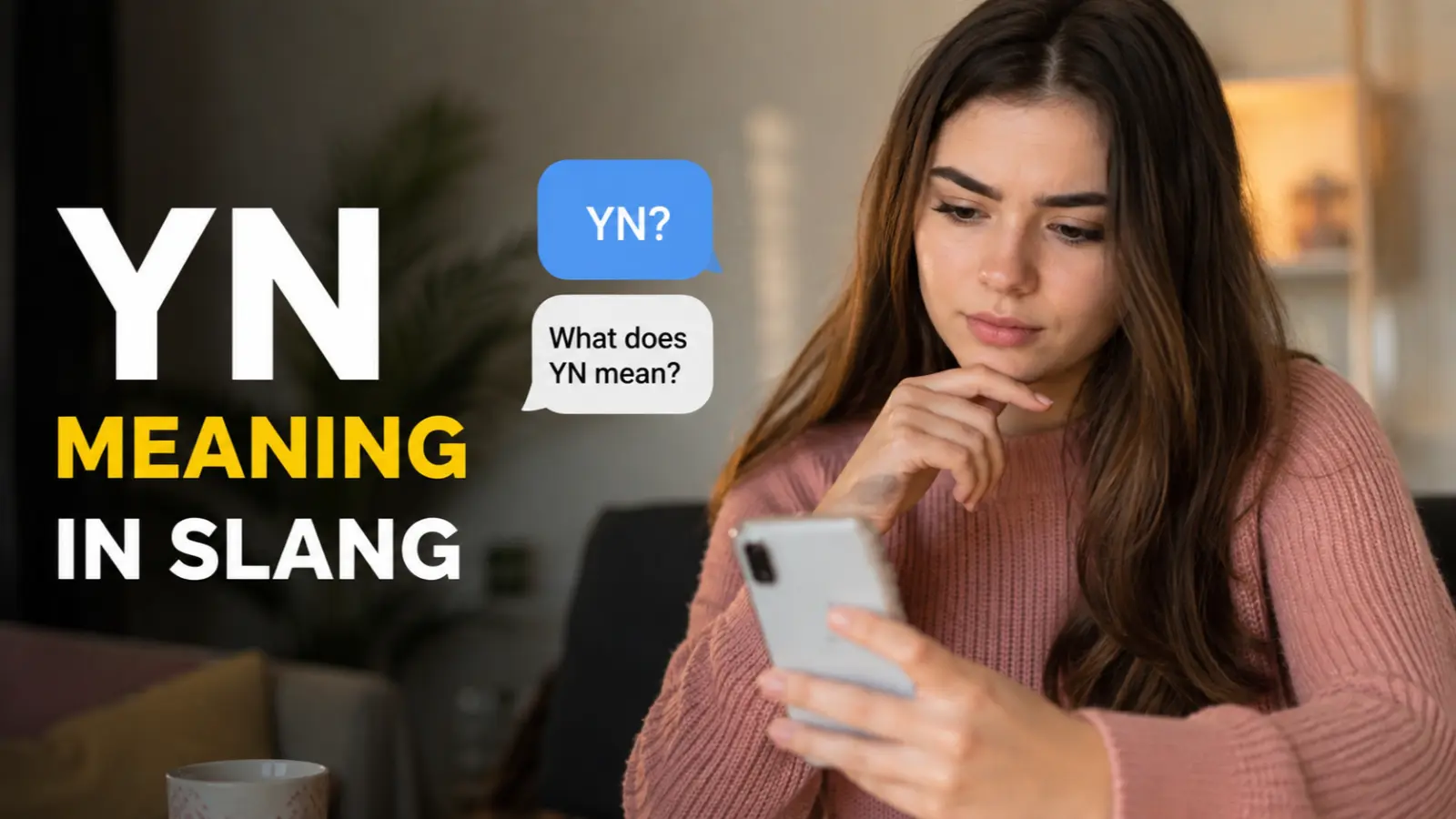
yn meaning slang can be confusing because these two letters can have different meanings depending on where you see them.
You might notice “YN” in a text message, TikTok comment, fanfiction, a social media post, or an online conversation and wonder what the person actually means.
Unlike slang terms with only one definition, YN does not have a universal meaning. In casual texting, it can be short for “yes or no.” In fanfiction and reader-insert stories, Y/N commonly means “your name.”
Some online communities, YN is also used as a sensitive slang abbreviation connected to a racial slur, so context is especially important.
Quick Answer
YN meaning in text usually depends on context. It can mean “yes or no,” while Y/N often means “your name” in fanfiction and reader-insert stories. In some slang communities, it has a sensitive additional meaning.
What Does YN Mean in Text?
There is no single YN full form that works in every situation.
The most common meanings include:
- YN = Yes or No — used to ask for a simple choice or confirmation.
- Y/N = Your Name — used as a placeholder in fanfiction, POV stories, and reader-insert content.
- YN = a sensitive slang abbreviation — used in some online and street-language communities.
The surrounding words usually make the intended meaning clear. For example:
“Are you coming tonight, YN?”
Here, the person may be asking for a yes-or-no answer.
But:
“YN walked into the room and saw him.”
In a reader-insert story, YN or Y/N may represent your name.
YN Full Form and Definition
1. YN = Yes or No
One common meaning of YN is “yes or no.”
People use it when they want a quick answer instead of a long explanation.
Examples:
- “Are you coming, YN?”
- “Do you like it? YN?”
- “You want to go, yn?”
This use is informal and works best in quick conversations.
2. Y/N = Your Name
In fanfiction and reader-insert stories, Y/N usually means “your name.”
The writer uses Y/N instead of giving the reader a specific name. The reader is expected to imagine their own name in its place. This convention is common in reader-insert fiction and online storytelling.
For example:
“Y/N opened the door and smiled.”
The reader mentally replaces “Y/N” with their own name.
This is particularly common in fanfiction, POV content, and fandom communities.
3. A Sensitive Slang Meaning
In some social-media and street-language contexts, YN is also used as an abbreviation for a phrase containing a racial slur. Because that meaning involves offensive language, it should not be casually repeated or used simply because you saw it online.
If you see YN alongside slang about street culture, young people, or criminal activity, the meaning may be different from “your name” or “yes or no.” Community discussions show that users frequently encounter all three interpretations, which is why context matters.
Meaning of YN in Different Contexts
| Context | Likely Meaning | Example |
|---|---|---|
| Texting | Yes or no | “You coming yn?” |
| Fanfiction | Your name | “Y/N looked at him.” |
| POV stories | Your name | “Y/N enters the room.” |
| Social media | Depends on context | “What does YN mean here?” |
| Street slang | May have a sensitive meaning | Check the surrounding words |
| School/work | Usually avoid it | Use complete words |
The slash matters sometimes, but not always. “Y/N” is strongly associated with “your name” in fanfiction and can also be used for “yes/no” in forms or questions. “YN” without the slash may have different slang interpretations.
Is YN Rude, Offensive, or Neutral?
It depends on which meaning is intended.
Neutral Uses
“YN” is generally neutral when it means:
- Yes or no
- Your name
- A fictional placeholder
For example:
“Y/N walked into the café.”
There is nothing offensive about this usage.
Potentially Offensive Use
The term can become offensive when it represents a racial slur in certain slang communities.
If you are unsure what someone means by “YN,” do not assume. Look at the surrounding sentence or politely ask what they mean.
Understanding a slang term does not mean you need to repeat every version of it.
Where Is YN Commonly Used?
You may encounter YN in several online environments.
Text Messages
Friends may use YN as a quick way to request a yes-or-no response.
Example:
“You free tonight yn?”
TikTok and Social Media
TikTok comments and captions can use YN in different ways. The exact meaning depends heavily on the type of content. Some posts use it in storytelling or fandom contexts, while others use it as slang.
Fanfiction
Y/N is especially recognizable in reader-insert fiction.
Example:
“Y/N smiled when the character called her name.”
Here, Y/N means “your name.”
Online Communities
Different communities develop their own abbreviations. That is why searching for “what does YN stand for” without looking at the original sentence can sometimes produce the wrong answer.
Real-Life YN Conversation Examples
Friendly Example
Person A: “You coming with us, yn?”
Person B: “Yeah, I’ll be there.”
Here, YN can function as a quick yes-or-no prompt.
Casual Example
Person A: “You watched the new episode yn?”
Person B: “Not yet.”
Again, the sender is looking for a simple answer.
Fanfiction Example
“Y/N looked around the room and realized everyone was watching.”
Here, Y/N means your name.
Social Media Example
“YN finally got the chance to meet her favorite singer.”
The meaning depends on the surrounding post. If this is reader-insert content, YN likely represents the reader.
Argumentative Example
Person A: “Are you helping me or not, yn?”
Person B: “Yes, I said I would.”
In this case, the abbreviation makes the message feel short and direct.
Emotional and Psychological Meaning
YN itself does not have a specific psychological meaning.
However, abbreviations can affect how a message feels.
For example, writing:
“Are you coming?”
sounds neutral.
Writing:
“You coming yn?”
can feel quicker, more casual, or more impatient depending on the relationship between the speakers.
In reader-insert stories, Y/N has a different effect. It allows readers to imagine themselves inside the story, which can make fictional situations feel more personal or immersive.
Origin and Background of YN
There is no single origin story for every use of YN.
The Y/N = your name convention developed in reader-insert and fanfiction communities, where writers wanted readers to imagine themselves as characters in a story. It became especially recognizable across online fandom spaces.
The yes/no abbreviation is more straightforward: people shorten common phrases to save time when communicating digitally.
The newer slang interpretation developed separately within particular communities. Therefore, treating every “YN” as having one origin or one definition can be misleading.
YN vs. Y/N: What’s the Difference?
| Term | Common Meaning | Where You May See It |
|---|---|---|
| YN | Yes or no / other slang meanings | Texts and social media |
| Y/N | Your name | Fanfiction and reader-insert stories |
| Y/N | Yes/no | Forms, questions, instructions |
| YNS | A related slang abbreviation | Some social-media communities |
The safest approach is to examine the sentence rather than relying only on capitalization or punctuation.
Common Misunderstandings About YN
People often misunderstand YN because it is extremely short.
Misunderstanding 1: YN Always Means “Your Name”
Not necessarily. In texting, it may mean “yes or no.”
Misunderstanding 2: YN Always Means “Yes or No”
Not necessarily. In fanfiction, Y/N commonly means “your name.”
Misunderstanding 3: Every YN Has the Same Meaning
No. Online slang changes between communities.
Misunderstanding 4: You Should Repeat Any Slang You See
Not always. Some versions of YN can represent offensive language. It is better to understand the term before using it.
Variations and Types of YN
You may see several forms:
- YN
- Y/N
- y/n
- y/n?
- YN?
The capitalization and slash can provide clues, but they are not perfect rules.
For example, Y/N in a fanfiction story is commonly a placeholder for “your name,” while Y/N? in a question can mean “yes/no?” depending on the context.
When Should You Use YN?
Use YN only when the people reading it are likely to understand what you mean.
Good Situations
- Casual texting
- Informal chats
- Fanfiction
- Reader-insert stories
- Social-media conversations
Situations to Avoid It
Avoid ambiguous slang in:
- School assignments
- Business emails
- Job applications
- Official documents
- Professional reports
- Important instructions
Instead of writing:
“Are you available yn?”
write:
“Are you available, yes or no?”
Clear language prevents unnecessary confusion.
How to Respond When Someone Uses YN
If the meaning is obvious, respond normally.
If it means yes or no:
“Yes, I am.”
or
“No, I can’t.”
If it means your name:
Simply understand that Y/N represents the reader in the story.
If the meaning is unclear:
You can ask:
“What do you mean by YN?”
This is often better than guessing.
Why Do People Use YN?
People use abbreviations because digital communication is fast.
Common reasons include:
- Saving typing time
- Making messages shorter
- Following internet trends
- Matching the language of friends
- Creating a casual tone
- Making reader-insert stories easier to personalize
Slang also helps people feel connected to a particular online community.
Is YN Safe for Social Media?
The abbreviation itself is not automatically unsafe or offensive.
However, the meaning matters.
If you’re using YN to mean “yes or no” or “your name,” it is generally harmless in the appropriate context. But if the abbreviation is being used to represent an offensive racial term, repeating it can cause harm or misunderstandings.
When posting publicly, clear wording is usually the safest choice.
Polite Alternatives to YN
If you want to avoid ambiguity, use the complete phrase.
Instead of YN, write:
- “Yes or no?”
- “Are you coming?”
- “What is your name?”
- “Your name goes here.”
- “Please answer yes or no.”
These alternatives are especially useful in professional or formal communication.
Comparison With Similar Slang
| Slang | Meaning | Typical Use |
|---|---|---|
| YN | Yes or no / context-dependent | Texting |
| Y/N | Your name | Fanfiction |
| IDK | I don’t know | Texting |
| LMK | Let me know | Texting |
| WYD | What are you doing? | Casual chat |
| TBH | To be honest | Social media/texting |
Unlike terms such as IDK or TBH, YN requires more context because it has several unrelated meanings.
Regional and Cultural Usage
YN does not have exactly the same meaning in every online community.
Fanfiction communities may immediately understand Y/N as “your name.” Someone who mainly uses texting abbreviations may understand Y/N as “yes/no.” Meanwhile, some social-media and street-language communities use YN differently.
This cultural difference explains why two people can see the same abbreviation and understand completely different things.
FAQs About YN Meaning Slang
What does YN mean in text?
YN can mean “yes or no” in casual texting. However, the meaning depends on context.
What does YN stand for?
There is more than one answer. YN can stand for “yes or no,” while Y/N can mean “your name” in fanfiction.
What does Y/N mean on TikTok?
On TikTok, Y/N may mean “your name” in POV or reader-insert content. Other posts may use it as slang, so check the context.
Is YN a bad word?
Not automatically. Some meanings are completely neutral, while another slang use can represent offensive language. Context is important.
Does YN mean “your name”?
It can. Y/N = your name is especially common in fanfiction and reader-insert stories.
Should I use YN in formal writing?
No. Because the abbreviation is ambiguous, it is better to write the complete phrase in professional, academic, or official communication.
Conclusion
YN meaning slang depends on where and how you see it. In casual texting, YN can mean “yes or no,” while Y/N commonly means “your name” in fanfiction and reader-insert stories. In some online communities, YN can also have a sensitive slang meaning that should be handled carefully.
The most important rule is simple: look at the context before deciding what YN means. If it appears in a question, it may be asking for a yes-or-no answer. If it appears in a fictional story, Y/N may represent the reader’s name.
When you’re writing professionally or communicating with someone who may not know the abbreviation, use clear words instead. Understanding the context will help you avoid confusion, awkward replies, and unintended offense.