Silence can be difficult to describe. Unlike a storm, a shout, or a bright color, silence does not always announce itself. Sometimes it feels peaceful. Sometimes it feels uncomfortable, heavy, mysterious, or full of emotion. That is where silent similes can make writing more vivid.
A simile compares two different things using words such as like or as. For example, “The room was as still as an unopened letter” connects silence with something familiar while creating a particular mood.
Writers use similes in poetry, fiction, essays, songs, speeches, and everyday conversation because a well-chosen comparison helps readers experience an idea rather than simply read about it. In this guide, you will find original silent similes, explanations of why they work, examples in context, and practical techniques for creating your own.
What Are Silent Similes?
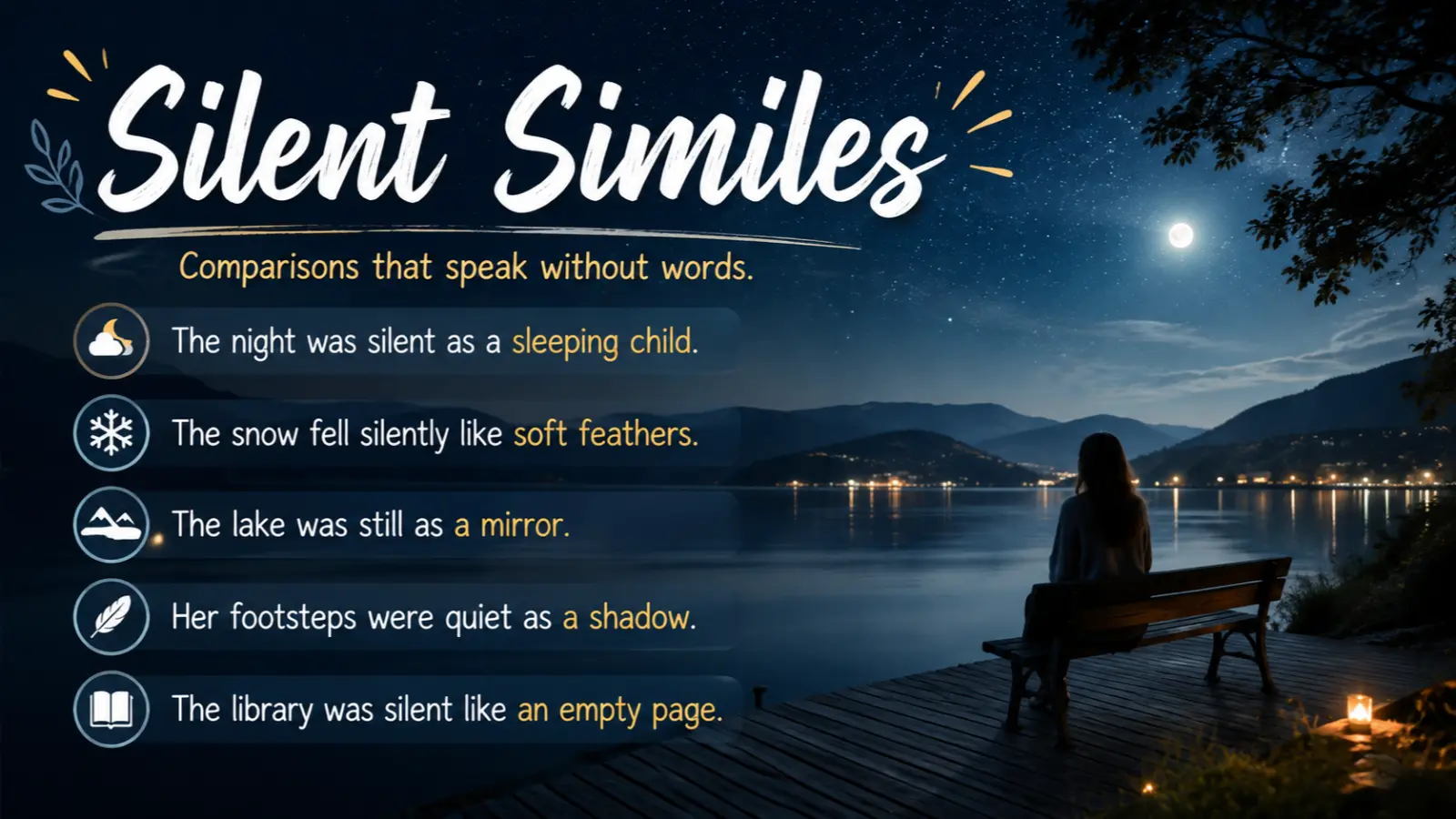
Silent similes are comparisons that describe silence, quietness, stillness, or an absence of sound by connecting them to another image.
For example:
The hallway was quiet like a library after closing time.
The comparison gives the reader more than the word quiet. It creates a visual and emotional setting.
A strong silent simile can communicate several kinds of quiet:
- peaceful silence
- awkward silence
- lonely silence
- mysterious silence
- respectful silence
- tense silence
- thoughtful silence
- emotionally heavy silence
The best comparison depends on the feeling you want the reader to experience.
Why Do Writers Use Similes for Silence?
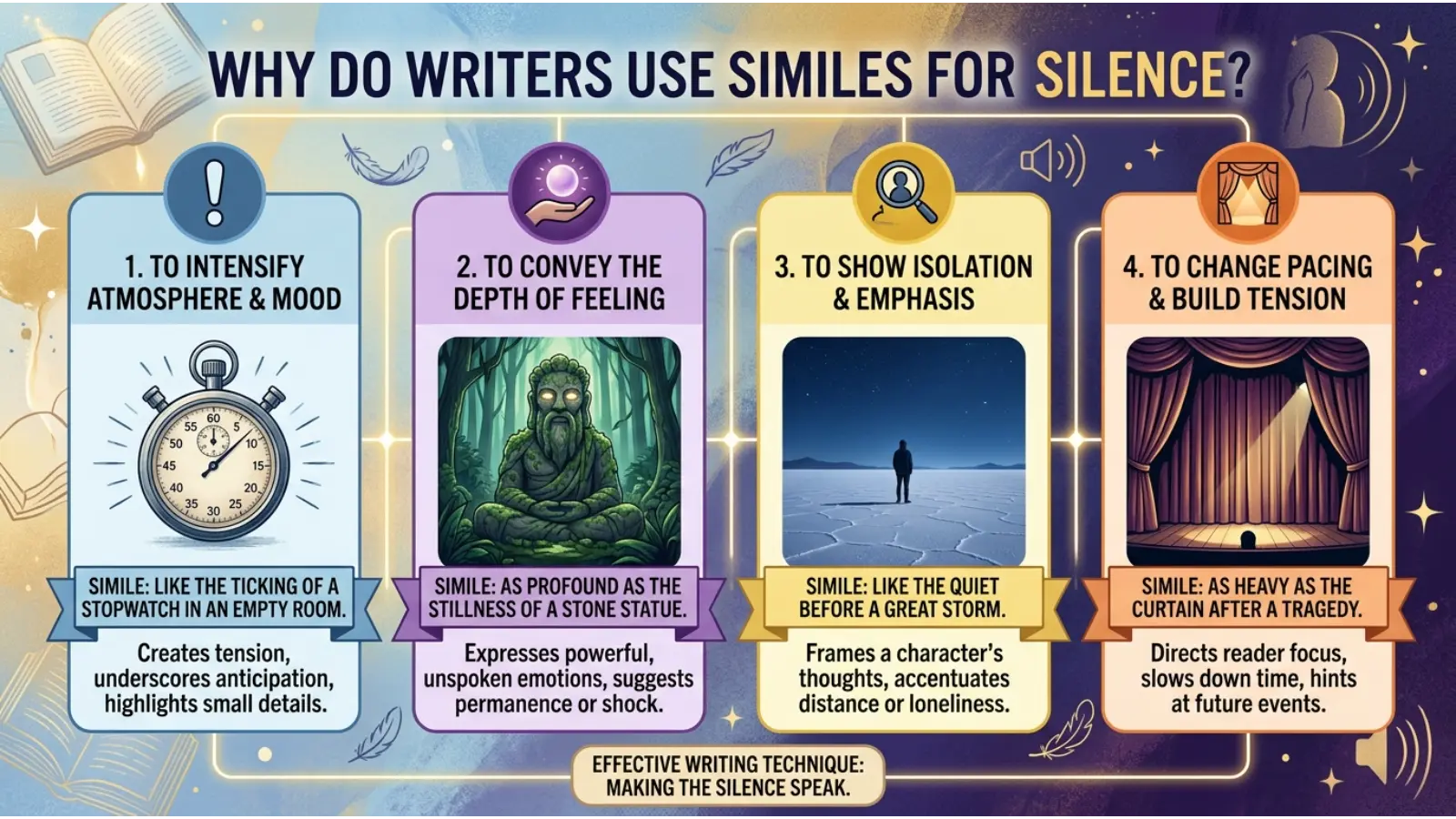
The word silent tells readers that there is little or no sound. A simile can explain what that silence feels like.
Compare these two sentences:
Basic:
The classroom was silent.
More vivid:
The classroom was as quiet as a photograph.
The second sentence gives silence a visual quality. It suggests that everything has stopped moving and making noise.
This is an important writing principle: a simile should add information, not simply decorate a sentence.
If your comparison reveals mood, setting, character, tension, or emotion, it is doing useful work.
30 Original Silent Similes for Creative Writing
1. Silent as an Unopened Letter
Meaning: This suggests a silence filled with anticipation or unanswered emotion.
Example:
The house was silent as an unopened letter.
She sat beside the window, waiting for someone to speak.
The comparison works because an unopened letter contains information that has not yet been revealed. It can make silence feel mysterious or expectant.
Best context: Suspense, emotional scenes, waiting, or uncertainty.
Writing tip: Use this when silence suggests that something important remains unsaid.
2. Quiet Like Snow Resting on a Roof
This comparison creates a soft, peaceful kind of silence.
Example:
The village was quiet like snow resting on a roof.
Even the distant road seemed to have disappeared.
The image combines stillness and softness. It works especially well in winter or nighttime descriptions.
Best context: Peaceful scenes, winter settings, reflection, and nature writing.
3. Silent as a Locked Garden
A locked garden suggests beauty that is present but inaccessible.
Example:
His thoughts were silent as a locked garden.
No one could tell what he was feeling.
This simile can describe emotional silence rather than literal silence.
Best context: Characters hiding feelings or keeping secrets.
4. Still Like a Candle Before It Is Lit
This creates a sense of potential. Nothing is happening yet, but something may happen soon.
Example:
The room was still like a candle before it is lit.
Everyone waited for the announcement.
The comparison is especially useful when quietness contains anticipation.
Best context: Suspense, waiting, ceremonies, and important moments.
5. Silent as Dust on an Old Piano
This simile gives silence a nostalgic quality.
Example:
The abandoned music room was silent as dust on an old piano.
The piano suggests music, while the dust suggests that the music has stopped.
Writing purpose: This is useful for showing absence without directly explaining it.
6. Quiet Like a Page Between Chapters
A page between chapters suggests a pause rather than an ending.
Example:
After the argument, the house became quiet like a page between chapters.
This comparison works particularly well in storytelling because it implies that something happened before and something may happen next.
Best context: Transitional scenes and emotional pauses.
7. Silent as a Closed Window at Midnight
This creates a private, isolated atmosphere.
Example:
The street outside was silent as a closed window at midnight.
The image suggests separation from the outside world.
Best context: Night scenes, loneliness, mystery, and introspection.
8. Quiet Like Footprints After Rain
This simile suggests temporary stillness after activity.
Example:
The playground was quiet like footprints after rain.
The comparison creates an unusual image because footprints remain visible even after the sound and movement have disappeared.
Writing tip: Use unexpected objects to make quietness feel less predictable.
9. Silent as a Clock Without Hands
A clock normally represents time, movement, and routine. Removing its hands creates an eerie sense of suspended time.
Example:
The empty station was silent as a clock without hands.
Emotional effect: Strange, lonely, and slightly unsettling.
Best context: Abandoned places or moments when time seems to stop.
10. Quiet Like a Secret Under a Pillow
This simile makes silence feel personal and hidden.
Example:
Her voice disappeared, leaving the room quiet like a secret under a pillow.
The comparison works because a secret is something deliberately kept from others.
Best context: Private emotions, childhood memories, secrets, and intimate scenes.
11. Silent as an Empty Theater Before the Curtain
An empty theater normally exists for sound, movement, and performance. Before the curtain rises, however, it can feel suspended.
Example:
The theater was silent as an empty stage before the curtain.
Writing purpose: This comparison creates anticipation.
It can also prepare readers for an important event.
12. Quiet Like Moonlight on a Sleeping Lake
This creates gentle, peaceful imagery.
Example:
The lake was quiet like moonlight resting on dark water.
The comparison combines visual stillness with nighttime calm.
Best context: Poetry, reflective prose, romance-free nature descriptions, and peaceful scenes.
13. Silent as a Photograph in a Drawer
A photograph preserves a moment without making a sound.
Example:
The old house stood silent as a photograph in a drawer.
The image can suggest memory, age, and emotional distance.
Best context: Nostalgic or reflective writing.
14. Quiet Like an Empty Notebook
An empty notebook contains possibilities without expressing any of them yet.
Example:
The room felt quiet like an empty notebook waiting for its first sentence.
This is particularly useful for writers because it connects silence with creativity.
Writing tip: When creating a simile, consider comparing an emotion to something that shares its function, not merely its appearance.
15. Silent as a Feather on Glass
This suggests delicate, almost complete stillness.
Example:
The morning was silent as a feather on glass.
The soft objects in the comparison make the scene feel fragile.
Best context: Peaceful descriptions and lyrical writing.
16. Quiet Like a Road Before Sunrise
This simile suggests temporary silence.
Example:
The city was quiet like a road before sunrise.
Unlike permanent silence, this kind of quiet implies that activity will soon return.
Best context: Early-morning scenes and transitions.
17. Silent as a Forgotten Photograph
This comparison gives silence an emotional and nostalgic quality.
Example:
His memories remained silent as a forgotten photograph.
The simile works because forgotten photographs preserve stories without telling them aloud.
Best context: Memory, loss, history, and reflection.
18. Quiet Like Grass Beneath Falling Snow
The image emphasizes softness and muffled movement.
Example:
The garden became quiet like grass beneath falling snow.
Emotional effect: Peaceful, delicate, and secluded.
Best context: Winter and nature writing.
19. Silent as a Door Waiting to Open
This creates suspense.
Example:
The corridor was silent as a door waiting to open.
The door represents possibility, making the silence feel active rather than empty.
Writing lesson: A strong simile can make an inanimate object seem emotionally charged without directly personifying it.
20. Quiet Like Ink Before the First Word
This is useful for writing about creativity and hesitation.
Example:
My notebook remained quiet like ink before the first word.
The comparison captures the moment before an idea becomes language.
Best context: Writers, artists, students, and creative scenes.
21. Silent as an Abandoned Playground
This creates a noticeable contrast between a place designed for noise and its present quietness.
Example:
The playground was silent as an abandoned playground after sunset.
The comparison becomes powerful because readers already associate playgrounds with movement and sound.
Writing tip: Contrast can make a simile stronger. Compare silence to something readers normally expect to be noisy.
22. Quiet Like a River Beneath Ice
A frozen surface suggests silence while the river beneath it suggests hidden movement.
Example:
He kept his thoughts quiet like a river beneath ice.
This is especially effective for characters who hide strong emotions.
Best context: Character development and emotional restraint.
23. Silent as a Bell That Has Stopped
The image suggests that sound existed moments ago but has now disappeared.
Example:
The churchyard was silent as a bell that had stopped ringing.
Emotional effect: Reflective and slightly melancholic.
Best context: Historical, reflective, or solemn scenes.
24. Quiet Like a Library Before the First Reader
This creates a calm, expectant atmosphere.
Example:
The school was quiet like a library before the first reader arrived.
The simile works because it connects silence with a place associated with quietness while adding a specific moment.
Writing lesson: Specific comparisons are often stronger than generic ones.
25. Silent as a Shadow at Noon
A shadow is already quiet, but this comparison emphasizes complete absence of sound.
Example:
She moved through the empty hallway, silent as a shadow at noon.
Best context: Fiction, mystery, and descriptive storytelling.
26. Quiet Like Tea Cooling on a Windowsill
This gives silence a domestic and reflective feeling.
Example:
The afternoon became quiet like tea cooling on a windowsill.
The comparison suggests time passing slowly.
Best context: Calm scenes, reflection, and everyday storytelling.
27. Silent as a Comma Between Thoughts
This comparison treats silence as part of communication.
Example:
His pause was silent as a comma between thoughts.
The simile shows that silence does not necessarily mean nothing is happening.
Writing lesson: Silence can function like punctuation. It can slow a scene, create emphasis, or invite the reader to interpret what remains unsaid.
28. Quiet Like an Unplayed Song
An unplayed song contains potential sound but remains silent.
Example:
The room felt quiet like an unplayed song.
This is particularly effective when describing music, creativity, or anticipation.
Best context: Music-related writing, emotional scenes, and poetry.
29. Silent as a Boat Tied to an Empty Dock
The boat suggests movement that has temporarily stopped.
Example:
The harbor was silent as a boat tied to an empty dock.
The comparison creates a lonely but visually clear setting.
Best context: Coastal scenes, solitude, and nighttime descriptions.
30. Quiet Like a Question No One Asked
This comparison turns silence into an emotional absence.
Example:
Their conversation ended, leaving a quiet like a question no one asked.
It suggests that something remains unresolved.
Best context: Awkward conversations, emotional tension, and unresolved conflict.
How to Make Silent Similes More Vivid
A weak simile often compares something to another thing simply because both are quiet.
For example:
The room was quiet like a quiet room.
The comparison adds nothing.
Instead, ask what kind of silence is present.
Is it:
- soft?
- tense?
- lonely?
- expectant?
- mysterious?
- peaceful?
- uncomfortable?
- temporary?
Then choose an image that naturally carries the same emotional quality.
For example:
The room was silent as a locked garden.
Now the reader receives an additional idea: the silence feels private and inaccessible.
Use Contrast to Strengthen Silence
One of the most effective techniques is comparing silence with something normally associated with sound.
Think about:
- a playground without children
- a theater without an audience
- a piano without music
- a station without passengers
- a street before sunrise
- a classroom after everyone leaves
Contrast makes silence noticeable.
Instead of telling readers that something is quiet, show them what is missing.
Give Silence a Physical Image
Silence is abstract. Concrete objects are easier to visualize.
Instead of:
The silence felt strange.
Try:
The silence hung over the hallway like an empty picture frame.
The second version gives readers an object they can imagine.
A useful creative-writing formula is:
Abstract feeling + concrete image + emotional connection
For example:
Silence + locked garden + secrecy
That combination can produce a more memorable comparison.
Silent Similes for Different Moods
Peaceful Silence
For peaceful scenes, choose soft, slow, or delicate images.
The garden was quiet like grass beneath falling snow.
This works because both sides of the comparison suggest gentleness.
Tense Silence
For tension, use images that imply something is about to happen.
The room was still like a candle before it is lit.
The reader senses that the quiet may not last.
Lonely Silence
For loneliness, use images associated with absence.
The harbor was silent as a boat tied to an empty dock.
The empty dock gives the silence an emotional context.
Mysterious Silence
For mystery, compare silence to something hidden or inaccessible.
The house was silent as an unopened letter.
The reader naturally wonders what remains undiscovered.
Emotional Silence
Sometimes silence comes from feelings that cannot easily be expressed.
His thoughts stayed quiet like a river beneath ice.
The surface appears still while something remains hidden underneath.
How Professional Writers Build Better Similes
Experienced writers usually do more than search for two things that look alike. They look for a shared quality.
Suppose you want to describe a character who refuses to reveal their feelings.
You could write:
She was quiet like a stone.
That communicates stillness but not much else.
A more purposeful comparison might be:
She kept her thoughts quiet like a river beneath ice.
Now the comparison suggests that something exists beneath the surface.
This is the difference between a decorative simile and a meaningful simile.
Before using a comparison, ask:
- What exactly am I describing?
- What emotion should the reader feel?
- What object or scene shares that quality?
- Does the comparison reveal something new?
- Does it fit the character, setting, or situation?
If the answer to the fourth question is no, look for a stronger image.
Silent Similes in Poetry, Stories, and Everyday Writing
Silent similes can work differently depending on the form.
In Poetry
Poetry benefits from compact images:
The morning was quiet like moonlight on a sleeping lake.
The image creates atmosphere without requiring much explanation.
In Fiction
Fiction can use a simile to reveal character or build tension:
Nobody spoke. The room was still like a door waiting to open.
Here, the simile helps create anticipation.
In Personal Writing
A simple comparison can make a memory more specific:
My grandfather’s workshop was quiet like an old photograph.
The comparison gives the memory an emotional texture.
In Conversation
Not every simile needs to sound poetic. Natural speech can be simple:
“The house was quiet like everyone had already gone to sleep.”
The best choice depends on the audience and purpose.
Related Literary Devices That Work With Silent Similes
Metaphor
A metaphor makes a direct comparison without using like or as.
Simile:
The room was quiet like an empty theater.
Metaphor:
The room was an empty theater.
The metaphor is more direct, while the simile makes the comparison explicit.
Imagery
Imagery uses sensory details to help readers picture, hear, feel, taste, or smell a scene.
A silent simile can strengthen imagery by giving an abstract condition a concrete form.
Personification
Personification gives human qualities to nonhuman things.
For example:
The silence waited outside the door.
This makes silence seem capable of action.
A writer can combine personification and simile:
The silence waited like a guest who had forgotten how to leave.
Hyperbole
Hyperbole deliberately exaggerates.
For example:
The silence felt louder than a thousand conversations.
This is not a literal statement. It emphasizes the emotional intensity of the quiet.
Symbolism
Silence can symbolize secrecy, peace, isolation, grief, hesitation, or uncertainty.
The meaning depends on the surrounding story. A silent room in a peaceful scene does not necessarily symbolize the same thing as silence after an argument.
How to Create Your Own Silent Similes
Creating original comparisons becomes easier when you work from the emotion rather than the word silent.
Step 1: Identify the kind of silence
Write one word:
peaceful
tense
lonely
mysterious
hopeful
awkward
Step 2: Brainstorm five related images
If the silence is peaceful, you might think of:
- falling snow
- moonlit water
- an empty notebook
- early morning
- a sleeping garden
Step 3: Find the strongest connection
Don’t automatically choose the prettiest image. Choose the one that communicates your intended feeling.
Step 4: Add a specific detail
Instead of:
quiet like a lake
try:
quiet like moonlight resting on a sleeping lake
The additional detail makes the image more distinctive.
Step 5: Test the sentence
Read the simile aloud.
If it sounds unnatural, overly dramatic, or disconnected from the scene, revise it.
Creative Exercises for Writing Better Silent Similes
Exercise 1: Change the Mood
Start with:
The room was silent like ______.
Complete it five times, but give each sentence a different mood:
- peaceful
- frightening
- lonely
- hopeful
- awkward
You will quickly discover how the comparison changes the emotional meaning.
Exercise 2: Use an Unexpected Object
Describe silence using something that is not normally associated with quietness.
For example, think about:
- a roller coaster
- a marching band
- a busy market
- a kitchen during dinner
- a soccer stadium
Then imagine each place after everyone has gone.
This exercise teaches you how contrast creates imagery.
Exercise 3: Write the Scene Without “Silent”
Describe a quiet room without using:
silent, quiet, still, calm, peaceful
Instead, describe what the reader can observe.
For example:
No chair moved. The clock became the loudest thing in the room.
This technique helps writers move from telling to showing.
Common Mistakes When Writing Silent Similes
Using Familiar Comparisons Too Often
Comparisons such as quiet as a mouse are familiar because they are easy to understand, but they may not give experienced readers anything new.
Try asking:
What image belongs specifically to this scene?
A school hallway, empty beach, hospital waiting room, and mountain cabin should not all have the same kind of silence.
Mixing Unrelated Images
A simile becomes confusing when its imagery points in several directions at once.
If your sentence begins with a winter image, suddenly switching to ocean imagery can weaken the picture unless the contrast is intentional.
Choose images that support the same mood.
Forcing a Poetic Comparison
Not every sentence needs a beautiful or unusual simile.
Sometimes:
The classroom was quiet after the bell.
is better than a complicated comparison.
Use a simile when it improves the writing, not simply because you can add one.
Explaining the Simile Too Much
If your comparison already communicates the emotion, trust the reader.
Instead of:
The hallway was silent as an unopened letter, which showed that everyone was waiting nervously for something to happen.
you may only need:
The hallway was silent as an unopened letter.
The image allows readers to participate in the meaning.
Confusing Similes and Metaphors
A simile usually uses like or as to make the comparison explicit.
The room was quiet like an empty theater.
A metaphor makes the comparison directly:
The room was an empty theater.
Both can create strong imagery, but they produce slightly different effects.
Frequently Asked Questions About Silent Similes
What is a good simile for silence?
A good simile depends on the mood. For peaceful silence, you might compare it to snow resting on a roof. For suspense, silence can be compared to a door waiting to open.
What are some creative ways to describe silence?
Use concrete images connected with stillness, absence, waiting, secrecy, or contrast. An empty theater, unopened letter, frozen river, or unplayed song can all create different kinds of silence.
How do I make a simile more original?
Start with the emotion you want to communicate and brainstorm specific images related to that emotion. Avoid choosing the first familiar comparison that comes to mind.
Can silent similes be used in poetry?
Yes. Similes about silence work particularly well in poetry because they can create atmosphere and emotional meaning with very few words.
What is the difference between a silent simile and a metaphor?
A silent simile explicitly compares silence with another image, often using like or as. A metaphor makes the comparison directly without those comparison words.
Can silence be used as symbolism?
Yes. Silence can symbolize many things, including secrecy, loneliness, peace, hesitation, uncertainty, or emotional distance. Its meaning depends on the surrounding context.
Are silent similes useful in storytelling?
Absolutely. They can establish setting, reveal a character’s emotional state, slow the pace of a scene, or create suspense before an important event.
Conclusion
The strongest silent similes do more than tell readers that a place or person makes no sound. They reveal what that silence means. A peaceful silence might resemble snow settling on a roof. A secretive silence might feel like an unopened letter. A tense silence might wait like a door that has not yet opened. When creating your own comparisons, begin with the emotion, search for a concrete image, and make sure the comparison adds something the original sentence could not express on its own. Avoid familiar clichés when a more specific image is available, but do not force originality simply for its own sake. Silence may contain no sound, but in good writing, it can still say a great deal.

I am Helena Frost, a writer captivated by the beauty of language and the art of comparison. Through my words, I explore the world by turning ordinary moments into vivid similes and reflections. I enjoy crafting phrases that spark imagination, evoke emotion, and linger in the mind. My writing celebrates the subtle connections between people, nature, and the stories we live. For me, every sentence is an opportunity to reveal the extraordinary in the everyday.