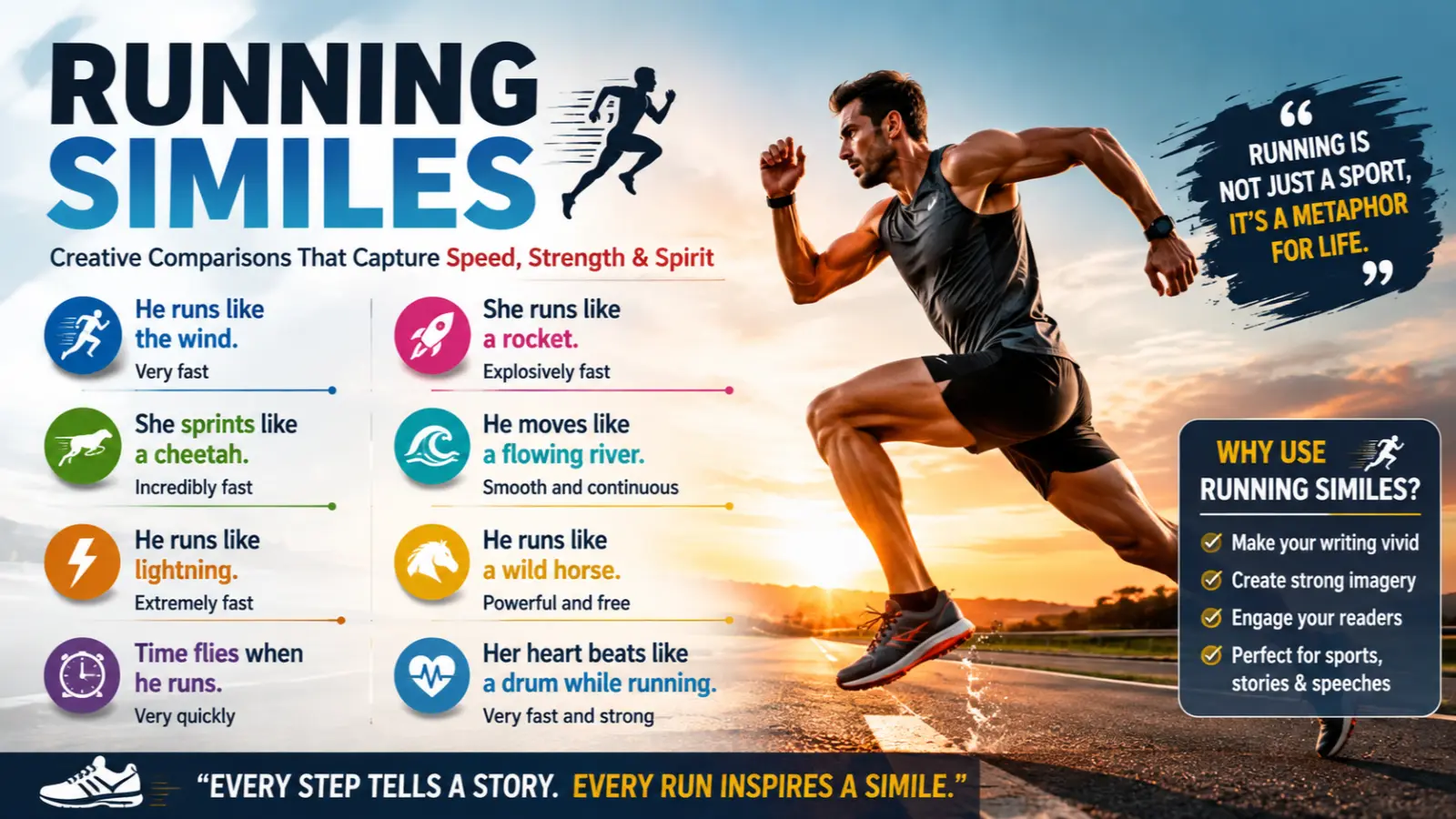
Running Similes is more than moving from one place to another. It can express excitement, fear, determination, freedom, or pure joy. That’s why writers often use similes to paint a clearer picture of movement and emotion.
A simile compares two different things using words like “as” or “like.” Instead of saying someone ran quickly, a simile helps readers imagine exactly how that movement looked or felt.
Whether you’re writing a story, poem, school assignment, speech, or personal journal, these running similes will help you create stronger, more memorable descriptions.
What Are Running Similes?
Running similes compare the way someone runs to another object, animal, force, or experience.
For example:
She ran like rain racing down a window.
The comparison doesn’t simply tell readers she moved fast—it creates an image they can almost see.
Good running similes do more than describe speed. They reveal mood, personality, energy, and purpose.
Why Writers Use Running Similes
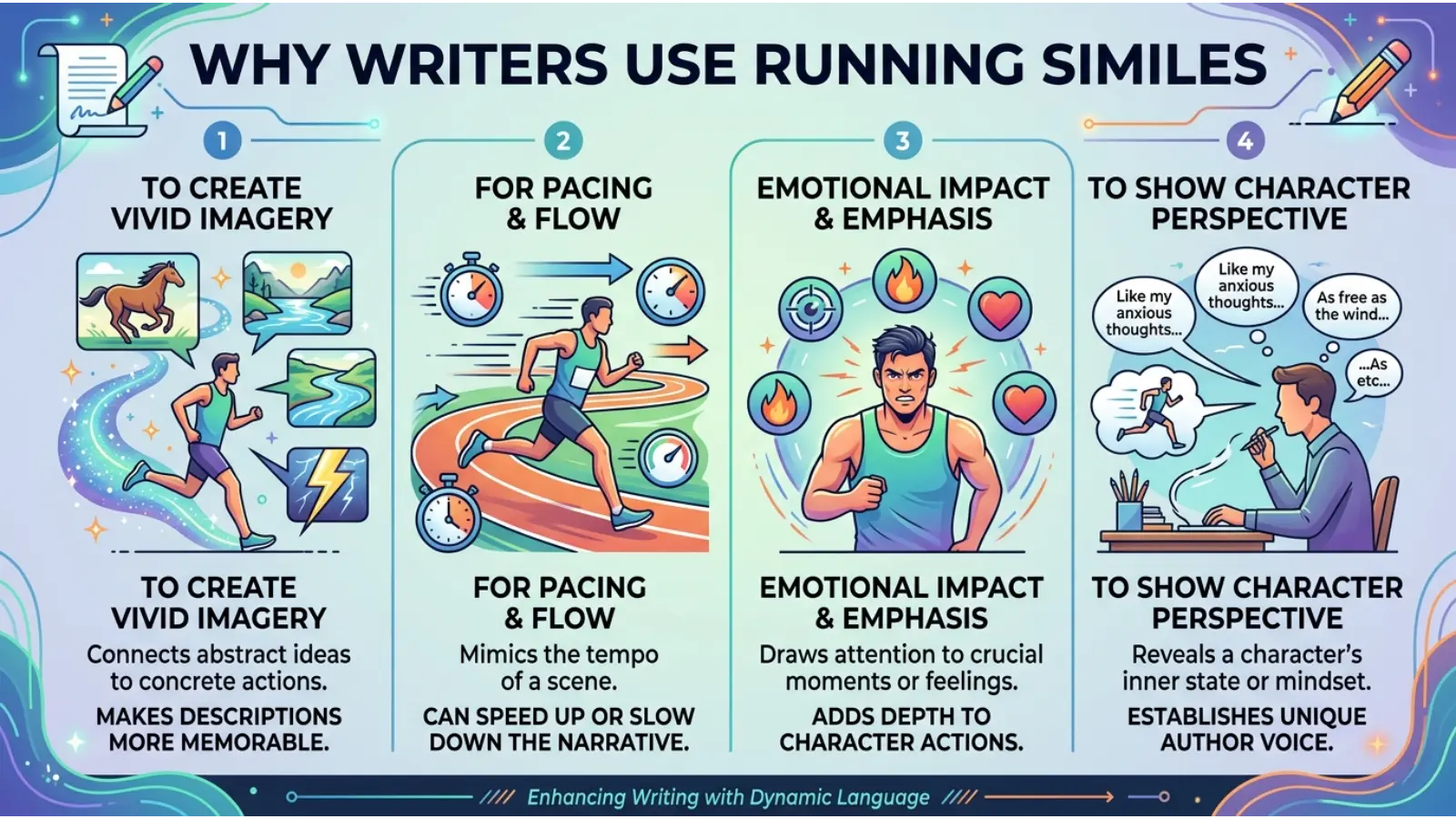
Running can communicate many emotions depending on the comparison.
A thoughtful simile can show:
- determination
- panic
- excitement
- freedom
- confidence
- urgency
- exhaustion
- playful energy
Instead of relying on plain descriptions, writers allow readers to experience movement through vivid imagery.
30 Original Running Similes
1. Running Like a Stream Finding the Sea
Meaning
Steady, natural movement with clear purpose.
Example Sentences
- She ran like a stream finding the sea, never slowing.
- The team pushed forward like a stream flowing toward open water.
Writing Purpose
Perfect for determination and long-distance running.
Conversation
“You were running like a stream—you never gave up.”
Storytelling
He crossed every hill like a stream searching for the ocean.
Writing Tip
Use when progress feels effortless.
2. Running Like Morning Light Across a Field
Meaning
Fast, graceful, and peaceful.
Example Sentences
- She ran like morning light across a quiet meadow.
- The children scattered like sunlight spreading over grass.
Emotional Effect
Creates hope and beauty.
Best Context
Nature writing and inspirational stories.
3. Running Like a Leaf Chasing the Wind
Meaning
Light, playful movement.
Examples
- The puppy ran like a leaf chasing the wind.
- She skipped ahead like a drifting leaf.
Writing Tip
Ideal for joyful scenes.
4. Running Like Thunder Rolling Through Hills
Meaning
Powerful and unstoppable.
Examples
- He ran like thunder rolling through distant hills.
- The players charged like thunder before the storm.
Storytelling
Adds strength and intensity.
5. Running Like Ink Across Fresh Paper
Meaning
Smooth and uninterrupted.
Examples
- She ran like ink across fresh paper.
- His footsteps flowed without hesitation.
Best Context
Creative writing.
6. Running Like a Spark Across Dry Leaves
Meaning
Sudden explosive speed.
Examples
- The boy ran like a spark across dry leaves.
- News spread through the crowd as people ran.
Writing Tip
Excellent for surprise scenes.
7. Running Like a Deer Through Silent Pines
Meaning
Graceful and quick.
Examples
- She ran like a deer through silent pines.
- He avoided every obstacle with ease.
Poetry Example
She danced through shadows like a woodland deer.
8. Running Like Waves Chasing the Shore
Meaning
Continuous motion.
Examples
- They ran like waves chasing the beach.
- The runners kept arriving without pause.
9. Running Like a Clock That Never Stops
Meaning
Consistent endurance.
Examples
- She ran like a clock that never stopped.
- His pace stayed steady all afternoon.
10. Running Like Fresh Paint Spreading Across a Wall
Meaning
Smooth, even movement.
Examples
- She glided like fresh paint covering a canvas.
- The dancers crossed the stage with effortless flow.
11. Running Like Wind Through Tall Grass
Meaning
Quiet speed.
Examples
- He disappeared like wind through tall grass.
- The messenger arrived almost unnoticed.
12. Running Like Fire Climbing a Hillside
Meaning
Rapid and unstoppable.
Examples
- Panic spread as people ran like fire climbing a hillside.
- The athlete surged ahead without looking back.
13. Running Like a Song That Knows Every Note
Meaning
Natural rhythm.
Examples
- She ran like a song that never missed a beat.
- Every stride felt perfectly timed.
14. Running Like Rain Sliding Off a Roof
Meaning
Fast and effortless.
Examples
- He ran like rain sliding from rooftop tiles.
- The children rushed outside laughing.
15. Running Like a Falcon Diving Toward the Earth
Meaning
Focused speed.
Examples
- The striker ran like a falcon diving toward its target.
- She attacked the finish line with precision.
16. Running Like a Shadow Escaping Sunset
Meaning
Silent and mysterious.
Examples
- He vanished like a shadow escaping sunset.
- Nobody noticed where he went.
17. Running Like a River Around Stones
Meaning
Flexible and adaptable.
Examples
- She ran like a river weaving around rocks.
- Every obstacle became another turn.
18. Running Like Laughter Through a Playground
Meaning
Happy and energetic.
Examples
- The children ran like laughter through the playground.
- Joy filled every corner of the park.
19. Running Like Smoke Rising Before Dawn
Meaning
Gentle but swift.
Examples
- She moved like smoke before sunrise.
- His footsteps barely made a sound.
20. Running Like a Needle Through Fabric
Meaning
Precise movement.
Examples
- He slipped through defenders like a needle through fabric.
- She found every opening.
21. Running Like Stars Crossing the Night Sky
Meaning
Brilliant and inspiring.
Examples
- She ran like stars crossing the night.
- Every stride captured attention.
22. Running Like a Fox Following a Hidden Trail
Meaning
Clever and agile.
Examples
- He escaped like a fox following an unseen path.
- She turned quickly around every corner.
23. Running Like Clouds Before a Storm
Meaning
Fast with growing urgency.
Examples
- They ran like clouds racing before heavy rain.
- The crowd sensed something important.
24. Running Like Pages Turning in the Wind
Meaning
Quick, light movement.
Examples
- She crossed the yard like pages turning in the wind.
- The children hurried inside.
25. Running Like a Kite Catching a Strong Breeze
Meaning
Freedom and excitement.
Examples
- He ran like a kite finding the perfect wind.
- Every step seemed lighter.
26. Running Like Sand Slipping Through Fingers
Meaning
Quick and impossible to catch.
Examples
- She escaped like sand slipping through fingers.
- The thief disappeared instantly.
27. Running Like Bees Returning Home
Meaning
Purposeful teamwork.
Examples
- The players ran like bees returning to their hive.
- Everyone knew exactly where to go.
28. Running Like Silver Fish Through Clear Water
Meaning
Elegant speed.
Examples
- She moved like silver fish through a stream.
- The runners glided around the curve.
29. Running Like the First Breeze of Spring
Meaning
Refreshing and full of life.
Examples
- He ran like the first breeze after winter.
- Hope returned with every stride.
30. Running Like an Arrow Finding Its Mark
Meaning
Direct, focused movement.
Example Sentences
- She ran like an arrow finding its mark.
- Every step brought him closer to victory.
Formal Example
The athlete advanced with unwavering purpose, like an arrow finding its mark.
Conversation Example
“You were running like an arrow today.”
Writing Tip
Use this simile when describing confidence rather than raw speed.
How to Make Running Similes More Vivid
The strongest similes compare movement to something readers instantly recognize. Instead of always comparing speed to animals, think about weather, music, water, light, or everyday experiences.
Ask yourself:
- How does the runner move?
- What emotion does the movement create?
- What image appears immediately in your mind?
Specific details almost always create stronger imagery than general comparisons.
Avoid Common Running Simile Mistakes
Don’t Rely on Overused Comparisons
Expressions like “fast as lightning” or “quick as a cheetah” are familiar, but they rarely surprise readers. Fresh comparisons are often more memorable.
Keep the Imagery Consistent
Avoid mixing unrelated images in a single sentence.
Weak
She ran like thunder while floating like a feather.
The comparison sends conflicting signals.
Match the Emotion
A playful simile doesn’t belong in a tense escape scene. Choose imagery that supports the mood.
Remember the Difference Between Similes and Metaphors
A simile uses like or as.
- Simile: She ran like a river.
- Metaphor: She was a river in motion.
Both create imagery, but they work differently.
Related Literary Devices
Imagery
Imagery helps readers see, hear, and feel a scene. Running similes naturally strengthen visual imagery by turning ordinary movement into memorable pictures.
Metaphor
Metaphors make direct comparisons without using “like” or “as.” They often create a stronger or more dramatic effect.
Personification
Giving human qualities to nature can make running scenes more dynamic.
Example:
The wind welcomed every runner.
Hyperbole
Hyperbole exaggerates for emphasis.
Example:
He ran so fast the horizon seemed to chase him.
Create Your Own Running Similes
You don’t need to copy someone else’s comparisons. Build your own by following a simple process.
Step 1: Decide What You’re Describing
Is the runner fast, tired, graceful, nervous, joyful, or determined?
Step 2: Think Beyond Animals
Consider:
- weather
- music
- rivers
- light
- machines
- sports
- art
- seasons
Step 3: Match the Feeling
Choose an image that creates the same emotion as the movement.
Step 4: Read It Aloud
If the comparison sounds awkward or forced, simplify it.
Creative Exercise
Write five sentences about someone running. Each sentence should compare the movement to a different category:
- nature
- weather
- music
- light
- everyday objects
Then revise each one to make the imagery more specific.
Frequently Asked Questions
What is a running simile?
A running simile compares the action of running to another object, experience, or idea using the words like or as.
Why are running similes useful in writing?
They help readers visualize movement, understand emotion, and connect with a scene more deeply than plain descriptions.
Can running similes describe emotions?
Yes. A runner can appear joyful, frightened, determined, nervous, or confident depending on the comparison you choose.
Are running similes only for stories?
No. They also work well in poetry, speeches, essays, classroom writing, and personal journals.
How can I avoid cliché running similes?
Look beyond common comparisons. Draw inspiration from nature, art, music, weather, or everyday experiences to create fresh imagery.
Should every action use a simile?
No. Similes are most effective when used selectively. Too many comparisons can slow the pace of your writing and reduce their impact.
Conclusion
Running similes do far more than describe speed. They reveal emotion, personality, rhythm, and purpose while helping readers picture every step. By creating fresh, meaningful comparisons instead of relying on familiar clichés, you can make stories, poems, and everyday writing more vivid and memorable. Use the examples in this guide as inspiration, then experiment with your own comparisons. The most effective similes often come from careful observation, creative thinking, and a willingness to see ordinary movement in unexpected ways.

I am Helena Frost, a writer captivated by the beauty of language and the art of comparison. Through my words, I explore the world by turning ordinary moments into vivid similes and reflections. I enjoy crafting phrases that spark imagination, evoke emotion, and linger in the mind. My writing celebrates the subtle connections between people, nature, and the stories we live. For me, every sentence is an opportunity to reveal the extraordinary in the everyday.