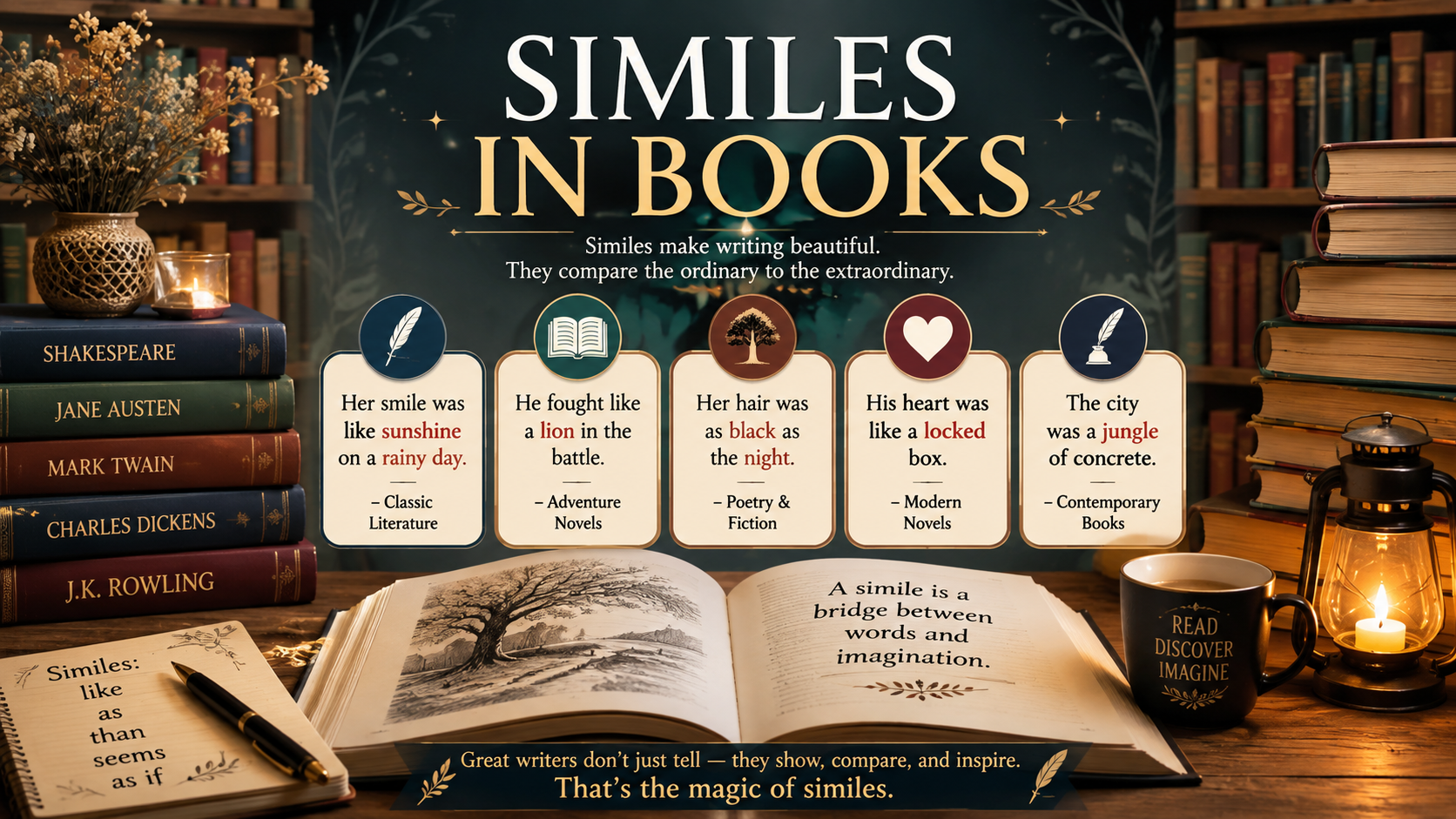
Similes in Books transport readers into new worlds, and one of the most effective tools writers use to create those worlds is the simile. A simile compares two different things using words like “as” or “like.” Instead of simply describing a character, place, or feeling, a simile helps readers picture it more clearly and experience it more deeply.
You’ll find similes in novels, short stories, children’s books, fantasy adventures, mysteries, historical fiction, and even nonfiction. They add emotion, create atmosphere, and make ordinary descriptions unforgettable.
This guide explores similes in books through fresh examples, explains why they work, and shows you how to create your own vivid comparisons.
Quick Answer
Similes in books are comparisons using “like” or “as” to help readers imagine characters, settings, emotions, and actions more vividly. Skilled authors use similes to strengthen imagery, reveal personality, and make scenes memorable without overwhelming the reader.
Why Similes Matter in Books
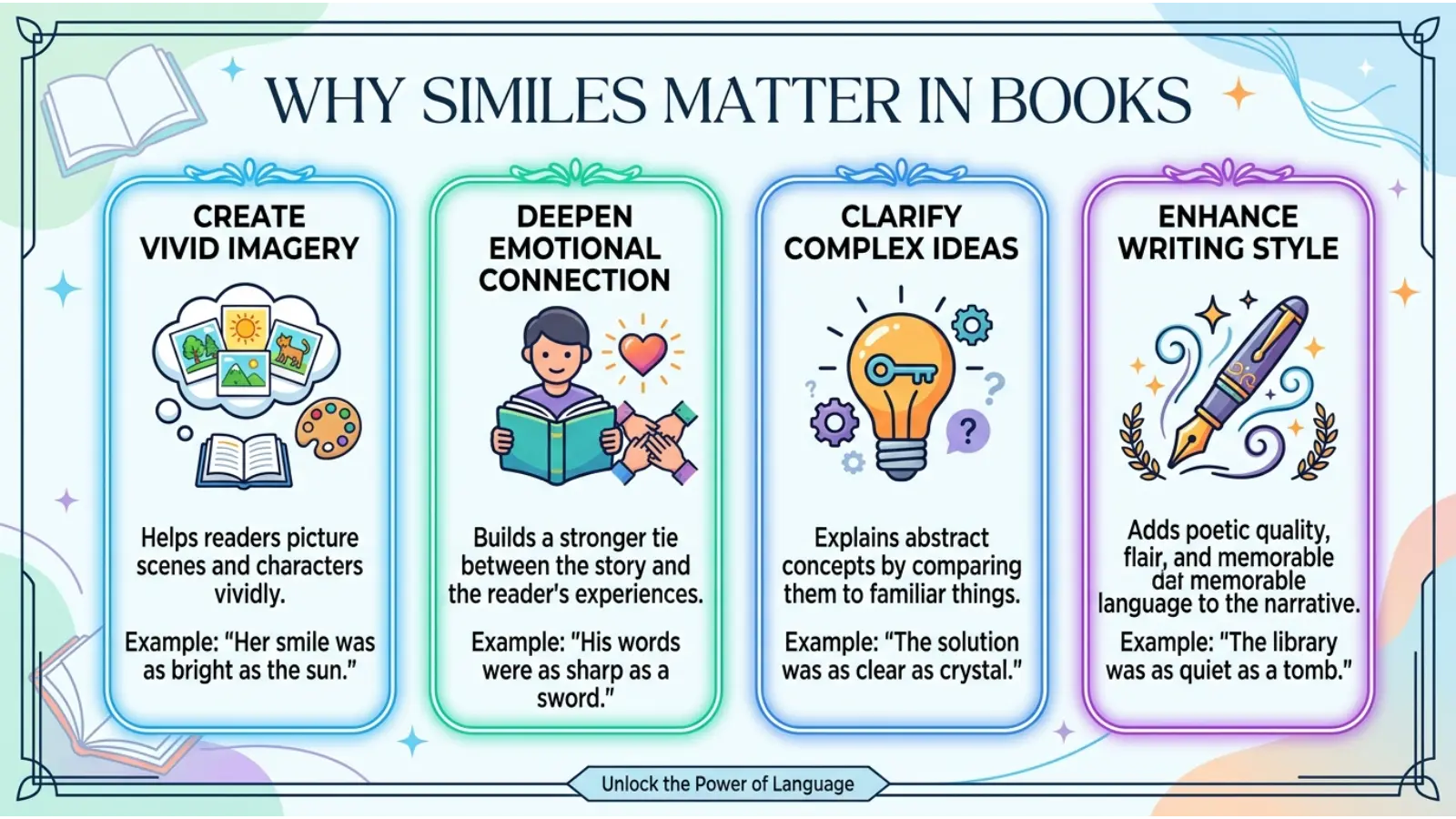
Books rely entirely on words to paint pictures.
A carefully chosen simile can instantly help readers understand:
- A character’s personality
- The mood of a scene
- The beauty of a setting
- The intensity of an emotion
- The speed or movement of action
Instead of writing:
The castle was old.
A stronger description becomes:
The castle stood like a forgotten giant guarding ancient memories.
Readers immediately imagine something larger, older, and more mysterious.
How Similes Bring Stories to Life
They Create Stronger Imagery
Readers remember images more than plain descriptions.
Compare:
- The leaves moved.
- The leaves danced like tiny green butterflies.
The second sentence creates movement and personality.
They Reveal Emotion
A character’s feelings become easier to understand through comparison.
Instead of saying someone is nervous, a writer might compare their heartbeat to an object or natural event that readers recognize.
They Improve Pacing
Short similes quickly communicate complex ideas without lengthy explanation.
One comparison can replace several descriptive sentences.
25 Original Similes in Books
1. As patient as a lighthouse waiting for dawn
Meaning: Extremely patient.
Example 1: The old fisherman remained as patient as a lighthouse waiting for dawn.
Example 2: She listened as patiently as a lighthouse through every complaint.
Writing Tip: Works well for wise or calm characters.
2. Like ink spreading across quiet water
Meaning: Something slowly expanding.
Example 1: The rumor spread like ink across quiet water.
Example 2: Fear moved through the village like ink across still water.
Best Context: Mystery and suspense.
3. As hopeful as the first flower after winter
Meaning: Filled with renewed optimism.
Example 1: She smiled as hopefully as the first flower after winter.
Example 2: The town welcomed spring with hopeful hearts.
Emotional Effect: Encourages optimism.
4. Like pages turning in the wind
Meaning: Fast-changing memories or events.
Example 1: His thoughts scattered like pages turning in the wind.
Example 2: Childhood memories returned unexpectedly.
5. As steady as an old bridge
Meaning: Reliable and dependable.
Example 1: Her advice was as steady as an old bridge.
Example 2: He never panicked during difficult moments.
6. Like sunlight finding forgotten windows
Meaning: Bringing unexpected happiness.
Example 1: Her laughter arrived like sunlight finding forgotten windows.
Example 2: Good news brightened everyone’s day.
7. As quiet as snow covering footprints
Meaning: Perfectly silent.
Example 1: The library became as quiet as snow covering footprints.
Example 2: Nobody spoke during the ceremony.
8. Like stars stitched into velvet
Meaning: Beautiful night scenery.
Example 1: The evening sky looked like stars stitched into velvet.
Example 2: Campers admired the peaceful sky.
9. As determined as roots finding water
Meaning: Never giving up.
Example 1: She kept trying as determined as roots finding water.
Example 2: The young athlete practiced daily.
10. Like a compass searching for north
Meaning: Looking for direction.
Example 1: His heart wandered like a compass searching for north.
Example 2: She searched for her purpose.
11. As bright as fresh morning rain
Meaning: Cheerful and refreshing.
Example Sentences
- Her smile was as bright as fresh morning rain.
- The classroom felt brighter after her arrival.
12. Like echoes inside an empty hall
Meaning: Lonely memories.
Example Sentences
- His regrets lingered like echoes inside an empty hall.
- Old promises returned unexpectedly.
13. As gentle as moonlight on glass
Meaning: Soft and comforting.
Conversation Example
“Her voice was as gentle as moonlight on glass.”
14. Like feathers carried by summer wind
Meaning: Light movement.
Storytelling Example
The children ran like feathers carried by summer wind.
15. As fearless as sunrise climbing mountains
Meaning: Courageous.
Writing Purpose
Ideal for heroes.
16. Like fresh bread warming a cold room
Meaning: Bringing comfort.
Poetry Example
Your kindness arrived like fresh bread warming a cold room.
17. As curious as rain exploring rooftops
Meaning: Deep curiosity.
Example
The child explored every shelf.
18. Like tiny boats crossing a silver lake
Meaning: Gentle movement.
Best Context
Nature writing.
19. As calm as hidden forest ponds
Meaning: Peaceful.
Example
Her breathing became as calm as hidden forest ponds.
20. Like lanterns guiding forgotten travelers
Meaning: Offering hope.
Formal Example
The teacher’s words were like lanterns guiding forgotten travelers.
21. As lively as birds greeting sunrise
Meaning: Energetic.
Conversation Example
“The kids are as lively as birds greeting sunrise.”
22. Like ribbons floating through autumn air
Meaning: Graceful motion.
Writing Tip
Excellent for dance scenes.
23. As clear as polished crystal
Meaning: Easy to understand.
Example
His explanation was as clear as polished crystal.
24. Like hidden treasure beneath ordinary sand
Meaning: Unexpected value.
Storytelling Example
The diary became like hidden treasure beneath ordinary sand.
25. As welcoming as a glowing fireplace
Meaning: Warm and inviting.
Example
The little bookstore felt as welcoming as a glowing fireplace.
What Makes a Simile Memorable?
Great similes don’t simply compare objects—they reveal something meaningful.
Ask yourself:
- Does the comparison create a picture?
- Does it fit the mood?
- Does it sound natural?
- Does it reveal character or emotion?
The best similes feel inevitable once readers encounter them.
How Professional Writers Create Powerful Similes
Professional authors rarely choose the first comparison that comes to mind.
Instead they ask:
- What emotion should readers feel?
- Which image best represents that emotion?
- Is the comparison fresh?
- Does it match the character’s perspective?
A farmer may compare clouds to fields.
A sailor may compare them to sails.
A musician may compare them to notes drifting across the sky.
Perspective makes similes believable.
Related Literary Devices
Metaphor
A metaphor states that one thing is another, while a simile says something is like or as another thing.
Simile: The road was like a ribbon.
Metaphor: The road was a ribbon.
Imagery
Imagery appeals to the senses.
Similes often strengthen imagery by making descriptions more vivid.
Personification
Personification gives human qualities to nonhuman things.
Example:
The wind whispered through the trees.
A simile and personification can work together in the same passage.
Symbolism
Sometimes a simile compares something to an object that also carries symbolic meaning, adding deeper layers to the story.
How to Create Your Own Similes
Step 1: Choose Your Subject
Decide what you’re describing.
Examples:
- A person
- A feeling
- A landscape
- An object
Step 2: Identify Its Strongest Quality
Ask what stands out most.
Is it:
- Bright?
- Slow?
- Loud?
- Gentle?
- Mysterious?
Step 3: Find an Unexpected Comparison
Instead of using common comparisons, look for fresh images from everyday life, nature, architecture, music, or travel.
Step 4: Read It Aloud
Good similes sound smooth.
If it feels forced, simplify it.
Creative Exercises
Exercise 1
Describe a rainy day using three original similes.
Exercise 2
Rewrite a simple sentence by adding one vivid simile.
Example:
“The horse ran.”
Try creating three different versions with different emotions.
Exercise 3
Pick an ordinary object in your room and compare it to something completely unexpected while keeping the comparison believable.
Common Mistakes Writers Make
Using Overused Comparisons
Readers have seen familiar comparisons countless times. Fresh images are far more memorable.
Mixing Imagery
Avoid combining unrelated comparisons in the same sentence.
Forcing a Comparison
If readers stop to figure out the simile, it probably isn’t helping.
Confusing Metaphors with Similes
Remember:
- Similes use like or as.
- Metaphors do not.
Choosing Weak Images
A comparison should strengthen the description rather than repeat obvious information.
Frequently Asked Questions
What are similes in books?
They are comparisons using like or as that make descriptions more vivid and engaging.
Why do authors use similes?
They help readers visualize scenes, understand emotions, and remember important details.
Are similes only used in fiction?
No. Similes also appear in memoirs, essays, speeches, children’s books, and some forms of nonfiction.
How are similes different from metaphors?
Similes compare using like or as, while metaphors make direct comparisons without those words.
Can too many similes weaken writing?
Yes. Using too many comparisons can slow the pace and distract readers. Choose only the strongest ones.
How can beginners write better similes?
Observe everyday life, focus on one clear quality, and create comparisons that feel natural rather than exaggerated.
What kinds of books use similes most?
Fantasy, literary fiction, children’s books, historical novels, romance, adventure stories, and poetry all make frequent use of similes.
Conclusion
Similes are more than decorative language—they are powerful storytelling tools that help readers see, feel, and remember your words. Whether you’re writing a novel, a short story, or a children’s book, thoughtful comparisons can transform ordinary descriptions into unforgettable scenes. Practice observing the world around you, experiment with fresh imagery, and don’t be afraid to revise your comparisons until they feel authentic. The more original and purposeful your similes become, the more vividly your stories will live in the minds of your readers.
I am Helena Frost, a writer captivated by the beauty of language and the art of comparison. Through my words, I explore the world by turning ordinary moments into vivid similes and reflections. I enjoy crafting phrases that spark imagination, evoke emotion, and linger in the mind. My writing celebrates the subtle connections between people, nature, and the stories we live. For me, every sentence is an opportunity to reveal the extraordinary in the everyday.