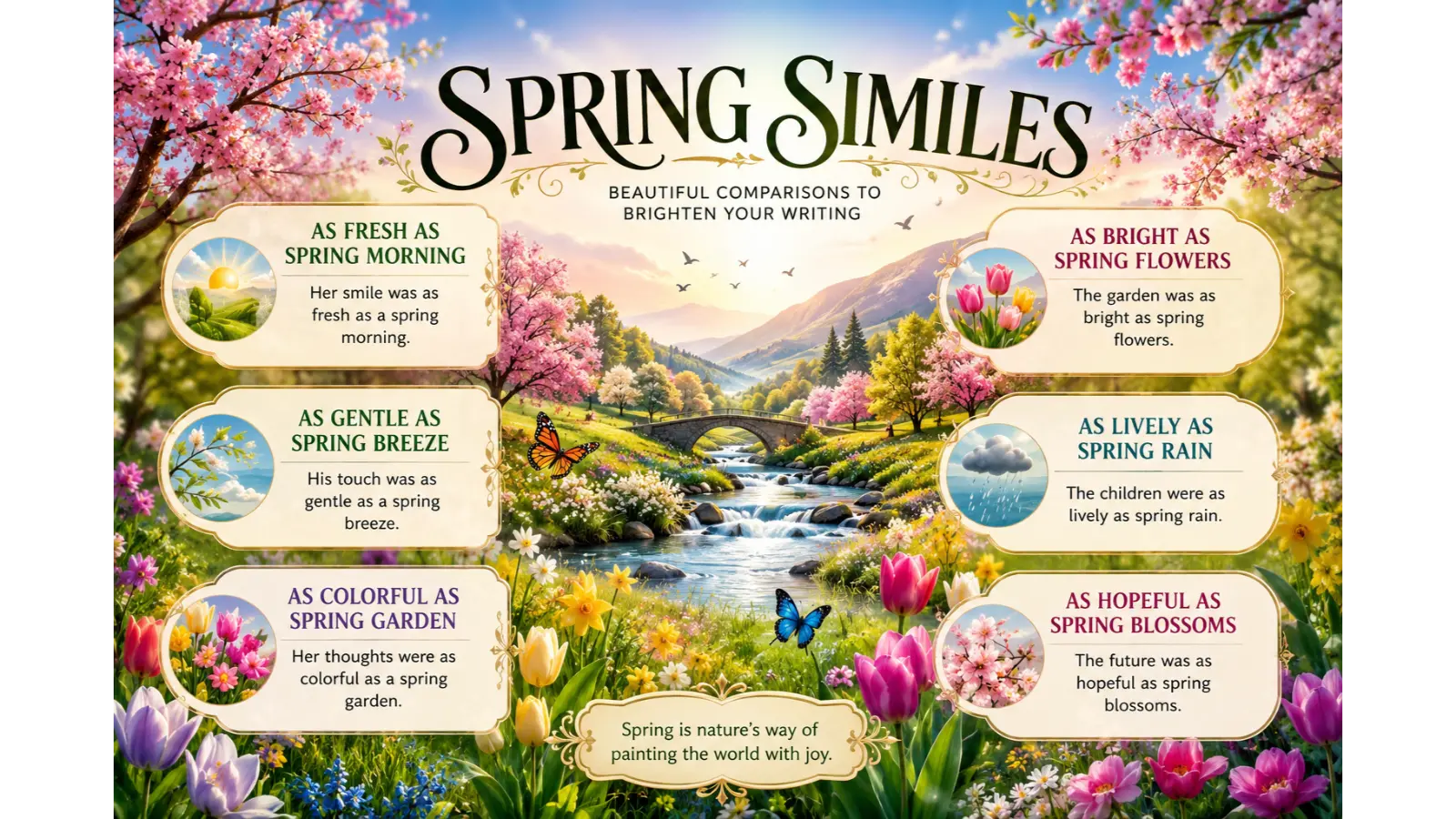
Spring has inspired writers for centuries because it represents renewal, color, hope, and change. One of the easiest ways to capture those feelings is through similes. A well-crafted simile paints a clear picture by comparing one thing to another using like or as. Whether you’re writing a poem, a short story, a school assignment, or simply trying to make everyday descriptions more engaging, spring similes can help your words feel more alive. In this guide, you’ll discover original spring similes, learn why they work, see them in different contexts, and practice creating your own memorable comparisons.
Quick Answer
A spring simile compares something to an aspect of spring using words such as like or as. These comparisons create vivid imagery, express emotions naturally, and help readers experience scenes more clearly. Effective spring similes often draw inspiration from blossoms, fresh rain, birds, sunshine, new leaves, gentle breezes, and the feeling of new beginnings.
Why Writers Love Spring Similes
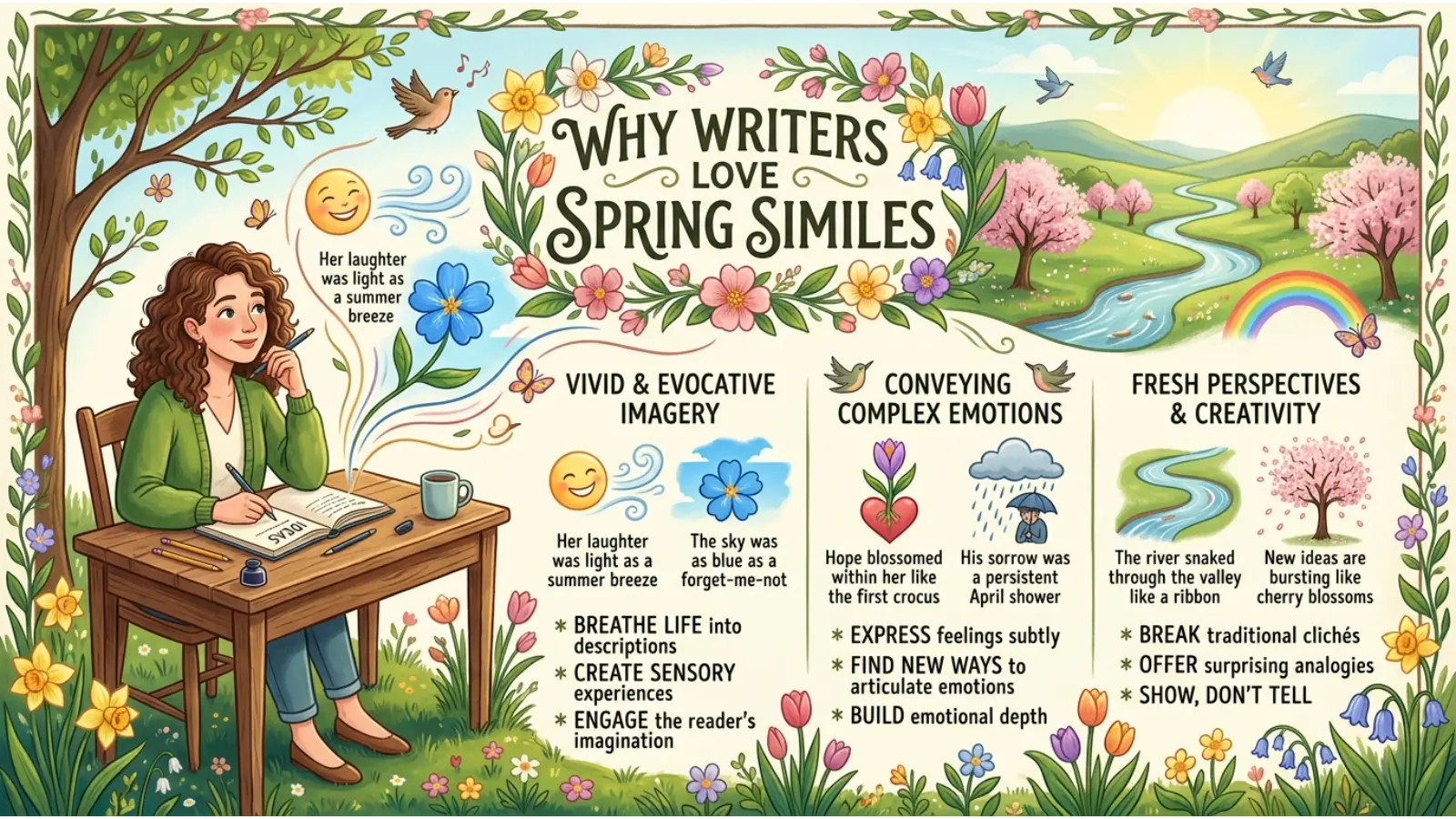
Spring naturally appeals to the senses.
Instead of simply saying someone looks happy, a writer might compare their smile to the first blossom after winter. Instead of describing a peaceful afternoon, they might compare it to a quiet spring meadow.
These comparisons make writing more memorable because readers connect emotionally with familiar seasonal experiences.
Spring similes are especially useful in:
- Poetry
- Fiction
- Children’s writing
- Personal essays
- Nature descriptions
- Speeches
- Greeting cards
- Journals
30 Original Spring Similes
1. As hopeful as the first blossom on a bare branch
Meaning
Represents optimism after difficult times.
Examples
- She felt as hopeful as the first blossom on a bare branch.
- His smile returned, as hopeful as the season’s first flower.
Writing Tip
Use after moments of struggle or change.
Best Context
Character growth and emotional recovery.
2. Like sunshine slipping through fresh leaves
Meaning
Gentle warmth and quiet happiness.
Examples
- Her laughter spread like sunshine slipping through fresh leaves.
- His kindness arrived like sunshine through young trees.
Poetry Example
Hope drifted like sunshine slipping through fresh leaves.
3. As gentle as a spring breeze across wildflowers
Meaning
Softness and calm.
Examples
- Her voice was as gentle as a spring breeze across wildflowers.
- The teacher spoke with gentle encouragement.
Conversation
“She was surprisingly gentle today.”
4. Like rain waking a sleeping garden
Meaning
Bringing new energy.
Examples
- His advice was like rain waking a sleeping garden.
- The good news revived the team.
Writing Purpose
Perfect for transformation scenes.
5. As colorful as a hillside in bloom
Meaning
Full of life and excitement.
Examples
- The festival was as colorful as a hillside in bloom.
- Her imagination painted colorful ideas.
6. Like birds returning at sunrise
Meaning
A joyful return.
Examples
- Friends gathered like birds returning at sunrise.
- Hope returned quietly.
7. As refreshing as morning dew
Meaning
Fresh and uplifting.
Examples
- The vacation felt as refreshing as morning dew.
- His ideas were surprisingly fresh.
8. Like petals dancing in the wind
Meaning
Graceful movement.
Examples
- She twirled like petals dancing in the wind.
- The dancers moved beautifully.
9. As bright as a field of tulips
Meaning
Cheerful and energetic.
Examples
- Her artwork looked as bright as a field of tulips.
- The classroom felt lively.
10. Like a robin greeting the dawn
Meaning
Optimistic beginnings.
Examples
- He greeted every morning like a robin greeting the dawn.
- She started the project eagerly.
11. As lively as bees among blossoms
Meaning
Busy and energetic.
Examples
- The playground was as lively as bees among blossoms.
- Everyone prepared for the celebration.
12. Like green leaves unfolding after rain
Meaning
Steady personal growth.
Examples
- Her confidence grew like green leaves unfolding after rain.
- The young company improved every month.
13. As peaceful as a quiet spring pond
Meaning
Complete calm.
Examples
- His expression was as peaceful as a quiet spring pond.
- The countryside felt wonderfully calm.
14. Like butterflies finding flowers
Meaning
Natural attraction.
Examples
- Children explored the garden like butterflies finding flowers.
- Visitors wandered with curiosity.
15. As light as floating dandelion seeds
Meaning
Weightless and carefree.
Examples
- Her worries drifted away.
- His footsteps felt effortless.
16. Like a rainbow after gentle rain
Meaning
Hope after hardship.
Examples
- Their friendship returned like a rainbow after gentle rain.
- Better days finally arrived.
17. As cheerful as birds after sunrise
Meaning
Bright happiness.
Examples
- The children sounded as cheerful as birds after sunrise.
- She entered the room smiling.
18. Like fresh grass after rainfall
Meaning
New beginnings.
Examples
- His confidence grew like fresh grass after rainfall.
- The neighborhood felt renewed.
19. As fresh as an orchard at dawn
Meaning
Clean and vibrant.
Examples
- The air smelled as fresh as an orchard at dawn.
- Her ideas felt original.
20. Like cherry blossoms greeting the sky
Meaning
Elegant beauty.
Examples
- The decorations stretched like cherry blossoms greeting the sky.
- Her dress flowed beautifully.
21. As playful as lambs in a meadow
Meaning
Carefree joy.
Examples
- The puppies were as playful as lambs in a meadow.
- The children laughed nonstop.
22. Like tiny buds reaching for sunlight
Meaning
Growing potential.
Examples
- Young writers improve like tiny buds reaching for sunlight.
- Confidence developed slowly.
23. As warm as afternoon sunshine in April
Meaning
Comfort and kindness.
Examples
- His welcome felt as warm as afternoon sunshine in April.
- The family created a comforting atmosphere.
24. Like vines climbing toward the light
Meaning
Determination.
Examples
- She pursued success like vines climbing toward the light.
- The athlete never stopped improving.
25. As sweet as blooming apple trees
Meaning
Gentle affection.
Examples
- Her compliment was as sweet as blooming apple trees.
- The letter carried warmth.
26. Like a brook singing after winter
Meaning
Renewed energy.
Examples
- The town felt alive like a brook singing after winter.
- Conversation flowed naturally.
27. As bright as daffodils beneath blue skies
Meaning
Pure optimism.
Examples
- His future looked as bright as daffodils beneath blue skies.
- Their celebration felt joyful.
28. Like a garden opening at sunrise
Meaning
Gradual awakening.
Examples
- Her creativity unfolded like a garden opening at sunrise.
- The city slowly came alive.
29. As calm as blossoms resting after rain
Meaning
Peace after challenges.
Examples
- She became as calm as blossoms resting after rain.
- The classroom finally settled.
30. Like spring painting the world again
Meaning
Complete renewal.
Examples
- The renovation transformed the house like spring painting the world again.
- His outlook completely changed.
Storytelling Example
The village awakened like spring painting the world again, every window glowing with fresh hope.
What Makes a Spring Simile Effective?
The strongest spring similes do more than mention flowers or sunshine.
They connect an emotion with a familiar spring experience.
Instead of comparing something only because it sounds pleasant, ask yourself:
- What feeling does this season create?
- Which spring image matches that feeling?
- Will readers instantly picture the comparison?
Specific images almost always create stronger writing than vague ones.
Related Literary Devices
Metaphor
A metaphor compares two things without using like or as.
Simile: Her smile was like spring sunshine.
Metaphor: Her smile was spring sunshine.
Imagery
Spring similes naturally strengthen imagery by helping readers see, hear, smell, and feel a scene.
Personification
You can combine personification with similes.
Example:
“The breeze danced like an excited child.”
Symbolism
Spring often symbolizes:
- Hope
- Growth
- Renewal
- Healing
- New opportunities
A spring simile can reinforce these deeper meanings without explaining them directly.
How to Create Your Own Spring Similes
Creating original similes becomes easier with practice.
Step 1
Choose one spring image.
Examples:
- Blossom
- Rain
- Robin
- Breeze
- Butterfly
- Green leaves
- Morning sunlight
Step 2
Choose an emotion.
Examples:
- Joy
- Peace
- Excitement
- Hope
- Love
- Curiosity
Step 3
Ask what the spring image naturally suggests.
A butterfly suggests freedom.
Fresh rain suggests renewal.
New leaves suggest growth.
Step 4
Combine them naturally.
Instead of copying familiar comparisons, build your own.
Exercise
Write three similes describing:
- A happy child
- A peaceful morning
- Someone overcoming failure
Focus on fresh images rather than familiar sayings.
Common Mistakes to Avoid
Using Overused Comparisons
Readers remember fresh ideas more than familiar ones.
Instead of relying on common phrases, look for specific spring details.
Mixing Images
Avoid combining unrelated comparisons.
Keep one clear picture throughout a sentence.
Forgetting the Emotion
Every simile should strengthen the feeling, not simply decorate the sentence.
Confusing Similes with Metaphors
Remember:
- Similes use like or as.
- Metaphors compare directly.
Choosing Comparisons That Don’t Fit
A dramatic comparison can weaken gentle writing if it doesn’t match the mood.
Always consider tone.
Frequently Asked Questions
What is a spring simile?
A spring simile compares something to an aspect of spring using like or as to create vivid imagery.
Why are spring similes popular in poetry?
Because spring naturally represents growth, beauty, hope, and renewal, making emotional descriptions more powerful.
Can children use spring similes?
Yes. Spring similes are excellent classroom exercises because students easily recognize seasonal images.
What’s the difference between a spring simile and a metaphor?
A simile uses like or as, while a metaphor makes the comparison directly.
How can I write more original spring similes?
Observe nature closely, focus on specific details, and connect them to genuine emotions instead of repeating familiar comparisons.
Should every spring simile mention flowers?
No. Rain, birds, breezes, budding trees, streams, insects, sunlight, and fresh grass can all inspire effective spring similes.
Conclusion
Spring offers endless inspiration because it speaks to fresh starts, quiet beauty, and steady growth. A thoughtful simile transforms ordinary descriptions into memorable images that readers can immediately picture and feel. As you practice writing, look beyond the obvious comparisons. Notice how light falls through new leaves, how rain changes the air, or how birds announce a new morning. Those small observations often lead to the most original similes. With regular practice, you’ll develop comparisons that sound authentic, enrich your storytelling, and make every piece of writing bloom with vivid imagery.

I am Helena Frost, a writer captivated by the beauty of language and the art of comparison. Through my words, I explore the world by turning ordinary moments into vivid similes and reflections. I enjoy crafting phrases that spark imagination, evoke emotion, and linger in the mind. My writing celebrates the subtle connections between people, nature, and the stories we live. For me, every sentence is an opportunity to reveal the extraordinary in the everyday.