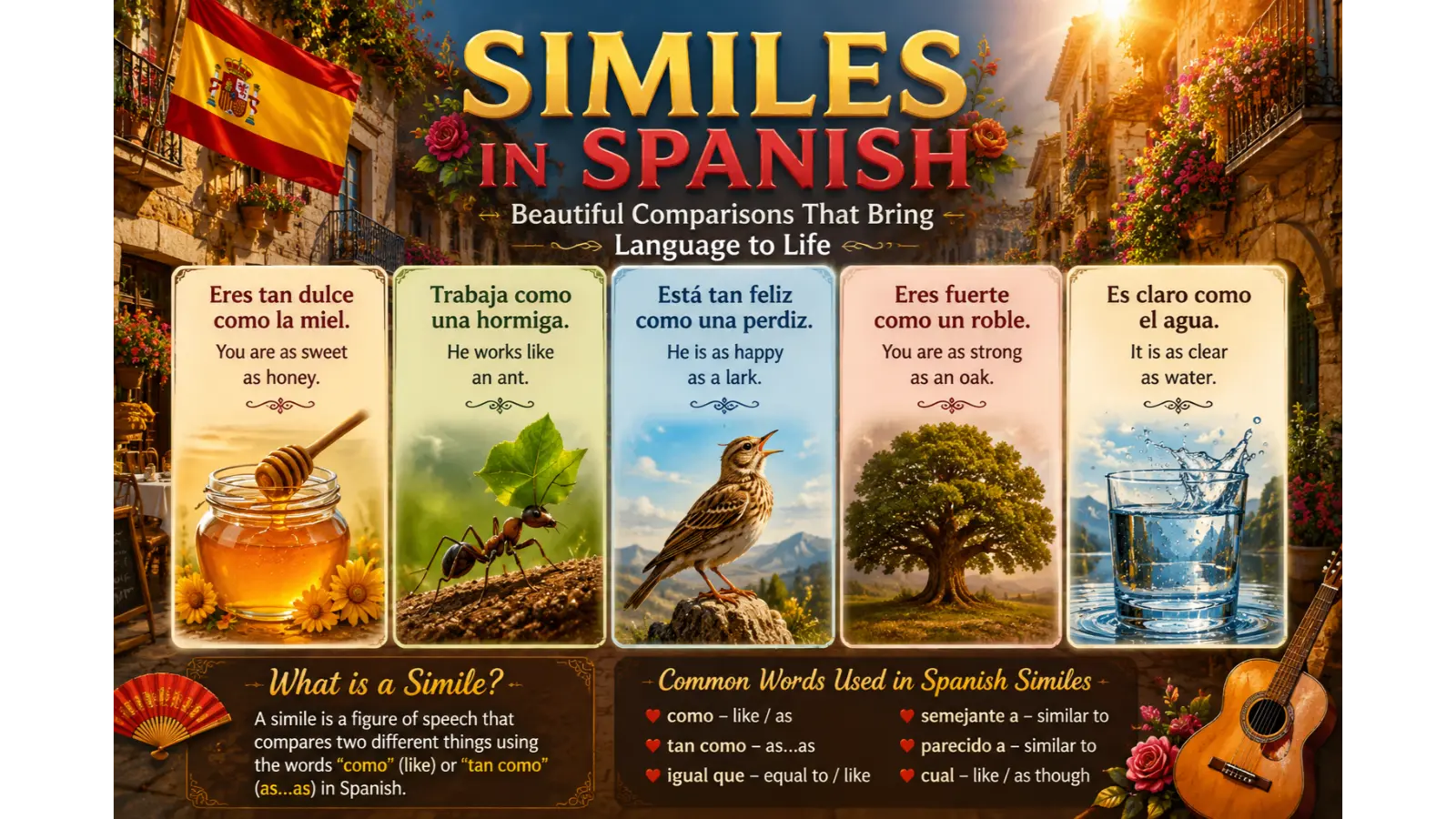
Language becomes memorable when it paints pictures in the reader’s mind. One of the easiest ways to create those pictures is through similes. Whether you’re learning Spanish, writing a story, composing poetry, or simply improving your conversation skills, understanding similes in Spanish helps your words become more expressive and engaging. A simile compares two different things using words such as como (“like” or “as”) in Spanish. These comparisons help explain emotions, appearances, actions, and experiences in ways that feel vivid and relatable. This guide explores original Spanish similes, explains why they work, and shows how to use them naturally in different kinds of writing.
Quick Answer
Similes in Spanish are comparisons that usually use the word como (“like” or “as”) to describe something more vividly. They appear in everyday conversation, literature, poetry, songs, and storytelling because they help readers and listeners imagine ideas more clearly.
Why Spanish Similes Make Writing More Expressive
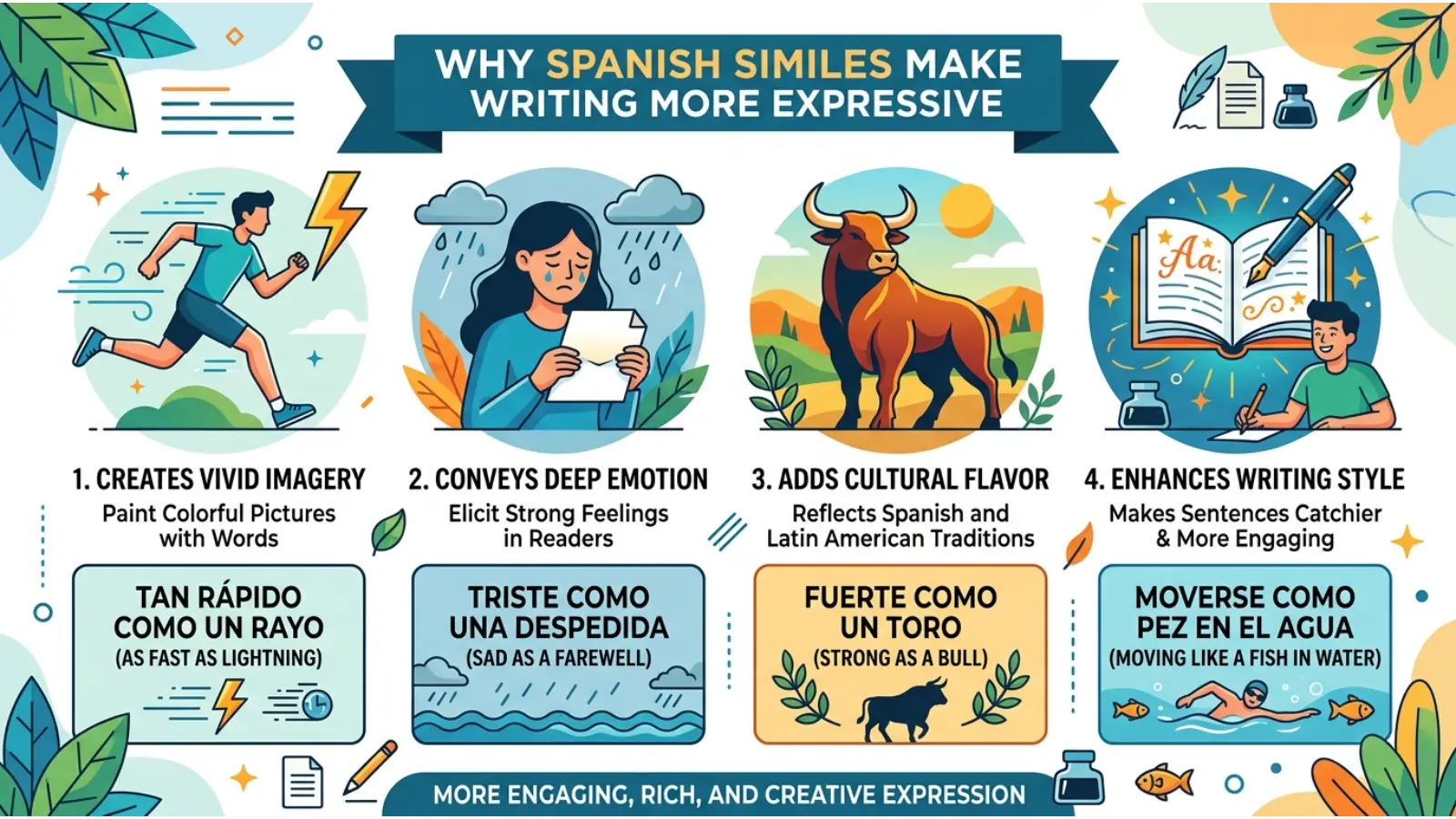
Spanish is naturally descriptive. Similes add color without making sentences complicated.
Writers use them to:
- Describe emotions
- Create memorable characters
- Build stronger imagery
- Add humor
- Make conversations sound more natural
- Bring poetry and stories to life
Instead of saying someone is nervous, a simile lets readers feel that nervousness.
30 Original Similes in Spanish
1. Brilla como una ventana después de la lluvia.
Meaning: Someone shines with freshness and positivity.
Examples
- Su sonrisa brilla como una ventana después de la lluvia.
- El salón brillaba como una ventana después de la lluvia.
Writing Effect
Creates an image of cleanliness, hope, and renewal.
Best Used For
Positive descriptions, happy endings, uplifting scenes.
2. Corre como el viento buscando su hogar.
Meaning
Running with purpose rather than speed alone.
Examples
- El niño corría como el viento buscando su hogar.
- El atleta avanzó como el viento buscando su hogar.
Writing Tip
Purpose often creates stronger imagery than simply describing speed.
3. Habla como un río tranquilo.
Meaning
Someone speaks smoothly and calmly.
Examples
- Ella habla como un río tranquilo.
- El maestro explicó la lección como un río tranquilo.
Works Best In
Dialogue and character descriptions.
4. Fuerte como un árbol en invierno.
Meaning
Quiet resilience during difficult times.
Examples
- Permaneció fuerte como un árbol en invierno.
- Mi abuela era fuerte como un árbol en invierno.
Emotional Effect
Determination and endurance.
5. Ligero como una hoja que aprende a volar.
Meaning
Feeling free and relaxed.
Examples
- Caminaba ligero como una hoja que aprende a volar.
- Después de las vacaciones me sentía ligero como una hoja que aprende a volar.
6. Silencioso como una estrella al amanecer.
Meaning
Extremely quiet.
Conversation
La habitación estaba silenciosa como una estrella al amanecer.
Storytelling
The comparison creates peaceful atmosphere.
7. Valiente como una pequeña llama contra la oscuridad.
Meaning
Courage despite fear.
Examples
- Era valiente como una pequeña llama contra la oscuridad.
- El niño enfrentó el reto como una pequeña llama contra la oscuridad.
8. Feliz como un jardín después de la primavera.
Meaning
Overflowing with joy.
Writing Purpose
Perfect for cheerful descriptions.
9. Paciente como la luna esperando la noche.
Meaning
Great patience.
Formal Example
El investigador fue paciente como la luna esperando la noche.
10. Claro como el primer rayo del día.
Meaning
Easy to understand.
Conversation
Tu explicación fue clara como el primer rayo del día.
11. Su risa saltó como una chispa alegre.
Meaning: Bright, energetic laughter.
Examples:
- Su risa saltó como una chispa alegre.
- Los niños reían como chispas alegres.
12. Frío como la sombra de una montaña.
Meaning: Calm, distant, or physically cold.
Best Context: Nature writing.
13. Su voz flotaba como una pluma sobre el agua.
Meaning: Soft, gentle speech.
Poetry Example:
Su voz flotaba como una pluma sobre el agua mientras el pueblo dormía.
14. Curioso como un gato frente a una puerta nueva.
Meaning: Deep curiosity.
Writing Tip:
Specific situations often make similes more memorable.
15. Brillante como una moneda bajo el sol.
Meaning: Highly noticeable.
Works well for descriptions of eyes, ideas, or objects.
16. Contento como un viajero viendo el mar.
Meaning: Genuine happiness after effort.
17. Rápido como una sombra al atardecer.
Meaning: Fast and nearly impossible to catch.
18. Su esperanza crecía como flores después de la lluvia.
Meaning: Hope returning.
Excellent for emotional storytelling.
19. Su imaginación volaba como un cometa libre.
Meaning: Rich creativity.
Useful in educational writing.
20. Tranquilo como una biblioteca al amanecer.
Meaning: Complete peace.
Conversation:
Estoy tranquilo como una biblioteca al amanecer.
21. Firme como un puente antiguo.
Meaning: Reliable and dependable.
22. Su mirada era como una ventana abierta al cielo.
Meaning: Honest and welcoming.
23. Su corazón latía como un tambor lejano.
Meaning: Nervous anticipation.
24. Brincaba como una gota sobre el río.
Meaning: Playful movement.
25. Creativo como un pintor descubriendo nuevos colores.
Meaning: Innovative thinking.
26. Su memoria era como un mapa lleno de caminos.
Meaning: Excellent memory.
27. Ligero como el perfume de una flor.
Meaning: Delicate presence.
28. Sonreía como el sol entrando por una ventana.
Meaning: Warm and comforting.
29. Su paciencia era como un reloj que nunca se apresura.
Meaning: Endless patience.
30. Su sueño crecía como un árbol junto al río.
Meaning: Dreams becoming stronger over time.
Perfect for motivational stories.
How Great Writers Build Better Similes
Professional writers rarely choose the first comparison that comes to mind. Instead, they ask:
- What emotion should the reader feel?
- Which image is unexpected but believable?
- Does the comparison reveal something new?
The strongest similes don’t simply decorate writing—they deepen understanding.
Instead of comparing speed to lightning for the hundredth time, compare it to something readers haven’t imagined before while keeping the image clear.
How to Create Your Own Spanish Similes
Creating original similes becomes easier with practice.
Step 1
Choose the thing you want to describe.
Example:
- Happiness
- Fear
- Rain
- Friendship
Step 2
Think about an object from nature, daily life, or culture that shares the same quality.
Step 3
Join them using como.
Example:
Emotion:
Calm
Comparison:
A quiet lake
Final simile:
Tranquilo como un lago sin viento.
Exercise
Write one simile for each word:
- Hope
- Courage
- Curiosity
- Love
- Winter
Try avoiding comparisons you’ve heard before.
Related Literary Devices
Metaphor
A metaphor makes a direct comparison without using como.
- Simile: Fuerte como un árbol.
- Metaphor: Es un árbol.
Imagery
Imagery appeals to the senses. Similes often strengthen imagery by giving readers a clear mental picture.
Personification
Personification gives human qualities to non-human things.
Example:
El viento cantaba.
Combining personification with similes can make descriptions even richer.
Hyperbole
Hyperbole intentionally exaggerates.
A simile may include exaggeration, but its primary purpose is comparison rather than overstatement.
Symbolism
Objects such as rivers, stars, trees, or birds often symbolize larger ideas. Using symbolic images inside similes adds emotional depth.
Common Mistakes When Writing Spanish Similes
Using Overused Comparisons
Readers remember fresh imagery more than familiar phrases.
Mixing Unrelated Images
Avoid combining different pictures that confuse the reader.
Poor example:
Como una nube de hierro bailando en el océano.
The images don’t naturally fit together.
Confusing Similes with Metaphors
A simile normally includes como, while a metaphor makes the comparison directly.
Adding Similes Everywhere
Not every sentence needs one. Strategic use creates greater impact.
Forgetting the Context
A poetic simile may sound out of place in formal business writing. Match your comparison to your audience.
Frequently Asked Questions
What is a simile in Spanish?
A simile compares two things using como (“like” or “as”) to make descriptions more vivid.
Why are similes important in Spanish writing?
They improve clarity, creativity, and emotional impact while helping readers visualize ideas.
Are similes common in everyday Spanish?
Yes. Native speakers use simple comparisons in conversation, while authors and poets often create more imaginative ones.
Can beginners use Spanish similes?
Absolutely. Even simple comparisons can make writing more expressive and enjoyable.
What’s the difference between a simile and a metaphor in Spanish?
A simile uses como to compare two things. A metaphor states that one thing is another without using a comparison word.
How can I write original Spanish similes?
Observe everyday life, focus on a single quality, and compare it with an unexpected but believable image instead of relying on familiar expressions.
Do similes work in poetry and stories?
Yes. They are widely used in poems, novels, speeches, songs, and personal writing because they create memorable imagery.
Conclusion
Learning similes in Spanish is about more than expanding your vocabulary—it’s about learning to see the world through fresh comparisons. A well-crafted simile can turn an ordinary sentence into one that readers remember long after they’ve finished reading. As you practice, look beyond familiar expressions. Notice nature, daily routines, emotions, and small moments that others might overlook. Those observations often become the foundation of your most original comparisons. With time, your Spanish writing will become clearer, more imaginative, and far more engaging for every reader.

I am Helena Frost, a writer captivated by the beauty of language and the art of comparison. Through my words, I explore the world by turning ordinary moments into vivid similes and reflections. I enjoy crafting phrases that spark imagination, evoke emotion, and linger in the mind. My writing celebrates the subtle connections between people, nature, and the stories we live. For me, every sentence is an opportunity to reveal the extraordinary in the everyday.