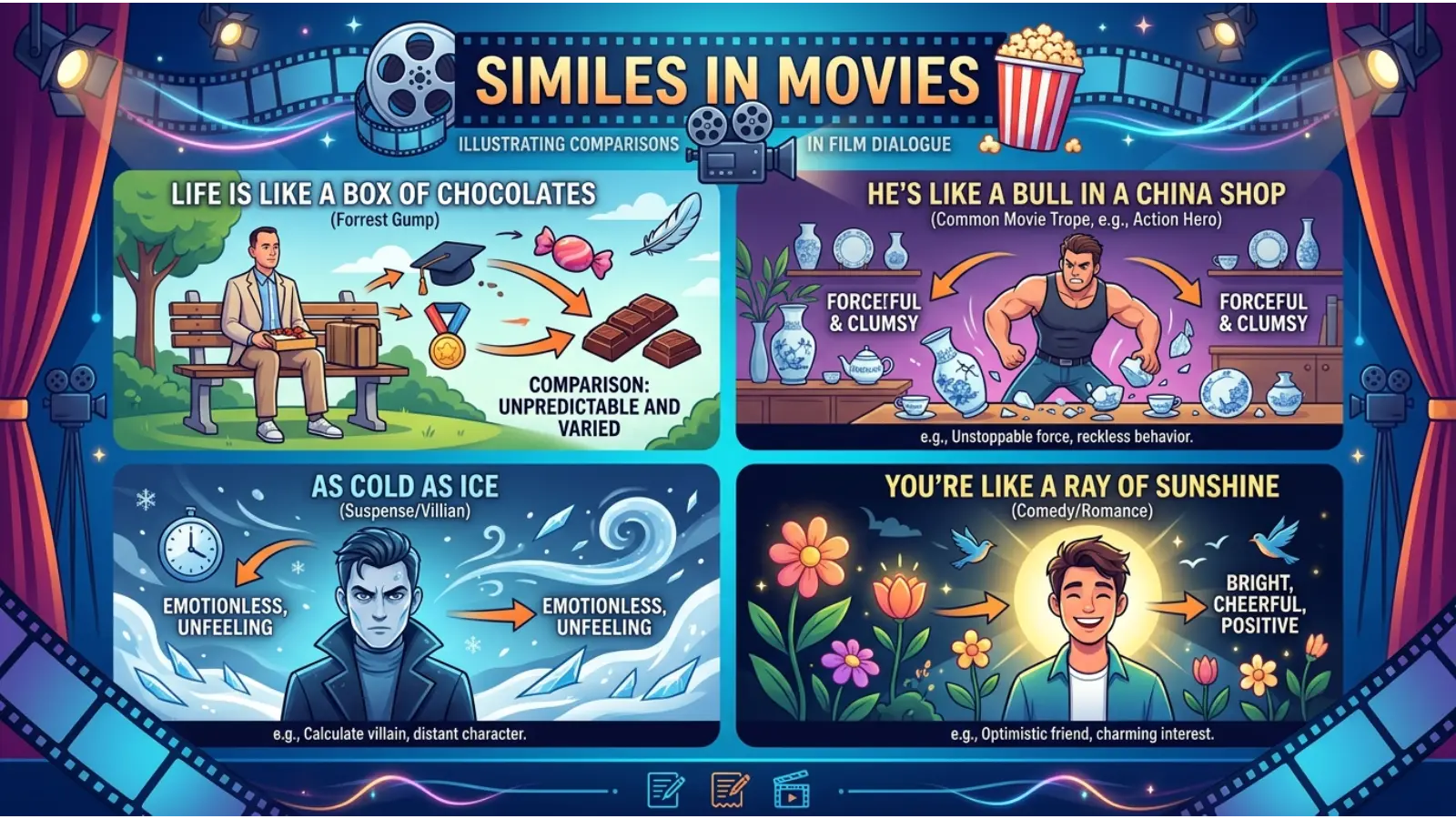
Movies tell stories through visuals, emotions, and memorable dialogue. One of the simplest ways to make a scene more powerful is by using a simile. A well-crafted simile helps readers and viewers picture a moment more clearly by comparing one thing to another using “like” or “as.” Whether you’re writing a screenplay, reviewing a film, creating fan fiction, or simply improving your creative writing, learning how to use similes in movies can make your descriptions feel more cinematic and engaging. In this guide, you’ll discover fresh, original movie-inspired similes, learn why they work, and find practical techniques for creating your own.
What Are Similes in Movies?
A movie simile is a comparison that helps describe a character, action, setting, emotion, or scene by relating it to something familiar.
For example:
- “The city lights shimmered like scattered diamonds.”
- “The villain smiled as calmly as still water hiding deep currents.”
These comparisons help audiences visualize scenes while adding emotion and personality.
Why Writers Use Similes in Movies
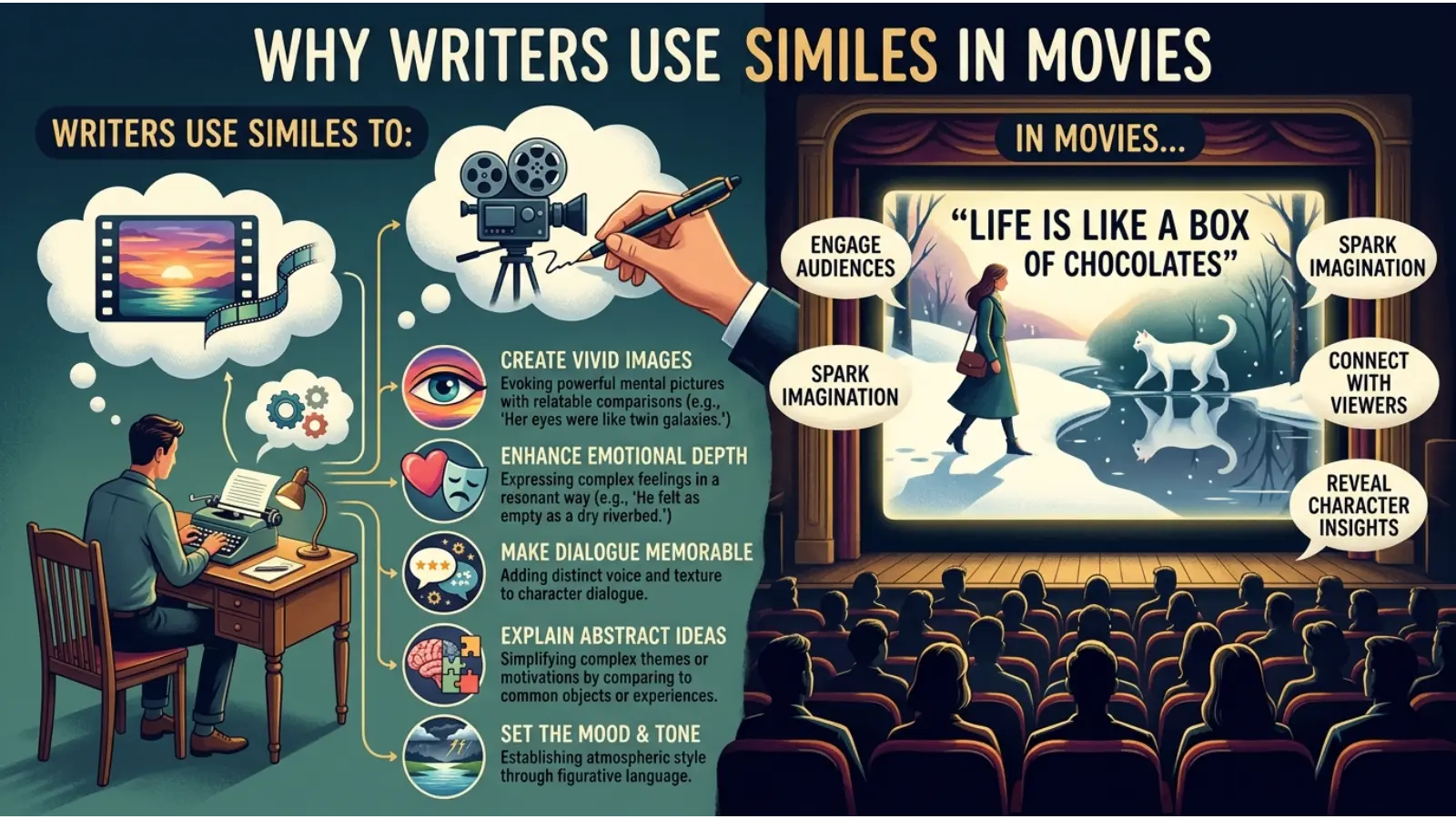
Film stories move quickly. A good simile lets writers communicate emotion and imagery in just a few words.
Movie similes can:
- Build atmosphere.
- Reveal character emotions.
- Increase suspense.
- Make action scenes more memorable.
- Create stronger visual imagery.
- Help readers imagine scenes like a film director.
The strongest comparisons feel natural rather than forced.
30 Original Similes in Movies
1. Like a projector painting dreams onto a wall
Meaning: Something transforms imagination into reality.
Examples
- Her memories unfolded like a projector painting dreams onto a wall.
- The opening scene felt like a projector painting dreams onto a wall.
Best for: Nostalgic storytelling, cinema writing.
Writing Tip: Use when describing vivid memories or imaginative scenes.
2. As silent as an empty theater before the curtain rises
Meaning: Complete silence filled with anticipation.
Examples
- The hallway was as silent as an empty theater before the curtain rises.
- Everyone waited as silent as an empty theater.
Emotional Effect: Suspense.
3. Like popcorn bursting in a hot pan
Meaning: Fast, energetic movement.
Examples
- Ideas popped like popcorn bursting in a hot pan.
- The crowd laughed like popcorn bursting in a hot pan.
Storytelling Use: Comedy scenes.
4. As bright as a movie premiere spotlight
Meaning: Extremely noticeable.
Examples
- Her smile was as bright as a movie premiere spotlight.
- The stage glowed as bright as a movie premiere spotlight.
5. Like film reels spinning through time
Meaning: Memories returning rapidly.
Examples
- Childhood flashed like film reels spinning through time.
- His thoughts raced like film reels.
6. As dramatic as the final scene before the credits
Meaning: Highly emotional.
Examples
- Their goodbye was as dramatic as the final scene before the credits.
- His speech felt as dramatic as a movie ending.
7. Like thunder behind a soundtrack
Meaning: Hidden danger approaching.
Examples
- Trouble rolled in like thunder behind a soundtrack.
- Fear arrived quietly like thunder behind music.
8. As smooth as a perfectly edited scene
Meaning: Seamless and effortless.
Examples
- The transition felt as smooth as a perfectly edited scene.
- Her presentation flowed beautifully.
9. Like shadows dancing across a movie screen
Meaning: Mysterious movement.
Examples
- Figures moved like shadows dancing across a movie screen.
- Clouds drifted like movie shadows.
10. As unforgettable as a film’s final line
Meaning: Deeply memorable.
Examples
- His promise became unforgettable.
- That moment stayed with me forever.
11. Like a camera finding perfect focus
Meaning: Gaining clarity.
Examples
- Everything became clear like a camera finding perfect focus.
- Her goals sharpened instantly.
12. As tense as a countdown before the climax
Meaning: Filled with suspense.
Examples
- The room felt as tense as a countdown before the climax.
- Everyone waited without speaking.
13. Like music swelling before a surprise
Meaning: Growing excitement.
Examples
- Hope rose like music swelling before a surprise.
- Excitement filled the room.
14. As colorful as a fantasy adventure
Meaning: Rich in imagination.
Examples
- The festival looked as colorful as a fantasy adventure.
- Her artwork felt magical.
15. Like a hero stepping into the light
Meaning: Showing courage.
Examples
- She walked forward like a hero stepping into the light.
- Confidence replaced fear.
16. As mysterious as an unopened script
Meaning: Full of unknown possibilities.
Examples
- The future felt as mysterious as an unopened script.
- Every day brought a new surprise.
17. Like a villain hiding behind a smile
Meaning: Deceptively friendly.
Examples
- His words felt like a villain hiding behind a smile.
- The offer seemed suspicious.
18. As quick as a jump cut
Meaning: Extremely fast.
Examples
- Time passed as quick as a jump cut.
- The mood changed instantly.
19. Like stars appearing after the credits
Meaning: Beauty arriving unexpectedly.
Examples
- Hope returned like stars appearing after the credits.
- Joy arrived quietly.
20. As bold as the opening scene
Meaning: Strong first impression.
Examples
- Her introduction was as bold as the opening scene.
- The design grabbed attention.
21. Like laughter echoing through a comedy theater
Meaning: Joy spreading widely.
Examples
- Happiness spread like laughter echoing through a comedy theater.
- The joke reached everyone.
22. As steady as a director calling “Action”
Meaning: Calm leadership.
Examples
- He stayed as steady as a director calling “Action.”
- She handled pressure confidently.
23. Like a soundtrack lifting every emotion
Meaning: Intensifying feelings.
Examples
- Her words lifted spirits like a soundtrack lifting every emotion.
- The speech inspired everyone.
24. As gripping as the final chase
Meaning: Impossible to ignore.
Examples
- The novel became as gripping as the final chase.
- The conversation held everyone’s attention.
25. Like lights fading before the first scene
Meaning: Quiet anticipation.
Examples
- The room settled like lights fading before the first scene.
- Excitement turned into silence.
26. As clear as subtitles on a quiet screen
Meaning: Easy to understand.
Examples
- His explanation was as clear as subtitles on a quiet screen.
- The instructions were simple.
27. Like a surprise twist changing everything
Meaning: Unexpected transformation.
Examples
- The news arrived like a surprise twist changing everything.
- Life shifted overnight.
28. As powerful as a standing ovation
Meaning: Inspiring and emotional.
Examples
- Her performance felt as powerful as a standing ovation.
- The speech moved the audience.
29. Like a slow-motion victory
Meaning: A deeply satisfying success.
Examples
- Graduation felt like a slow-motion victory.
- The final goal seemed unforgettable.
30. As timeless as a classic movie
Meaning: Never losing value.
Examples
- Their friendship remained as timeless as a classic movie.
- Great stories never fade.
What Makes a Movie Simile Effective?
Strong movie similes share several qualities:
- They create a clear mental image.
- They fit the mood of the scene.
- They avoid exaggerated comparisons that distract readers.
- They feel fresh instead of relying on familiar clichés.
- They support the story instead of interrupting it.
Before adding a simile, ask yourself whether it helps the reader see or feel something more vividly.
Related Literary Devices
Metaphor
A metaphor compares two things directly without using “like” or “as.”
Simile: The hallway was like a maze.
Metaphor: The hallway was a maze.
Imagery
Imagery appeals to the senses through descriptive language. Similes are one of the easiest ways to create vivid imagery in movie-inspired writing.
Personification
Personification gives human qualities to non-human things.
Example:
“The city whispered through the rain.”
Combining personification with a carefully chosen simile can create memorable scenes.
Symbolism
Movies often use objects, colors, or places to represent deeper meanings. A thoughtful simile can reinforce those symbols without explaining them directly.
How to Create Your Own Movie Similes
Follow these steps:
- Picture the scene in your mind.
- Identify the strongest emotion.
- Think of a familiar object, action, or setting that matches that feeling.
- Connect the two with like or as.
- Read the sentence aloud. If it sounds forced, simplify it.
Practice Exercise
Describe each of these using an original simile:
- A mysterious stranger
- A crowded city street
- A superhero arriving
- A heartbreaking goodbye
- A magical forest
- A suspenseful chase scene
Challenge yourself to avoid comparisons you’ve heard before.
Common Mistakes to Avoid
Using Overused Comparisons
Phrases like “as busy as a bee” or “as brave as a lion” rarely surprise readers. Look for fresh, believable comparisons instead.
Mixing Imagery
Avoid combining unrelated images in the same sentence. A scene should feel consistent rather than confusing.
Forcing Similes
Not every sentence needs a comparison. Use similes where they add meaning or emotion.
Confusing Similes with Metaphors
Remember that similes use like or as, while metaphors make a direct comparison.
Choosing Weak Descriptions
If the comparison doesn’t make the image clearer, replace it with one that does.
Frequently Asked Questions
What are similes in movies?
They are comparisons using “like” or “as” that make scenes, characters, or emotions easier to imagine.
Why do screenwriters use similes?
They help communicate visual details and emotions quickly, making scenes more memorable.
Can similes improve film reviews?
Yes. Original similes make reviews more engaging and help readers picture your opinions.
Are similes only used in dialogue?
No. They can appear in screenplays, narration, descriptions, novels, and movie reviews.
How many similes should I use in one story?
Use only as many as naturally strengthen the writing. Quality matters more than quantity.
What’s the difference between a movie simile and a metaphor?
A simile compares using “like” or “as.” A metaphor says one thing is another without those words.
Conclusion
The best similes in movies don’t simply decorate a sentence—they help readers see, hear, and feel a scene more vividly. By choosing comparisons that match the mood, fit the characters, and avoid tired clichés, you can make your writing more cinematic and memorable. Practice observing films with a writer’s eye. Notice how lighting, sound, movement, and emotion work together, then transform those observations into your own original similes. With time, you’ll develop comparisons that feel fresh, natural, and uniquely yours.
I am Helena Frost, a writer captivated by the beauty of language and the art of comparison. Through my words, I explore the world by turning ordinary moments into vivid similes and reflections. I enjoy crafting phrases that spark imagination, evoke emotion, and linger in the mind. My writing celebrates the subtle connections between people, nature, and the stories we live. For me, every sentence is an opportunity to reveal the extraordinary in the everyday.