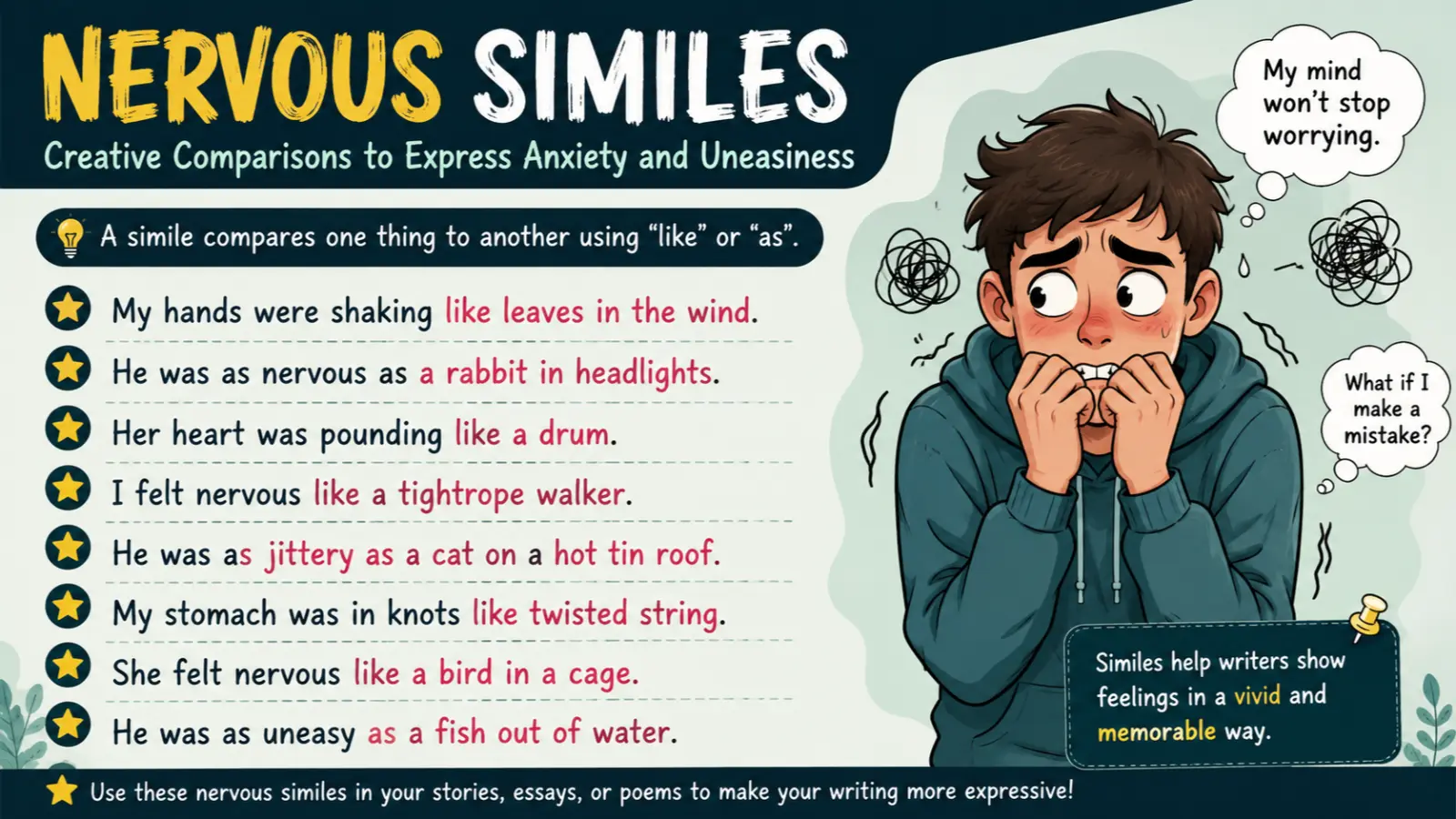
Every writer has faced the challenge of describing a nervous character without repeating words like worried, anxious, or afraid. That’s where nervous similes become valuable. They transform ordinary descriptions into memorable images that readers can instantly picture and feel. A simile compares two different things using “like” or “as.” Instead of simply telling readers someone is nervous, a simile helps them experience the emotion through vivid imagery. Whether you’re writing a novel, poem, speech, essay, or dialogue, this collection of original nervous similes will help you create stronger emotional scenes while improving your creative writing skills.
What Are Nervous Similes?
A nervous simile compares the feeling or appearance of nervousness to something familiar.
For example:
His thoughts scattered like birds startled from a tree.
Rather than saying someone felt nervous, the comparison paints a picture that readers immediately understand.
Good nervous similes often express:
- Fear
- Uneasiness
- Anticipation
- Tension
- Uncertainty
- Self-doubt
- Stage fright
- Excitement mixed with anxiety
Why Writers Use Nervous Similes
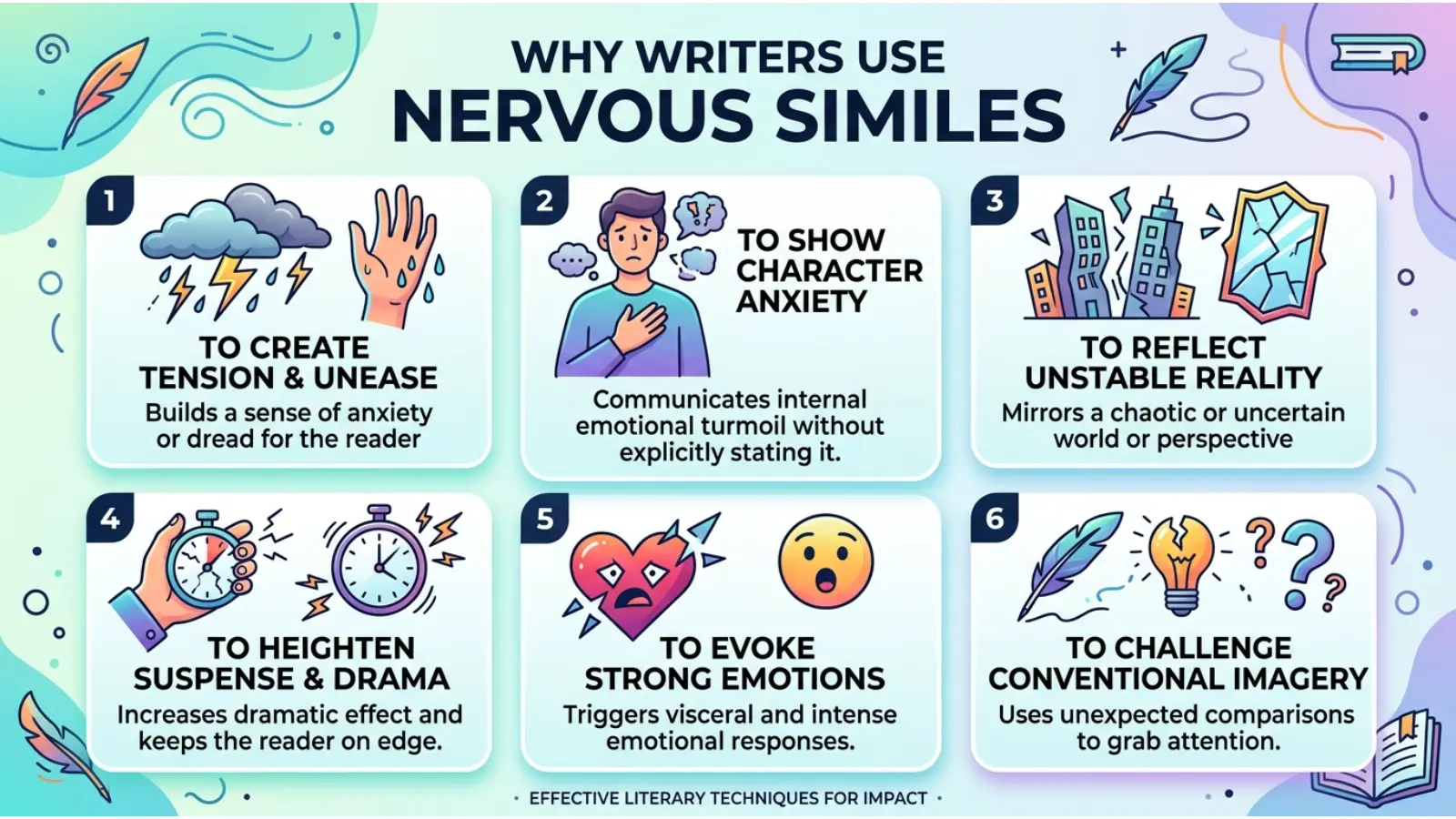
Strong similes do more than decorate sentences.
They help readers:
- Visualize emotions.
- Connect with characters.
- Build suspense.
- Remember important moments.
- Experience scenes instead of simply reading about them.
Professional writers rarely repeat “he was nervous” multiple times. Instead, they vary their descriptions using fresh comparisons.
35 Original Nervous Similes
1. As restless as a candle in a windy doorway
Meaning: Constantly unsettled.
Examples
- She stood as restless as a candle in a windy doorway before her interview.
- The child waited for the results, as restless as a candle in a windy doorway.
Writing Tip
Perfect for moments filled with uncertainty.
2. Like a bird searching for a safe branch during a storm
Meaning: Looking desperately for reassurance.
Examples
- His eyes moved like a bird searching for a safe branch during a storm.
- She glanced around like a bird searching for a safe branch.
Best Context
Stories involving fear or unfamiliar situations.
3. As shaky as morning dew on a blade of grass
Meaning
Physically trembling.
Examples
- His hands were as shaky as morning dew on a blade of grass.
- She signed the form with fingers as shaky as morning dew.
4. Like a violin string pulled too tightly
Meaning
Ready to snap under pressure.
Storytelling Example
The room grew silent while his nerves stretched like a violin string pulled too tightly.
5. As uncertain as footprints in fresh snow
Meaning
Unsure of the next step.
Conversation Example
“I feel as uncertain as footprints in fresh snow.”
6. Like leaves whispering before a storm
Meaning
Quiet anxiety building.
Poetry Example
Her heartbeat fluttered like leaves whispering before a storm.
7. As fragile as thin ice beneath careful footsteps
Meaning
Emotionally vulnerable.
Formal Example
The witness appeared as fragile as thin ice beneath careful footsteps.
8. Like a compass spinning without north
Meaning
Completely confused and anxious.
Examples
- His thoughts spun like a compass without north.
- She felt like a compass spinning without direction.
9. As tense as a drawn bow
Meaning
Prepared for something difficult.
Writing Purpose
Excellent for suspense scenes.
10. Like rain waiting inside dark clouds
Meaning
Anxiety ready to burst.
Example
His emotions gathered like rain waiting inside dark clouds.
11. As uneasy as a fox crossing an open field
Meaning
Feeling exposed.
12. Like paper caught in swirling wind
Meaning
Unable to stay calm.
13. As jumpy as a shadow at sunset
Meaning
Startling easily.
14. Like a clock ticking inside a silent room
Meaning
Growing tension.
15. As nervous as an unopened letter
Meaning
Fear of unknown news.
16. Like ripples spreading across still water
Meaning
Small worries growing larger.
17. As hesitant as a traveler at a broken bridge
Meaning
Unsure whether to continue.
18. Like a kite losing the wind
Meaning
Confidence fading.
19. As quiet as hidden thunder
Meaning
Anxiety beneath the surface.
20. Like sand slipping through open fingers
Meaning
Losing control.
21. As delicate as frost beneath the morning sun
Meaning
Emotionally vulnerable.
22. Like waves pressing against a cliff
Meaning
Relentless worry.
23. As cautious as a deer hearing distant footsteps
Meaning
Highly alert.
24. Like smoke searching for an escape
Meaning
Restless thoughts.
25. As tangled as vines after heavy rain
Meaning
Confused thinking.
26. Like a lantern flickering before dawn
Meaning
Hope mixed with uncertainty.
27. As stiff as frozen branches
Meaning
Paralyzed by nervousness.
28. Like clouds hiding the morning sun
Meaning
Worry covering confidence.
29. As impatient as water behind a dam
Meaning
Waiting under pressure.
30. Like a pebble skipping across deep water
Meaning
Unable to settle.
31. As breathless as the moment before applause
Meaning
Expecting judgment.
32. Like echoes inside an empty hallway
Meaning
Repeated anxious thoughts.
33. As careful as someone carrying a full glass across uneven ground
Meaning
Trying not to make mistakes.
34. Like stars hidden behind thick clouds
Meaning
Confidence temporarily concealed by fear.
35. As tightly wound as a spring before release
Meaning
Extreme tension waiting to explode.
Examples
- He sat as tightly wound as a spring before release.
- The athletes looked as tightly wound as springs before the race began.
How to Make Nervous Similes More Vivid
The strongest similes come from observation rather than imagination alone.
Instead of comparing nervousness to something generic, think about how nervous people actually behave.
Ask yourself:
- Do they shake?
- Do they avoid eye contact?
- Do they hesitate?
- Does their breathing change?
- Do they fidget?
Then compare those actions to something readers instantly recognize.
Specific images always create stronger writing than vague comparisons.
Why These Similes Work
Effective nervous similes succeed because they connect emotion with movement.
Notice how many examples involve:
- Wind
- Water
- Animals
- Weather
- Light
- Sound
- Balance
These natural elements already suggest instability, making the emotional connection feel believable rather than forced.
Related Literary Devices
Metaphor
A metaphor says something is another thing instead of using “like” or “as.”
Simile: Her thoughts scattered like autumn leaves.
Metaphor: Her thoughts became autumn leaves.
Imagery
Imagery appeals to the senses.
Adding sights, sounds, textures, or movement makes nervous scenes much stronger.
Personification
Personification gives human qualities to non-human things.
Example:
The hallway seemed to watch every nervous step.
Hyperbole
Hyperbole exaggerates for emphasis.
Example:
His heart felt loud enough to wake the whole city.
Symbolism
Objects can symbolize anxiety.
Examples include:
- Cracked glass
- Flickering lights
- Storm clouds
- Locked doors
- Empty chairs
How to Create Your Own Nervous Similes
Creating original similes is easier when you follow a simple process.
Step 1: Identify the emotion
Instead of just “nervous,” choose a more specific feeling.
Examples:
- Uneasy
- Overwhelmed
- Hesitant
- Apprehensive
- Panicked
Step 2: Observe the physical reaction
Think about what the body does.
- Trembling
- Sweating
- Fidgeting
- Looking around
- Speaking softly
Step 3: Find a matching image
Ask:
“What naturally behaves the same way?”
The answer might come from:
- Nature
- Animals
- Weather
- Music
- Everyday objects
Creative Exercise
Describe a student giving their first speech without using the word nervous.
Write three different similes based on:
- Nature
- Animals
- Weather
Compare which creates the strongest image.
Common Mistakes to Avoid
Using Overused Comparisons
Readers have seen many common similes countless times. Fresh imagery leaves a stronger impression.
Mixing Images
Avoid combining unrelated comparisons in one sentence.
Instead of piling several similes together, choose one clear image.
Confusing Similes with Metaphors
Remember:
- Simile uses like or as.
- Metaphor makes a direct comparison.
Forcing Comparisons
Every simile should fit the scene naturally.
If readers stop to question the comparison, it probably isn’t working.
Choosing Weak Images
A comparison should reveal something new about the emotion, not simply repeat it.
Frequently Asked Questions
What is a nervous simile?
A nervous simile compares feelings of anxiety or tension to another object, action, or situation using like or as to create vivid imagery.
Why are similes better than simply saying “nervous”?
Similes help readers picture and experience emotions instead of merely being told about them.
Can nervous similes be used in formal writing?
Yes. They work well in creative essays, speeches, literary analysis, and narrative writing when used appropriately.
What makes a good nervous simile?
It should be original, easy to understand, relevant to the situation, and emotionally meaningful.
Should I use many similes in one paragraph?
Usually not. One strong simile often creates a greater impact than several weaker ones.
What’s the difference between a nervous simile and a nervous metaphor?
A simile compares using like or as, while a metaphor states the comparison directly without those words.
Conclusion
Nervous similes turn ordinary descriptions into memorable scenes by helping readers see and feel anxiety through fresh, believable comparisons. Rather than relying on familiar phrases, use specific images drawn from nature, movement, weather, or everyday life to make your writing more engaging. As you practice creating your own similes, focus on the emotion behind the comparison and choose imagery that fits the moment naturally. With time, you’ll develop a unique writing style that captures nervousness with clarity, originality, and lasting impact.
I am Helena Frost, a writer captivated by the beauty of language and the art of comparison. Through my words, I explore the world by turning ordinary moments into vivid similes and reflections. I enjoy crafting phrases that spark imagination, evoke emotion, and linger in the mind. My writing celebrates the subtle connections between people, nature, and the stories we live. For me, every sentence is an opportunity to reveal the extraordinary in the everyday.