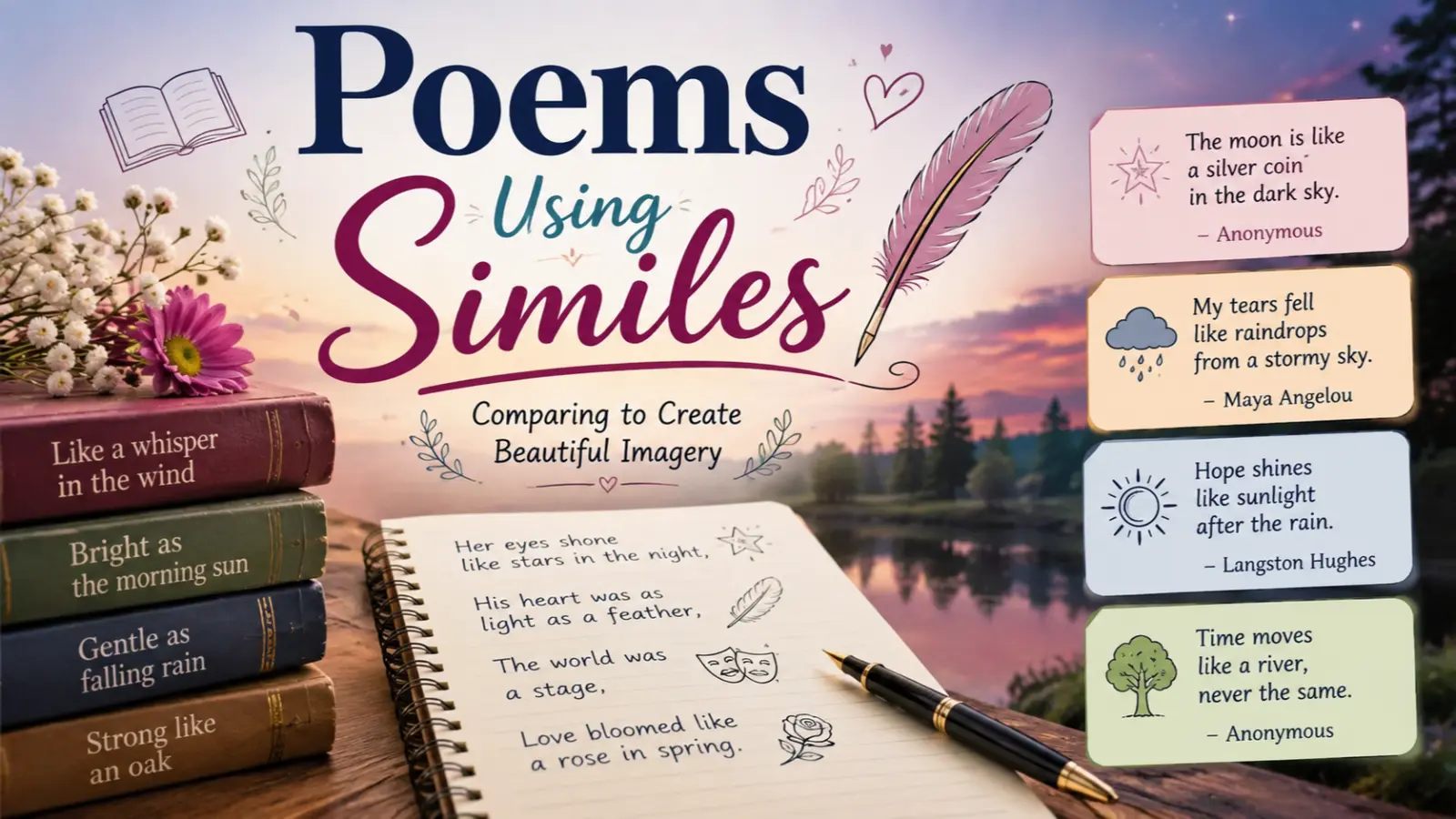
Poetry has a special way of turning ordinary moments into unforgettable images. One of the most effective tools for doing that is the simile. By comparing one thing to another using like or as, similes help readers see, hear, and feel a poem in a new way. You’ll find poems using similes in classrooms, poetry collections, greeting cards, spoken-word performances, and songwriting. A well-crafted simile can make even a simple sentence memorable. In this guide, you’ll discover how similes strengthen poetry, explore original examples, learn practical writing techniques, avoid common mistakes, and create your own imaginative comparisons.
What Are Poems Using Similes?
A poem using similes includes comparisons that connect two unlike things with the words like or as.
Rather than simply describing something, a simile paints a picture that readers can easily imagine.
Example:
The morning spread across the hills like warm honey.
Instead of saying the morning was beautiful, the comparison creates a gentle visual and emotional experience.
Why Similes Make Poetry More Memorable

Similes do much more than decorate a poem.
They help readers:
- Visualize scenes more clearly.
- Feel emotions more deeply.
- Remember important lines.
- Discover unexpected connections.
- Enjoy richer sensory details.
Strong poetry often invites readers to experience an image instead of merely reading about it.
How Great Poets Build Powerful Similes
Many beginning writers compare obvious things.
Instead of writing:
Bright as the sun.
Try finding a comparison readers haven’t seen before.
For example:
Bright like a lighthouse waking an empty coast.
The second comparison feels more personal and paints a stronger mental image.
Professional poets often observe ordinary objects and connect them in surprising but believable ways.
Original Poems Using Similes Examples
1. Like Rain Remembering the Earth
Simile
Her laughter returned like rain remembering the earth.
Meaning
Joy feels natural and comforting.
Poetry Example
Her laughter returned
like rain remembering the earth,
waking forgotten gardens.
Writing Tip
Use nature to express emotional renewal.
2. As Quiet as Snow Waiting for Dawn
Meaning
Represents peaceful silence.
Storytelling Example
The village rested as quiet as snow waiting for dawn.
Best Context
Winter poems, peaceful reflections.
3. Like a Lantern Floating Across Water
Meaning
Suggests hope moving gently through darkness.
Poetry Example
Hope drifted
like a lantern floating across water.
4. As Restless as Leaves Before a Storm
Meaning
Captures nervous anticipation.
Conversation Example
“I’ve been as restless as leaves before a storm all week.”
5. Like Ink Spreading Through Clear Water
Meaning
Describes emotions slowly growing stronger.
Writing Purpose
Perfect for sadness or uncertainty.
6. As Gentle as a Feather Landing on Moss
Creates an image of softness and kindness.
Poetry Example
Her words settled
as gentle as a feather landing on moss.
7. Like Windows Opening After Winter
Expresses freedom, optimism, and fresh beginnings.
8. As Curious as Moonlight Exploring Empty Streets
Works well for mystery and adventure poems.
9. Like a Sparrow Carrying Morning Songs
Suggests optimism despite small size.
10. As Brave as a Candle Facing the Wind
Shows quiet courage rather than dramatic heroism.
11. Like Rivers Learning Their Way Home
Ideal for poems about personal growth.
12. As Bright as Dew Holding Sunrise
Creates delicate beauty without sounding exaggerated.
13. Like Clouds Borrowing Mountain Shadows
Useful for reflective landscape poetry.
14. As Patient as Roots Beneath the Forest
Represents unseen strength.
15. Like Bells Floating Through Evening Air
Creates peaceful sound imagery.
16. As Delicate as Frost on a Window
Perfect for fragile emotions.
17. Like a Compass Searching for North
Represents purpose and direction.
18. As Free as Waves Forgetting the Shore
Excellent for poems about independence.
19. Like Fireflies Sewing Stars into the Night
Adds magical imagery to nature poems.
20. As Steady as Mountains Watching Seasons Pass
Expresses endurance and wisdom.
21. Like a Thread Pulling Light Through Darkness
Ideal for hopeful endings.
22. As Warm as Bread Fresh from the Oven
Conveys comfort, family, and belonging.
23. Like Autumn Gathering Golden Secrets
Works beautifully in seasonal poetry.
24. As Soft as Fog Hiding the Hills
Creates mystery and calm at the same time.
25. Like Stars Whispering Across Winter Skies
A peaceful image suited to reflective poems.
How to Create Your Own Poetry Similes
You don’t need extraordinary experiences to write memorable similes.
Follow this simple process:
Step 1: Choose an emotion.
Examples:
- Joy
- Fear
- Hope
- Loneliness
- Wonder
Step 2: Observe real life.
Look around for:
- Weather
- Animals
- Food
- Music
- Nature
- Cities
- Childhood memories
Step 3: Find a shared quality.
Ask yourself:
“What do these two things have in common?”
Step 4: Build the comparison.
Use:
- Like…
- As…as…
Step 5: Read it aloud.
If it sounds forced or confusing, simplify it.
How to Make Similes More Vivid
Strong similes usually include specific details.
Instead of:
Like a bird.
Try:
Like a swallow cutting through summer rain.
Specific images help readers picture the scene instantly.
Avoiding Clichés in Poetry
Many comparisons have been used so often that they no longer surprise readers.
Examples include:
- Busy as a bee
- Cold as ice
- Brave as a lion
- Quiet as a mouse
Fresh poetry often comes from careful observation rather than familiar sayings.
Look for comparisons inspired by your own experiences.
Related Literary Devices
Metaphor
A metaphor says something is another thing instead of comparing it with like or as.
Simile
Her smile was like sunrise.
Metaphor
Her smile was sunrise.
Imagery
Imagery appeals to the senses.
Similes often strengthen imagery by helping readers see, hear, smell, taste, or feel a moment more clearly.
Personification
Personification gives human qualities to non-human things.
Example:
The wind whispered through the trees.
Combining personification with similes can make poems even richer.
Hyperbole
Hyperbole intentionally exaggerates.
A simile may include gentle exaggeration, but hyperbole pushes far beyond reality.
Symbolism
Symbols allow one object to represent a larger idea.
A bird may symbolize freedom, while a bridge might symbolize change.
Similes and symbolism often work well together in poetry.
Creative Exercises for Writing Better Similes
Exercise 1
Write five similes using only weather.
Exercise 2
Describe happiness without mentioning smiles.
Exercise 3
Compare time to something found in your kitchen.
Exercise 4
Rewrite an old cliché using a completely new image.
Exercise 5
Take one emotion and write three different similes from the perspectives of a child, an adult, and an elderly person.
Common Mistakes When Writing Similes
Choosing Overused Comparisons
Readers remember originality more than familiarity.
Mixing Unrelated Images
Don’t combine unrelated comparisons that confuse the picture.
Keep one clear image at a time.
Confusing Similes and Metaphors
Remember:
- Similes use like or as.
- Metaphors do not.
Making Comparisons Too Complicated
If readers need to decode the comparison, simplify it.
The strongest similes feel natural.
Forgetting the Poem’s Emotion
Every simile should support the feeling of the poem rather than distract from it.
Frequently Asked Questions
What is a simile in poetry?
A simile compares two different things using like or as to create vivid imagery and deepen emotional meaning.
Why do poets use similes?
Poets use similes to make descriptions more imaginative, relatable, and memorable while helping readers visualize ideas.
Can every poem include similes?
Yes, but they should be used thoughtfully. Too many comparisons can overwhelm a poem.
How many similes should a short poem contain?
There is no fixed number. One meaningful simile is often more effective than several weak ones.
What is the difference between a simile and a metaphor?
A simile uses like or as, while a metaphor directly states that one thing is another.
Are similes good for beginner poets?
Absolutely. Similes are one of the easiest literary devices to learn and can instantly make writing more expressive.
How can I make my similes original?
Observe everyday life, focus on a specific emotion, and create comparisons that come from your own experiences rather than relying on familiar expressions.
Conclusion
The best poems using similes don’t rely on familiar comparisons—they reveal ordinary experiences in unexpected ways. A thoughtful simile can transform a quiet moment into a vivid memory, helping readers connect with your words through sight, sound, emotion, and imagination. Practice noticing the world around you, experiment with fresh comparisons, and revise until each simile feels natural. Over time, you’ll develop a poetic voice that is both original and memorable, creating verses that readers will want to return to again and again.
I am Helena Frost, a writer captivated by the beauty of language and the art of comparison. Through my words, I explore the world by turning ordinary moments into vivid similes and reflections. I enjoy crafting phrases that spark imagination, evoke emotion, and linger in the mind. My writing celebrates the subtle connections between people, nature, and the stories we live. For me, every sentence is an opportunity to reveal the extraordinary in the everyday.