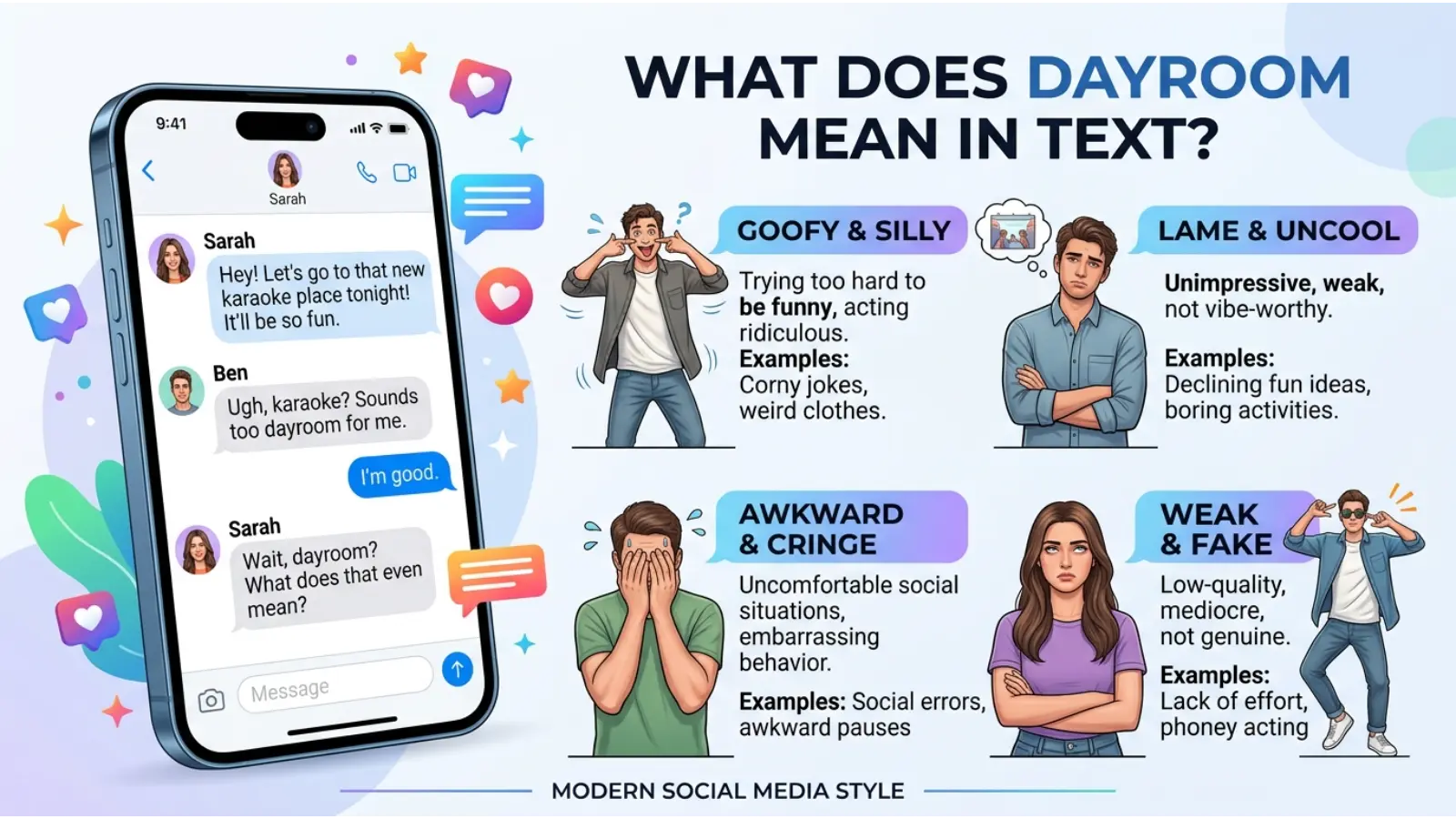
Dayroom meaning slang can be confusing because “dayroom” has both a normal English meaning and several informal slang meanings.
If you have seen someone call a person, comment, outfit, or action “dayroom,” you may wonder whether they are talking about an actual room or insulting someone.
In modern online and casual speech, dayroom is often used negatively to describe behavior that seems goofy, lame, weak, awkward, fake, embarrassing, or socially off. The exact meaning can change depending on the community and context.
The word also has a literal meaning: a dayroom is a shared space where people can relax, socialize, or take part in recreational activities, especially in institutions such as hospitals or correctional facilities.
Quick Answer
Dayroom meaning slang usually refers to someone or something that seems goofy, lame, weak, awkward, fake, or embarrassing. For example, “That’s dayroom” can mean “That’s corny” or “That behavior is embarrassing.”
What Does Dayroom Mean in Text?
In texting, dayroom is generally an informal insult or criticism. Someone may use it to describe a person who is acting foolish, awkward, weak, or socially unaware.
For example:
“Bro, why are you acting dayroom?”
This means something like:
“Why are you acting goofy or embarrassing?”
Another example is:
“That whole conversation was dayroom.”
Here, the speaker is saying that the conversation felt awkward, lame, or embarrassing.
The exact meaning is not completely fixed. Some slang sources describe dayroom as meaning fake or someone who switches up, while others emphasize goofy, weak, awkward, or corny behavior.
So, when interpreting the word, context matters more than a single dictionary definition.
What Is the Dayroom Full Form?
There is no special acronym or official full form for “dayroom.”
The word is simply formed from “day” + “room.” The traditional word refers to a common room used during the day. Wiktionary records the word as referring to a communal room in places such as barracks, hospitals, prisons, or dormitories.
Therefore, if someone asks, “What does dayroom stand for?”, the answer is that it does not stand for a longer phrase like many texting abbreviations do.
Its slang meaning developed from the word’s existing use rather than from an acronym.
Dayroom Meaning in Different Contexts
The meaning can change significantly depending on where you see it.
| Context | Meaning of “dayroom” |
|---|---|
| Texting | Goofy, lame, weak, awkward, or embarrassing |
| Social media | A negative reaction to someone’s behavior |
| Street/informal slang | May suggest weakness, fake behavior, or being corny |
| Prison/institutional context | A shared communal or recreational area |
| Hospital setting | A room for relaxation and recreation |
| General English | A common room used during the day |
The traditional definition is well established. Merriam-Webster defines a dayroom as a room equipped for relaxation and recreation, while Oxford describes it as a room in a hospital or institution where people can sit and relax during the day.
Is “Dayroom” Rude, Offensive, or Neutral?
It depends on how it is being used.
The literal word is neutral. Saying:
“We spent the afternoon in the dayroom.”
is not insulting at all.
The slang use is usually negative. Calling someone “dayroom” can be a put-down, especially if you mean that they are weak, fake, foolish, or embarrassing.
However, friends may sometimes use it jokingly.
For example:
“You really wore those shoes? You’re dayroom 😂”
This could be playful teasing between friends.
In a serious argument, however, it may sound disrespectful.
Where Is Dayroom Commonly Used?
The slang version can appear in:
- Text messages
- TikTok comments
- Instagram replies
- Discord chats
- Gaming conversations
- Memes
- Casual conversations
- Online communities
Recent slang explanations associate the word with informal and online communities, although definitions vary between groups.
Because slang changes quickly, one group may use dayroom to mean “corny,” while another may use it more specifically for someone who is fake or switches up.
Dayroom Meaning in Social Media
On social media, dayroom is often used as a quick reaction.
Someone might comment:
“That’s dayroom.”
They could mean:
- That is lame.
- That is embarrassing.
- That is goofy.
- That is weak.
- That is not cool.
Another common structure is:
“Bro is moving dayroom.”
This criticizes someone’s behavior rather than describing a physical location. Some contemporary slang sources specifically describe “moving dayroom” as acting goofy, weak, or out of line.
Real-Life Conversation Examples
Friendly Example
A: “I accidentally sent the screenshot to the person we were talking about.”
B: “Brooo, that’s dayroom 😂”
Here, the word is playful teasing.
Casual Example
A: “Did you see his post?”
B: “Yeah. That was kinda dayroom.”
The speaker thinks the post was lame or embarrassing.
Argumentative Example
A: “You said you were going to support me, but now you’re taking their side.”
B: “You’re being dayroom.”
Here, the term is more confrontational.
Social Media Example
“Posting that private conversation was dayroom.”
This means the poster’s behavior is being criticized as inappropriate, embarrassing, or socially unacceptable.
Gaming Example
“Blaming your whole team after making that mistake is dayroom.”
Here, dayroom describes behavior considered foolish or weak.
Emotional and Psychological Meaning
Calling something dayroom usually expresses a judgment about how behavior looks to other people.
It may communicate feelings such as:
- Disappointment
- Embarrassment
- Amusement
- Annoyance
- Disapproval
- Secondhand embarrassment
It does not, however, describe a recognized psychological condition. It is informal slang, not a clinical or psychological term.
The emotional force depends heavily on tone. A laughing emoji can make it sound playful, while using the word during an argument can make it sound like a serious insult.
Origin and Background of “Dayroom”
The literal word dayroom is much older than its modern slang use. Merriam-Webster records its first known use as 1823, defining it as a room used for relaxation and recreation.
Dayrooms have traditionally existed in institutional environments, including hospitals, military facilities, dormitories, and correctional settings.
The slang history is less certain and varies across sources. Some slang references connect the informal use to prison or street culture, while contemporary slang sites describe its spread into online and youth culture.
Because slang evolves through communities, it is better to treat the modern definition as context-dependent rather than claiming one universally accepted origin.
Dayroom vs. Similar Slang
| Slang | General meaning | Tone |
|---|---|---|
| Dayroom | Goofy, lame, weak, awkward, fake, or embarrassing | Negative/teasing |
| Corny | Uncool, predictable, or trying too hard | Mildly negative |
| Cringe | Embarrassing or uncomfortable to watch | Negative |
| Lame | Uninteresting, weak, or uncool | Negative |
| Goofy | Silly or foolish | Often playful |
| Fake | Not genuine or trustworthy | Negative |
These words overlap, but they are not exact synonyms. Dayroom can carry a more specific informal or cultural tone depending on the community using it.
Variations and Types of “Dayroom”
You may encounter several forms of the slang.
“That’s dayroom”
Usually means:
“That is lame, goofy, weak, or embarrassing.”
“You’re dayroom”
Usually describes the person as acting in an embarrassing or weak way.
“Moving dayroom”
Means someone is behaving in a goofy, weak, fake, or otherwise questionable way.
“Dayroom behavior”
Describes a pattern of behavior viewed as lame, awkward, or socially inappropriate.
“Dayroom energy”
A more playful way of saying something gives off an awkward, weak, or uncool feeling.
Common Misunderstandings
One of the biggest mistakes is assuming that every use of “dayroom” is slang.
For example:
“The patients were relaxing in the dayroom.”
This is literal.
But:
“Why are you being so dayroom?”
This is slang.
Another misunderstanding is assuming that the slang always means “fake.” Some communities use it that way, but other speakers use it for behavior that is simply goofy, weak, corny, or embarrassing.
When Should You Use “Dayroom”?
Use it mainly in casual conversations when you know the people you’re talking to understand the slang.
It may work well in:
- Friendly group chats
- Casual texting
- Gaming chats
- Memes
- Informal social media conversations
Avoid it in:
- Job applications
- Professional emails
- Academic writing
- Formal presentations
- Important business conversations
- Situations where the other person may not understand slang
Slang can make communication more fun, but it can also create confusion.
Polite Alternatives to “Dayroom”
If you want to communicate the same general idea without sounding insulting, try:
- “That seems awkward.”
- “That was a little embarrassing.”
- “That doesn’t look good.”
- “That’s not a great idea.”
- “That seems unnecessary.”
- “That was kind of goofy.”
- “I don’t think that’s a good move.”
These alternatives are clearer and safer in formal or unfamiliar situations.
Why Do People Use “Dayroom”?
People use slang because it allows them to communicate an attitude quickly.
Instead of saying:
“I think your behavior is socially awkward and makes you look foolish.”
someone can simply say:
“That’s dayroom.”
It is shorter, more expressive, and fits naturally into fast-moving online conversations.
Slang also helps people show humor, group identity, or familiarity with a particular online culture.
Is “Dayroom” Safe for Social Media?
Generally, the word itself is not dangerous or inherently inappropriate. However, its slang meaning can be insulting.
If you use it toward another person, consider:
- Whether they understand the slang.
- Whether you’re joking or genuinely criticizing them.
- Whether the comment could embarrass them.
- Whether the conversation is public.
- Whether the situation calls for respectful language.
A harmless joke between friends can sound like bullying when posted publicly.
How to Respond When Someone Calls You “Dayroom”
Your response depends on the situation.
If they are joking, you could say:
“😂 Chill, I’m just having fun.”
If you do not understand:
“What do you mean by dayroom?”
If they are seriously insulting you:
“If you have an issue, just tell me directly.”
Sometimes the best response is simply to ignore it, especially when someone is trying to start an argument online.
Regional and Cultural Usage
The slang meaning of dayroom is not universal English. It appears particularly in certain U.S. informal, street, and online communities, and different communities may attach slightly different meanings to it.
This is important because slang can travel quickly through TikTok, music, gaming, memes, and social media. Once a word moves between communities, its meaning may broaden or change.
So, if you hear dayroom from someone, consider their community and the surrounding conversation before deciding exactly what they mean.
FAQs About Dayroom Meaning Slang
1. What does dayroom mean in text?
In text, dayroom usually means goofy, lame, weak, awkward, fake, or embarrassing. The exact meaning depends on context.
2. What does dayroom stand for?
It does not stand for a longer phrase. Dayroom is a normal word that developed additional slang meanings.
3. Is dayroom a bad word?
Not inherently. The literal word is completely neutral, but the slang version can be insulting or disrespectful.
4. Does dayroom mean fake?
Sometimes. Some slang communities use dayroom for someone who acts fake, switches up, or behaves in an untrustworthy way. Other communities use it more broadly for goofy, weak, or embarrassing behavior.
5. What does “moving dayroom” mean?
“Moving dayroom” generally means acting goofy, weak, fake, embarrassing, or out of line.
6. Can I use dayroom professionally?
It is better to avoid it in professional communication. Since slang meanings vary, it may confuse the reader or sound disrespectful.
Conclusion
The dayroom meaning slang is usually connected to behavior that someone considers goofy, lame, weak, awkward, fake, or embarrassing. In some communities, it can specifically describe a person who switches up or acts inauthentically.
However, dayroom also has a completely different literal meaning: a shared room for relaxation and recreation, particularly in hospitals and other institutions.
The best way to understand dayroom meaning in text is to look at the surrounding conversation. If someone says, “We met in the dayroom,” they probably mean a physical room. If they say, “That was dayroom,” they are most likely criticizing something as lame, goofy, weak, or embarrassing.
Because the slang can vary by community, use it casually and thoughtfully—and remember that tone and context can completely change how the word is understood.










1 thought on “Dayroom Meaning Slang What Does Dayroom Mean in Text”