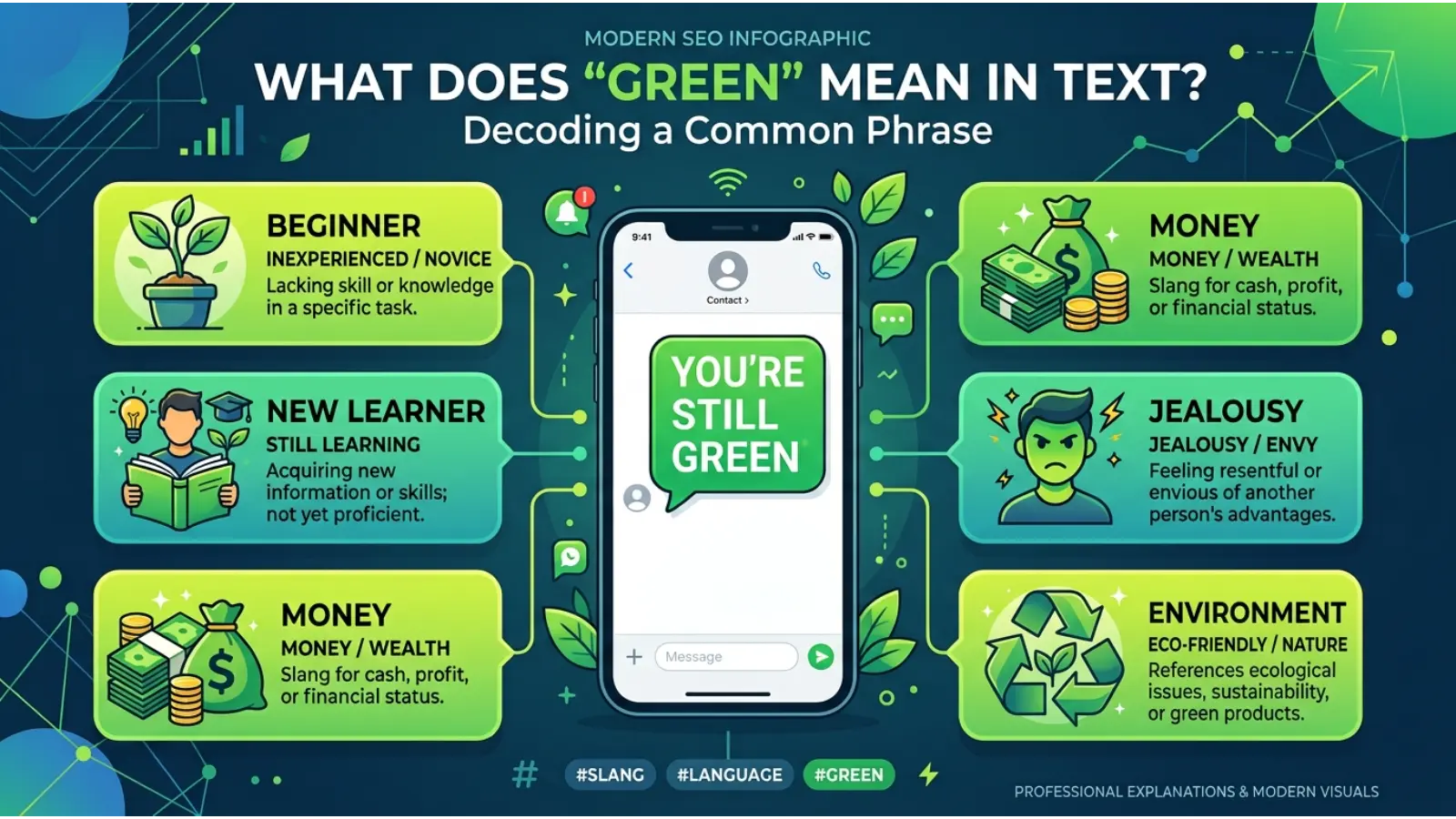
Green slang meaning can be confusing because the word “green” has several meanings beyond its usual reference to a color.
In texting, social media, gaming, music, and everyday conversation, green may describe someone who is inexperienced, naive, jealous, or even money or marijuana, depending on the context.
In gaming, especially basketball video-game communities, it can also describe a perfectly successful action, such as a perfectly timed shot.
People often search for green slang meaning after seeing phrases like “you’re green,” “I need some green,” or “that was green.” The good news is that the surrounding words usually reveal the intended meaning.
Quick Answer
In slang, “green” most commonly means new, inexperienced, or naive. However, it can also mean money, marijuana, jealousy, or a perfectly executed action depending on the situation.
What Does Green Mean in Text?
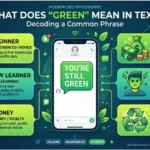
The most common green meaning slang use is to describe someone who is new, inexperienced, or unfamiliar with something.
For example:
“He’s still green at his new job.”
This means he is new and still learning.
Calling someone “green” can be friendly, neutral, or slightly critical. It depends on the speaker’s tone. The word has long been associated with freshness, youth, inexperience, and being untested. Dictionaries also recognize “green” as meaning inexperienced, unsophisticated, or gullible.
Is Green an Acronym?
No. Green is not an acronym or abbreviation, so there is no official “green full form.”
If someone asks, “What does green stand for?”, the answer depends on the context rather than a hidden letter-by-letter expansion.
Green Meaning in Different Contexts
One reason green slang meaning in text is difficult to understand is that the same word can have several meanings.
1. Green Means Inexperienced
This is one of the most common slang uses.
Example:
“She’s green, so give her some time.”
Meaning: She is new and needs more experience.
2. Green Means Money
In informal American English, green can refer to money because U.S. currency is traditionally associated with the color green.
Example:
“He’s chasing the green.”
Meaning: He is trying to make money.
This meaning is also connected with expressions such as “greenbacks.”
3. Green Means Marijuana
In some casual conversations, particularly cannabis-related contexts, green can refer to marijuana or cannabis.
Example:
“They were talking about green.”
Here, the surrounding conversation is important because “green” can mean many other things.
4. Green Means Jealous
Green can also refer to jealousy or envy, especially through the familiar expression “green with envy.”
Example:
“He was looking green after hearing about her promotion.”
Depending on context, this could suggest jealousy.
5. Green Means Perfect in Gaming
A newer online use appears in gaming communities. In games such as NBA 2K, a “green” shot can refer to a perfectly timed successful shot. Some social-media users have carried this meaning into comments and memes.
Example:
“That shot was green!”
Meaning: The shot was perfectly timed or executed.
Is Green Rude, Offensive, or Neutral?
Usually, green is neutral or mildly teasing when it means inexperienced.
For example:
“Don’t worry, you’re still green.”
This may simply mean someone is learning.
However, it can become insulting if someone uses it to call another person clueless, naive, or easily fooled.
The tone matters:
- Friendly: “You’re still green. You’ll get it soon.”
- Teasing: “Bro, you’re so green 😂.”
- Negative: “He’s too green to handle this.”
- Complimentary gaming use: “That was green!”
So, the word itself is generally not offensive. The situation and intention determine how it sounds.
Where Is Green Slang Commonly Used?
You may encounter green slang in:
- Text messages
- TikTok comments
- Instagram captions
- Snapchat chats
- Discord conversations
- Gaming communities
- Sports discussions
- Music and pop culture
- Casual conversations
- Workplace conversations
The meaning can change from one community to another. For example, workplace conversations often use “green” to mean inexperienced, while gaming conversations may use it to describe a perfect play.
Real-Life Conversation Examples
Here are examples showing different meanings and tones.
Friendly
A: “I’m terrible at cooking.”
B: “You’re just green. You’ll learn.”
Meaning: You are inexperienced.
Casual
A: “How long has Jake been working here?”
B: “Only two weeks. He’s still green.”
Meaning: Jake is new.
Argumentative
A: “You don’t know what you’re talking about.”
B: “Maybe I’m green, but I’m learning.”
Meaning: The speaker admits they are inexperienced.
Money Context
“Everyone wants the green.”
Meaning: Everyone wants money.
Gaming Context
“That was green! 🔥”
Meaning: The action or shot was perfectly executed.
Jealousy Context
“She’s green because he got the promotion.”
Meaning: She is jealous or envious.
Emotional and Psychological Meaning of Green
The slang meaning of green can sometimes connect to feelings and personality.
When it means inexperienced, it suggests that someone is still developing confidence or knowledge. Calling someone green does not necessarily mean they are unintelligent. It may simply mean they have not had enough experience yet.
When green refers to jealousy, it describes an emotional reaction to another person’s success, relationship, possessions, or opportunities.
So, green can describe both a person’s experience level and an emotional state, depending on the sentence.
Origin and Background of Green Slang
The slang uses of green developed from older meanings and associations of the color.
The connection between green and inexperience is tied to ideas of freshness, youth, and something not yet mature. Traditional English dictionaries record “green” as meaning immature, untrained, inexperienced, or gullible.
The money meaning comes from the long-standing association between green and U.S. paper currency. The jealousy meaning is connected to the established expression “green with envy.” Marijuana-related use is associated with the plant’s appearance.
Modern internet culture has added newer meanings, especially in gaming and social-media communities.
Green Slang vs. Similar Terms
| Term | Meaning | Example |
|---|---|---|
| Green | New or inexperienced | “He’s green at this.” |
| Rookie | A beginner | “She’s a rookie.” |
| Newbie | Someone new to a group or activity | “I’m a newbie here.” |
| Naive | Lacking experience or judgment | “He was naive about the situation.” |
| Amateur | Someone without professional experience | “He’s still an amateur.” |
| Jealous | Feeling envy toward someone | “She is jealous of her success.” |
Green is especially flexible because it can refer to several completely different ideas depending on context.
When Should You Use Green Slang?
You can usually use green casually with friends, online communities, and people who understand the context.
Good situations
- Friendly conversations
- Casual texting
- Gaming chats
- Social media comments
- Informal discussions
- Talking about someone who is new to something
Avoid it when:
- You are writing a formal business document
- The meaning could easily be misunderstood
- You are speaking to someone unfamiliar with the expression
- Calling someone “green” could embarrass them
In professional communication, it is usually clearer to say “new,” “inexperienced,” or “still learning.”
Polite Alternatives to Green
If you want to avoid sounding critical, try:
- New to this
- Still learning
- Inexperienced
- Just getting started
- New to the role
- Still gaining experience
- Learning the ropes
For example:
Instead of:
“She’s green.”
You could say:
“She’s still gaining experience.”
This sounds more professional and supportive.
Why Do People Use Green Slang?
People use slang because it makes communication shorter, more casual, expressive, and relatable.
“Green” can communicate an idea quickly without needing a longer explanation.
For example:
“He’s green.”
is much shorter than:
“He doesn’t have much experience with this yet.”
Online communities also create new meanings for familiar words. Gaming culture is one example where “green” has developed a specialized meaning related to perfect execution.
Impact of Using Green in Communication
Using slang can make a conversation feel relaxed and friendly. However, slang can also cause confusion when people from different age groups, regions, or online communities interpret the same word differently.
For example, if someone says:
“I need green.”
You cannot know for certain whether they mean money, marijuana, or something else without additional context.
Context is the key.
Look at:
- The words before and after “green”
- The topic being discussed
- The platform or community
- The speaker’s tone
- Whether emojis or other slang are present
Is Green Safe for Social Media?
Generally, yes. Green is a normal, widely used word and is not inherently offensive.
However, some contexts can involve adult or potentially sensitive subjects, particularly when “green” refers to marijuana or other slang meanings.
For general audiences, the safest use is the ordinary meaning of new or inexperienced, especially when the context is clear.
Common Misunderstandings About Green
“Green” always means inexperienced.
Not necessarily. It can mean money, marijuana, jealousy, or something successful in gaming contexts.
“Green” has a full form.
No. Green is not an acronym, so it does not have an official full form.
Calling someone green is always an insult.
No. It can be neutral, supportive, playful, or negative depending on tone.
Green only means a color.
No. English has developed many figurative and slang uses for the word.
Variations and Types of Green Slang
Some related expressions include:
- Green with envy — jealous
- Greenback — an informal term for U.S. money
- Green light — permission or approval
- Still green — still inexperienced
- Green around the ears — inexperienced or naive
- Go green — adopt environmentally friendly practices
- Green shot — in certain gaming contexts, a perfectly timed successful shot
These expressions are not interchangeable, so always check the surrounding context.
How to Respond When Someone Uses “Green”
Your response should depend on what they mean.
If they mean inexperienced:
“Yeah, I’m still learning.”
If they are teasing:
“Give me time—I’ll get better 😂.”
If they are complimenting a gaming move:
“Thanks! 🔥”
If you don’t understand:
“What do you mean by green?”
Asking for clarification is better than guessing.
Regional and Cultural Usage
The word green has a long history in English, but its slang meaning can vary by community. Money-related uses are particularly familiar in American English, while gaming communities may use “green” in a specialized way that newcomers do not immediately recognize.
Social media can spread these meanings quickly across countries, which means a phrase that began in one community may eventually appear in international chats.
FAQs About Green Slang Meaning
What does green mean in text?
Most commonly, green means someone is new, inexperienced, or naive. It can also mean money, marijuana, jealousy, or a perfect gaming action depending on context.
What does green slang stand for?
Green does not stand for a specific phrase. It is an ordinary English word that has developed several slang meanings.
Is green slang a bad word?
No. Green is not generally a bad or offensive word. Its tone depends on how and why someone uses it.
What does “you’re green” mean?
Usually, “you’re green” means “you’re inexperienced or new at this.” It can be friendly advice or mild teasing.
Does green mean money?
Yes. In informal language, green can refer to money, especially U.S. dollars, because of their traditional green appearance.
What does green mean in gaming?
In some gaming communities, particularly around NBA 2K, green can describe a perfectly timed successful shot or action.
Conclusion
Understanding green slang meaning requires looking at the context. Most often, calling someone green means they are new, inexperienced, or naive. But the word can also refer to money, marijuana, jealousy, or a perfectly executed gaming action.
The safest way to understand “green” in a text or social-media post is to examine the surrounding conversation. Tone, platform, and topic can completely change the meaning.
If you are using the word yourself, keep the audience in mind. With friends and online communities, green can sound natural and casual. In formal communication, clearer alternatives such as new, inexperienced, or still learning are usually better.




1 thought on “Green Slang Meaning in Text Explained Simply”