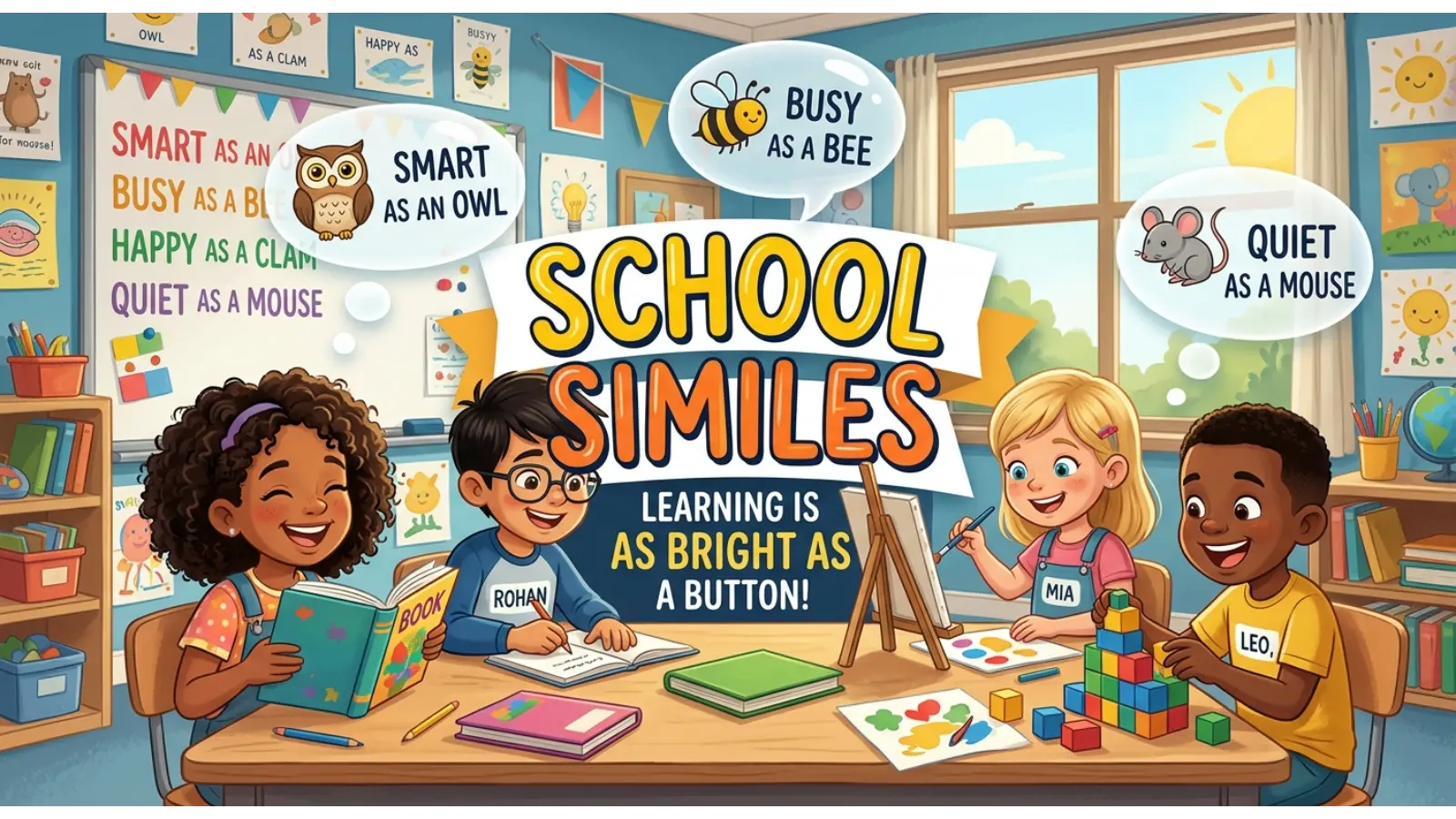
School Similes is full of moments that are easy to describe but surprisingly difficult to put into words. A noisy classroom, a nervous student before a test, a teacher explaining a difficult lesson, or a hallway crowded between classes can all become more memorable with the right comparison.
A simile compares two different things using words such as like or as. For example, “The classroom was as quiet as a closed library” helps readers imagine the silence rather than simply telling them that the room was quiet.
School similes are especially useful for students because they make essays, stories, poems, speeches, and everyday descriptions more vivid. This guide provides original examples, explains why they work, and shows you how to create your own.
What Is a Simile?
A simile is a figure of speech that compares one thing with another to highlight a particular quality.
For example:
The students rushed into the hallway like birds leaving a tree.
The students are not actually birds. The comparison emphasizes their quick, energetic movement.
A useful pattern is:
Subject + linking verb + like/as + comparison
Examples include:
- The test felt like a locked door.
- Her explanation was as clear as a window.
- The school bell rang like a tiny alarm.
The strongest similes do more than decorate a sentence. They help readers see, hear, feel, or understand something more clearly.
Why Do Similes Work So Well in School Writing?
Students often write sentences that communicate an idea without creating a strong picture.
Compare:
The hallway was crowded.
with:
The hallway swelled with students like a river squeezed between two banks.
The second sentence gives the reader movement, pressure, and a sense of limited space.
Similes can improve:
- Creative writing
- Descriptive essays
- Personal narratives
- Poetry
- School assignments
- Speeches
- Short stories
- Classroom presentations
The key is choosing a comparison that adds meaning rather than simply adding words.
30 Creative School Similes
1. The Classroom Was Like a Busy Beehive
Meaning: The classroom was active, noisy, and full of movement.
Example:
The classroom was like a busy beehive before the teacher arrived.
Writing purpose: This works well when you want to show energetic activity instead of merely saying “the classroom was noisy.”
2. The School Bell Rang Like a Silver Chime
Meaning: The bell sounded bright and clear.
Example:
The school bell rang like a silver chime, sending everyone toward their classrooms.
Best context: Descriptive stories and poems.
Writing tip: Match the comparison to the sound you actually want readers to imagine.
3. The Test Felt Like a Locked Door
Meaning: The test seemed difficult or impossible to understand.
Example:
The final math problem felt like a locked door with no key.
Emotional effect: It creates frustration and uncertainty.
This is particularly effective in personal narratives about academic challenges.
4. Her Handwriting Was Like Tiny Footprints
Meaning: Her handwriting was small and delicate.
Example:
Her notes covered the page in letters like tiny footprints.
Writing tip: Notice that the comparison focuses on one visual quality—smallness. Strong similes usually have a clear target.
5. The Library Was as Quiet as Fresh Snow
Meaning: The library was extremely peaceful and quiet.
Example:
After lunch, the library became as quiet as fresh snow.
Best context: Descriptive writing.
This comparison creates a calm atmosphere without simply repeating the word “quiet.”
6. The School Hallway Was Like a River
Meaning: Students moved continuously through the hallway.
Example:
At dismissal, the hallway became like a river carrying hundreds of students toward the doors.
Writing purpose: Movement and crowd description.
7. His Backpack Was as Heavy as a Suitcase
Meaning: The backpack felt unusually heavy.
Example:
After packing every textbook, his backpack was as heavy as a suitcase.
Writing tip: Concrete comparisons are often easier for readers to visualize than abstract ones.
8. The Teacher’s Voice Was Like a Lighthouse
Meaning: The teacher’s voice guided students through confusion.
Example:
During the difficult lesson, the teacher’s explanation was like a lighthouse in thick fog.
Emotional effect: Reassurance and guidance.
This is an example of a simile that describes an abstract quality rather than a physical object.
9. The Pencil Moved Like a Skater
Meaning: Someone wrote smoothly and quickly.
Example:
Her pencil moved like a skater gliding across ice as she finished the assignment.
Best context: Creative narratives.
10. The Cafeteria Was Like a Festival
Meaning: The cafeteria was lively, crowded, and energetic.
Example:
At lunchtime, the cafeteria sounded like a festival packed into one room.
Writing tip: Use comparisons that capture several related details without becoming confusing.
11. His Answer Was as Clear as Glass
Meaning: His answer was easy to understand.
Example:
After the teacher explained the problem, her answer became as clear as glass.
Best context: Essays and classroom narratives.
12. The Science Experiment Was Like a Miniature Storm
Meaning: The experiment was energetic, unpredictable, or visually exciting.
Example:
The bubbling experiment looked like a miniature storm trapped inside the beaker.
Writing purpose: Visual description.
13. The Principal’s Announcement Spread Like Wind
Meaning: Students heard the announcement quickly.
Example:
The news of the schedule change spread like wind through the school.
Writing tip: This type of simile works particularly well for showing how information travels.
14. The Classroom Clock Was Like a Slow Walker
Meaning: Time seemed to move very slowly.
Example:
During the difficult exam, the classroom clock seemed like a slow walker refusing to hurry.
Emotional effect: Impatience and tension.
15. The Students Were as Excited as Fireworks
Meaning: The students were extremely enthusiastic.
Example:
The students were as excited as fireworks when the field trip was announced.
Best context: Stories about celebrations or special school events.
16. The Whiteboard Was Like a Blank Canvas
Meaning: The empty board offered possibilities for a new lesson or idea.
Example:
The clean whiteboard stood like a blank canvas waiting for the first stroke.
Writing purpose: This comparison can introduce a lesson, project, or creative activity.
17. Her Presentation Was Like a Well-Rehearsed Song
Meaning: Her presentation was smooth, organized, and confident.
Example:
Her presentation flowed like a well-rehearsed song, with every idea arriving at the right moment.
Writing tip: Choose a comparison that reflects the specific quality you want to emphasize.
18. The School Bus Was Like a Rolling Classroom
Meaning: Students continued talking, learning, and interacting while traveling.
Example:
The school bus became like a rolling classroom filled with conversations and questions.
Best context: Personal narratives.
19. His Pencil Case Was Like a Tiny Toolbox
Meaning: It contained many useful writing tools.
Example:
His pencil case was like a tiny toolbox, packed with pens, pencils, rulers, and erasers.
Writing purpose: Making an ordinary object more interesting.
20. The Exam Room Was as Still as a Photograph
Meaning: Everyone was extremely still and quiet.
Example:
When the exam began, the room became as still as a photograph.
Emotional effect: Tension and concentration.
21. Her Question Was Like a Key
Meaning: Her question helped unlock an idea or solve a problem.
Example:
Her simple question was like a key that opened the whole discussion.
Best context: Essays about learning and discovery.
22. The Homework Piled Up Like Snowdrifts
Meaning: A large amount of homework accumulated.
Example:
By Friday, unfinished assignments had gathered like snowdrifts on his desk.
Writing tip: A good simile can turn an ordinary complaint into a memorable image.
23. The Classroom Lights Were Like Little Moons
Meaning: The lights created a soft or noticeable glow.
Example:
The ceiling lights shone like little moons above the desks.
Best context: Poetry and atmospheric storytelling.
24. The Debate Was Like a Tennis Match
Meaning: Speakers responded rapidly to each other’s arguments.
Example:
The classroom debate moved like a tennis match, with every argument answered by another.
Writing purpose: Showing back-and-forth action.
25. The New Student Entered Like a Shadow
Meaning: The student entered quietly and unnoticed.
Example:
The new student slipped into the classroom like a shadow.
Emotional effect: Mystery, nervousness, or shyness depending on the surrounding context.
26. The Teacher’s Desk Was Like a Command Center
Meaning: The desk was the central place from which classroom activities were managed.
Example:
The teacher’s desk looked like a command center, surrounded by papers, folders, and lesson plans.
Best context: Humorous or descriptive school writing.
27. The School Garden Was Like a Green Pocket
Meaning: The garden was a small peaceful natural area within the school.
Example:
Behind the science building, the school garden felt like a green pocket hidden inside the busy campus.
Writing purpose: Setting description.
28. His Confidence Grew Like a Young Tree
Meaning: His confidence developed gradually and steadily.
Example:
After each successful presentation, his confidence grew like a young tree reaching toward sunlight.
Writing tip: This is useful when describing personal growth over time.
29. The Final School Day Felt Like a Door Closing
Meaning: The final day represented the end of an important period.
Example:
The final school day felt like a door slowly closing behind us.
Emotional effect: Nostalgia and change.
30. A Good Teacher Is Like a Compass
Meaning: A good teacher helps students find direction.
Example:
A good teacher can be like a compass, helping students discover where their curiosity can lead.
Best context: School essays, speeches, and reflective writing.
How to Make Your School Similes More Vivid
The best similes usually begin with a specific observation.
Instead of asking, “What sounds fancy?” ask:
What does this thing remind me of?
If students are running down a hallway, consider movement. a classroom is silent, think about places or objects associated with silence. If a student is nervous, search for something that physically behaves like nervousness.
A useful process is:
- Identify the quality you want to describe.
- Think of something familiar that shares that quality.
- Connect the two with like or as.
- Check whether the comparison makes sense.
- Remove unnecessary words.
- Read the sentence aloud.
For example:
Basic:
The student was nervous.
Observation:
His hands kept moving and he could not sit still.
Comparison:
His hands moved like restless birds.
Final sentence:
His hands fluttered like restless birds beneath the desk.
The final version gives readers something they can picture.
How Students Can Avoid Cliché Similes
Some comparisons are so familiar that readers barely notice them. Familiar expressions are not automatically wrong, but original writing often becomes stronger when the comparison feels specific to the situation.
Instead of reaching immediately for a familiar comparison, ask yourself:
- What exactly am I trying to show?
- What object behaves in a similar way?
- Can I connect the comparison to the setting?
- Can I make it more specific?
- Does the comparison reveal something about the character?
For example, rather than simply writing that a student is “busy as a bee,” you might write:
Maya moved between desks like a conductor trying to keep an entire orchestra together.
The second comparison tells us more about the student’s role and the activity around her.
School Similes for Different Types of Writing
For Essays
Use similes carefully. Academic writing usually benefits from clarity first.
The new classroom system spread like a carefully connected network, linking students, teachers, and resources.
Avoid filling an academic paragraph with comparisons that do not add information.
For Stories
Stories allow more imaginative comparisons because they create atmosphere and character.
The empty hallway stretched ahead like a tunnel waiting for footsteps.
A storytelling simile should contribute to the mood of the scene.
For Poetry
Poetry gives you more freedom to experiment with sound, rhythm, and unusual images.
The morning bell floated through the building like a bright thread through cloth.
The comparison does not have to be literal; it needs to create a meaningful image.
For Speeches
Keep the comparison easy to understand.
Education can be like a map: it does not walk the road for you, but it can help you choose a direction.
A speech simile should support the main idea rather than distract from it.
Simile vs. Metaphor in School Writing
A simile makes a comparison using words such as like or as.
The classroom was like a beehive.
A metaphor makes the comparison directly.
The classroom was a beehive.
Both can create imagery, but they create it differently.
When students are learning figurative language, this distinction is important. If your teacher asks specifically for a simile, make sure your comparison clearly uses an appropriate linking word.
Common Mistakes Students Make With Similes
Using a Comparison That Has No Purpose
A simile should contribute something.
Weak:
The teacher walked like a banana.
Unless the surrounding story gives the banana comparison a clear purpose, the reader has no useful image.
Better:
The teacher walked like someone balancing a stack of books.
Now the comparison explains the teacher’s careful movement.
Mixing Two Images
Avoid combining unrelated comparisons.
Confusing:
The hallway was like a river flying through a jungle.
The reader has to work too hard to understand the image.
Choose one strong comparison instead:
The hallway flowed like a river between the classrooms.
Explaining the Same Idea Twice
Once the simile makes the point, you may not need a long explanation.
The library was as quiet as fresh snow. It was very, very quiet and peaceful, with almost no sound at all.
The second sentence repeats information the simile has already communicated.
Making Every Sentence Figurative
Similes are more effective when they have room to stand out.
A paragraph full of comparisons can become tiring. Mix figurative language with clear, direct sentences.
Create Your Own School Similes
Try this simple exercise.
Step 1: Choose a School Subject
Pick something ordinary:
- Math class
- Science lab
- Library
- Cafeteria
- School bus
- Playground
- Homework
- Exam
- Teacher
- School hallway
Step 2: Choose One Quality
Decide what you want to describe:
- Loud
- Quiet
- Fast
- Slow
- Difficult
- Exciting
- Nervous
- Peaceful
- Crowded
- Confusing
Step 3: Find a Fresh Comparison
For example:
Subject: Homework
Quality: Large amount
Comparison: Snowdrifts
Result:
Homework piled up like snowdrifts across my desk.
Step 4: Make It Specific
Instead of:
The classroom was like a storm.
Try:
The classroom buzzed like a storm trapped behind four walls.
Specific details make comparisons more memorable.
A Quick Challenge for Students
Complete these sentences with your own comparisons:
- The school hallway was like __________.
- My teacher’s explanation was as clear as __________.
- The exam felt like __________.
- The cafeteria sounded like __________.
- My backpack was as heavy as __________.
- The school bus moved like __________.
- The library was as quiet as __________.
- My excitement before the field trip was like __________.
Then ask yourself one question:
Does my comparison help the reader experience the scene?
If the answer is yes, you probably have a useful simile.
Frequently Asked Questions
What are school similes?
School similes are comparisons used to describe classrooms, teachers, students, homework, exams, school events, and other educational experiences. They commonly use like or as to connect two different things.
What is a simple school simile?
A simple example is:
The classroom was like a beehive.
It compares the active classroom to a busy beehive.
How can students use similes in essays?
Students can use similes to make descriptions more vivid, particularly in personal narratives, descriptive essays, creative writing, and poetry. In formal academic writing, use them selectively when they clarify an idea.
What is a good simile for a classroom?
One example is:
The classroom was like a busy beehive before the lesson began.
It suggests activity, conversation, and movement.
What is a simile for school being difficult?
You could write:
School sometimes felt like climbing a staircase with an unfamiliar number of steps.
This suggests that progress can feel uncertain while still being possible.
What is the difference between a simile and a metaphor?
A simile usually makes a comparison with words such as like or as. A metaphor makes the comparison directly. For example, “The classroom is like a beehive” is a simile, while “The classroom is a beehive” is a metaphor.
How do I make a school simile original?
Start with a specific observation rather than searching for a familiar phrase. Identify the quality you want to describe, then find an unexpected but believable object, action, place, or experience that shares that quality.
Can similes be used in school speeches?
Yes. A well-chosen simile can make a speech easier to visualize and remember. Keep it relevant to your main point and avoid using so many comparisons that the message becomes unclear.
Conclusion
School gives writers endless material for figurative language. A crowded hallway can become a river, a difficult assignment can resemble a locked door, and a teacher’s guidance can become a compass. The goal is not to make every sentence sound poetic. The goal is to help readers see something they might otherwise overlook. When creating your own school similes, begin with observation. Notice how something moves, sounds, feels, looks, or changes. Then find a comparison that captures that particular quality. The most memorable similes are often simple, specific, and surprising. Experiment with them in essays, stories, poems, and classroom assignments, and let your comparisons make ordinary school moments easier for readers to picture.

I am Helena Frost, a writer captivated by the beauty of language and the art of comparison. Through my words, I explore the world by turning ordinary moments into vivid similes and reflections. I enjoy crafting phrases that spark imagination, evoke emotion, and linger in the mind. My writing celebrates the subtle connections between people, nature, and the stories we live. For me, every sentence is an opportunity to reveal the extraordinary in the everyday.