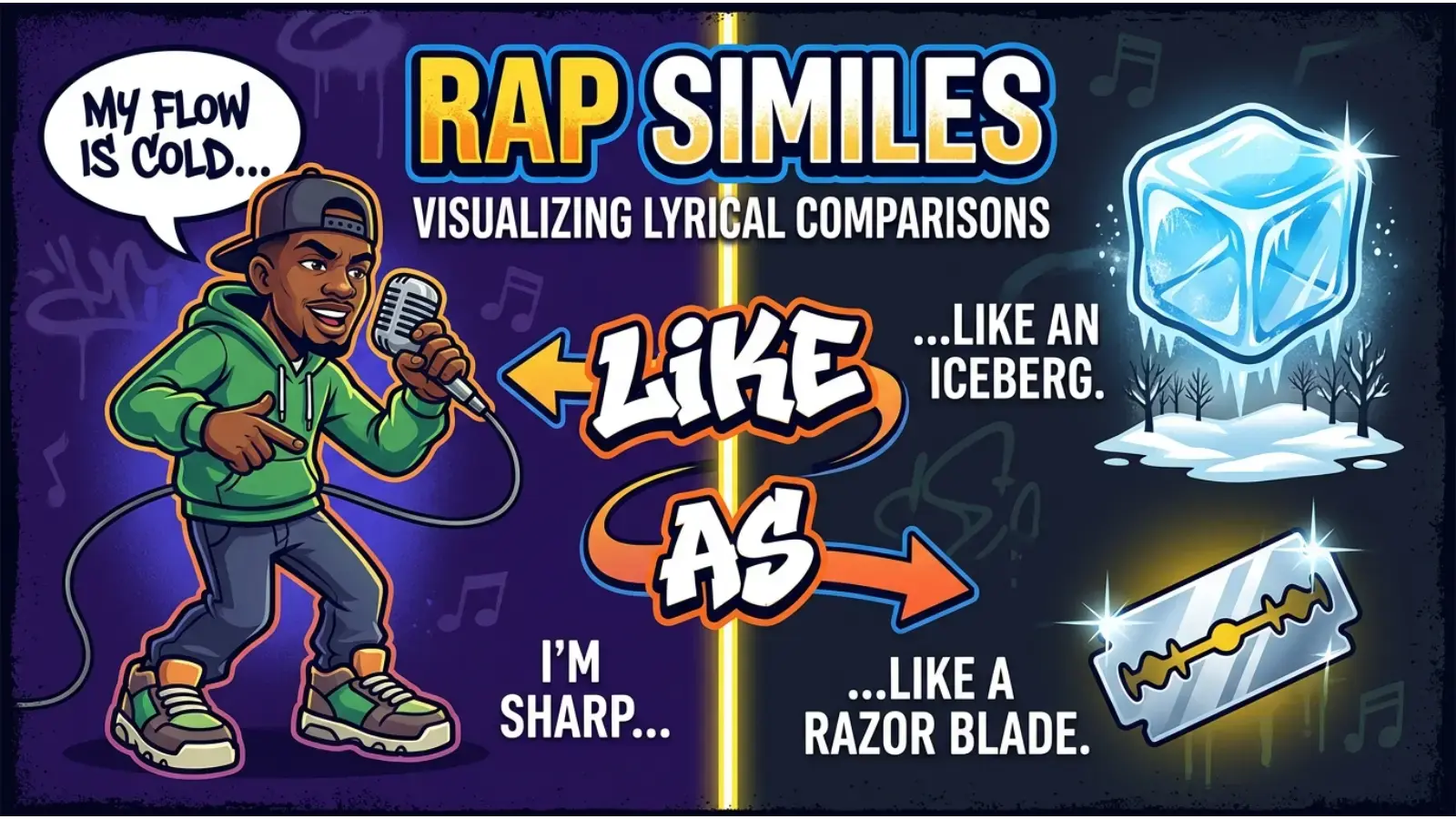
Rap Similes are one of the easiest ways to make language more vivid. By comparing one thing to another with words such as “like” or “as,” writers can turn an ordinary statement into an image readers can hear, feel, or picture.
In Rap Similes music, that effect becomes even stronger. A good Rap Similes can give a lyric attitude, emotion, rhythm, or personality. Rap artists often use comparisons to make confidence sound larger, heartbreak feel sharper, or an ordinary moment become memorable.
This guide focuses especially on rap similes and similes in music, while also exploring useful comparisons for happiness, friendship, rain, love, anger, everyday writing, and humor. The examples are original so you can study how they work without simply copying familiar phrases.
What Is a Simile?
A Rap Similes directly compares two different things using words such as like or as.
For example:
Her voice moved through the room like warm light through a window.
The voice is not literally light. The comparison helps the reader imagine its gentle, comforting quality.
A Rap Similes usually has three parts:
- The subject: what you are describing
- The comparison: what you connect it to
- The shared quality: the characteristic both have in common
The strongest Rap Similes do more than say that two things are similar. They reveal how they are similar.
Why Similes Work So Well in Rap and Music
Music depends on more than literal information. Lyrics need images that listeners can understand quickly.
Consider the difference between:
I was nervous before the performance.
and:
My nerves bounced like coins in a dryer.
The second sentence gives the emotion movement and sound.
Rap benefits especially from this technique because a compact comparison can communicate attitude without requiring a long explanation. A rapper can compare confidence to something unstoppable, pressure to something crushing, or ambition to something constantly moving.
A Rap Similes useful rule is this:
Don’t choose a comparison simply because it sounds impressive. Choose it because it reveals something about the subject.
Original Rap Similes for Powerful Lyrics
1. “My thoughts race like trains with no final station.”
Meaning: The speaker cannot easily stop thinking.
Why it works: Trains suggest speed, direction, and constant movement.
Best context: Reflective rap, storytelling, or verses about overthinking.
Writing tip: When describing thoughts, choose an image that moves rather than one that simply looks interesting.
2. “I walk into the beat like thunder through a quiet street.”
This comparison creates contrast. The quiet street establishes stillness, while thunder suddenly introduces power.
It works well for an entrance, performance, or moment when a rapper changes the energy of a track.
3. “My ambition burns like a streetlight before sunrise.”
The image suggests determination that remains active while everything around it is still dark.
It is particularly useful for motivational lyrics because it avoids the obvious comparison between ambition and fire.
4. “My words cut through the silence like a train whistle.”
The comparison emphasizes how sharply a voice can interrupt a quiet moment.
Writing purpose: Use it when the lyric needs presence or urgency.
5. “I stack every lesson like bricks for a higher wall.”
Here, learning becomes construction. The comparison suggests that experience gradually creates strength.
This works especially well in autobiographical rap.
6. “The bass hit my chest like a door kicked open.”
This is a physical simile. Instead of merely saying the bass was loud, it shows what the sound feels like.
Best context: Concert descriptions, energetic verses, and music reviews.
7. “My doubts follow like shadows at noon.”
A shadow is normally associated with darkness, but the phrase “at noon” makes the comparison more interesting because even bright conditions cannot completely remove it.
Writing lesson: Familiar objects can become fresh when you place them in an unexpected situation.
8. “I bend around the pressure like wire in a storm.”
The comparison communicates resilience without claiming that the speaker is completely unaffected by difficulty.
That distinction makes the image more believable.
9. “My memories flicker like old signs outside a closed shop.”
This gives memory a visual quality while suggesting something distant or fading.
Best context: Nostalgic storytelling and emotional rap.
10. “The crowd rose like waves behind a speeding boat.”
This creates movement and excitement.
It also demonstrates an important musical-writing technique: use comparisons that naturally contain motion when the song itself feels energetic.
Similes for Happiness That Feel Fresh
Happiness does not always need to be described with sunshine, smiles, or fireworks. More specific images often create stronger writing.
11. “Her happiness opened like curtains on a bright morning.”
The comparison suggests gradual revelation rather than instant excitement.
12. “His laugh bounced like a rubber ball across the room.”
This gives happiness sound and movement.
13. “The good news spread through me like warm tea on a cold afternoon.”
The image emphasizes comfort rather than wild excitement.
14. “Their faces lit up like windows in a dark neighborhood.”
The comparison makes happiness visible without simply saying someone looked happy.
15. “Joy moved through the room like music from an open window.”
This works particularly well in poetry because sound and emotion become connected.
16. “My weekend felt as light as a balloon released into clear air.”
The comparison communicates freedom and relief.
Writing tip: Happiness has many forms. Before creating a simile, decide whether your character feels relieved, excited, peaceful, proud, playful, or grateful. Then choose an image that matches that specific emotion.
Similes for Friendship
Good friendship similes often communicate reliability, comfort, trust, or shared history.
17. “Our friendship fits like two keys on the same ring.”
The image suggests that the friends belong naturally together without implying that they are identical.
18. “You stood beside me like a porch light after dark.”
A porch light suggests welcome, guidance, and reassurance.
19. “Our conversations wander like roads with no locked gates.”
This emphasizes openness and ease.
20. “We laughed like two old songs playing from the same radio.”
The comparison suggests familiarity and shared history.
21. “Her advice landed like a compass in unfamiliar country.”
This is useful when describing a friend who provides direction during uncertainty.
22. “Their friendship grew like vines around an old fence.”
The comparison suggests something that develops gradually and becomes intertwined with everyday life.
Writing lesson: Strong friendship imagery often focuses on what the relationship does, not simply how close the people are.
Similes for Rain
Rain offers enormous creative possibilities because it can represent calm, sadness, renewal, loneliness, romance, or change.
23. “Rain tapped the roof like impatient fingers.”
The comparison gives the weather a rhythmic quality.
24. “The drizzle hung over the town like a gray curtain.”
This creates a muted, enclosed atmosphere.
25. “Rain rushed down the street like children late for school.”
The unusual human comparison creates speed and personality.
26. “The first drops fell like tiny knocks on the window.”
This is effective for a quiet opening scene.
27. “Heavy rain rolled across the fields like a dark blanket.”
The image creates a broad sense of coverage.
28. “Rain glittered on the pavement like scattered pieces of glass.”
This focuses on the visual effect after rainfall.
Writing tip: Don’t automatically make rain sad. The same weather can support completely different emotions depending on the surrounding details.
Similes for Love
Love becomes more interesting in writing when the comparison captures a particular experience rather than trying to define love completely.
29. “Her kindness settled over me like a familiar song.”
This suggests comfort and emotional recognition.
30. “Their love grew like a garden nobody hurried.”
The comparison emphasizes patience and gradual development.
31. “His presence felt like a lamp left on in an empty hallway.”
The image suggests reassurance and warmth.
32. “Their memories clung like perfume to an old jacket.”
This works especially well for reflective writing because scent can trigger memories.
33. “Her words warmed the room like sunlight through winter glass.”
The comparison combines emotional warmth with a specific physical image.
34. “Their bond held firm like a knot tied before a long journey.”
This focuses on commitment and durability.
Writing lesson: Avoid trying to make every love simile grand. Quiet comparisons can sometimes feel more genuine than enormous declarations.
Similes for Anger
Anger can be loud, but it can also be controlled, hidden, or slowly growing.
35. “His anger waited like a match beside dry paper.”
The image suggests potential rather than immediate explosion.
36. “Her voice shook like a window in strong wind.”
This communicates anger through a physical detail.
37. “The argument spread like sparks across dry grass.”
The comparison shows how quickly conflict can grow.
38. “His frustration pressed down like a heavy backpack.”
This presents anger as exhausting rather than explosive.
39. “Her words struck the table like thrown stones.”
The image creates force and sharpness.
40. “Silence sat between them like a locked door.”
This is useful when anger is being expressed through withdrawal rather than shouting.
Writing tip: Ask what anger looks like in the scene. Is it hot, cold, restless, controlled, sudden, or exhausted? Your answer should determine the comparison.
Funny Similes for Songs, Stories, and Everyday Writing
Humor often comes from an unexpected comparison.
41. “He ran like a phone at one percent battery.”
The joke comes from connecting human urgency with a familiar modern problem.
42. “My room looked like a tornado had a shopping list.”
The comparison exaggerates disorder while giving the tornado a humorous personality.
43. “She stared at the homework like it had personally betrayed her.”
This uses personification alongside a comic comparison.
44. “He danced like a robot trying to remember the instructions.”
The image works because it combines movement with awkwardness.
45. “My alarm sounded like a tiny lawyer arguing my case against sleep.”
The comparison turns an ordinary alarm into an annoying character.
46. “The dog guarded the sandwich like it was a priceless museum painting.”
The humor comes from the enormous importance given to an ordinary object.
Writing tip: Funny similes often become stronger when there is a large gap between the two things being compared.
Common Similes That Writers Still Use Effectively
Not every simile has to be completely unusual. Familiar comparisons can work when they are appropriate for the audience and context.
Examples include:
- as busy as a bee
- as quiet as a mouse
- as cold as ice
- as light as a feather
- as fast as lightning
- like a fish out of water
- like a needle in a haystack
- like two peas in a pod
These are useful because readers understand them immediately. The problem comes when a writer depends on familiar comparisons too often.
For important creative writing, try asking:
Can I replace this familiar image with a more specific one?
Instead of:
He was as nervous as a cat.
Try:
His fingers kept tapping the desk like rain trapped inside a tin roof.
The second version gives the reader something more specific to imagine.
How to Make a Simile More Vivid
A strong simile usually begins with a precise observation.
Suppose you want to describe a person walking slowly.
A weak comparison might be:
She walked slowly like a turtle.
That works, but it is predictable.
A more developed image could be:
She moved through the hallway like someone carrying a glass full to the edge.
Now the comparison suggests care, tension, and caution.
The key difference is specificity.
When creating a simile, ask:
- What exactly am I trying to show?
- What physical quality represents that feeling?
- What unusual object shares that quality?
- Can I make the image more specific?
- Does the comparison fit the tone of the scene?
How Professional Writers Avoid Forced Similes
A simile becomes forced when the comparison exists mainly because the writer wants to sound poetic.
For example:
The sandwich was like a mysterious galaxy of emotional destiny.
Unless the context is intentionally absurd, the comparison does not help the reader understand the sandwich.
A better comparison might be:
The sandwich was stacked like a tiny construction site.
The image gives the reader a reason to visualize it.
A useful test: Remove the simile. If the sentence becomes clearer and nothing important is lost, the comparison may not be necessary.
Use Concrete Details
Compare:
The city was beautiful like a dream.
with:
The city glittered like a tray of coins beneath the evening lights.
The second version gives the reader a concrete visual experience.
Match the Simile to the Speaker
A child’s comparison, a comedian’s comparison, and a serious rapper’s comparison should not necessarily sound the same.
Voice matters.
A streetwise narrator might choose urban imagery. A nature-loving character might naturally compare things to rivers, birds, trees, or weather.
The best simile feels as though that particular speaker would actually think of it.
Similes in Music: More Than Just Decoration
In songwriting, a simile can perform several jobs at once.
It can establish mood:
The room felt like winter before the first snow.
can reveal character:
He guarded his secrets like keys to a locked room.
It can create rhythm:
We move like waves, rise like smoke, disappear with the dawn.
It can also create a memorable image that stays with the listener after the song ends.
However, lyrics have an additional constraint that ordinary prose does not always have: sound.
When writing a musical simile, read it aloud. Listen for:
- syllable count
- stressed words
- repeated sounds
- awkward clusters of consonants
- phrases that are difficult to perform
- whether the comparison lands on an important beat
A beautiful simile that is impossible to say naturally may need revision.
Rap Similes and Rhyme: Don’t Sacrifice Meaning for Sound
Rhyming can tempt writers to choose a comparison simply because the final word fits.
That can produce awkward lyrics.
Instead, build the image first and polish the rhyme afterward.
For example, decide that you want to compare persistence to a river. Then search for a line that naturally develops the idea rather than forcing a random rhyme around “river.”
The strongest rap similes usually combine image, attitude, rhythm, and meaning.
A Simple Rap-Writing Exercise
Write four lines about ambition.
First, describe ambition literally.
Then create three comparisons:
- one involving nature
- one involving a machine
- one involving an everyday object
Choose the comparison that best fits the rapper’s personality.
This exercise teaches an important lesson: the best simile is not always the most complicated one.
Simile vs. Metaphor
A simile makes a direct comparison using words such as like or as.
Her voice was like velvet.
A metaphor makes the comparison more directly:
Her voice was velvet.
Both can create imagery, but they produce slightly different effects.
A simile reminds the reader that the two things are being compared. A metaphor can feel more immediate and absolute.
Simile vs. Hyperbole
Hyperbole is deliberate exaggeration.
I waited a million years for the bus.
That sentence is not normally meant literally.
A simile can contain exaggeration, but its main function is comparison.
The bus arrived like a miracle after a century of waiting.
Here, the comparison creates the image while the surrounding wording can still exaggerate the speaker’s frustration.
How to Create Your Own Original Similes
Try this five-step method.
Step 1: Identify the exact quality
Don’t begin with “What sounds poetic?”
Begin with:
What am I actually describing?
Maybe it is nervousness, speed, loneliness, confidence, confusion, or excitement.
Step 2: List physical examples
If the feeling is nervousness, think about things that shake, race, tighten, flicker, or refuse to stay still.
Step 3: Look beyond obvious choices
Don’t stop at hearts, storms, fire, oceans, or stars.
Look at:
- kitchen objects
- traffic
- technology
- architecture
- animals
- tools
- sports
- weather
- sounds
- ordinary household objects
Step 4: Test the emotional effect
A comparison should create the right feeling.
A soft image may weaken an angry scene. A violent image may overwhelm a gentle romantic moment.
Step 5: Read it aloud
Especially for rap and music, sound matters.
If you stumble over the sentence, revise it.
Three Creative Exercises for Better Similes
Exercise 1: One Emotion, Five Images
Choose one emotion such as happiness.
Write five comparisons using completely different categories:
- nature
- technology
- food
- architecture
- sound
You might discover that one category produces much stronger imagery than the others.
Exercise 2: Upgrade a Cliché
Take a familiar simile such as:
She was as quiet as a mouse.
Keep the basic idea of quietness, but replace the mouse with something unexpected.
The goal is not to make the comparison strange for its own sake. Make it more specific.
Exercise 3: Write From a Character’s Perspective
Imagine a teenager, musician, athlete, teacher, comedian, or detective describing the same rainy afternoon.
Each person should notice different things.
This teaches you that a simile is not only about imagery. It is also about point of view.
Common Mistakes Writers Make With Similes
Using Too Many Comparisons
A paragraph packed with similes can become exhausting.
If every sentence contains a comparison, none of them receives enough attention.
Use your strongest image and let it breathe.
Mixing Images
Be careful with sentences that combine unrelated comparisons:
Her anger exploded like a frozen river burning through the room.
The images compete rather than reinforce each other.
Choose one central picture.
Choosing a Comparison That Doesn’t Fit
A comparison can be technically understandable while still feeling emotionally wrong.
A peaceful scene probably does not need an image associated with violence unless the contrast is intentional.
Explaining the Simile Too Much
Sometimes writers create a strong image and then immediately explain it.
Trust the reader when the image is clear.
Confusing Similes With Metaphors
Remember:
Simile: He moved like a shadow.
Metaphor: He was a shadow.
The distinction is simple, but knowing it helps you control the effect of your writing.
Making Every Simile Sound Poetic
Not every comparison needs to be beautiful.
A funny, awkward, strange, or ordinary comparison can be more effective when it matches the speaker.
Frequently Asked Questions About Similes
What are similes in rap?
Similes in rap are comparisons that commonly use like or as to make lyrics more vivid, memorable, emotional, or forceful. They can describe confidence, struggle, relationships, ambition, places, or personal experiences.
What is an example of a simile in music?
An original example is:
“The bass hit my chest like a door kicked open.”
The comparison turns a sound into a physical experience, helping the listener imagine its intensity.
Why do rappers use similes?
Rappers use similes to communicate ideas quickly while adding imagery, personality, rhythm, and attitude to their lyrics. A strong comparison can make an abstract idea easier to visualize.
What are some good similes for happiness?
Examples include:
“Her happiness opened like curtains on a bright morning.”
and:
“The good news spread through me like warm tea on a cold afternoon.”
The best choice depends on whether the happiness is peaceful, exciting, playful, or relieving.
What are some similes for love?
Love can be compared to familiar experiences, places, sounds, or objects. For example:
“Her kindness settled over me like a familiar song.”
Specific comparisons tend to feel more personal than generic declarations.
How can I make my similes less cliché?
Start with the quality you want to describe, then search for less obvious objects that share that quality. Specific observations from everyday life often produce fresher comparisons than familiar poetic images.
Can a simile be funny?
Absolutely. Humor often comes from comparing something ordinary to something unexpectedly dramatic:
“The dog guarded the sandwich like it was a priceless museum painting.”
The contrast creates the joke.
Conclusion
The best similes do not simply decorate sentences. They change how readers experience an idea. In rap and other music, a carefully chosen comparison can give a lyric movement, attitude, emotion, or sound. A everyday writing, similes can make descriptions clearer and more memorable. In poetry and storytelling, they can reveal character and create atmosphere. Start with the feeling or quality you want to communicate. Look closely at the world around you. Find an object, sound, movement, or situation that shares that quality. Then test the comparison until it feels natural. A fresh simile does not need to be complicated. It only needs to make the reader see something they might not have noticed before.

I am Helena Frost, a writer captivated by the beauty of language and the art of comparison. Through my words, I explore the world by turning ordinary moments into vivid similes and reflections. I enjoy crafting phrases that spark imagination, evoke emotion, and linger in the mind. My writing celebrates the subtle connections between people, nature, and the stories we live. For me, every sentence is an opportunity to reveal the extraordinary in the everyday.