KMS meaning in text can be confusing because this short slang term can have a very serious meaning depending on the conversation. People commonly see “KMS” in text messages, comments, group chats, gaming conversations, and social media posts.
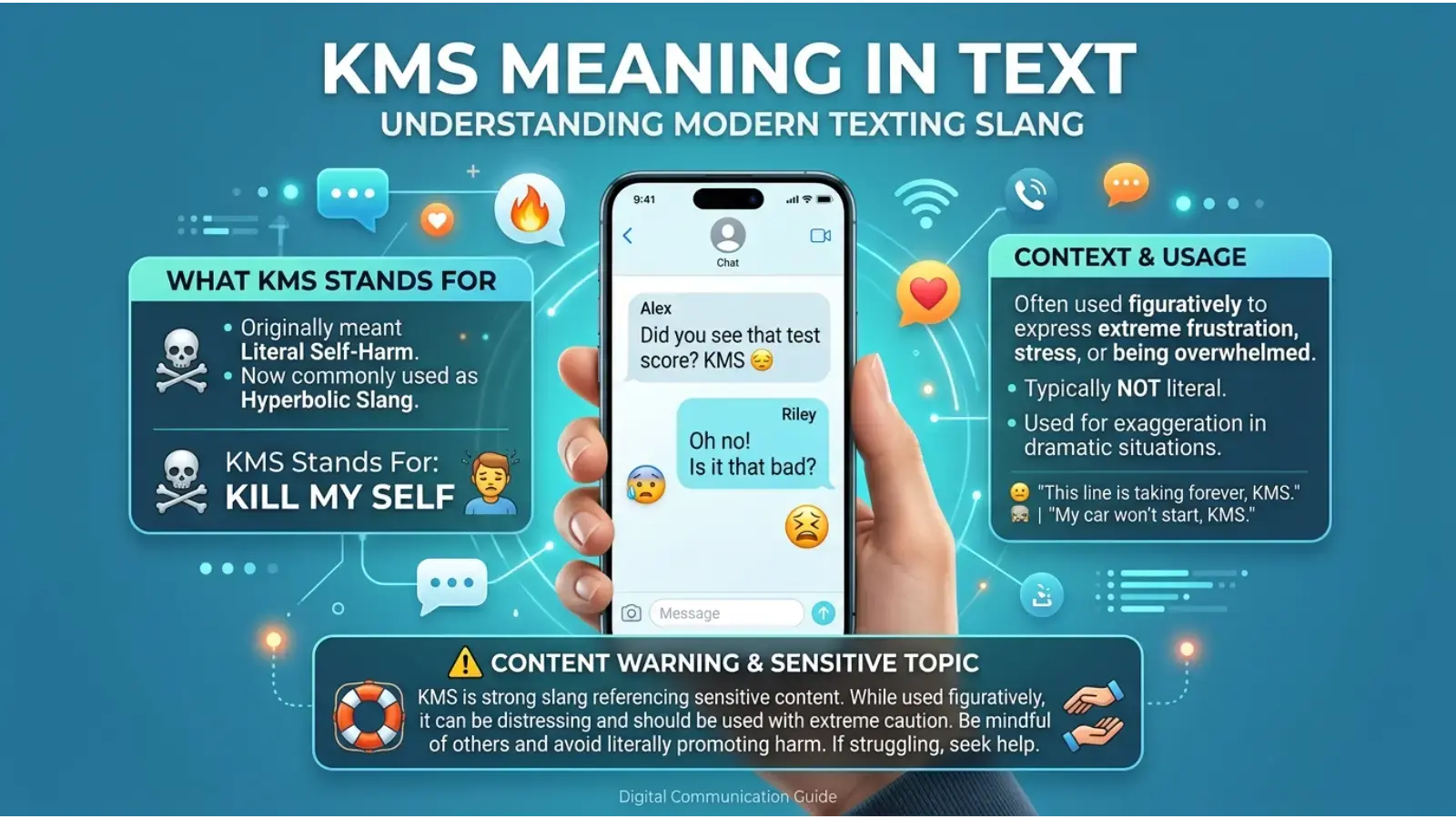
In most online conversations, KMS stands for “kill myself.” However, people sometimes use it jokingly or dramatically to express embarrassment, frustration, stress, or annoyance. Because the phrase literally refers to suicide, it should not automatically be treated as harmless slang.
The meaning depends heavily on the person’s words, tone, and situation. If someone uses KMS seriously or repeatedly, it may be a sign that they need support rather than a phrase to joke about.
Quick Answer
KMS meaning in text is usually “kill myself.” It is often used online to express extreme frustration or embarrassment, but it can also indicate genuine emotional distress, so context matters.
What Does KMS Mean in Text?
The most common KMS meaning slang is “kill myself.”
KMS is an abbreviation formed from the first letters of the phrase:
- K = Kill
- M = Myself
- S = Self
For example:
“I just sent the message to the wrong person. KMS.”
In this example, the person may be using KMS as an exaggerated way to say they are extremely embarrassed.
However, because the phrase has a literal connection to suicide, it is important not to assume that every use is simply a joke.
KMS Full Form and Definition
The common KMS full form in texting is “kill myself.”
It is internet slang rather than formal English. You may see it in:
- Text messages
- Snapchat
- TikTok comments
- Instagram comments
- Discord
- Gaming chats
- Group chats
- Online forums
- Memes
The abbreviation saves time and is easy to type, but its meaning can be emotionally serious.
Meaning of KMS in Different Contexts
1. KMS as a Joke
Some people use KMS as exaggerated internet humor.
Example:
“I studied all night and the exam was canceled. KMS.”
Here, the speaker may simply be expressing extreme frustration.
2. KMS After Embarrassment
KMS can also appear when someone makes an embarrassing mistake.
Example:
“I called my teacher ‘Mom’ today. KMS.”
The person is probably expressing embarrassment rather than literally stating an intention to die.
3. KMS During an Argument
In a heated conversation, KMS can have a more concerning meaning.
Example:
“I can’t deal with this anymore. KMS.”
Unlike a humorous example, this statement may indicate genuine emotional distress. The surrounding conversation should be taken seriously.
4. KMS in Gaming
Gamers sometimes use exaggerated slang when they lose, make a mistake, or experience something frustrating.
Example:
“I missed the final shot. KMS.”
Again, this may be casual internet slang, but the phrase itself has a serious literal meaning.
Is KMS Rude, Offensive, or Neutral?
KMS is generally considered informal and potentially offensive or disturbing.
It is not a neutral abbreviation like “BRB” or “LOL.” Since it refers to suicide, using it casually can make other people uncomfortable, especially those who have experienced serious emotional difficulties.
Whether it is considered offensive depends on:
- The situation
- The relationship between speakers
- The person’s intention
- The platform
- The audience
- The seriousness of the conversation
For professional, school, or formal communication, it is best to avoid KMS.
Where Is KMS Commonly Used?
KMS is especially common in informal online communication.
You might encounter it on:
- Social media
- Messaging apps
- Gaming platforms
- Discord servers
- Meme pages
- Group chats
- Comment sections
It is much less appropriate in formal emails, workplace communication, academic writing, or professional conversations.
Real-Life Examples of KMS
Friendly or Humorous
“I forgot my friend’s birthday. KMS 😭”
This may be exaggerated humor between friends.
Casual
“KMS, I have three assignments due tomorrow.”
The speaker may be expressing stress dramatically.
Argumentative
“Everyone is blaming me for this. KMS.”
This context is more emotionally serious and deserves attention.
Embarrassing Situation
“I waved back at someone who wasn’t waving at me. KMS.”
The person may be joking about embarrassment.
Gaming Context
“I fell off the map again. KMS.”
The phrase may be used as exaggerated frustration.
Emotional and Psychological Meaning
KMS can sometimes be more than internet slang.
When someone says “KMS” repeatedly, talks about wanting to die, says goodbye unusually, expresses hopelessness, or describes a plan to hurt themselves, it should not be dismissed as a meme.
A supportive response is more appropriate than making fun of the person or ignoring the statement.
You can respond with something simple such as:
“Are you okay? Do you mean that seriously?”
Or:
“I’m here if you want to talk.”
If there appears to be immediate danger, encourage the person to contact local emergency services or a trusted person who can stay with them.
Origin and Background of KMS
KMS developed as part of the broader culture of internet abbreviations and text slang. Online users frequently shorten phrases to communicate quickly, particularly in fast-moving chats, gaming communities, and social media.
The abbreviation became associated with dark humor and exaggerated expressions of frustration. Over time, it appeared in memes and casual conversations.
However, its literal meaning has remained serious. This is why context is especially important when interpreting KMS.
KMS vs. Similar Slang Terms
| Slang | Common Meaning | Typical Use |
|---|---|---|
| KMS | Kill myself | Extreme frustration, dark humor, or possible distress |
| LOL | Laughing out loud | Humor or amusement |
| SMH | Shaking my head | Disappointment or disbelief |
| OMG | Oh my God | Surprise or shock |
| I can’t | I can’t deal with this | Frustration or amusement |
| I’m done | I’m finished / can’t continue | Frustration, exhaustion, or joking |
KMS is different from most everyday slang because its literal meaning involves self-harm. That makes it more sensitive than ordinary internet abbreviations.
When Should You Avoid Using KMS?
It is generally better to avoid KMS when:
- You are speaking professionally.
- You are talking to someone you barely know.
- You do not know how the other person may interpret it.
- You are discussing mental health.
- You are communicating with children or vulnerable people.
- You are posting publicly.
- The statement could be misunderstood as a genuine threat to yourself.
Even if you intend it as a joke, someone reading it may interpret it literally.
Polite Alternatives to KMS
If you simply want to express frustration or embarrassment, consider safer alternatives:
- “I’m so embarrassed.”
- “I can’t believe I did that.”
- “I’m done 😭.”
- “This is so frustrating.”
- “I can’t deal with this.”
- “I’m freaking out.”
- “That was so awkward.”
- “I need a break.”
These alternatives communicate emotion without referring to suicide.
Why Do People Use KMS?
People may use KMS for several reasons:
- Humor — Some internet communities use dark humor.
- Frustration — A person may be extremely annoyed.
- Embarrassment — They may have made an awkward mistake.
- Stress — They may feel overwhelmed.
- Attention — Some users use dramatic language to get a reaction.
- Genuine distress — Sometimes the phrase is meant literally.
The words alone cannot always tell you which meaning applies.
Impact of KMS on Communication
Using KMS casually can create misunderstandings.
For example, one person may think:
“They’re just joking.”
Another person may think:
“They might actually be in danger.”
This difference can make conversations uncomfortable or even prevent someone from receiving help when they genuinely need it.
For that reason, clearer language is often better.
Is KMS Safe for Social Media?
KMS is not ideal for public social media because posts and comments can be read without the original context.
A short comment such as:
“KMS 😭”
might be intended as a joke, but another person may interpret it as a genuine statement of suicidal thoughts.
Some platforms may also have rules or moderation systems concerning self-harm-related language.
If you are simply expressing frustration, choose clearer and less harmful wording.
Common Misunderstandings About KMS
Misunderstanding 1: KMS Always Means a Serious Suicide Threat
Not necessarily. Online users sometimes use KMS as exaggerated slang.
However, you should never assume it is only a joke when the surrounding conversation suggests genuine distress.
Misunderstanding 2: KMS Is a Normal Replacement for LOL
It is not. KMS carries a much more serious meaning than ordinary laughter or reaction slang.
Misunderstanding 3: KMS Is Appropriate Everywhere
It is primarily informal internet slang. It is not suitable for professional or formal communication.
Variations and Types of KMS Usage
The abbreviation can appear in different forms, including:
- “kms”
- “KMS”
- “kms rn”
- “I kms”
- “I’m gonna kms”
- “kms lol”
Adding other words can change the tone, but the underlying abbreviation usually refers to the same phrase.
For example, “kms rn” means something like “kill myself right now,” which can sound more serious than a simple humorous use.
How to Respond When Someone Uses KMS
Your response should depend on context.
If It Clearly Sounds Like a Joke
You can acknowledge the frustration without repeating the harmful phrase.
“That sounds really frustrating.”
If You’re Unsure
Ask directly but calmly:
“Are you okay? Do you mean that seriously?”
If It Sounds Serious
Take the person seriously. Encourage them to reach out to someone they trust and seek immediate professional or emergency help if they may be in danger.
Do not mock them or tell them that they are “just being dramatic.”
Regional and Cultural Usage
KMS is primarily associated with internet and English-language slang, but online slang can spread quickly across countries and cultures.
Its interpretation can differ depending on:
- Age
- Online community
- Country
- Language background
- Friend group
- Platform
Someone familiar with internet culture may recognize KMS as dark humor, while someone unfamiliar with online slang may interpret it literally.
This is another reason context matters.
FAQs About KMS Meaning in Text
What does KMS stand for in texting?
KMS usually stands for “kill myself.” It is informal internet slang and can be used either jokingly or seriously.
What is the KMS full form?
The common KMS full form is “kill myself.”
What does KMS mean on social media?
On social media, KMS is often used as an exaggerated reaction to embarrassment, frustration, stress, or an unpleasant situation. However, it can also indicate genuine distress.
Is KMS a bad word?
KMS is not a traditional swear word, but it refers to suicide and can be disturbing or offensive in some situations. It is best avoided in formal communication.
Is KMS appropriate in school or work messages?
Generally, no. KMS is informal and can easily be misunderstood. Use clear language such as “I’m really frustrated” instead.
What should I do if someone uses KMS seriously?
Take the statement seriously, ask whether they are safe, and encourage them to contact a trusted person or appropriate professional or emergency support if they may be in immediate danger.
Conclusion
Understanding KMS meaning in text requires more than simply knowing the abbreviation. KMS usually means “kill myself,” and people may use it as internet slang to express embarrassment, frustration, stress, or dark humor. However, because the phrase has a serious literal meaning, context and tone are extremely important.
If someone uses KMS casually, safer alternatives such as “I’m so embarrassed” or “I can’t deal with this” can communicate the same emotion without using self-harm language. If someone appears genuinely distressed, do not assume they are joking. Take their words seriously and respond with care.
In short, KMS is informal, sensitive slang that should be used carefully—or avoided altogether when clearer wording is possible.