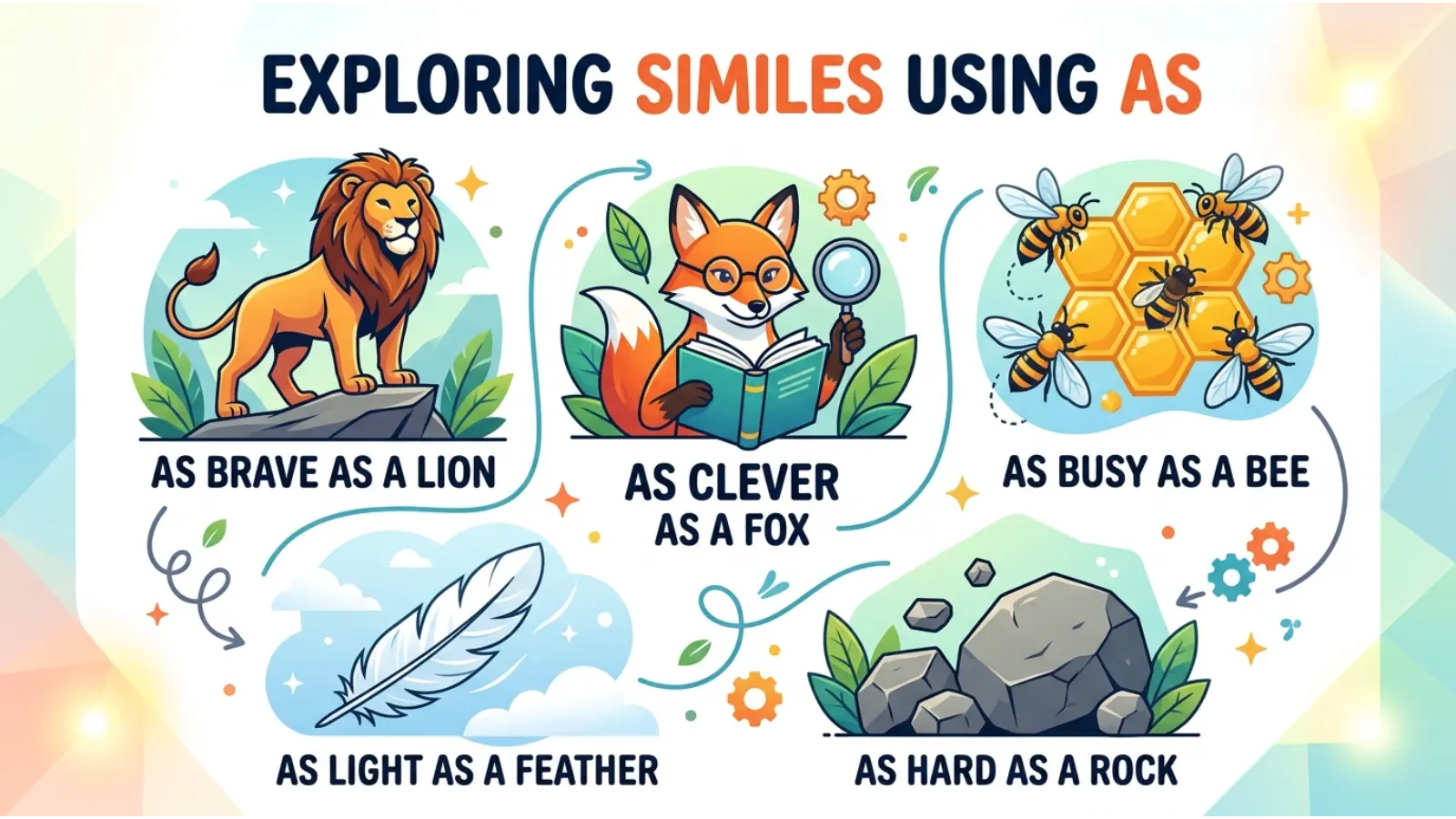
Similes Using As make ordinary descriptions more vivid by comparing one thing with another using words such as “like” or “as.” They appear in poetry, songs, stories, everyday conversation, speeches, and creative nonfiction because a well-chosen comparison can make an idea easier to picture and feel.
Similes using “as” are especially useful when you want a description to sound natural and memorable. Instead of simply saying someone is calm, for example, you can show that calmness through an image the reader can immediately imagine.
This guide explores original “as” similes, explains why they work, and shows how to adapt them for stories, poetry, conversation, and other forms of writing.
What Is a Simile Using “As”?
A simile using “as” compares two different things with a structure such as “as + adjective + as.”
For example:
As quiet as snowfall settling on a roof.
The comparison does more than say something is quiet. It gives the reader a sensory image of silence.
A useful formula is:
as + describing word + as + vivid image
The strongest similes do not merely match two things because they share a basic quality. They create an image that adds mood, personality, or meaning.
Why “As” Similes Make Descriptions Stronger
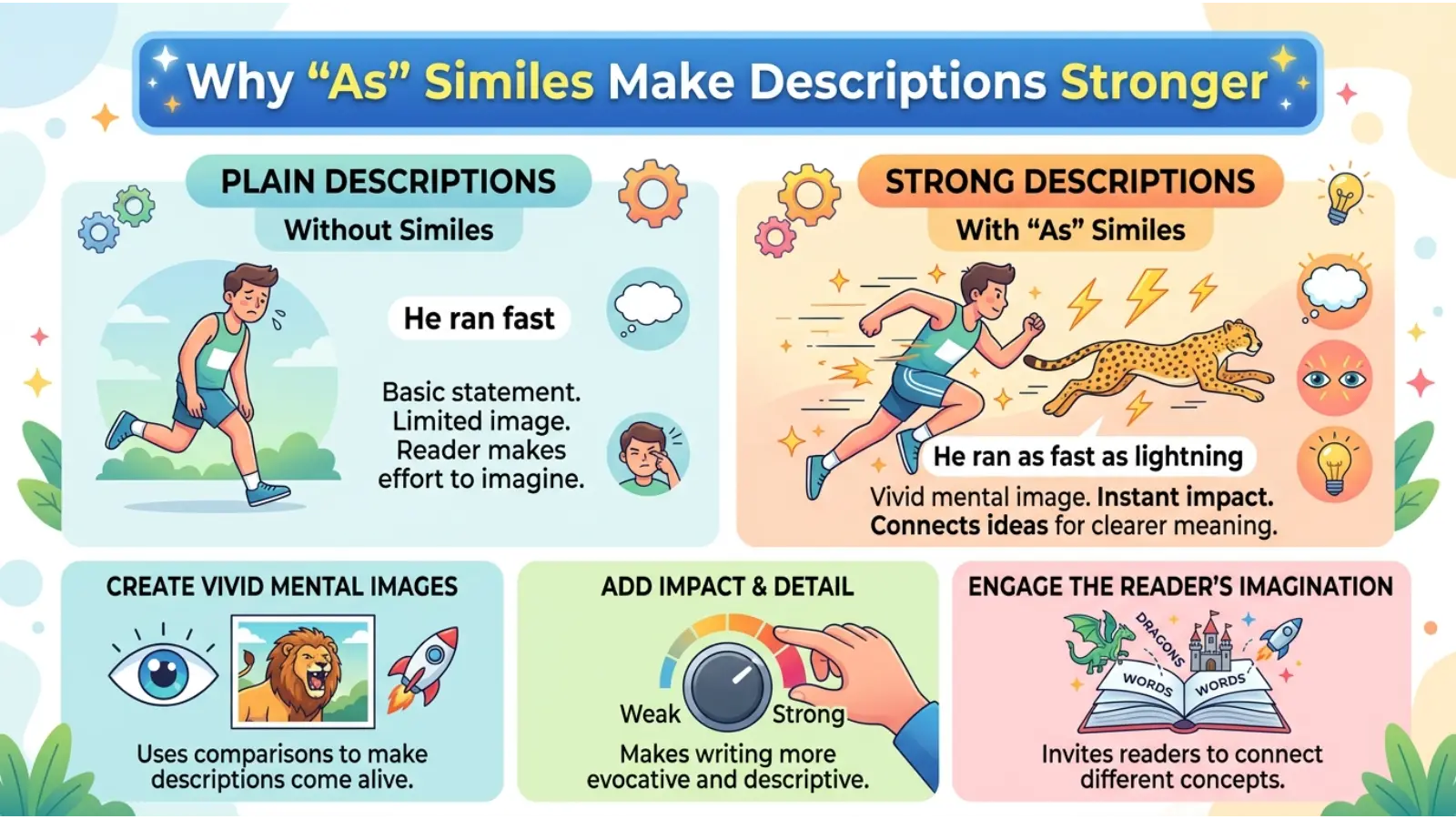
Compare these two sentences:
The room was quiet.
The room was as quiet as an empty theater after the final curtain.
The second sentence gives the reader somewhere to go mentally. It suggests stillness, space, and perhaps a feeling of absence.
That is the central value of a good simile: it turns an abstract quality into something readers can experience through imagination.
30 Original Similes Using “As”
1. As Bright as a Window Full of Morning
Meaning: Extremely cheerful, energetic, or full of light.
Example:
Her expression was as bright as a window full of morning.
The classroom felt as bright as a window full of morning after the storm passed.
Writing purpose: This works especially well for happiness, hope, optimism, and fresh beginnings.
Tip: Use light-based comparisons when you want a scene to feel uplifting without simply writing “happy.”
2. As Quiet as Snowfall Settling on a Roof
Meaning: Completely or almost completely silent.
Example:
The library was as quiet as snowfall settling on a roof.
For a moment, the entire house was as quiet as snowfall settling on a roof.
Emotional effect: Peaceful, reflective, and slightly mysterious.
Best context: Poetry, descriptive prose, nighttime scenes, and moments of calm.
3. As Restless as a Kite Tugging at Its String
Meaning: Unable to settle down or remain still.
Example:
He was as restless as a kite tugging at its string.
The children were as restless as kites tugging at their strings before the picnic began.
Why it works: A kite constantly pulling against its string creates a clear physical image of impatience and movement.
4. As Gentle as Rain on a Tent
Meaning: Soft, comforting, and soothing.
Example:
Her voice was as gentle as rain on a tent.
The music sounded as gentle as rain on a tent in the middle of the night.
Best context: Love, friendship, comfort, bedtime scenes, and reflective writing.
5. As Nervous as a Compass Near a Magnet
Meaning: Extremely uncertain or unable to settle on a direction.
Example:
Before the interview, I felt as nervous as a compass near a magnet.
He was as nervous as a compass near a magnet when the results were announced.
Writing purpose: This is useful when ordinary words such as “worried” or “uncertain” feel too flat.
6. As Happy as Sunlight Through Colored Glass
Meaning: Filled with colorful, energetic happiness.
Example:
The festival was as happy as sunlight through colored glass.
Her laughter made the kitchen feel as happy as sunlight through colored glass.
Emotional effect: Warm, playful, colorful, and optimistic.
7. As Loyal as a Shadow at Noon
Meaning: Consistently present and dependable.
Example:
His friend was as loyal as a shadow at noon.
She remained as loyal as a shadow at noon through every difficult season.
Writing tip: Friendship similes become stronger when they show a behavior rather than merely saying “good friend.”
8. As Angry as a Storm Trapped Behind Glass
Meaning: Intensely angry while being unable to release that emotion.
Example:
He stood there as angry as a storm trapped behind glass.
She looked as angry as a storm trapped behind glass but said nothing.
Why it works: The storm suggests force, while the glass suggests restraint. Together they create emotional tension.
9. As Fast as a Thought Before It Finds Words
Meaning: Extremely quick.
Example:
The idea arrived as fast as a thought before it finds words.
The runner disappeared from sight as fast as a thought before it finds words.
Best context: Creative writing, action scenes, poetry, and descriptions of sudden movement.
10. As Cold as Moonlight on an Empty Road
Meaning: Very cold or emotionally distant.
Example:
The hallway felt as cold as moonlight on an empty road.
His reply was as cold as moonlight on an empty road.
Writing purpose: The same image can describe physical temperature or emotional distance.
11. As Curious as a Cat Discovering a Locked Door
Meaning: Extremely interested in finding out something unknown.
Example:
The students were as curious as cats discovering a locked door.
She became as curious as a cat discovering a locked door when she noticed the hidden drawer.
Best context: Children’s stories, mysteries, classroom writing, and humorous descriptions.
12. As Steady as a Lighthouse During Heavy Surf
Meaning: Calm and reliable despite difficult circumstances.
Example:
Her leadership was as steady as a lighthouse during heavy surf.
He remained as steady as a lighthouse during heavy surf while everyone else panicked.
Writing tip: For character development, compare a person to something that demonstrates the quality through action.
13. As Fragile as a Paper Boat on Rising Water
Meaning: Vulnerable and easily damaged.
Example:
Their plan was as fragile as a paper boat on rising water.
His confidence felt as fragile as a paper boat on rising water.
Emotional effect: Creates vulnerability and uncertainty.
14. As Funny as a Parrot Giving Serious Advice
Meaning: Naturally amusing or absurd.
Example:
His explanation was as funny as a parrot giving serious advice.
The scene became as funny as a parrot giving serious advice.
Best context: Humor, children’s writing, dialogue, social posts, and lighthearted storytelling.
15. As Warm as a Mug Between Cold Hands
Meaning: Comforting, welcoming, or physically warm.
Example:
The café felt as warm as a mug between cold hands.
Her welcome was as warm as a mug between cold hands.
Writing purpose: This comparison combines physical sensation with emotional comfort.
16. As Lonely as a Streetlight at Dawn
Meaning: Deeply isolated or alone.
Example:
He felt as lonely as a streetlight at dawn.
The old station looked as lonely as a streetlight at dawn.
Why it works: The image creates loneliness without directly explaining the character’s emotions.
17. As Excited as Fireworks Waiting for Darkness
Meaning: Full of anticipation and energy.
Example:
The children were as excited as fireworks waiting for darkness.
I felt as excited as fireworks waiting for darkness before the concert began.
Best context: Celebrations, anticipation, childhood memories, and dramatic openings.
18. As Careful as a Gardener Carrying a Seedling
Meaning: Extremely cautious and gentle.
Example:
She handled the old photograph as carefully as a gardener carrying a seedling.
He was as careful as a gardener carrying a seedling while repairing the instrument.
Writing tip: A concrete action often makes a comparison more believable than an abstract description.
19. As Confused as a Map in a Windstorm
Meaning: Completely uncertain about what to do or where to go.
Example:
I was as confused as a map in a windstorm.
The new student looked as confused as a map in a windstorm during the first week.
Best context: Funny situations, dialogue, personal essays, and storytelling.
20. As Proud as a Mountain Holding the Sunrise
Meaning: Filled with dignity, confidence, or satisfaction.
Example:
Her father looked as proud as a mountain holding the sunrise.
The young artist stood as proud as a mountain holding the sunrise beside her painting.
Emotional effect: Strong, dignified, and celebratory.
21. As Tender as a Song Played on an Old Piano
Meaning: Emotionally soft, delicate, and moving.
Example:
Their goodbye was as tender as a song played on an old piano.
The memory remained as tender as a song played on an old piano.
Best context: Love, friendship, nostalgia, poetry, and reflective prose.
22. As Loud as Thunder Inside a Small Room
Meaning: Extremely loud or impossible to ignore.
Example:
His laughter was as loud as thunder inside a small room.
The argument became as loud as thunder inside a small room.
Writing purpose: This comparison emphasizes not only volume but also the feeling of being overwhelmed by sound.
23. As Patient as a River Shaping Stone
Meaning: Willing to wait and continue steadily.
Example:
She was as patient as a river shaping stone.
Learning the new skill required being as patient as a river shaping stone.
Why it works: A river changes stone gradually, making patience visible through a natural process.
24. As Sharp as a Question No One Wants to Answer
Meaning: Intense, piercing, or mentally challenging.
Example:
His criticism was as sharp as a question no one wanted to answer.
The journalist’s final question was as sharp as a question no one wanted to answer.
Best context: Serious dialogue, essays, journalism-inspired fiction, and psychological scenes.
25. As Free as a Bird Crossing an Open Valley
Meaning: Completely unrestricted or independent.
Example:
After finishing the project, she felt as free as a bird crossing an open valley.
He dreamed of being as free as a bird crossing an open valley.
Writing tip: Freedom becomes more powerful when the comparison suggests movement without boundaries.
26. As Bitter as Coffee Left Forgotten
Meaning: Harsh, unpleasant, or emotionally resentful.
Example:
His words were as bitter as coffee left forgotten.
The ending felt as bitter as coffee left forgotten on a cold morning.
Emotional effect: Suggests disappointment or resentment without naming it directly.
27. As Mysterious as Footprints Ending at the Water
Meaning: Difficult to explain or understand.
Example:
The disappearance was as mysterious as footprints ending at the water.
Her sudden decision was as mysterious as footprints ending at the water.
Best context: Mystery stories, suspense, poetry, and intriguing introductions.
28. As Cheerful as a Window Open During Spring
Meaning: Pleasant, lively, and refreshing.
Example:
Her personality was as cheerful as a window open during spring.
The room felt as cheerful as a window open during spring.
Writing purpose: Useful for describing people, places, celebrations, and positive moods.
29. As Awkward as a Dance Step Learned Backward
Meaning: Uncomfortable, clumsy, or socially uncertain.
Example:
His introduction was as awkward as a dance step learned backward.
The first conversation felt as awkward as a dance step learned backward.
Best context: Humor, school stories, character descriptions, and everyday conversation.
30. As Hopeful as a Seed Beneath Spring Soil
Meaning: Quietly full of potential and optimism.
Example:
She remained as hopeful as a seed beneath spring soil.
The young writer was as hopeful as a seed beneath spring soil after receiving useful feedback.
Emotional effect: Suggests potential that has not yet become visible.
How to Make “As” Similes More Vivid
A weak simile often compares something with the first object that comes to mind.
For example:
He was as strong as a strong person.
The comparison tells the reader almost nothing.
A stronger version chooses an image that demonstrates strength:
He was as steady as a lighthouse during heavy surf.
The key difference is specificity.
When creating a simile, ask:
- What exact quality am I describing?
- What object naturally demonstrates that quality?
- What sensory detail can I add?
- Does the comparison fit the mood?
- Is the image fresh enough to be worth noticing?
A memorable simile usually contains a small story of its own.
Similes for Happiness
Happiness does not always look the same. It can be energetic, peaceful, playful, relieved, or quietly hopeful.
That means writers should choose comparisons based on the kind of happiness they want to show.
For energetic happiness, an image involving movement can work well:
She was as excited as fireworks waiting for darkness.
For peaceful happiness:
He felt as warm as a mug between cold hands.
For hopeful happiness:
She was as hopeful as a seed beneath spring soil.
This approach creates more precise emotional writing than repeatedly using words such as happy, joyful, or delighted.
Similes for Friendship
Good friendship comparisons often emphasize reliability, comfort, shared experiences, or loyalty.
Consider:
He was as loyal as a shadow at noon.
The comparison works because loyalty is presented as something consistently present.
When writing about friendship, avoid making every comparison sentimental. Friendship can also be funny, awkward, competitive, or adventurous.
For example:
Their conversations were as unpredictable as two radio stations changing channels at once.
The image can suggest a friendship that is chaotic but entertaining.
Similes for Rain
Rain offers many different moods.
Soft rain can be:
as gentle as rain on a tent.
Heavy rain might be:
as loud as drums above a metal roof.
Cold rain could feel:
as sharp as tiny needles against a winter window.
The lesson is important: do not describe rain only by its appearance. Think about its sound, temperature, movement, smell, effect on people, and emotional atmosphere.
That gives you more original material.
Similes for Love
Love is often difficult to describe because it can involve warmth, vulnerability, excitement, trust, and uncertainty.
Instead of relying on familiar comparisons, focus on a specific experience.
For example:
Their affection was as tender as a song played on an old piano.
Or:
Her presence felt as comforting as a familiar road after a long journey.
The best love similes do not merely announce that something is wonderful. They reveal what the relationship feels like.
Similes for Anger
Anger can be explosive, controlled, silent, sudden, or slowly developing.
Compare:
He was as angry as a storm trapped behind glass.
with:
She was as cold as moonlight on an empty road.
Both communicate intensity, but they create completely different characters.
The first suggests contained force. The second suggests emotional distance.
That distinction is valuable when writing dialogue and character-driven scenes.
How Similes Work in Music and Poetry
Songwriters and poets often rely on comparisons because imagery gives emotions a concrete form.
A line about sadness may feel abstract on its own. A comparison can turn that sadness into an image involving weather, distance, sound, or physical space.
When creating a simile for a song or poem, pay attention to rhythm and sound as well as meaning.
For example:
As soft as rain on a window
has a different rhythm from:
As gentle as rain on an old windowpane.
Neither is automatically better. The right choice depends on the surrounding line, rhythm, and mood.
A simile should serve the piece rather than interrupt it.
Similes vs. Metaphors: What Is the Difference?
A simile explicitly compares two things, commonly with “like” or “as.”
Her voice was as gentle as rain on a tent.
A metaphor makes the comparison directly:
Her voice was rain on a tent.
The two devices can create similar imagery, but they produce different effects.
Similes often feel more conversational because the comparison is clearly signaled. Metaphors can feel more immediate or poetic because the two ideas are fused together.
Simile, Imagery, and Personification
These literary devices can work together.
Simile:
The moon was as pale as a forgotten letter.
Imagery:
The sentence creates a visual picture through pale, moon, and forgotten letter.
Personification:
The moon waited patiently above the empty street.
A writer does not have to choose only one device. Combining techniques carefully can create richer descriptions.
How to Create Your Own “As” Similes
Start with the quality you want to communicate.
Step 1: Name the quality
Choose one:
- nervous
- peaceful
- energetic
- lonely
- curious
- proud
- confused
- gentle
Step 2: Brainstorm physical examples
If the quality is nervous, think about things that shake, move unpredictably, hesitate, or react to pressure.
Step 3: Choose an unexpected comparison
Instead of choosing the obvious image, look for something more specific.
Rather than:
as nervous as a scared person
try:
as nervous as a compass near a magnet.
Step 4: Test the emotional effect
Ask whether the image creates the feeling you intended.
A funny image may weaken a serious scene. A dark comparison may be inappropriate for a cheerful moment.
Step 5: Read it aloud
Good similes should sound natural in context. Reading aloud helps you notice awkward rhythm, unnecessary words, and comparisons that feel forced.
Creative Exercises for Better Similes
The Five-Object Challenge
Choose one emotion, such as anger.
Write down five unrelated objects:
- kettle
- thundercloud
- locked door
- cracked mirror
- engine
Now create an “as” simile from each object.
The goal is not to produce five perfect sentences. The goal is to train your brain to make unusual connections.
Change the Mood
Take one basic idea:
She was as quiet as…
Create three versions:
- peaceful
- frightening
- sad
The exercise teaches you that the same basic quality can produce completely different imagery.
Replace the Cliché
Write a familiar comparison you have heard many times.
Then ask:
What could represent the same quality in my own world?
If you need to describe someone as extremely fast, don’t automatically reach for a familiar racing image. Think about something else that moves quickly—a dropped thought, a door in a strong wind, or a message traveling through a crowded group chat.
Originality often begins with paying closer attention to ordinary experiences.
Common Mistakes Writers Make With Similes
Using Too Many Similes
A paragraph packed with comparisons can become difficult to follow. Give your strongest image room to work.
Mixing Images
Avoid combining unrelated comparisons in one sentence unless the effect is intentional.
A sentence that begins with a storm image and suddenly shifts to cooking imagery can confuse the reader.
Choosing a Comparison That Does Not Fit
A technically understandable comparison can still feel emotionally wrong.
If a character is grieving, a playful comparison may break the scene’s tone.
Explaining the Simile Too Much
If the image is clear, trust the reader.
Instead of writing:
She was as nervous as a compass near a magnet, which means she could not decide which direction to take because she was uncertain…
let the comparison do its work.
Confusing a Simile With an Idiom
An idiom has a conventional meaning that may not be literal. A simile creates an explicit comparison.
Learning the difference helps writers choose the right device for their purpose.
Frequently Asked Questions
What are similes using “as”?
Similes using “as” compare two different things with a structure such as “as + adjective + as.” They make descriptions more vivid by connecting a quality with a concrete image.
What is a good example of an “as” simile?
One example is: “The room was as quiet as snowfall settling on a roof.” It compares silence with the almost imperceptible sound of falling snow.
Why do writers use “as” similes?
Writers use them to create imagery, communicate emotions, make descriptions memorable, and help readers visualize abstract qualities.
Can similes using “as” be used in poetry?
Yes. They are particularly useful in poetry because a short comparison can create an image, establish mood, and add rhythm to a line.
Are “like” and “as” similes different?
Both can introduce similes, but they are structured differently. “Like” commonly connects two nouns, while “as” often appears in constructions such as “as quiet as” or “as bright as.”
How do I make my similes less cliché?
Start with the quality you want to express and brainstorm specific experiences, objects, sounds, or actions associated with it. Choose an image that feels precise rather than predictable.
Can a simile be funny?
Absolutely. Humor often comes from unexpected comparisons. The key is to choose an image that exaggerates or contrasts with the subject in a recognizable way.
Conclusion
The strongest similes do more than decorate a sentence. They help readers see, hear, feel, and understand an idea.When you write an “as” simile, don’t ask only, “What is this like?” Ask a more useful question:
“What image would make the reader experience this quality?”
That shift can transform ordinary description into memorable writing. Experiment with unexpected objects, sensory details, emotions, sounds, and actions. Some comparisons will fail, but the process of testing them will sharpen your creative instincts—and eventually help you discover images that feel unmistakably your own.

I am Helena Frost, a writer captivated by the beauty of language and the art of comparison. Through my words, I explore the world by turning ordinary moments into vivid similes and reflections. I enjoy crafting phrases that spark imagination, evoke emotion, and linger in the mind. My writing celebrates the subtle connections between people, nature, and the stories we live. For me, every sentence is an opportunity to reveal the extraordinary in the everyday.