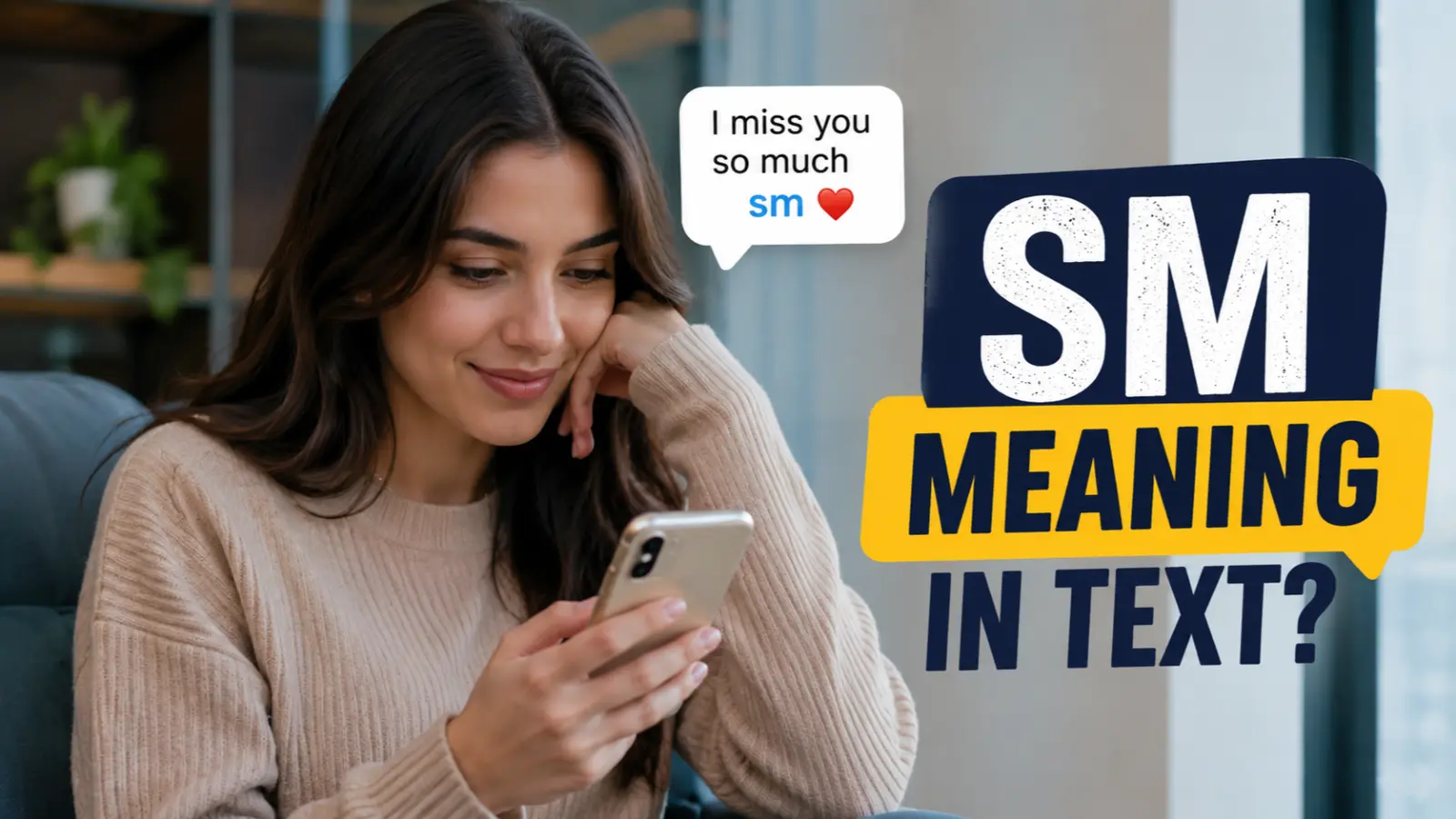
SM meaning in text can be confusing because the abbreviation “SM” can have several meanings depending on the conversation.
If you have seen someone write “sm” in a text, DM, comment, or social media post, you may wonder what they actually meant.
In casual texting, SM most commonly means “so much.” For example, “I miss you sm” means “I miss you so much.” However, SM can have other meanings in different contexts, so looking at the words around it is important.
People often search for the meaning of SM because texting slang is short, informal, and sometimes unclear. Understanding the context can help you avoid misunderstandings and respond naturally.
Quick Answer
SM meaning in text is usually “so much.” For example, “Thank you sm!” means “Thank you so much!”
What Does SM Mean in Text?
The most common SM meaning slang in everyday texting is “so much.”
People use SM to make messages shorter and faster. It is especially common in texts, Instagram comments, TikTok messages, Snapchat, and other casual online conversations.
Examples
- “I love this sm!” = I love this so much!
- “Thank you sm!” = Thank you so much!
- “I miss you sm.” = I miss you so much.
- “That helped me sm.” = That helped me so much.
In these examples, SM replaces the phrase “so much.”
SM Full Form
The most common SM full form in texting is:
SM = So Much
It is an informal abbreviation rather than a formal English word.
For example:
“You made me laugh sm 😂”
This means:
“You made me laugh so much.”
The abbreviation is useful when someone wants to type quickly or sound casual.
What Does SM Stand for in Different Contexts?
Although “so much” is common in texting, SM can stand for different things depending on where you see it.
Possible meanings include:
- So Much — common in texting
- Social Media — common in online discussions
- Small — sometimes used as an abbreviation
- Subject Matter — used in professional or academic contexts
- Short Message — sometimes used in communication-related contexts
The context usually makes the intended meaning clear.
For example:
“I love you sm.”
Here, SM almost certainly means “so much.”
“SM has changed how businesses communicate.”
Here, SM may mean “social media.”
This is why you should not assume that every use of SM has the same meaning.
SM Meaning in Texting and Chat
In texting, SM is generally casual and friendly.
It is often placed at the end of a sentence:
- “I appreciate you sm.”
- “That movie was good sm.”
- “I want that dress sm.”
- “You helped me sm.”
It can also appear in emotional messages:
- “I miss you sm ❤️”
- “I love this sm!”
- “You mean sm to me.”
The exact meaning comes from the surrounding sentence.
Is SM Rude, Offensive, or Neutral?
When SM means “so much,” it is generally neutral and harmless.
It is not normally considered rude or offensive. However, it is informal, so it may not be suitable for every situation.
Appropriate uses
SM works well in:
- Text messages
- Casual chats
- Social media comments
- DMs
- Conversations with friends
- Informal online posts
Situations where you may avoid it
Avoid using SM in:
- Formal business emails
- Academic papers
- Professional reports
- Official applications
- Important workplace communication
In formal writing, simply write “so much” instead.
Where Is SM Commonly Used?
You may see SM in many online spaces, including:
- TikTok
- Snapchat
- X
- Discord
- Text messages
- Online forums
- Private DMs
Younger internet users and people who frequently communicate through texting may use abbreviations like SM more often.
Real-Life Conversation Examples
Friendly Example
Friend 1: “I love your new profile picture!”
Friend 2: “Thank you sm!”
Here, SM means “so much.”
Casual Example
Person 1: “Did you like the concert?”
Person 2: “Yes, I enjoyed it sm!”
Meaning: “I enjoyed it so much!”
Emotional Example
Person 1: “I miss you sm.”
Person 2: “I miss you too ❤️”
The abbreviation adds a casual and emotional tone.
Argumentative Example
Person 1: “You complain sm.”
Person 2: “I know, I’m working on it.”
Here, SM still means “so much,” but the overall sentence has a negative or critical tone.
Emotional and Psychological Meaning of SM
When SM means “so much,” it can strengthen the emotional feeling of a message.
For example:
“I like you.”
is less intense than:
“I like you sm.”
Similarly:
“I miss you sm.”
can communicate stronger emotion than simply saying:
“I miss you.”
However, the abbreviation itself does not automatically indicate a particular emotion. The emotion depends on the complete message and the relationship between the people communicating.
Origin and Background of SM
SM became popular as part of the broader growth of internet and texting language.
People began shortening common words and phrases to communicate faster, especially on platforms where messages were short and informal. Similar abbreviations include:
- OMG = Oh My God
- LOL = Laughing Out Loud
- IDK = I Don’t Know
- BTW = By The Way
- TBH = To Be Honest
- ILY = I Love You
- TYSM = Thank You So Much
SM fits naturally into this culture of quick digital communication.
SM vs. Similar Texting Abbreviations
| Slang | Meaning | Example |
|---|---|---|
| SM | So Much | “I love it sm.” |
| TYSM | Thank You So Much | “TYSM for helping!” |
| ILYSM | I Love You So Much | “ILYSM ❤️” |
| SO | So | “I’m so happy!” |
| OMG | Oh My God | “OMG, that’s amazing!” |
One important difference is that SM by itself usually means “so much,” while TYSM and ILYSM contain additional words.
When Should You Use SM?
Use SM when the conversation is informal and the other person understands texting abbreviations.
For example:
- “Thanks sm!”
- “I love this sm.”
- “You helped me sm.”
- “I miss everyone sm.”
It is especially natural when chatting with friends or commenting online.
When should you avoid SM?
If you are writing to a teacher, employer, client, customer, or official organization, write the complete phrase.
Instead of:
“Thank you sm for your help.”
Use:
“Thank you so much for your help.”
The second version sounds more professional.
Polite Alternatives to SM
If you want to sound clearer or more formal, replace SM with:
- So much
- Very much
- A great deal
- Extremely
- Really
For example:
Casual: “Thanks sm!”
Polite: “Thank you so much!”
Casual: “I appreciate this sm.”
Formal: “I appreciate this very much.”
Why Do People Use SM?
People use SM mainly because it is:
- Quick to type
- Easy to understand in context
- Casual
- Common in online conversations
- Useful for expressing emotion
- Convenient on mobile devices
Texting slang also helps conversations feel relaxed and informal.
Impact of Using SM in Communication
Using SM can make a message feel more casual and friendly. It may also make an emotional statement feel natural in a text conversation.
However, abbreviations can create confusion when the reader does not know the intended meaning.
For example, someone unfamiliar with texting slang may not know whether SM means “so much,” “social media,” or something else.
That is why context matters.
Is SM Safe for Social Media?
Yes. When SM means “so much,” it is generally harmless and safe to use on social media.
It is not normally offensive or inappropriate.
Still, remember that different platforms and communities may use abbreviations differently. If the meaning could be misunderstood, writing the full phrase is better.
Common Misunderstandings About SM
One common mistake is assuming that SM always means “so much.”
That is not necessarily true.
For example:
“SM marketing is becoming important.”
Here, SM could mean “social media.”
Another misunderstanding is thinking that SM is a formal abbreviation. It is generally better suited to casual communication.
Always examine the sentence before deciding what SM means.
Variations and Related Forms
You may see SM combined with other texting abbreviations.
TYSM
TYSM = Thank You So Much
Example:
“TYSM for the gift!”
ILYSM
ILYSM = I Love You So Much
Example:
“ILYSM ❤️”
LSM
In some conversations, people may create additional abbreviations or use SM differently. These less-common uses depend heavily on the community and context.
How to Respond When Someone Uses SM
If someone says:
“Thank you sm!”
you can simply respond:
- “You’re welcome!”
- “No problem!”
- “Anytime!”
- “Of course!”
If someone says:
“I miss you sm.”
a natural response could be:
- “I miss you too!”
- “Aww, same!”
- “I miss you so much too.”
If you are unsure what SM means, you can politely ask:
“What do you mean by SM?”
There is nothing wrong with asking for clarification.
Regional and Cultural Usage
Texting abbreviations can vary between countries, age groups, and online communities.
“SM” meaning “so much” is widely understandable in English-language internet communication, but not everyone uses it regularly.
In professional or international communication, the safest choice is often to write the complete phrase. This reduces the chance of confusion.
People Usually Search For
People searching for this term may also ask:
- What does SM mean in text?
- What does SM stand for in texting?
- What is the SM full form?
- SM meaning slang
- What does SM mean on Snapchat?
- What does SM mean on Instagram?
- What does SM mean in chat?
- What does SM mean in a text message?
- Is SM short for so much?
- What does “I miss you sm” mean?
FAQs About SM Meaning in Text
1. What does SM mean in text?
SM most commonly means “so much” in casual texting.
2. What does SM stand for in slang?
In texting slang, SM usually stands for “so much.”
3. What does “I love you sm” mean?
“I love you sm” means “I love you so much.”
4. Is SM a rude word?
No. When SM means “so much,” it is generally neutral and not rude.
5. Can SM mean social media?
Yes. In some contexts, SM can mean “social media.” The surrounding sentence determines the meaning.
6. Should I use SM in formal writing?
Usually, no. In formal writing, write “so much” instead of SM.
Conclusion
Understanding sm meaning in text is simple once you look at the context. In most casual texts, chats, and social media messages, SM means “so much.” For example, “Thank you sm” means “Thank you so much,” while “I miss you sm” means “I miss you so much.”
However, SM can have other meanings, such as “social media,” depending on the conversation. Because of this, always consider the words around the abbreviation.
SM is best for casual communication with friends, family, and online communities. For school, work, business, or other formal situations, writing the complete phrase is clearer and more professional.