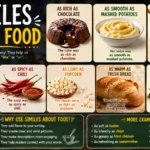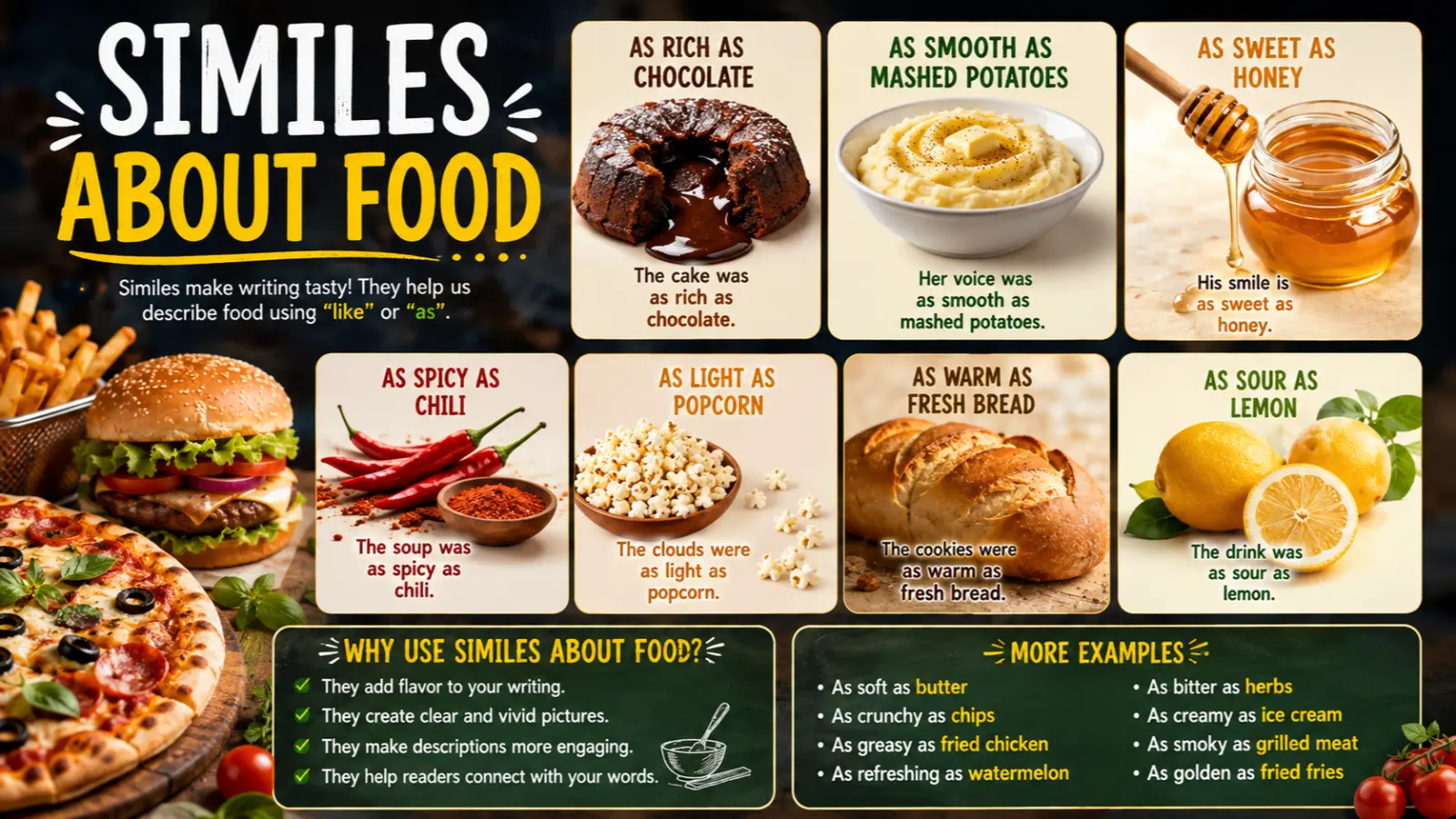
Food is more than something we eat. It can remind us of home, celebrations, childhood, comfort, adventure, or even a difficult day. Writers often use similes about food to turn ordinary descriptions into images readers can almost taste, smell, or feel.
A simile compares two different things using words such as like or as. Instead of saying, “The soup was hot,” a writer might say, “The soup was as hot as a summer sidewalk.” The comparison gives the reader a stronger sense of the experience.
Food similes are useful in stories, poems, essays, reviews, conversations, menus, advertisements, and creative descriptions. In this guide, you’ll find original examples along with explanations of why they work and how you can create your own.
What Are Similes About Food?
Food similes compare food, flavors, textures, smells, eating experiences, or feelings connected to food with something else.
For example:
The bread was as soft as a pillow fresh from the dryer.
The bread is not literally a pillow. The comparison helps the reader imagine its softness.
A strong food simile does more than decorate a sentence. It gives the reader a sensory experience.
Quick Answer: What Is a Good Food Simile?
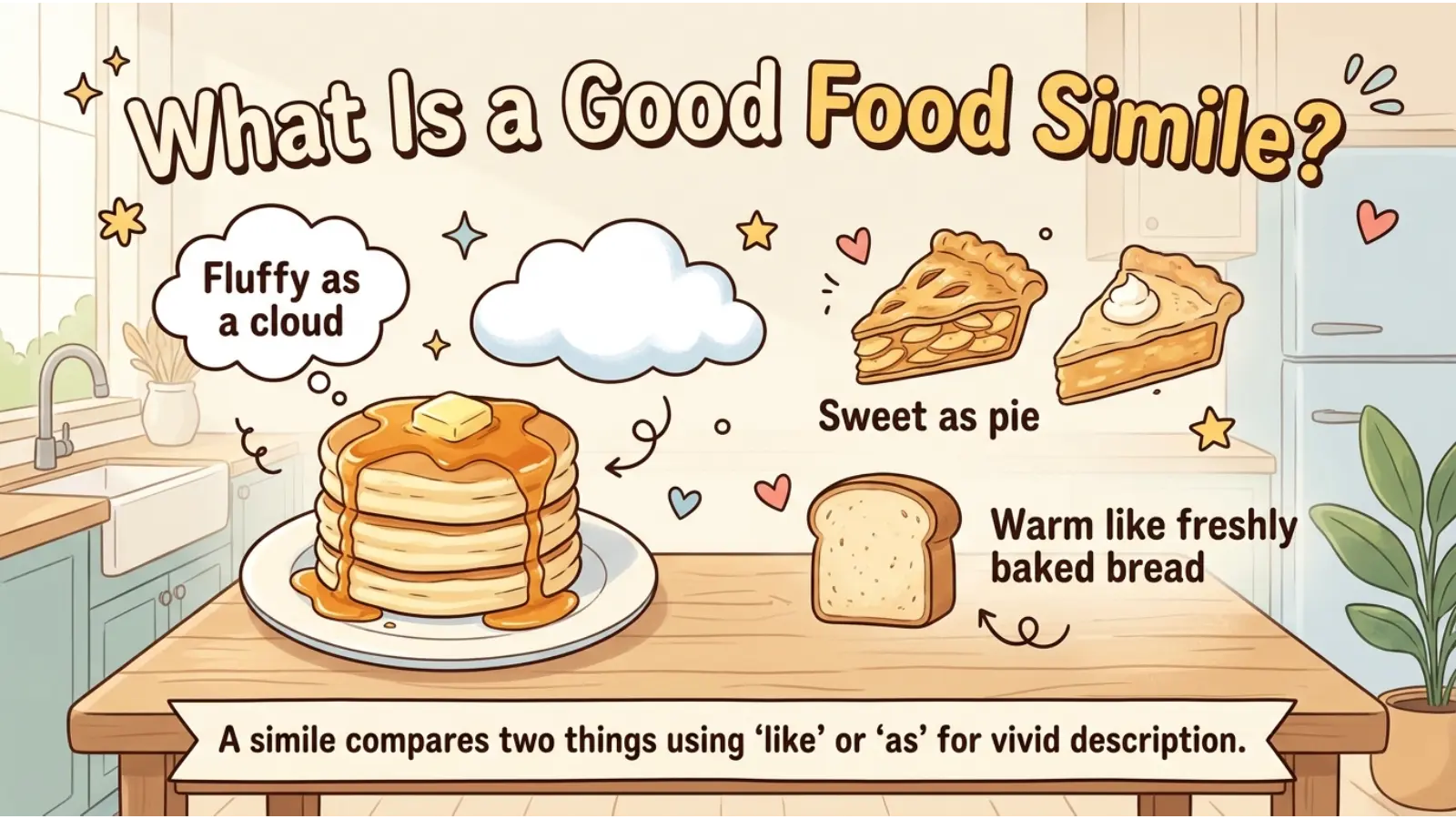
A good food simile makes a food-related quality easier to imagine by comparing it with something familiar.
Examples include:
- The lemonade was as bright as a sunny morning.
- The popcorn crackled like tiny fireworks.
- The cake felt as soft as a cloud.
- The spicy sauce hit my tongue like a sudden drumbeat.
- The cookies disappeared like footprints in fresh snow.
The best comparison depends on what you want the reader to notice: flavor, texture, smell, appearance, sound, temperature, or emotion.
30 Original Similes About Food
1. The Bread Was as Soft as a Warm Pillow
Meaning: The bread was extremely soft and comforting.
Why it works: A pillow immediately suggests softness and comfort. Adding “warm” makes the image more inviting.
Example:
The homemade bread was as soft as a warm pillow, and steam curled from its center.
Best context: Food writing, storytelling, and descriptions of homemade meals.
Writing tip: Compare texture with something readers already know physically. Familiar objects often create stronger sensory images.
2. The Popcorn Popped Like Tiny Fireworks
Meaning: The popcorn made quick, energetic popping sounds.
Example:
The popcorn popped like tiny fireworks while we waited for the movie to begin.
Why it works: “Fireworks” creates both sound and movement. The comparison makes an ordinary kitchen noise feel lively.
Best context: Stories, children’s writing, and playful descriptions.
3. The Lemonade Was as Bright as a Summer Morning
Meaning: The lemonade looked or tasted fresh, lively, and cheerful.
Example:
Her lemonade was as bright as a summer morning, glowing yellow in the glass.
Emotional effect: Cheerful and refreshing.
Writing tip: Color-based food similes can also suggest mood. A bright yellow drink can represent energy or happiness without directly saying “happy.”
4. The Chili Hit My Tongue Like a Sudden Drumbeat
Meaning: The chili created a sharp, immediate sensation.
Example:
The chili hit my tongue like a sudden drumbeat, and I reached for my water.
Why it works: A drumbeat is sudden and noticeable, making it useful for describing an unexpected burst of heat.
Best context: Personal narratives and humorous food stories.
5. The Cookies Disappeared Like Footprints in Fresh Snow
Meaning: The cookies were eaten very quickly.
Example:
I placed the cookies on the table, and they disappeared like footprints in fresh snow.
Why it works: The comparison communicates speed without simply saying, “Everyone ate them quickly.”
Writing purpose: This is useful when describing a group of people enjoying food.
6. The Soup Smelled Like a Rainy Afternoon at Grandma’s House
Meaning: The soup had a comforting, familiar smell associated with home.
Example:
The soup smelled like a rainy afternoon at Grandma’s house.
Emotional effect: Warm, nostalgic, and comforting.
Writing tip: Some of the strongest food similes connect food with memories rather than another food.
7. The Apple Was Crisp Like a Freshly Folded Sheet of Paper
Meaning: The apple had a sharp, clean crispness.
Why it works: The comparison focuses on the sound and sensation of crispness rather than simply calling the apple “crunchy.”
Best context: Descriptive writing and sensory essays.
8. The Ice Cream Melted Like a Secret in the Sun
Meaning: The ice cream disappeared quickly as it warmed.
Example:
The ice cream melted like a secret in the sun before we reached the park.
Emotional effect: Playful and slightly poetic.
Writing tip: Unexpected comparisons can make familiar subjects memorable, but the connection should still be understandable.
9. The Pancakes Were as Fluffy as Clouds Over the Hills
Meaning: The pancakes were light and soft.
Example:
The pancakes were as fluffy as clouds over the hills, stacked beneath a drizzle of syrup.
Best context: Food blogs, stories, menus, and creative descriptions.
10. The Garlic Bread Smelled Like a Kitchen Waking Up
Meaning: The aroma suggested that a meal was beginning.
Why it works: A kitchen cannot literally wake up. The personification gives the smell a sense of movement and anticipation.
Related device: This example blends simile with personification.
11. The Watermelon Was Cool as Shade Beneath a Tree
Meaning: The watermelon felt especially refreshing.
Example:
After the long walk, the watermelon was cool as shade beneath a tree.
Emotional effect: Refreshing and peaceful.
Writing tip: Compare temperature with a familiar experience rather than relying on generic words such as “cold” or “cool.”
12. The Chocolate Was Smooth Like Polished Stone
Meaning: The chocolate had an exceptionally smooth texture.
Example:
The chocolate was smooth like polished stone as it slowly melted.
Why it works: Polished stone gives the reader a tactile image.
Best context: Product descriptions, food reviews, and sensory writing.
13. The Rice Sparkled Like Tiny Pearls
Meaning: Individual grains of rice looked bright and attractive.
Example:
Under the dining-room light, the rice sparkled like tiny pearls.
Writing purpose: This simile emphasizes appearance rather than taste.
Writing tip: When describing food visually, look for comparisons based on shape, shine, color, or arrangement.
14. The Coffee Was as Dark as a Moonless Night
Meaning: The coffee had a very deep, dark appearance.
Example:
His coffee was as dark as a moonless night in the small white cup.
Best context: Atmospheric descriptions and storytelling.
Caution: Comparisons involving darkness can become predictable. Use them when the surrounding scene supports the mood.
15. The Salad Was Like a Garden in a Bowl
Meaning: The salad contained a colorful mixture of fresh vegetables.
Example:
The salad was like a garden in a bowl, filled with greens, tomatoes, carrots, and herbs.
Emotional effect: Fresh, natural, and lively.
Why it works: It transforms a list of ingredients into one visual picture.
16. The Sauce Clung to the Pasta Like a Red Ribbon
Meaning: The sauce coated the pasta closely and visibly.
Example:
The tomato sauce clung to the pasta like a red ribbon.
Writing purpose: This is especially useful for visual food descriptions.
Writing tip: Look at how food moves, folds, drips, stretches, or sticks. Movement often produces better similes than simply describing appearance.
17. The Soup Was as Gentle as a Quiet Conversation
Meaning: The soup had a mild, soothing quality.
Example:
After a difficult day, the soup was as gentle as a quiet conversation.
Emotional effect: Calm and comforting.
Best context: Reflective storytelling and personal essays.
18. The Onion Crunch Was Like a Tiny Door Closing
Meaning: The onion made a small, distinct crunch.
Example:
Each bite of the sandwich came with a crunch like a tiny door closing.
Why it works: The unusual comparison draws attention to sound.
Writing lesson: Not every simile has to be grand or beautiful. Small, precise comparisons can be more memorable.
19. The Cake Rose Like a Soft Mountain
Meaning: The cake looked tall, rounded, and fluffy as it baked.
Example:
Behind the oven glass, the cake rose like a soft mountain.
Best context: Baking stories and descriptive writing.
20. The Honey Dripped Like Golden Thread
Meaning: Honey fell slowly in a thin, golden stream.
Example:
Honey dripped like golden thread from the wooden spoon.
Why it works: The comparison captures both color and movement.
Writing tip: When describing liquids, consider comparisons involving ribbons, threads, rivers, rain, or other flowing objects—but choose the one that best matches the motion.
21. The Pretzel Was Twisted Like a Tiny Rope Bridge
Meaning: The pretzel had a curved, twisted shape.
Example:
The pretzel was twisted like a tiny rope bridge, sprinkled with coarse salt.
Best context: Children’s stories, playful descriptions, and visual writing.
22. The Strawberry Was Red as a Painted Lantern
Meaning: The strawberry had a vivid red color.
Example:
A strawberry sat on the plate, red as a painted lantern.
Writing purpose: This focuses attention on color and appearance.
Writing tip: Avoid stacking several color comparisons in the same paragraph. One precise image is usually stronger than five similar ones.
23. The Noodles Slid Like Ribbons Through the Sauce
Meaning: The noodles moved smoothly through the sauce.
Example:
The noodles slid like ribbons through the glossy sauce.
Why it works: “Ribbons” gives the reader an immediate sense of shape and movement.
24. The Cheese Stretched Like a Sunset Across the Plate
Meaning: Melted cheese stretched widely and created a warm visual effect.
Example:
The cheese stretched like a sunset across the plate when I lifted the slice.
Emotional effect: Warm and indulgent.
Best context: Creative food writing.
25. The Muffins Were Warm as Sunlit Stones
Meaning: The muffins had a pleasant warmth.
Example:
The muffins were warm as sunlit stones when we carried them outside.
Why it works: Sunlit stones provide a tactile image of gentle warmth.
26. The Crust Crackled Like Dry Leaves Underfoot
Meaning: The crust made a crisp, brittle sound.
Example:
The pizza crust crackled like dry leaves underfoot when I took the first bite.
Writing purpose: This simile makes sound part of the eating experience.
Writing tip: Sound is often forgotten in food descriptions. Listen to food as carefully as you look at it.
27. The Berry Jam Shone Like a Tiny Red Window
Meaning: The jam looked glossy and bright.
Example:
Berry jam shone like a tiny red window on the warm toast.
Best context: Poetry and vivid descriptive prose.
28. The Curry Wrapped Around the Rice Like a Warm Blanket
Meaning: The curry covered the rice generously and created a comforting sensation.
Example:
The curry wrapped around the rice like a warm blanket on a cold evening.
Emotional effect: Comforting and satisfying.
Writing lesson: Food can be described through emotional associations. Warmth, shelter, celebration, and nostalgia can all deepen a food description.
29. The Fizzy Drink Tickled My Nose Like Tiny Bubbles of Laughter
Meaning: The carbonation created a playful sensation.
Example:
The fizzy drink tickled my nose like tiny bubbles of laughter.
Emotional effect: Playful and cheerful.
Best context: Children’s writing, casual storytelling, and humorous scenes.
30. The Birthday Cake Stood Like a Bright Little Castle
Meaning: The cake looked impressive, decorated, and celebratory.
Example:
The birthday cake stood like a bright little castle beneath the kitchen lights.
Why it works: A castle suggests importance and celebration, making the cake feel like the centerpiece of the event.
Best context: Birthday stories, celebrations, and children’s literature.
How to Make Food Similes More Vivid
A weak simile often names a comparison without giving the reader a reason to care.
For example:
The soup was like water.
This does not tell us much.
A more specific version might be:
The soup was thin as rainwater after a long storm.
Now the reader receives a clearer impression of texture and atmosphere.
Focus on One Sensory Detail
Food can involve nearly every sense:
- Sight: color, shape, shine, arrangement
- Smell: sweetness, spice, freshness, richness
- Taste: bitterness, sweetness, sourness, heat
- Touch: softness, crispness, warmth, smoothness
- Sound: crunching, sizzling, crackling, popping
Choose the sense that matters most in the scene.
Use Specific Comparisons
Instead of:
The cake was very soft.
Try:
The cake was soft as a cushion of fresh cotton.
The second version gives the reader something concrete to imagine.
Let the Scene Influence the Simile
A food comparison should fit the mood.
A peaceful breakfast might invite a gentle comparison:
The oatmeal was as warm as a quiet morning.
A chaotic kitchen might call for something more energetic:
The pans clattered like a band warming up backstage.
The same food can feel completely different depending on the surrounding scene.
How Writers Avoid Cliché Food Similes
Some comparisons have become so familiar that readers barely notice them.
Examples include phrases such as:
- sweet as honey
- hard as a rock
- cool as ice
- soft as a cloud
- fresh as a daisy
These aren’t automatically wrong. Familiar similes can work well when simplicity is the goal. The problem comes when a writer uses them repeatedly without adding anything new.
Instead of asking, “What is this food usually compared with?” ask:
“What does this food remind me of in this particular scene?”
That question often leads to fresher imagery.
Simile vs. Metaphor in Food Writing
A simile makes a comparison using words such as like or as.
The soup was like a warm blanket.
A metaphor makes the comparison directly.
The soup was a warm blanket.
Both can create vivid imagery, but they have different effects.
Similes often feel conversational and explanatory. Metaphors can feel stronger or more immediate.
For beginner writers, similes are especially useful because they help develop the habit of thinking visually.
Food Similes and Imagery
Imagery is the language writers use to create sensory experiences.
Consider this sentence:
The bread was good.
It communicates an opinion but creates little imagery.
Now consider:
The crust crackled like dry leaves, while the soft center released a warm, buttery smell.
The reader can hear, feel, and smell the bread.
The simile is only one part of the description. Strong food writing combines comparisons with precise verbs, sensory nouns, and carefully chosen adjectives.
How to Create Your Own Food Similes
You do not need to wait for inspiration. Try this simple process.
Step 1: Choose the Food
Pick something specific.
Instead of “food,” choose:
- toasted bread
- mango slices
- tomato soup
- chocolate cake
- roasted corn
Specific subjects produce specific ideas.
Step 2: Identify One Quality
Ask what stands out.
Is it:
- crunchy?
- creamy?
- spicy?
- steaming?
- colorful?
- sticky?
- fragrant?
- cold?
- heavy?
- delicate?
Step 3: Brainstorm Familiar Objects
If the food is crunchy, think about things that make similar sounds.
If it is smooth, think about surfaces.
it is hot, think about warm places or objects.
If it smells strong, think about scents associated with memorable locations.
Step 4: Pick the Unexpected but Understandable Comparison
Suppose you are describing crispy toast.
You could write:
The toast was crunchy like gravel.
The image is understandable, but it may not create an appetizing feeling.
Try something that matches both the quality and the mood:
The toast crackled like dry leaves beneath a winter boot.
Now the sound is clearer and more distinctive.
Step 5: Test the Sentence
Read the simile aloud.
Ask:
- Does it make sense?
- Is the comparison easy to picture?
- Does it fit the mood?
- Does it add information?
- Is it stronger than the original description?
If the answer is yes, keep it.
Creative Exercises for Practicing Food Similes
Exercise 1: Describe One Meal Five Ways
Choose one meal and describe it using five different senses.
For example, write one sentence about:
- How it looks
- How it smells
- How it tastes
- How it feels
- How it sounds
This teaches you to avoid relying on visual descriptions alone.
Exercise 2: Change the Mood
Describe the same cup of hot chocolate as:
- comforting
- mysterious
- funny
- exciting
- lonely
The food stays the same, but your comparisons should change.
This exercise teaches an important writing skill: imagery is shaped by emotion.
Exercise 3: Ban the Obvious Comparison
Choose a food and write three similes without using the first comparison that comes to mind.
For example, if you choose ice cream, avoid “cold as ice.”
Search for a different image based on its melting, color, texture, smell, or emotional association.
Exercise 4: Turn a Plain Sentence Into a Scene
Start with:
The pizza was hot.
Build it into something more vivid:
The pizza was hot enough to send a ribbon of steam toward the kitchen ceiling, while the crust crackled like dry leaves under my fingers.
The goal is not simply to make sentences longer. It is to make each added detail meaningful.
Common Mistakes When Writing Food Similes
Using Too Many Similes
A paragraph packed with comparisons can become exhausting.
The cake was like a cloud, the frosting was like snow, the berries were like jewels, and the plate was like a mirror.
Each comparison may sound fine alone, but together they compete for attention.
Choose the strongest image and let it lead the description.
Mixing Unrelated Images
Avoid combining comparisons that pull the reader in opposite directions.
The soup was like a roaring ocean and a fluffy pillow.
The first comparison suggests movement and danger; the second suggests softness and comfort. Unless the contrast is intentional, the image becomes confusing.
Choosing a Comparison That Does Not Fit
A simile should clarify rather than obscure.
If you compare crunchy vegetables to velvet, the reader may struggle to understand the intended quality because velvet suggests softness.
Explaining the Simile Too Much
Sometimes writers create a good comparison and then immediately explain it.
The honey dripped like golden thread. This means that it was thin, golden, and moved slowly.
The explanation may be unnecessary if the image already communicates the idea.
Trust readers to make reasonable connections.
Confusing Similes With Metaphors
Remember:
Simile: The cake was like a castle.
Metaphor: The cake was a castle.
Both are comparisons, but the grammatical structure is different.
Using Adjectives Instead of Precise Images
Words such as “nice,” “good,” “delicious,” and “beautiful” can be useful, but they are often vague.
Instead of simply saying:
The meal was delicious.
Show what makes it appealing:
The roasted vegetables tasted smoky and sweet, with crisp edges that cracked softly between my teeth.
The reader experiences the food rather than being told how to judge it.
When Should You Use a Food Simile?
Food similes work especially well when you want to:
- make a description memorable
- create sensory imagery
- establish a mood
- describe a character’s reaction
- bring a setting to life
- make poetry more vivid
- add humor to a story
- make a food review more descriptive
- create appealing menu or advertising language
- help children understand descriptive writing
They are less useful when a direct statement is clearer.
Good writing is not about adding figurative language to every sentence. It is about choosing the right moment for an image.
Frequently Asked Questions About Food Similes
What is a simile for delicious food?
A useful food simile should describe what makes the food appealing rather than simply replacing “delicious.” For example, you might compare a rich dessert to a comforting experience or describe its texture through a familiar object.
What are some similes for tasty food?
You can compare tasty food with things associated with pleasure, warmth, freshness, celebration, or comfort. For example, a meal might be described as comforting as a familiar song or bright as a festive morning.
What is a simile for something sweet?
Try comparing sweetness with something naturally associated with sweetness, but avoid predictable phrases when possible. A fresh comparison might describe sweetness as “a quiet burst of summer.”
How do you describe food using similes?
First identify the food’s strongest quality—such as texture, temperature, smell, color, flavor, or sound. Then compare that quality with something familiar and easy to visualize.
What is a simile for spicy food?
Spicy food can be compared with something sudden, energetic, or intense. For example, you could describe a spicy sauce as hitting your tongue “like a sudden drumbeat.”
Can food similes be used in poems?
Yes. Food similes can work particularly well in poetry because they combine sensory detail with emotion and imagery. A carefully chosen comparison can make a short poem feel much more vivid.
Are food similes useful for children’s writing?
Absolutely. Food is familiar to children, which makes it an excellent subject for teaching comparison, sensory vocabulary, and descriptive writing.
What is the difference between a food simile and a food metaphor?
A food simile uses a comparison word such as like or as, while a metaphor makes the comparison directly. For example, “The soup was like a warm blanket” is a simile, while “The soup was a warm blanket” is a metaphor.
Conclusion
The strongest similes about food do not merely make descriptions sound fancy. They help readers experience the moment. A crunchy crust can become dry leaves. A warm bowl of soup can become a quiet conversation. A colorful salad can become a garden. A spoonful of honey can become golden thread. The key is observation. Notice how food looks, sounds, smells, feels, and changes. Then search your imagination for a comparison that captures one important quality. Start with ordinary food. Look at it closely. Ask what it reminds you of—and, more importantly, why. That simple habit can turn everyday descriptions into writing readers can see, hear, smell, and almost taste.

I am Helena Frost, a writer captivated by the beauty of language and the art of comparison. Through my words, I explore the world by turning ordinary moments into vivid similes and reflections. I enjoy crafting phrases that spark imagination, evoke emotion, and linger in the mind. My writing celebrates the subtle connections between people, nature, and the stories we live. For me, every sentence is an opportunity to reveal the extraordinary in the everyday.