SOL meaning slang can be confusing when you see it in a text, comment, gaming chat, or social media post. Is “SOL” a word, an abbreviation, or just another internet expression?
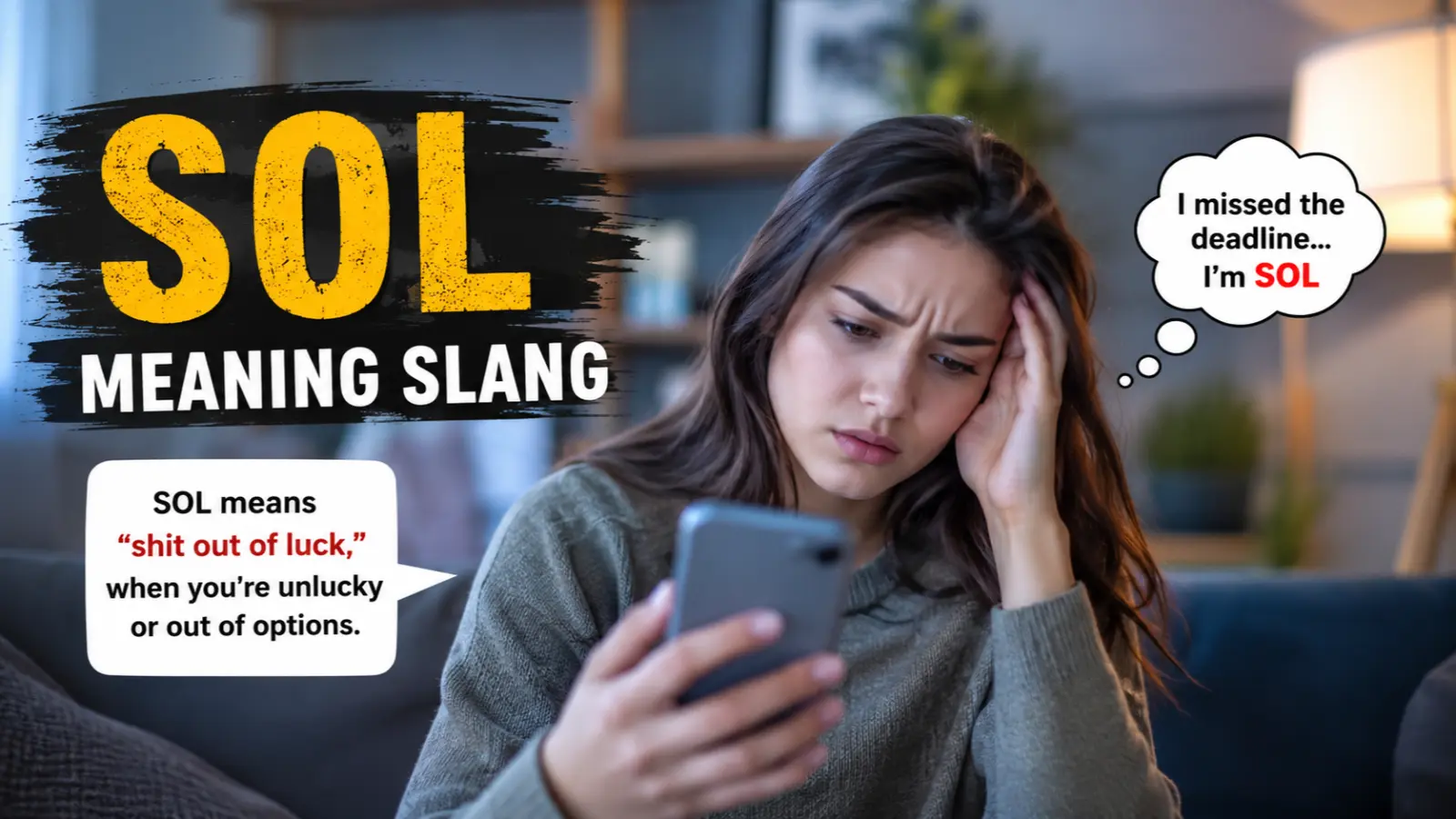
In most casual conversations, SOL is an abbreviation for “shit out of luck.” It describes a situation where someone is extremely unlucky, stuck, or has very few options left.
People often search for this slang because the meaning is not obvious from the three letters alone. You may see someone write, “You’re SOL,” “I’m totally SOL,” or “We’re SOL now.” The exact tone can be serious, funny, sarcastic, or sympathetic depending on the situation.
Quick Answer
SOL slang usually means “shit out of luck,” meaning someone is in a bad situation with little or no chance of fixing it. It is informal and contains a vulgar word in its full form.
What Does SOL Mean in Text?
In texting and online slang, SOL most commonly means “shit out of luck.”
It is used when someone has run out of good choices or has ended up in an unfortunate situation.
For example:
“You forgot your wallet? You’re SOL.”
This means the person is probably stuck because they do not have their wallet and may not have an easy solution.
Another example:
“The last bus left. We’re SOL.”
Here, SOL means that the speakers are out of luck because there is no convenient way to get home.
The abbreviation is sometimes written as S.O.L., SOL, or sol, although uppercase SOL makes the slang meaning easier to recognize.
SOL Full Form and Definition
The most common SOL full form is:
S = Shit
O = Out
L = Luck
Together, SOL means “shit out of luck.”
The expression is vulgar slang, but using the abbreviation can make it feel less direct than saying the complete phrase. Dictionary.com describes SOL as a slang abbreviation for “shit out (of) luck,” while Wiktionary identifies it as a vulgar slang expression meaning that someone’s luck has run out or an impasse has been reached.
What does SOL stand for?
If someone asks “What does SOL stand for?”, the answer in slang is generally “shit out of luck.”
However, SOL can have completely different meanings in other fields. Context is therefore important.
SOL Meaning in Different Contexts
Although the slang meaning is common, SOL is not limited to slang.
1. Texting and Chatting
In casual texting, SOL usually means someone is out of luck or stuck.
Example:
“Missed the deadline? You’re SOL.”
2. Gaming
Gamers may use SOL when a player has made a mistake or is in a nearly impossible situation.
Example:
“You lost all your health potions. You’re SOL.”
The expression may be humorous rather than genuinely serious.
3. Social Media
On platforms such as TikTok, Instagram, Discord, and other online communities, SOL can appear in comments and captions describing an unlucky situation.
Example:
“No internet during the final match. I’m SOL 💀”
The emoji can make the message feel more humorous.
4. Professional or Workplace Conversations
You may occasionally see SOL in informal workplace chats, but it is not recommended for formal emails or professional documents because its full form contains profanity.
Instead of:
“We’re SOL.”
A professional alternative would be:
“We don’t have any options left.”
5. Other Meanings
Outside slang, SOL can refer to several unrelated terms. For example, it can be an abbreviation for statute of limitations, speed of light, slice of life, or standards of learning.
So, always check the surrounding words before deciding what SOL means.
Is SOL Rude, Offensive, or Neutral?
SOL is informal and mildly offensive because its full form contains a swear word.
The abbreviation itself is often used casually and humorously, so many people may not consider it strongly offensive. Still, it is not completely neutral.
SOL may be okay when:
- Talking with close friends
- Chatting casually online
- Playing games
- Making a joke
- Discussing an unfortunate situation informally
Avoid SOL when:
- Writing a formal email
- Speaking to a customer
- Writing an academic assignment
- Applying for a job
- Communicating with someone you do not know well
- Talking in a highly professional setting
When in doubt, choose a cleaner phrase.
Real-Life SOL Conversation Examples
Friendly Example
Alex: “Did you manage to get tickets?”
Sam: “No, they sold out.”
Alex: “Ah, you’re SOL.”
Here, SOL expresses sympathy with a little humor.
Casual Example
Mike: “I forgot my charger.”
Jake: “You’re SOL until we get home.”
This means Mike is stuck without a charger.
Argumentative Example
1 Person : “You should have checked the deadline.”
2 Person : “I know, but the website was down.”
1 Person : “Well, now you’re SOL.”
In an argument, SOL can sound dismissive or harsh.
Funny Example
“I ate the last slice of pizza before realizing it was yours. I’m SOL now 😂.”
Here, the speaker jokingly suggests that they are going to face consequences.
Emotional and Psychological Meaning of SOL
SOL does not have a specific psychological definition. However, people often use it to express feelings such as:
- Frustration
- Disappointment
- Helplessness
- Regret
- Stress
- Embarrassment
- Acceptance of a bad outcome
For example:
“I studied all night, but I brought the wrong book. I’m SOL.”
The speaker is expressing frustration and recognizing that the mistake may be difficult to fix.
The emotional meaning depends heavily on tone. A laughing emoji can make SOL sound playful, while a serious conversation can make it sound genuinely hopeless.
Origin and Background of SOL
The expression “shit out of luck” has been used in American informal English for many decades. SOL developed as a shortened initialism of the phrase. Dictionary sources now list SOL as a slang abbreviation or initialism for the expression.
The abbreviation became useful because it allowed people to communicate the idea quickly without spelling out the profanity.
Today, SOL can appear in:
- Text messages
- Internet forums
- Gaming chats
- Social media
- Casual conversations
- Memes
- Informal group chats
It is best understood as a classic informal abbreviation, rather than a newly invented word.
SOL vs. Similar Slang Terms
| Slang | Meaning | Tone | Formal? |
|---|---|---|---|
| SOL | Out of luck | Casual, sometimes humorous | No |
| Out of luck | Unlucky or without options | Neutral | Yes, depending on context |
| Screwed | In serious trouble | Informal | No |
| Stuck | Unable to move forward | Neutral | Yes |
| Doomed | Likely to fail or have a bad outcome | Dramatic | Usually informal |
| No chance | There is little or no possibility | Neutral | Yes |
If you want to communicate the same basic idea without profanity, “out of luck” is the safest alternative.
When Should You Use SOL?
Use SOL when the conversation is relaxed and you know the other person understands casual slang.
Good situations
“No tickets left? We’re SOL.”
“Forgot the password again? You’re SOL.”
“The store closed five minutes ago. I’m SOL.”
Situations to avoid
Do not use SOL in a formal business email such as:
“Unfortunately, our team is SOL because the system failed.”
A better version would be:
“Unfortunately, we no longer have a workable option.”
This sounds more professional and respectful.
Polite Alternatives to SOL
If you want to avoid profanity, try:
- Out of luck
- Out of options
- In a difficult situation
- Stuck
- In trouble
- No easy solution
- There’s nothing we can do
- We’ve run out of options
For example:
Informal:
“Looks like we’re SOL.”
Polite:
“Looks like we’re out of options.”
Both communicate a similar idea, but the second is suitable for a wider range of situations.
Why Do People Use SOL?
People use SOL because it is short, expressive, and easy to understand in casual settings.
Instead of typing:
“We are in a situation where we have no good options.”
Someone can simply write:
“We’re SOL.”
The abbreviation also adds emotional flavor. Depending on the situation, it can communicate frustration, humor, sarcasm, sympathy, or resignation.
This is one reason abbreviations remain popular in digital communication.
Impact of Using SOL in Communication
The biggest issue with SOL is tone.
With close friends, it may sound funny:
“You forgot the tickets? Bro, you’re SOL 😂.”
But with a stranger, customer, teacher, manager, or employer, it could sound rude or careless.
Before using it, consider:
- Who are you talking to?
- Is the conversation formal or casual?
- Could the profanity bother the reader?
- Would “out of luck” communicate the same idea?
If you are unsure, use the cleaner alternative.
Is SOL Safe for Social Media?
Generally, SOL is common enough in casual online communication that people understand it as slang for being out of luck.
However, the full expression contains profanity. Because of that, it may not be ideal for professional pages, school accounts, business profiles, or content aimed at young children.
On casual social media, gaming platforms, and private chats, SOL is more likely to be understood as humorous slang.
Remember that context matters. Sol can also refer to unrelated things, including the Spanish word for “sun,” a musical syllable, and other meanings.
Common Misunderstandings About SOL
Is SOL always slang?
No. SOL has several meanings outside slang, so context is essential.
Does SOL always mean “shit out of luck”?
In casual slang, this is the most common interpretation, but not every use of SOL has that meaning.
Is SOL the same as “out of luck”?
Basically, yes. SOL is a more informal and somewhat stronger way to express being out of luck.
Is SOL a swear word?
The abbreviation itself is not the complete swear phrase, but its most common full form contains profanity.
Variations and Types of SOL
You may encounter SOL in several forms:
- SOL
- S.O.L.
- sol
- S.O.L
- You’re SOL
- I’m SOL
- We’re SOL
- Totally SOL
The meaning usually stays the same.
For example:
“I’m SOL.”
means:
“I’m out of luck.”
While:
“You’re SOL.”
means:
“You’re out of luck.”
How to Respond When Someone Uses SOL
Your response depends on the situation.
If they are joking:
“Haha, that’s rough!”
If they are genuinely stuck:
“Can I help you find another option?”
If they say “I’m SOL”:
“What happened?”
If you want to offer a solution:
“Maybe we can try another way.”
You do not need to use slang just because the other person does.
Regional and Cultural Usage
SOL is particularly associated with American informal English and can be recognized in other English-speaking online communities as well. Wiktionary labels the slang usage as North American, specifically Canada and the United States.
However, international users may interpret sol differently. For example, “sol” is also associated with the Spanish word for sun, while in music “sol” is the fifth syllable in the familiar do-re-mi system.
That is why capitalization and context can be important.
FAQs
1. What does SOL mean in slang?
SOL usually means “shit out of luck.” It describes someone who is stuck, unlucky, or has no good options remaining.
2. What does SOL stand for in texting?
In texting, SOL generally stands for “shit out of luck.” It is used informally to describe an unfortunate situation.
3. Is SOL a bad word?
The abbreviation is less direct than the complete phrase, but its full form contains profanity. It is therefore best treated as informal slang.
4. Can I use SOL at work?
It is better to avoid SOL in formal workplace communication. Use “out of luck,” “out of options,” or “in a difficult situation” instead.
5. What is the difference between SOL and “out of luck”?
They have essentially the same basic meaning, but SOL is more slang-heavy and includes an abbreviated profanity.
6. Does sol have other meanings?
Yes. Depending on context, sol can refer to the sun, a musical syllable, a currency, or several technical abbreviations.
Conclusion
Understanding sol meaning slang is simple once you know the context. In casual texting and online conversations, SOL most commonly means “shit out of luck.” It describes a situation where someone is unlucky, stuck, or has no good options left.
The expression is often humorous or sarcastic, but its full form contains profanity. That makes it appropriate mainly for informal conversations with people who are comfortable with casual language.
If you are writing professionally, a cleaner phrase such as “out of luck,” “out of options,” or “in a difficult situation” is usually better.
Most importantly, remember that SOL can have other meanings outside slang. Context, capitalization, and the surrounding words will tell you which meaning is intended.