Football Similes is more than a game of passes, tackles, goals, and final scores. It is also a game of movement, pressure, emotion, timing, and sudden change. Those qualities make football especially rich territory for figurative language.
A simile compares two different things using words such as “like” or “as.” Instead of simply saying that a player was fast, a writer might say, “He moved like a spark skipping across dry grass.” The comparison gives the reader something concrete to imagine.
Football similes can make match reports more vivid, stories more energetic, poems more expressive, and everyday conversations more colorful. They can describe players, passes, crowds, goals, defenders, pressure, teamwork, disappointment, and the unpredictable rhythm of a match.
The examples below are designed to do more than decorate a sentence. Each one shows how a comparison can create a particular image and emotional effect while giving you ideas for your own writing.
What Are Football Similes?
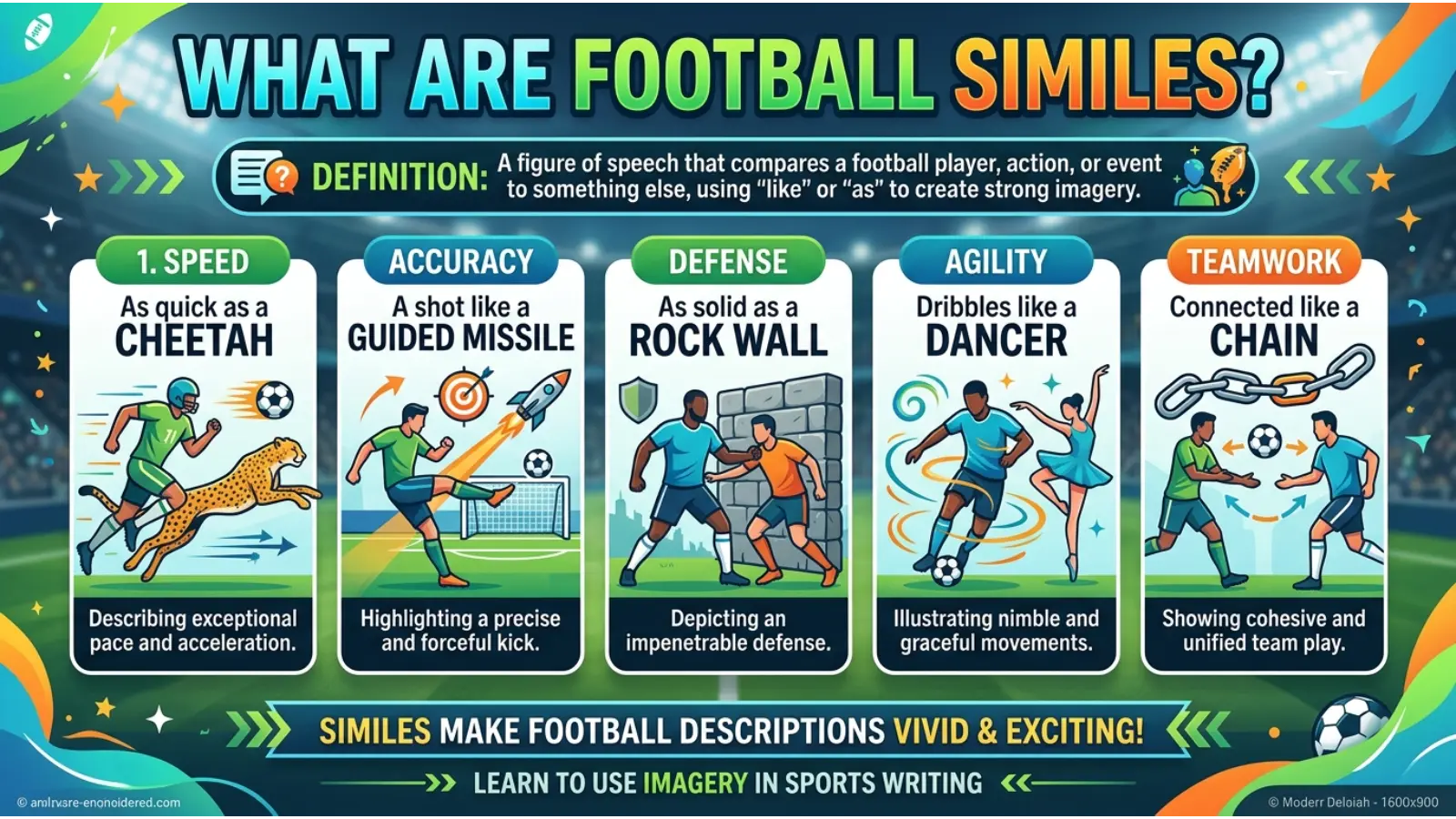
Football similes are comparisons that connect something in football with another familiar image.
For example:
The striker moved like a shadow slipping behind the defenders.
The striker is not literally a shadow. The comparison suggests quiet, quick movement that is difficult for defenders to track.
A useful football simile should add something that a plain description cannot easily communicate. It can show speed, strength, tension, confidence, confusion, teamwork, excitement, or disappointment.
30 Original Football Similes for Creative Writing
1. The Winger Was Like a Match Spark
Simile:
The winger was like a match spark, flashing into space before anyone could react.
Meaning:
This comparison presents the player as extremely quick and sudden.
Why it works:
A spark appears quickly and attracts immediate attention. It gives the player’s movement a sense of explosive energy.
Example:
She burst down the left wing like a match spark, leaving the defense scrambling behind her.
Best context: Match reports, sports stories, and energetic descriptions.
Writing tip:
Use a short, bright image when you want speed to feel sudden rather than merely fast.
2. The Midfielder Read the Field Like an Open Book
Simile:
The midfielder read the field like an open book.
Meaning:
He understood what was happening and seemed to anticipate the next move.
Why it works:
An open book suggests information that is easy to understand. The comparison turns tactical awareness into something readers can visualize.
Example:
He scanned the pitch like an open book before sending the ball through a narrow gap.
Best context:
Player analysis, commentary, and character descriptions.
Writing tip:
Comparisons can describe intelligence as effectively as they describe physical movement.
3. The Pass Cut Through the Defense Like a Needle Through Cloth
Simile:
The pass cut through the defense like a needle through cloth.
Meaning:
The pass was precise, narrow, and effective.
Why it works:
A needle creates a small but direct path. The image emphasizes accuracy rather than power.
Example:
Her through-ball sliced between two defenders like a needle through cloth.
Writing purpose:
This is especially useful when describing technical skill.
4. The Crowd Rose Like a Sudden Wave
Simile:
The crowd rose like a sudden wave when the ball hit the net.
The comparison captures how thousands of people can react almost simultaneously.
Emotional effect:
It creates excitement and collective energy.
Best context:
Stadium scenes, match reports, sports fiction, and storytelling.
Writing tip:
For crowd descriptions, use images that suggest movement across a large space.
5. The Goalkeeper Stretched Like a Bowstring
Simile:
The goalkeeper stretched like a bowstring as he reached for the shot.
The image emphasizes tension and extension.
A bowstring is pulled tight before releasing energy, so the comparison makes the goalkeeper’s movement feel tense and powerful.
Example:
She stretched like a bowstring and tipped the ball over the crossbar.
6. The Defender Was Solid as a Stone Wall
Simile:
The defender stood as solid as a stone wall.
This comparison emphasizes resistance and reliability.
Why it works:
A wall suggests something difficult to move or break through.
Best context:
Defensive performances and character-driven sports writing.
Writing tip:
Simple comparisons can be effective when they match the action. Do not make every simile elaborate.
7. The Ball Skipped Like a Pebble Across Water
Simile:
The ball skipped like a pebble across water after the low pass.
This creates a visual image of rapid, light movement along the grass.
Example:
The wet ball skipped like a pebble across water and caught the goalkeeper off guard.
Best context:
Match reports where weather and pitch conditions matter.
8. His First Touch Was Soft as Falling Snow
Simile:
His first touch was as soft as falling snow.
The comparison suggests control, delicacy, and precision.
Writing purpose:
It works particularly well for describing technically gifted players.
Emotional effect:
The image feels calm and graceful, which contrasts nicely with the intensity of a match.
9. The Striker Waited Like a Cat in Tall Grass
Simile:
The striker waited like a cat in tall grass.
The player appears patient, alert, and ready to react.
Why it works:
The image suggests controlled patience rather than inactivity.
Example:
He waited like a cat in tall grass until the defender made one careless step.
Best context:
Storytelling and suspenseful match descriptions.
10. The Counterattack Arrived Like a Thunderclap
Simile:
The counterattack arrived like a thunderclap.
This comparison makes the attack feel sudden and powerful.
Emotional effect:
It creates surprise and urgency.
Example:
Within seconds, the counterattack arrived like a thunderclap at the opposite end of the field.
Writing tip:
Use sound-based images when you want readers to feel the shock of an event.
11. The Captain Was Calm as a Lighthouse
Simile:
The captain remained as calm as a lighthouse during the storm.
The comparison suggests stability while everything around the player becomes chaotic.
Why it works:
A lighthouse stays fixed while waves and weather move around it.
Best context:
Leadership, pressure, and dramatic moments.
12. The Final Minutes Crawled Like a Slow Clock
Simile:
The final minutes crawled like a slow clock.
This describes how time seems to move painfully slowly when the result is uncertain.
Example:
With the score tied, the final minutes crawled like a slow clock.
Emotional effect:
Tension and impatience.
Writing tip:
Time-based similes are powerful because readers already understand how differently time can feel during stressful moments.
13. The Midfield Battled Like Two Rivers Colliding
Simile:
The two midfielders battled like rivers colliding.
The comparison conveys constant movement and force.
Why it works:
Rivers suggest motion, pressure, and competing currents.
Best context:
Competitive match writing.
14. The Goalkeeper Was a Magnet for the Ball
This example moves slightly toward metaphor, but it can be converted into a simile:
Simile:
The goalkeeper seemed like a magnet for every dangerous shot.
The comparison suggests that the goalkeeper repeatedly found a way to attract or stop the ball.
Example:
He seemed like a magnet for danger, pulling every difficult shot into his gloves.
Writing tip:
When creating a simile, ask what object behaves similarly to the thing you are describing.
15. The Fullback Ran Like a Train Leaving the Station
Simile:
The fullback ran like a train leaving the station.
This gives the player’s run a sense of acceleration and unstoppable momentum.
Emotional effect:
Energy and force.
Best context:
Descriptions of overlapping runs or powerful sprints.
16. The Team Moved Like a Single Machine
Simile:
The team moved like a single machine.
This emphasizes coordination and teamwork.
Why it works:
A machine has interconnected parts that perform different functions while working toward the same result.
Example:
Every pass arrived on time, and the team moved like a single machine.
Writing tip:
Teamwork similes should focus on connection rather than simply praising everyone as “good.”
17. The Free Kick Curled Like a Ribbon in the Wind
Simile:
The free kick curled like a ribbon in the wind.
The image focuses on graceful, curved movement.
Best context:
Poetry, match reports, and artistic sports writing.
Emotional effect:
Beauty and elegance.
18. The Defender Charged Like a Bull
Simile:
The defender charged like a bull toward the loose ball.
This creates an image of direct, forceful movement.
Why it works:
The animal comparison immediately communicates physical intensity.
Writing tip:
Animal comparisons are most effective when the animal’s behavior clearly matches the action.
19. The Stadium Was as Loud as a Roaring River
Simile:
The stadium was as loud as a roaring river.
The comparison gives the crowd’s noise a continuous, powerful quality.
Example:
The stadium was as loud as a roaring river after the winning goal.
Best context:
Atmospheric descriptions.
20. The Penalty Felt Like a Loaded Question
Simile:
The penalty felt like a loaded question.
This comparison focuses on psychological pressure rather than physical movement.
The player knows that the moment demands an answer, but there is no easy one.
Emotional effect:
Nervousness, pressure, and uncertainty.
Writing tip:
Some of the strongest similes compare emotions with ordinary experiences instead of physical objects.
21. His Shot Was Like a Hammer Striking Iron
Simile:
His shot was like a hammer striking iron.
This conveys force and impact.
Example:
The midfielder’s shot was like a hammer striking iron, leaving the goalkeeper no time to react.
Best context:
Powerful shots and dramatic goals.
22. The Young Player Entered the Match Like a Fresh Breeze
Simile:
The young player entered the match like a fresh breeze.
The comparison suggests freshness, energy, and a change in rhythm.
Why it works:
A breeze can refresh an atmosphere without being violent or overwhelming.
Best context:
Substitutions and positive momentum shifts.
23. The Defender Followed Him Like a Shadow
Simile:
The defender followed him like a shadow.
This is a familiar comparison, so it should be used carefully.
Meaning:
The defender stayed extremely close to the attacker.
Writing lesson:
Not every effective simile has to be completely new, but writers should avoid relying too heavily on familiar expressions.
Try a fresher version:
The defender stayed beside him like a second set of footsteps.
24. The Match Turned Like a Door in the Wind
Simile:
The match turned like a door in the wind.
The comparison emphasizes sudden changes in momentum.
Example:
One interception changed everything, and the match turned like a door in the wind.
Emotional effect:
Uncertainty and unpredictability.
25. The Ball Fell Like a Leaf
Simile:
The ball fell like a leaf into the crowded penalty area.
The image suggests a gentle, floating descent.
Best context:
High crosses, lofted passes, and poetic descriptions.
Writing tip:
Look beyond the usual football vocabulary. Nature can provide surprising but believable comparisons.
26. The Fans Were Like a Choir Without a Conductor
Simile:
The fans were like a choir without a conductor.
This suggests a huge group producing sound together without a single person controlling it.
Why it works:
The image captures the unpredictable rhythm of chants, cheers, whistles, and reactions.
Best context:
Stadium atmosphere and narrative writing.
27. The Defender’s Clearance Was Like a Door Slamming Shut
Simile:
The defender’s clearance was like a door slamming shut.
This makes the defensive action feel sudden and decisive.
Emotional effect:
Finality and relief.
Example:
His last-second clearance was like a door slamming shut on the attack.
28. The Attackers Swarmed Like Bees Around a Flower
Simile:
The attackers swarmed like bees around a flower.
The comparison communicates numbers, movement, and constant pressure.
Writing tip:
Use group-based comparisons when several players are acting together.
29. The Scoreboard Hung Like a Question Mark
Simile:
The scoreboard hung above them like a question mark.
This works especially well when the score leaves the outcome uncertain.
Emotional effect:
Suspense and anticipation.
Best context:
Storytelling and dramatic match endings.
30. The Winning Goal Landed Like a Firework in the Night
Simile:
The winning goal landed like a firework in the night.
The comparison makes the moment feel bright, sudden, and unforgettable.
Example:
The late winner arrived like a firework in the night, transforming the entire stadium.
Best context:
Sports journalism, fiction, poetry, and celebratory writing.
How to Make Football Similes More Vivid
A strong simile does not simply tell readers that something is impressive. It gives them a specific experience.
Compare these sentences:
The player was very fast.
and:
The player accelerated like a match spark catching dry grass.
The first sentence gives information. The second creates an image.
To strengthen a football simile, identify the specific quality you want to show.
Is the player:
- fast?
- patient?
- powerful?
- unpredictable?
- graceful?
- nervous?
- aggressive?
- intelligent?
- exhausted?
- confident?
Then choose an image that naturally shares that quality.
Focus on One Main Quality
Weak comparisons often try to communicate too many ideas at once.
Instead of:
He ran like a powerful, clever, beautiful, unstoppable storm.
Choose one dominant quality:
He ran like a storm breaking across the hills.
The reader gets a clearer image.
Use Unexpected Comparisons Carefully
Originality matters, but unusual does not automatically mean effective.
A comparison should still make sense.
For example, comparing a precise pass to a needle is understandable because both create a narrow, accurate path. A comparison that has no meaningful connection will feel forced.
Let the Action Support the Simile
The best football similes usually appear beside an action.
Instead of:
He was like a train.
Try:
He accelerated like a train leaving the station.
The verb accelerated gives the comparison a job.
Football Similes for Match Commentary
Sports commentary needs language that is quick, clear, and energetic. Long literary comparisons can slow the action.
Useful examples include:
- The winger burst forward like a spark.
- The goalkeeper stretched like a bowstring.
- The counterattack struck like thunder.
- The defense closed like a steel gate.
- The crowd erupted like a breaking wave.
For commentary, choose comparisons that can be understood immediately.
Football Similes for Stories
Fiction gives you more space to explore emotion.
Consider the difference between:
The striker stepped toward the penalty spot.
and:
The striker stepped toward the penalty spot like someone walking toward a difficult question.
The second version introduces psychology. The reader begins to feel the pressure.
In storytelling, a football simile can reveal what a character feels, not just what a character does.
Football Similes for Poetry
Poetry allows more freedom with rhythm, sound, and unusual imagery.
For example:
The ball curved like a silver ribbon,
and the goalkeeper reached too late.
The simile works because the curved movement of a ribbon connects naturally with the ball’s flight.
When writing football poetry, consider:
- sound
- rhythm
- repetition
- color
- weather
- movement
- silence
- crowd reactions
A good poetic simile should contribute to the atmosphere rather than merely fill space.
Football Similes for Describing Emotion
Football creates strong emotional contrasts, which makes it ideal for figurative writing.
Excitement
The crowd surged like a wave breaking over the shore.
Nervousness
His hands felt as restless as birds trapped beneath a roof.
Confidence
She walked onto the field as calmly as a traveler who already knew the road.
Disappointment
The final whistle fell like a curtain at the end of a play.
Relief
The goalkeeper’s breath escaped like air from a slowly opened balloon.
Notice how each comparison focuses on a different emotional experience.
How Professional Writers Build Better Similes
Experienced writers rarely begin by asking, “What is a fancy comparison for this?”
They usually begin with observation.
Suppose you want to describe a striker making a run.
First, observe the action:
The striker waits behind the defender.
Then identify the quality:
He is patient and difficult to predict.
Next, search mentally for something with similar behavior:
A cat waiting to pounce. A shadow moving behind someone. A hunter watching quietly.
Then choose the image that best fits the scene:
The striker waited like a cat in tall grass.
This process creates purposeful imagery instead of random decoration.
Simile vs. Metaphor in Football Writing
A simile makes a comparison using words such as like or as.
The midfielder moved like a chess player.
A metaphor makes the comparison directly.
The midfielder was a chess player on the field.
Both can be effective.
A simile often feels more explanatory because it tells readers exactly what kind of resemblance to notice. A metaphor can feel stronger and more immediate.
Choose the form that matches the voice of your writing.
Football Similes and Imagery
Imagery appeals to the senses.
Instead of writing:
The stadium was exciting.
Try building an image:
The stadium shook like a drum beneath thousands of stamping feet.
Now readers can imagine sound and movement.
Good football imagery can involve:
Sound: whistles, chants, shouting, drums
Sight: jerseys, floodlights, grass, rain
Movement: sprinting, sliding, turning, jumping
Touch: cold air, wet grass, a hard tackle
Emotion: fear, hope, frustration, joy
A simile becomes more powerful when it connects with one or more of these sensory details.
How to Create Your Own Football Similes
Try this five-step method.
Step 1: Choose the football action
Pick something specific:
A goalkeeper saves a shot.
Step 2: Identify the quality
Maybe the save is:
sudden, flexible, desperate, or precise.
Step 3: Find a matching image
For flexibility:
a bowstring
For suddenness:
a trapdoor
For precision:
a needle
Step 4: Write the comparison
The goalkeeper stretched like a bowstring.
Step 5: Test the sentence
Ask:
Does the comparison clarify the action?
If yes, keep it. If the image distracts from the action, replace it.
Creative Exercises for Football Similes
Exercise 1: Describe Five Players
Write one simile for each:
- A very fast winger
- A calm goalkeeper
- A nervous striker
- A powerful defender
- A creative midfielder
Do not use the same type of image twice.
Exercise 2: Describe One Match Five Ways
Write five sentences about the same goal.
Make one comparison based on:
- nature
- animals
- music
- weather
- everyday objects
This exercise teaches you how different images can change the mood of the same event.
Exercise 3: Replace Weak Descriptions
Start with:
The team played well.
Now create a comparison that shows how they played well.
For example:
The team passed the ball like musicians sharing the same rhythm.
The goal is not to make the sentence more complicated. It is to make the meaning more visible.
Common Mistakes When Using Football Similes
Using Too Many Similes
If every sentence contains a comparison, none of them feels special.
Let some sentences remain simple so your strongest images have room to stand out.
Choosing a Random Comparison
A strange comparison is not automatically creative.
Ask what the two things genuinely share.
Mixing Images
Avoid sentences such as:
The midfielder exploded like a quiet feather sailing through a train.
The images pull in unrelated directions.
Choose one central picture.
Explaining Too Much
If you write:
He moved like a shadow, meaning he was very difficult to see, hard to track, and quiet like a shadow.
The explanation weakens the image.
Trust the reader when the comparison is clear.
Relying on Clichés
Expressions such as “fast as lightning” or “strong as an ox” are familiar. They are not always wrong, but they rarely surprise the reader.
Try asking:
What have I personally noticed about this action?
Your own observation is often the starting point for fresher imagery.
Frequently Asked Questions About Football Similes
What is a good simile for a football player?
A good football-player simile depends on the quality you want to emphasize. For speed, you might compare a player to a spark; for patience, a cat waiting in tall grass; for leadership, a lighthouse during a storm.
What is a simile for a football game?
You can describe a football game as like a storm changing direction without warning when you want to emphasize uncertainty and shifting momentum.
What is a simile for a football goal?
A goal might be described as like a firework in the night when you want to emphasize sudden excitement and celebration.
How do you use similes in sports writing?
Use a simile when a comparison adds a clear quality, emotion, or visual image. Avoid adding one simply to make a sentence sound dramatic.
What are some football similes for speed?
You can compare speed with images such as sparks, trains, arrows, rushing water, or sudden wind. The best choice depends on whether you want the speed to feel explosive, smooth, powerful, or graceful.
Can football similes be used in essays?
Yes. They can work well in creative essays, descriptive writing, sports journalism, and personal narratives. In formal analytical writing, use them sparingly and make sure they support your point.
Are football similes useful for poems?
Absolutely. Football has strong visual movement, sound, tension, and emotion, giving poets many opportunities to create original comparisons.
Conclusion
Football gives writers a natural vocabulary of movement and emotion, but the strongest similes come from looking beyond the sport itself. A goalkeeper can become a bowstring. A crowd can become a wave. A precise pass can resemble a needle. A tense penalty can feel like a difficult question. These comparisons work because they connect familiar football moments with images readers already understand. When creating your own football similes, start with the action, identify its strongest quality, and then search for something outside football that behaves in a similar way. Keep the image clear, purposeful, and believable. The goal is not to make every sentence sound poetic. The goal is to help readers see, hear, and feel the game. That is what makes a good simile worth remembering.

I am Helena Frost, a writer captivated by the beauty of language and the art of comparison. Through my words, I explore the world by turning ordinary moments into vivid similes and reflections. I enjoy crafting phrases that spark imagination, evoke emotion, and linger in the mind. My writing celebrates the subtle connections between people, nature, and the stories we live. For me, every sentence is an opportunity to reveal the extraordinary in the everyday.