jit meaning slang is a common search for people who come across “jit” in a text, TikTok comment, meme, gaming chat, or social media post. At first, the word may look like a typo or an abbreviation, but it is actually an informal slang term.
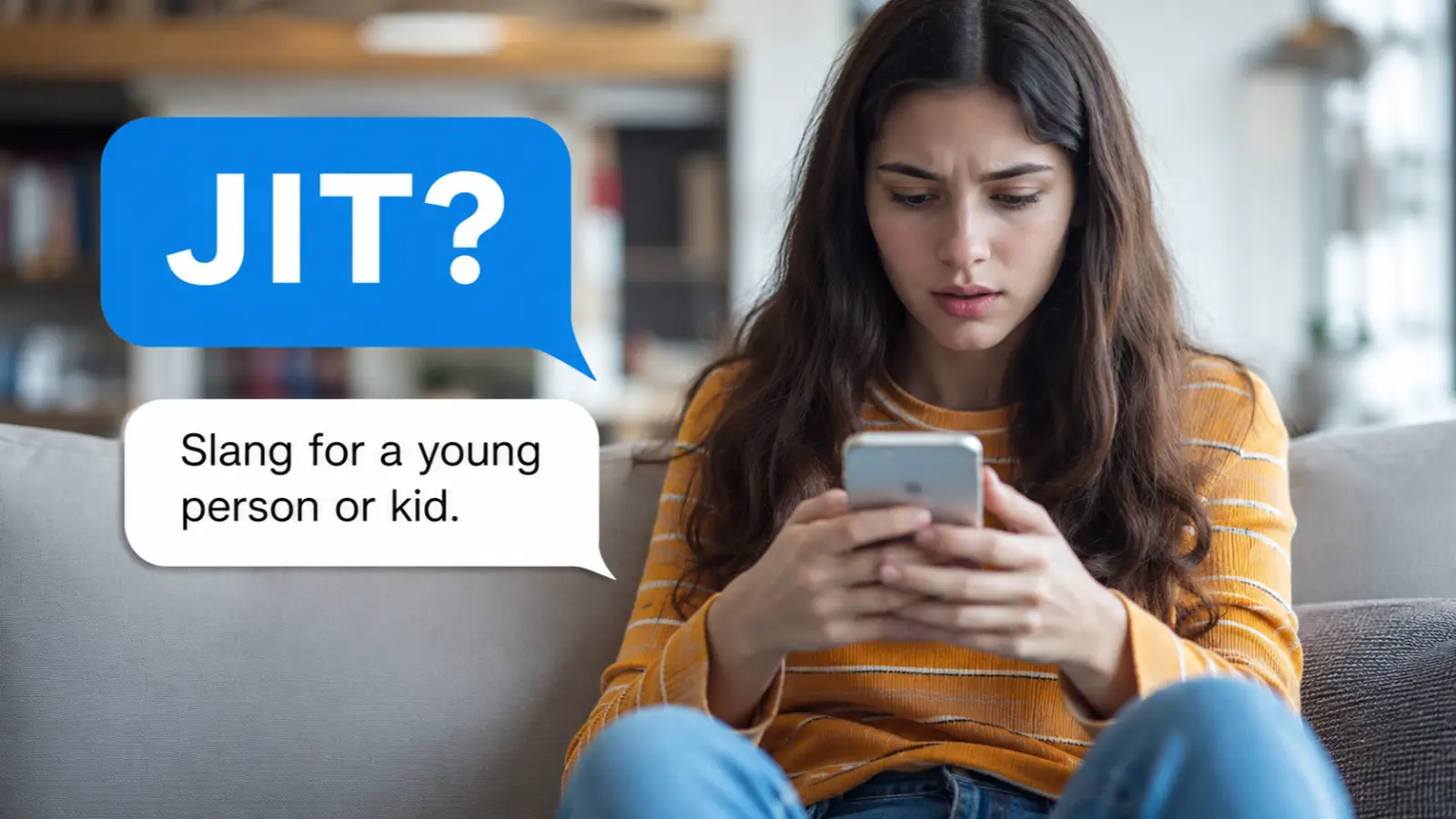
In most casual conversations, jit refers to a young person, kid, or someone who is younger or less experienced. The word can be playful when friends use it with each other, but it can also sound dismissive if someone uses it to make fun of another person.
The meaning can also change slightly depending on the sentence. A comment like “that jit is funny” may be harmless, while “this jit doesn’t know anything” can sound insulting. Understanding the situation, relationship between the speakers, and tone is therefore important.
Quick Answer
Jit meaning slang is usually a young person, kid, or younger/inexperienced person. It is informal slang and can be friendly, teasing, or disrespectful depending on how it is used.
What Does Jit Mean in Text?
When someone writes “jit” in a text, they are usually talking about a young person.
It can be similar to saying:
- Kid
- Young person
- Young guy
- Younger person
- Inexperienced person
For example:
“That jit is fast.”
Depending on the situation, this could simply mean:
“That kid is fast.”
The word does not automatically mean something bad. Two friends may use it as a joke, while someone in an argument might use it to belittle another person.
Simple meaning
Jit = a young or inexperienced person.
The surrounding words tell you whether the speaker is being friendly, humorous, or disrespectful.
Jit Full Form: What Does Jit Stand For?
One reason people become confused about jit is that it is sometimes written as JIT and treated like an acronym.
You may see the phrase “Juvenile in Training” given as a supposed full form. This explanation is popular in some online slang discussions.
However, jit should not automatically be treated as an acronym. The word has a longer history as slang, and its exact historical development is more complicated than simply expanding three letters.
So, if someone asks:
“What does jit stand for?”
A careful answer is:
Jit is mainly an informal slang word for a young person or kid. “Juvenile in Training” is a commonly mentioned explanation, but it should not be presented as the definite origin of the word.
This distinction is useful because internet slang often develops through communities and spoken language rather than through formal abbreviations.
Jit Meaning in Different Contexts
The same slang word can communicate different feelings in different situations.
Jit in Texting
In texting, jit normally describes a young person.
Example:
“That jit keeps asking questions.”
Here, the speaker is probably referring to a kid or younger person.
Jit on TikTok
TikTok has helped many regional slang terms reach people around the world.
Someone might comment:
“Jit really thought he was going to win.”
The comment may be humorous rather than seriously insulting.
Jit on Instagram
On Instagram, you may see the word in comments, captions, reels, or memes.
For example:
“Why is jit dancing like that? 😂”
Here, the person is probably teasing someone in a humorous way.
Jit in Gaming
Gamers may use jit for a younger player or someone who is acting inexperienced.
“This jit just started the game.”
The speaker is suggesting that the person is new or inexperienced.
Jit in Everyday Conversation
People who already know the slang may use it while talking with friends.
“My little brother is such a jit.”
In this example, the word may be affectionate or playful.
Is Jit Rude, Offensive, or Neutral?
Jit is usually informal rather than inherently offensive.
However, its tone can change dramatically depending on how it is used.
Friendly use
“What’s up, jit?”
Among friends, this could simply be playful slang.
Teasing use
“Look at this jit trying to cook.”
The speaker may be joking about someone who is inexperienced.
Disrespectful use
“Nobody listens to that jit.”
Here, the word is being used to put someone down.
Therefore, it is better to think of jit as context-dependent slang rather than automatically labeling it as either good or bad.
Where Is Jit Commonly Used?
Jit has a strong association with Florida and Southern U.S. slang and has become much more widely recognized through music, internet culture, memes, and social media.
Today, you may encounter it in:
- TikTok comments
- Instagram posts
- Snapchat messages
- YouTube comments
- Gaming communities
- Memes
- Group chats
- Casual conversations
- Rap and hip-hop-related discussions
Someone who has never heard the word before may still recognize it after seeing it repeatedly online.
The Origin and Background of Jit
Unlike many newer internet abbreviations, jit did not begin with social media.
The word has older regional slang roots, particularly connected with Florida and African American English. Its modern online popularity has made it much more visible to people outside those communities.
There are different explanations about where the word originally came from. One explanation connects it with older slang such as “jitterbug,” while “Juvenile in Training” is another explanation commonly repeated online.
Because slang develops naturally through speech and communities, its history should not be reduced to one guaranteed expansion.
What is clear is that jit has been around longer than today’s TikTok and meme culture. Social media simply helped carry the term to a much larger audience.
Emotional and Social Meaning of Jit
The word itself does not have a special psychological meaning. However, using it can reveal how the speaker views the person being discussed.
Depending on context, “jit” can communicate:
- Affection
- Humor
- Familiarity
- Teasing
- Annoyance
- Disapproval
- A sense of superiority
For example, an older sibling might call a younger sibling “jit” affectionately.
On the other hand, a stranger might use the same word to suggest that someone is immature or inexperienced.
That is why the relationship between the speakers matters just as much as the dictionary meaning.
Real-Life Examples of Jit
1. Friendly Example
A: “Yo jit, you coming with us?”
B: “Yeah, give me five minutes.”
The word sounds casual and friendly.
2. Casual Example
“That jit is always playing basketball.”
Here, “jit” simply refers to a young person.
3. Funny Example
“Jit really thought he could beat everyone 😂”
The speaker is teasing the person.
4. Argumentative Example
“Don’t listen to that jit.”
In this case, the word sounds disrespectful because the speaker is dismissing the other person.
5. Gaming Example
“That jit got lucky that round.”
This could be friendly trash talk between players.
6. Social Media Example
“Jit saw one tutorial and thinks he’s a professional.”
This use is humorous but also somewhat mocking.
Variations and Types of Jit
Internet users sometimes change the spelling or combine “jit” with other words.
| Expression | Common idea |
|---|---|
| Jit | Young or inexperienced person |
| Jitt | Alternate informal spelling |
| Lil jit | Younger person or kid |
| That jit | That kid/person |
| Jit trippin’ | Someone is overreacting or behaving strangely |
| Jit really thought… | Used to tease someone’s expectations or actions |
These expressions are informal and should not be treated like standard English vocabulary.
Jit vs. Similar Slang Terms
“Jit” overlaps with several other words, but the meanings are not exactly the same.
| Term | Basic meaning | Typical tone |
|---|---|---|
| Jit | Young or inexperienced person | Casual/teasing |
| Kid | Young person | Neutral |
| Rookie | New or inexperienced person | Casual |
| Youngster | Young person | Neutral |
| Little bro | Younger person or friend | Friendly/teasing |
| Newbie | Someone new to something | Casual |
The main difference is that jit strongly carries a slang and regional flavor, while words such as “kid” and “youngster” are more broadly understood.
Common Misunderstandings About Jit
Is jit always an insult?
No. Friends can use it playfully, and the word can simply refer to a young person.
Does jit always mean a child?
Not necessarily. It can refer to a young person or someone perceived as inexperienced or immature.
Is “jit” an abbreviation?
Not necessarily. It is commonly used as a slang word. The proposed expansion “Juvenile in Training” is widespread online, but it should not be assumed to be the definitive origin.
Is jit new internet slang?
No. Its current popularity online is relatively recent, but the slang itself has older regional roots.
Does jit mean “bro”?
Not exactly. Both can be casual terms, but “jit” generally carries an idea of youth or inexperience.
When Should You Use Jit?
You can use jit when the setting is informal and the people involved understand the slang.
It can fit naturally in:
- Friendly group chats
- Gaming conversations
- Memes
- Social media comments
- Casual conversations
- Joking with friends
However, it is better to avoid the term when you need professional or formal language.
For example, don’t write:
“The jit submitted the report.”
in a professional email.
Instead, write:
“The employee submitted the report.”
The second version is clearer and more appropriate.
Polite Alternatives to Jit
If you are unsure how the other person will react, choose a more neutral word.
Depending on the meaning, you can say:
- Kid
- Young person
- Younger person
- Teenager
- Young man
- Young woman
- Beginner
- Newcomer
- Rookie
Choose the word that describes the person accurately instead of using slang simply because it is popular online.
Why Do People Use Jit?
Slang makes conversations feel shorter, more relaxed, and more expressive.
People may use “jit” because it:
- Sounds casual
- Fits internet culture
- Adds humor
- Shows familiarity
- Makes teasing feel lighter
- Connects with a particular slang community
- Is quick to type
Online communities also spread slang very quickly. A word that begins as regional language can become familiar to millions of people through videos, music, memes, and comments.
Is Jit Safe for Social Media?
Generally, jit is not inherently explicit or dangerous language.
The bigger issue is how you use it.
A harmless comment such as:
“Jit is cooking 😂”
may be understood as playful internet slang.
But repeatedly calling someone “jit” to mock their age or experience can become insulting.
If you are commenting on someone else’s post, consider the relationship and context before using unfamiliar slang.
How to Respond When Someone Calls You Jit
Your response depends on what the person means.
If they are joking
You can joke back:
“Bro, I’m not a jit 😂”
If you don’t understand
Simply ask:
“What does jit mean?”
If they are being friendly
You can respond normally and continue the conversation.
If they are insulting you
You don’t need to argue. You can say:
“You can talk to me without the name-calling.”
The best response depends on the speaker’s tone.
Regional and Cultural Usage
Jit has a notable connection to Florida slang and African American English. Its use has expanded considerably through popular culture and social media.
This is important because slang is often connected to particular communities before it becomes mainstream online.
If you see someone using “jit” on social media, they may be using the term because they enjoy internet slang, because they heard it in music or videos, or because it is already part of their everyday vocabulary.
The meaning can therefore vary from one community to another.
How to Tell What Jit Means in a Sentence
When you see “jit,” look at the words around it.
Ask yourself:
- Who is being called jit?
- Are the speakers friends?
- Is the sentence funny or angry?
- Is the person being described as young?
- Is the speaker criticizing their behavior?
For example:
“That jit is hilarious.”
sounds fairly positive.
But:
“That jit doesn’t know anything.”
sounds dismissive.
The word stays the same, but the tone changes the message.
FAQs About Jit Meaning Slang
What does jit mean in text?
Jit usually means a young person, kid, or someone who is inexperienced. The exact tone depends on the conversation.
What does jit stand for?
Jit is primarily used as a slang word rather than a universally established acronym. “Juvenile in Training” is a commonly suggested expansion, but it should not be treated as the only confirmed origin.
Is jit a bad word?
No, not automatically. It is informal slang. However, it can sound insulting when someone uses it to belittle another person’s age or experience.
What does “lil jit” mean?
“Lil jit” generally refers to a younger person or kid. It can be affectionate, humorous, or teasing.
What does “jit trippin’” mean?
It generally suggests that someone is overreacting, acting strangely, or making too much of a situation.
Is jit used only by young people?
No. Although it is popular among younger internet users, people of different ages can use slang if they are familiar with it.
Conclusion
Understanding jit meaning slang is fairly simple once you look at the context. In most casual situations, jit refers to a young person, kid, or someone who seems inexperienced or immature.
The term has older regional roots and is strongly associated with Florida and African American English. Its popularity has grown through music, memes, gaming, TikTok, and other forms of internet culture.
“Jit” can be friendly, funny, neutral, or insulting. The difference usually comes from who says it, who they are talking about, and how they say it.
If you’re chatting with friends or participating in casual online conversations, “jit” may feel natural. In professional, academic, or formal communication, however, a clearer word such as kid, young person, beginner, or younger person is usually a better choice.
In simple words: jit meaning slang = a young, younger, or inexperienced person.