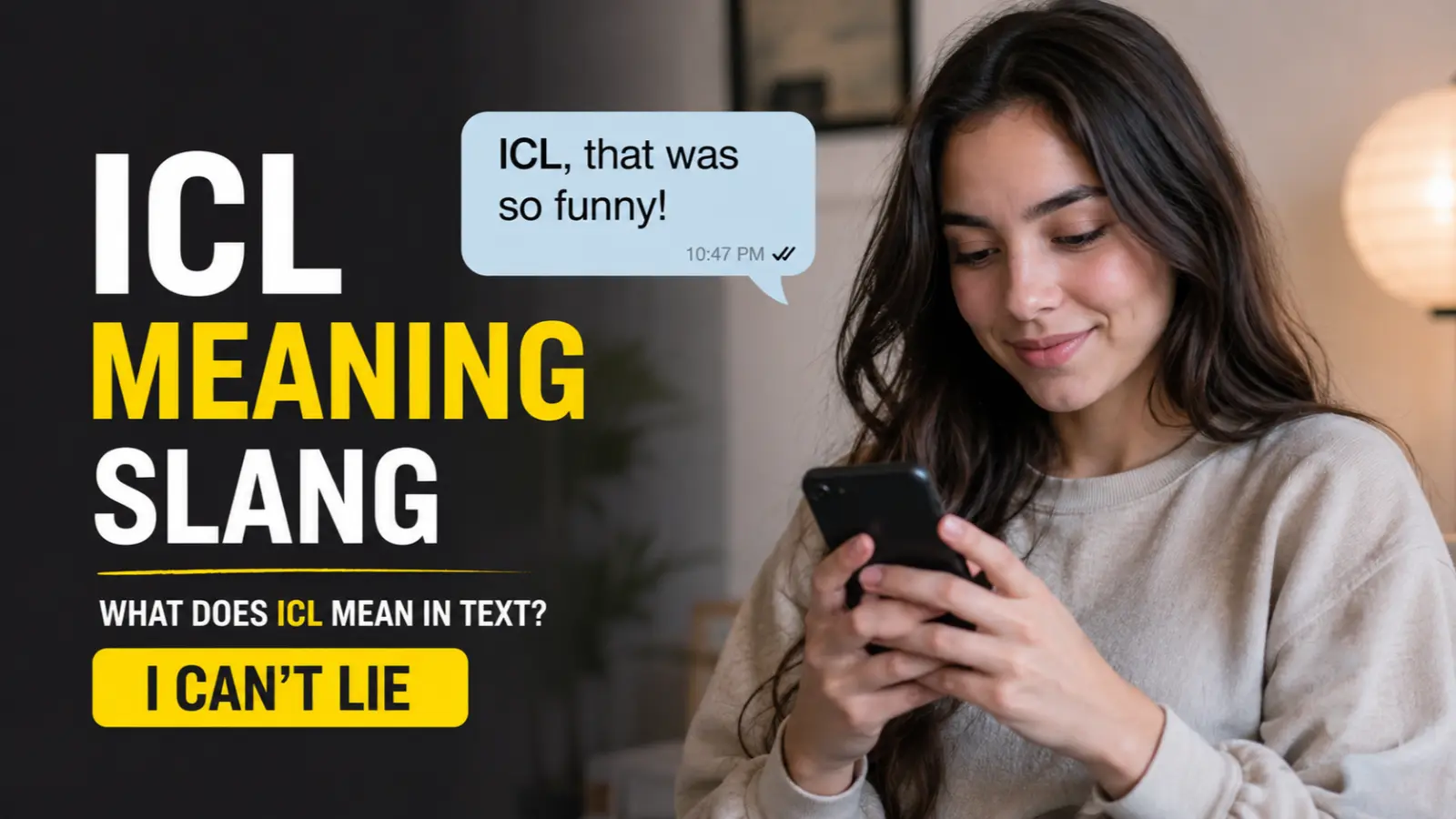
ICL meaning slang is something many people search for after seeing “ICL” in a text, comment, Snapchat message, TikTok caption, or social media conversation. If you are not familiar with internet slang, these three letters can look confusing at first.
In texting and online conversations, ICL usually means “I Can’t Lie.” People use it when they want to be honest about what they think, feel, or believe. It can introduce a serious opinion, a funny confession, a compliment, or even a criticism.
For example, someone might text, “ICL, that movie was amazing.” Here, the person is saying, “I can’t lie, that movie was amazing.”
Understanding the context is important because slang can sometimes have different meanings.
Quick Answer
ICL means “I Can’t Lie” in texting and social media slang. It is used to introduce an honest opinion, confession, or statement.
What Does ICL Mean in Text?
The most common ICL meaning in text is “I Can’t Lie.”
It is an informal abbreviation used mostly in digital communication. Instead of typing the complete phrase “I can’t lie,” someone can simply type “ICL.”
ICL Full Form
ICL = I Can’t Lie
It is similar to saying:
- “Honestly…”
- “To be honest…”
- “I’m being real…”
- “If I’m honest…”
- “I have to admit…”
For example:
“ICL, I was nervous before the exam.”
This means:
“I can’t lie, I was nervous before the exam.”
The abbreviation makes the message shorter and gives it a casual, conversational feel.
ICL Meaning Slang in Different Contexts
The meaning of ICL can stay the same while its emotional tone changes depending on the conversation.
1. Giving an Honest Opinion
Someone may use ICL before sharing an honest opinion.
Example:
“ICL, this is the best pizza I’ve had.”
The person is emphasizing that they genuinely believe the pizza is very good.
2. Making a Confession
ICL can introduce a personal admission.
Example:
“ICL, I forgot to do my homework.”
Here, the speaker is openly admitting something.
3. Giving a Compliment
ICL can also make a compliment sound more sincere.
Example:
“ICL, you look really good today.”
The speaker is stressing that they genuinely mean the compliment.
4. Expressing Disagreement
Sometimes ICL introduces a negative opinion.
Example:
“ICL, I didn’t really like that song.”
The phrase softens the statement slightly by presenting it as personal honesty.
Is ICL Rude, Offensive, or Neutral?
ICL is generally neutral and not offensive.
It is simply an informal way of saying “I can’t lie.” However, what follows ICL can determine whether the overall message sounds friendly, rude, serious, or critical.
Compare these examples:
- Friendly: “ICL, you’re really funny 😂”
- Neutral: “ICL, I prefer the old version.”
- Critical: “ICL, that wasn’t your best idea.”
The abbreviation itself is not rude. The tone depends on the words around it and the relationship between the people communicating.
Where Is ICL Commonly Used?
ICL is especially common in informal digital communication, including:
- Text messages
- Snapchat
- TikTok
- X
- Discord
- Gaming chats
- Group chats
- Online comments
You may also see it in casual conversations between friends.
It is much less appropriate in formal writing such as academic papers, business reports, job applications, or professional emails.
ICL Meaning Slang in Real-Life Conversations
Here are some examples of how people may naturally use ICL.
Friendly Example
Friend 1: “Do you like my new shoes?”
Friend 2: “ICL, they’re actually fire.”
The speaker is honestly saying that they really like the shoes.
Casual Example
Friend 1: “Are you going to the party?”
Friend 2: “ICL, I might stay home tonight.”
The phrase introduces a casual personal decision.
Argumentative Example
Person 1: “You think that was a good decision?”
Person 2: “ICL, no. I think you should have waited.”
Here, ICL introduces an honest disagreement.
Funny Example
“ICL, I opened the fridge five times hoping new food would appear.”
The phrase can make a humorous confession feel more natural.
Emotional and Psychological Meaning of ICL
Although ICL is only an abbreviation, it can add emotional meaning to a message.
When people write “ICL,” they often want to signal that they are being honest or direct.
It can communicate:
- Sincerity
- Honesty
- Vulnerability
- Confidence
- Personal opinion
- Emotional openness
For example:
“ICL, I really missed talking to you.”
The phrase can make the statement feel more personal because the speaker is presenting it as a genuine admission.
However, ICL does not automatically prove that someone is telling the truth. It is simply a conversational way of emphasizing honesty.
Origin and Background of ICL
ICL developed as part of the broader culture of internet and texting abbreviations.
As online communication became faster, users began shortening common phrases. Expressions such as “I can’t lie,” “to be honest,” and “in my opinion” became easy to abbreviate.
ICL became a convenient way to write “I Can’t Lie” without typing the entire phrase.
Like many forms of internet slang, its popularity is strongest in casual digital communication, particularly among younger online users.
Comparison With Similar Slang
ICL is closely related to several other internet abbreviations.
| Slang | Full Form | Main Meaning | Typical Use |
|---|---|---|---|
| ICL | I Can’t Lie | Introducing an honest statement | Casual texting |
| NGL | Not Gonna Lie | Introducing an honest opinion | Texting/social media |
| TBH | To Be Honest | Giving an honest opinion | Texting/social media |
| IMO | In My Opinion | Giving a personal opinion | Online discussions |
| FR | For Real | Agreement or emphasis | Casual conversations |
| ISTG | I Swear To God | Strong emphasis or frustration | Informal texting |
NGL vs. ICL
ICL and NGL are probably the closest alternatives.
- “ICL, that game was difficult.”
- “NGL, that game was difficult.”
Both communicate a similar idea: the speaker is emphasizing that they are being honest.
ICL vs. TBH
“TBH” means “To Be Honest.”
For example:
“TBH, I don’t like the design.”
This has almost the same function as:
“ICL, I don’t like the design.”
The choice usually depends on personal preference and online communication style.
When Should You Use ICL?
ICL works best when you are communicating casually with people who understand internet slang.
You can use it when:
- Talking with friends
- Sending casual text messages
- Commenting on social media
- Chatting during games
- Sharing an honest opinion
- Making a casual confession
- Reacting to something online
Example
“ICL, this was one of the funniest videos I’ve seen today.”
This sounds natural in a casual online conversation.
When Should You Avoid Using ICL?
Avoid ICL in situations where formal or professional English is expected.
For example, do not normally write:
“ICL, I believe your proposal needs changes.”
in a formal business email.
Instead, write:
“To be honest, I believe your proposal needs some changes.”
You should generally avoid slang in:
- Job applications
- Academic assignments
- Formal reports
- Business emails
- Official letters
- Professional presentations
The complete phrase is clearer and more appropriate in these settings.
Polite Alternatives to ICL
If your audience may not understand internet slang, use a more standard phrase.
Good alternatives include:
- “To be honest…”
- “Honestly…”
- “If I’m being honest…”
- “I have to admit…”
- “In my opinion…”
- “I genuinely think…”
- “To tell you the truth…”
For example:
Informal:
“ICL, I don’t like it.”
More polite:
“To be honest, I don’t really like it.”
The second version can sound more appropriate when communicating with someone you do not know well.
Why Do People Use ICL?
People use ICL mainly because it is short, expressive, and informal.
It can help a message sound more like natural speech.
Common reasons include:
- Saving time – Three letters are faster than typing the full phrase.
- Showing honesty – It signals that an opinion is genuine.
- Adding emphasis – It draws attention to what comes next.
- Sounding casual – It fits naturally into online conversations.
- Following internet culture – Slang is common across social platforms.
Impact of Using ICL in Communication
ICL can make informal conversations feel more relaxed and personal.
For friends, it may make a message sound natural:
“ICL, I was scared for a second 😂”
However, slang can create confusion when the reader does not know the abbreviation.
For this reason, consider your audience before using it.
If you are unsure whether someone understands ICL, simply write “I can’t lie” or “to be honest.”
Is ICL Safe for Social Media?
Yes. ICL is generally harmless slang.
The abbreviation itself is not offensive, sexual, or dangerous. It is simply an informal expression meaning “I Can’t Lie.”
However, the statement that follows ICL can still be inappropriate depending on what you say.
For example:
“ICL, this is hilarious.”
is harmless, while an insulting statement after ICL could obviously offend someone.
So, as with any slang, context and wording matter.
Common Misunderstandings About ICL
Some people may misunderstand ICL because abbreviations can have multiple meanings in different fields.
In everyday texting and social media, “I Can’t Lie” is the common slang interpretation.
Do not automatically assume every occurrence of ICL has this meaning, especially in technical, professional, medical, educational, or organizational contexts.
Always consider the surrounding conversation.
Variations and Types of ICL Usage
ICL can appear in several informal forms.
ICL, …
This is the most common structure.
“ICL, I’m tired today.”
ICL I…
It can be followed directly by a statement.
“ICL I wasn’t expecting that.”
ICL 😭
An emoji can add emotion or humor.
“ICL 😭 that was embarrassing.”
ICL bro…
This can make the message sound even more conversational.
“ICL bro, that was crazy.”
These variations are informal and are mainly used in digital conversations.
How to Respond When Someone Uses ICL
Your response depends on what the person says after ICL.
If They Give a Compliment
“ICL, your outfit looks great.”
You could reply:
“Thanks! I appreciate that.”
If They Disagree
“ICL, I don’t think that’s a good idea.”
You could say:
“Fair enough. Why do you think so?”
If They Make a Confession
“ICL, I was nervous too.”
You could respond:
“Honestly, same!”
You do not need to use slang in your response. A normal sentence works perfectly well.
Regional and Cultural Usage
ICL is part of modern internet language rather than a formal regional expression.
You may see it among English-speaking internet users in different countries. However, slang preferences can vary from one online community to another.
Some people may prefer NGL, TBH, or FR, while others may frequently use ICL.
Age, social platform, friendship group, and online community can all influence which abbreviations people use.
Frequently Asked Questions
What does ICL mean in texting?
ICL usually means “I Can’t Lie.” It is used before an honest opinion, confession, or statement.
What is the ICL full form?
The common slang full form of ICL is “I Can’t Lie.”
What does ICL stand for on social media?
On social media, ICL generally stands for “I Can’t Lie.” It is commonly used to introduce an honest or personal statement.
Is ICL a rude word?
No. ICL itself is not rude or offensive. The tone depends on what follows the abbreviation.
Is ICL the same as NGL?
They have very similar meanings. ICL means “I Can’t Lie,” while NGL means “Not Gonna Lie.” Both are often used to introduce an honest opinion.
Can I use ICL in formal writing?
It is better to avoid ICL in formal writing. Use phrases such as “to be honest” or “honestly” instead.
Conclusion
Understanding the icl meaning slang is simple: in most texting and social media conversations, ICL means “I Can’t Lie.” People use it to introduce an honest opinion, personal feeling, confession, compliment, or criticism.
The expression is casual and generally neutral. It works well in conversations with friends, social media comments, gaming chats, and other informal settings.
Remember that context matters. While ICL is perfectly normal online, it may not be suitable for professional or academic writing. In those situations, phrases such as “to be honest” or “honestly” are clearer and more appropriate.
So, if someone texts “ICL, that was amazing,” they are simply saying, “I can’t lie, that was amazing.”