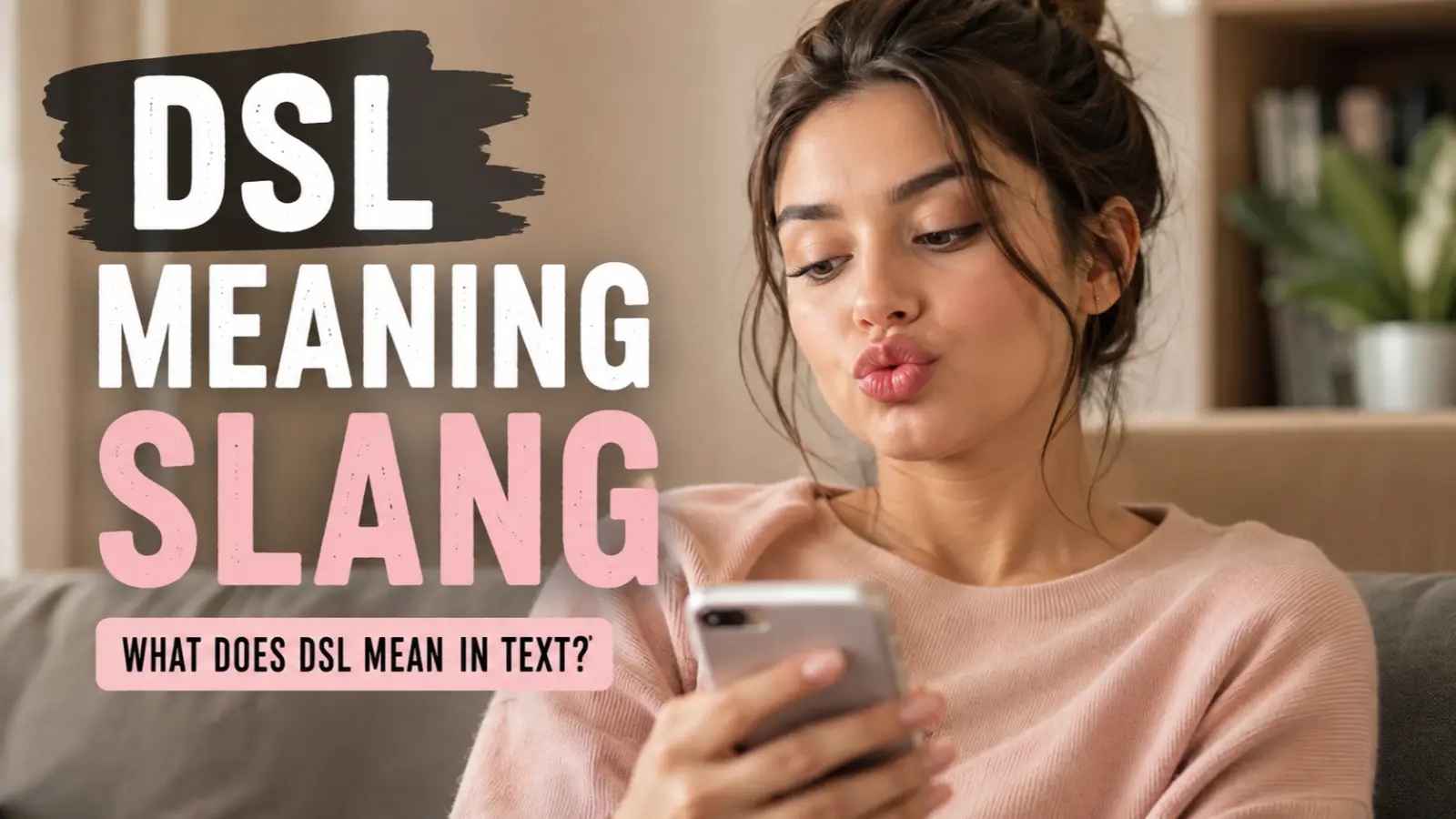
DSL meaning slang can be confusing because “DSL” has several meanings. If you saw it in a TikTok comment, text message, meme, or social media post, the slang meaning may be very different from its well-known technology meaning.
In internet slang, DSL commonly refers to a sexual phrase describing someone’s lips, usually suggesting that the lips are large, full, or attractive.
The term has circulated online since at least the mid-2000s and became more visible again through social media and TikTok in the early 2020s.
However, context matters. In technology, DSL normally means Digital Subscriber Line, while in French texting, “dsl” can be shorthand for désolé, meaning “sorry.”
Quick Answer
In English internet slang, DSL usually stands for “dick sucking lips,” a crude sexual expression referring to full or attractive lips. It can be flirtatious, joking, or offensive depending on who says it and the context.
What Does DSL Mean in Text?
When someone writes “DSL” in an English-language text, comment, or social media post, they may be referring to a person’s lips.
The slang is generally used to describe lips that appear:
- Full
- Large
- Plump
- Prominent
- Attractive
The important point is that the expression has a sexual meaning, not simply a neutral description of lip size.
For example:
“She has DSL.”
Depending on the relationship between the people, this might be intended as a flirtatious compliment, a joke, or an inappropriate comment.
Because the phrase behind the acronym is explicit, it is generally better understood as adult or NSFW slang rather than ordinary everyday English.
DSL Full Form and Definition
The common English slang DSL full form is:
DSL = “Dick Sucking Lips.”
It is an explicit expression used online to comment on someone’s lips, usually implying that they are sexually attractive or particularly suited to oral sex.
This is why someone might see the abbreviation and not immediately understand it. The three letters hide a phrase that is much more explicit than the abbreviation itself suggests.
What Does DSL Stand For?
If you’re asking “what does DSL stand for?” in an English slang context, the answer is usually the sexual phrase above.
But don’t assume every appearance of “DSL” has this meaning.
For example:
| Context | Meaning of DSL |
|---|---|
| Internet/technology | Digital Subscriber Line |
| English internet slang | Sexual slang referring to lips |
| French texting | désolé (“sorry”) |
| Programming | Domain-Specific Language |
So, context is essential.
DSL Meaning in Different Contexts
1. Social Media Slang
On platforms such as TikTok and other social networks, DSL may appear in comments about someone’s appearance or lips.
The slang gained renewed attention when users began posting about having or being told they had “DSLs.”
2. Text Messages
In a private conversation, someone might use DSL as a flirtatious or sexual comment.
For example:
“Those DSLs though.”
The speaker is probably commenting on the person’s lips in a sexualized way.
3. Internet Technology
In a technology conversation, DSL almost certainly means Digital Subscriber Line, a type of internet connection delivered over telephone lines.
So:
“My DSL connection is slow.”
has nothing to do with the slang meaning.
4. French Texting
In French-language texting, dsl can be an abbreviation for désolé, meaning “sorry.”
Therefore, an English slang interpretation could be completely wrong if you’re reading a French conversation.
Is DSL Rude, Offensive, or Neutral?
The slang meaning is not neutral.
Because the full phrase is sexually explicit, calling someone’s lips “DSL” can feel:
- Sexual
- Objectifying
- Inappropriate
- Flirtatious
- Insulting
- Funny between close friends
Some people use it jokingly or even describe their own lips this way. Others consider it rude or uncomfortable. Community discussions also show that people can interpret the term differently depending on their relationship and the circumstances.
The safest approach is simple: don’t use it with someone unless you know they are comfortable with that kind of language.
Where Is DSL Commonly Used?
You may encounter DSL meaning slang in:
- TikTok comments
- Instagram comments
- Memes
- Online forums
- Private messages
- Casual texting
- Dating conversations
- Internet jokes
The term has existed online since the 2000s and later experienced renewed attention on TikTok and other social platforms.
It is much less appropriate in professional, educational, or formal communication.
Real-Life Conversation Examples
Friendly Example
Friend: “Your new lip gloss looks amazing.”
You: “Thanks! I wanted something different.”
This is a normal way to compliment someone’s lips without using sexual slang.
Casual Example
Person A: “Did you see her new selfie?”
Person B: “Yeah, she definitely has DSL.”
This uses the slang casually, but it still carries a sexual meaning.
Flirty Example
Person A: “You look really good tonight.”
Person B: “Haha, thank you.”
A person might use DSL in a flirtatious conversation, but the term is more explicit than a normal compliment.
Argumentative Example
“Why are you commenting on my lips like that?”
This demonstrates why DSL can create discomfort when the person receiving the comment does not welcome it.
Emotional and Psychological Meaning
DSL does not have a fixed psychological meaning.
Its emotional effect depends mainly on:
- Who says it
- Who receives it
- Their relationship
- The tone
- The platform
- Whether the comment was invited
A close friend may use it as an inside joke. A stranger using it on someone’s photo may come across as sexual harassment or objectification.
The same three letters can therefore produce very different reactions.
Origin and Background of DSL Slang
The slang expression has been documented online since the mid-2000s. Know Your Meme traces early online documentation to Urban Dictionary and notes that the term was subsequently used across internet communities.
Its visibility increased again in the early 2020s, particularly through TikTok posts where people discussed the term after discovering its meaning or being told they had “DSLs.”
This renewed popularity is one reason people who have never encountered older internet slang may suddenly see DSL meaning slang searches appearing today.
DSL vs. Similar Meanings
Because DSL is a common abbreviation, it can easily be confused with completely unrelated meanings.
| Term | Meaning | Context |
|---|---|---|
| DSL | Sexual slang referring to lips | Internet slang |
| DSL | Digital Subscriber Line | Technology |
| dsl | désolé (“sorry”) | French texting |
| DSL | Domain-Specific Language | Programming |
The surrounding words usually tell you which definition is intended.
For example, “DSL internet” points toward technology, while “she has DSL” in an appearance-related comment may indicate slang.
When Should You Avoid Using DSL?
Avoid the slang meaning when:
- You are speaking to someone you don’t know well.
- You are communicating professionally.
- You are posting in a school-related environment.
- The audience may include children.
- You don’t know whether the person is comfortable with sexual jokes.
- The comment could be interpreted as harassment.
- You are discussing someone’s appearance without their permission.
Even when meant as a compliment, sexual language can make the recipient uncomfortable.
Polite Alternatives to DSL
If you simply want to compliment someone’s lips, use a neutral phrase instead.
Try:
- “You have beautiful lips.”
- “Your lips look great.”
- “I love your lip color.”
- “Your lipstick looks amazing.”
- “You have a lovely smile.”
- “Your lips look really full.”
These alternatives communicate the compliment without the explicit sexual implication.
Why Do People Use DSL Slang?
People use internet slang because it can be:
- Short
- Humorous
- Memorable
- Playful
- Flirtatious
- Part of online culture
- Familiar within a particular friend group
Acronyms can also make an explicit phrase feel less direct. However, abbreviating a sexual phrase doesn’t remove its underlying meaning.
Impact of Using DSL in Communication
Using DSL can make a conversation feel playful among people who understand the joke.
But with the wrong audience, it can have the opposite effect.
Possible reactions include:
Positive:
The recipient understands it as a joke or flirtatious compliment.
Neutral:
The recipient understands the meaning but doesn’t respond strongly.
Negative:
The recipient considers it inappropriate, sexual, or disrespectful.
This is why context and consent matter more than the abbreviation itself.
Is DSL Safe for Social Media?
The abbreviation itself is not necessarily dangerous, but its common slang meaning is sexually explicit.
Before posting it publicly, consider:
- Who can see your post?
- Are you commenting on another person’s appearance?
- Is the conversation appropriate for the platform?
- Could the comment embarrass the person?
- Are minors likely to see it?
If you’re unsure, choose a neutral compliment instead.
Common Misunderstandings About DSL
“DSL always means internet.”
No. In technology, DSL means Digital Subscriber Line, but internet slang has a separate sexual meaning.
“DSL is just another word for big lips.”
Not exactly. The slang carries an explicit sexual implication, so it is stronger than simply saying someone has full lips.
“DSL is always a compliment.”
Not necessarily. Some people may find it offensive or objectifying.
“Everyone knows what DSL means.”
Definitely not. Because DSL has several meanings, people can easily misunderstand it.
Variations and Types of DSL Usage
You may see forms such as:
- DSL
- DSLs
- has DSL
- got DSL
- those DSLs
- mad DSLs
The plural DSLs generally refers to someone’s lips as a pair or to multiple people being described this way.
The meaning remains dependent on the surrounding conversation.
How to Respond When Someone Uses DSL
Your response depends on how you feel about the comment.
If you’re comfortable:
“Haha, thanks.”
If you’re confused:
“What do you mean by DSL?”
If you don’t like it:
“I’d rather you not comment on my body like that.”
If you want to keep things polite:
“Please keep the comments respectful.”
You do not have to respond positively to a sexual comment simply because someone intended it as a compliment.
Regional and Cultural Usage
DSL slang is particularly associated with English-language internet culture, but abbreviations can have completely different meanings in other languages.
For example, French speakers may use dsl as shorthand for désolé (“sorry”) in text messages.
This is a good reminder that language, culture, and context matter. Never assume an acronym has one universal definition.
FAQs About DSL Meaning Slang
What does DSL mean in slang?
In English internet slang, DSL commonly stands for “dick sucking lips,” an explicit expression referring to full or sexually attractive lips.
What is the DSL full form?
The common slang full form is “dick sucking lips.” However, DSL can have unrelated meanings in technology, programming, and other contexts.
What does DSL mean on TikTok?
On TikTok, DSL may refer to the same sexual slang about someone’s lips. The term became more visible again through TikTok discussions in the early 2020s.
Is DSL a bad word?
The abbreviation itself is not a traditional swear word, but its common English slang expansion is sexually explicit. It can therefore be inappropriate in many situations.
Does DSL always mean lips?
No. In technology, DSL commonly means Digital Subscriber Line. In French texting, dsl can mean “sorry.” Context determines the meaning.
Is DSL appropriate for school or work?
Usually not when it is being used as sexual slang. A neutral phrase such as “You have beautiful lips” is much more appropriate.
Conclusion
Understanding dsl meaning slang is important because the abbreviation can have several completely different meanings. In English internet slang, DSL commonly refers to an explicit sexual phrase about someone’s lips.
However, DSL doesn’t always mean the slang definition. In technology, it usually means Digital Subscriber Line, while French texters may use “dsl” to mean “sorry.”
If you see DSL in a social media comment or text about someone’s appearance, the sexual slang meaning is likely. Because it can be crude or objectifying, use it carefully and consider a polite alternative when speaking with people you don’t know well.
In short: context is everything when interpreting DSL.